Your head is full of strong opinions, hard-won lessons, and client stories that would make a great book or a steady run of LinkedIn posts. Your calendar, however, is packed back-to-back until Thursday, and the half-finished Google Doc you started six weeks ago still stops mid-sentence.
That gap between having something worth saying and having the hours to write it is why people ask how does ghostwriting work. Most explanations treat the job like a cloak-and-dagger secret where you hand over a vague topic, vanish for a month, and receive a finished manuscript from an invisible typist.
Real ghostwriting works nothing like that. It's a structured knowledge-transfer and governance process where you stay in charge of the thinking, the facts, and the final sign-off, while a professional writer handles the interviews, architecture, and prose. Modern workflows also bring AI tools into the room, which makes clarity about voice, contracts, and human judgment matter more than ever.
What Ghostwriting Really Means
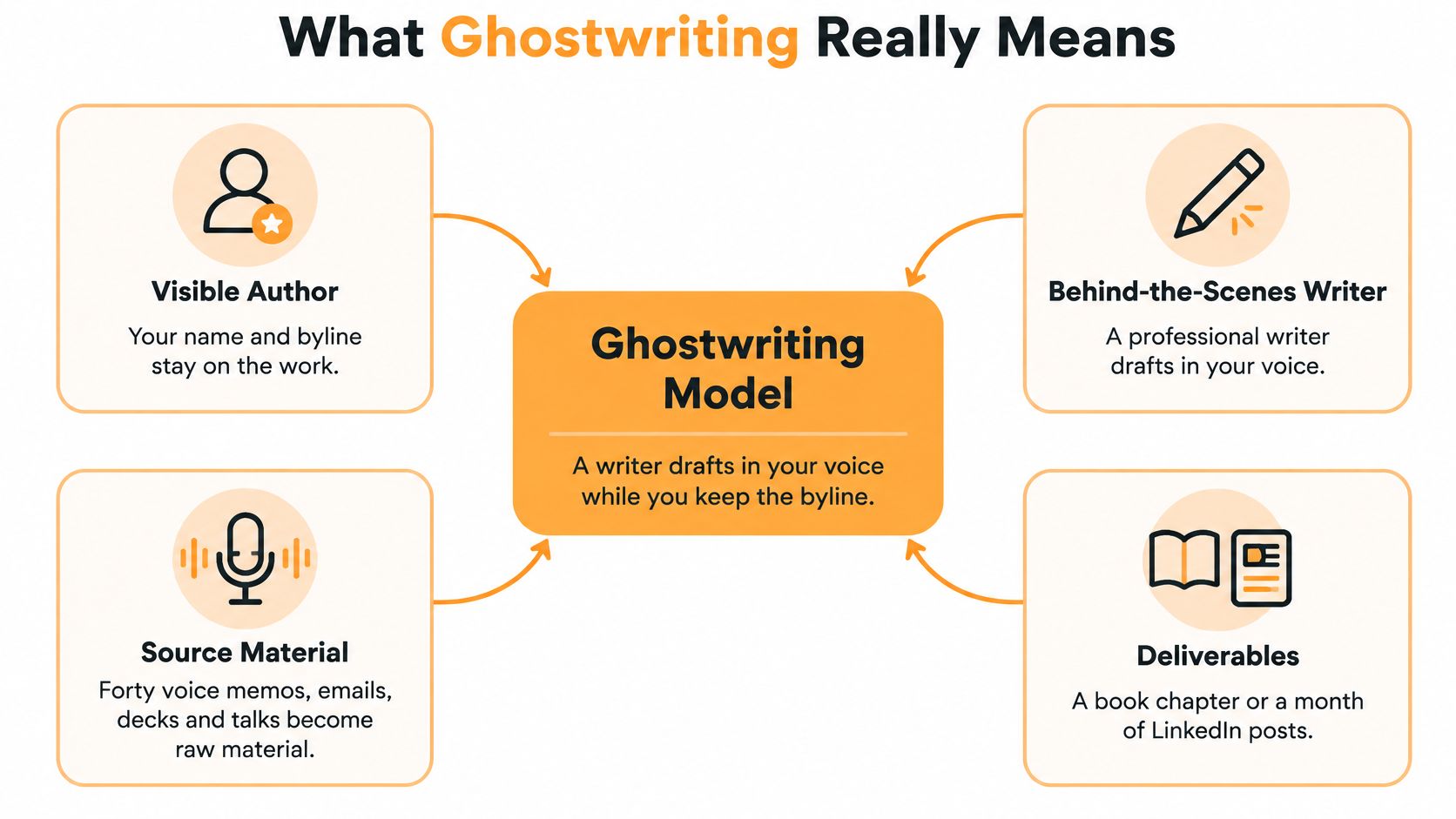
Say a software founder sits on forty voice memos recorded on the drive home from client meetings. They know their market cold, they have no time to write, and they hire a ghostwriter to turn those raw recordings into a book chapter or a month of LinkedIn posts.
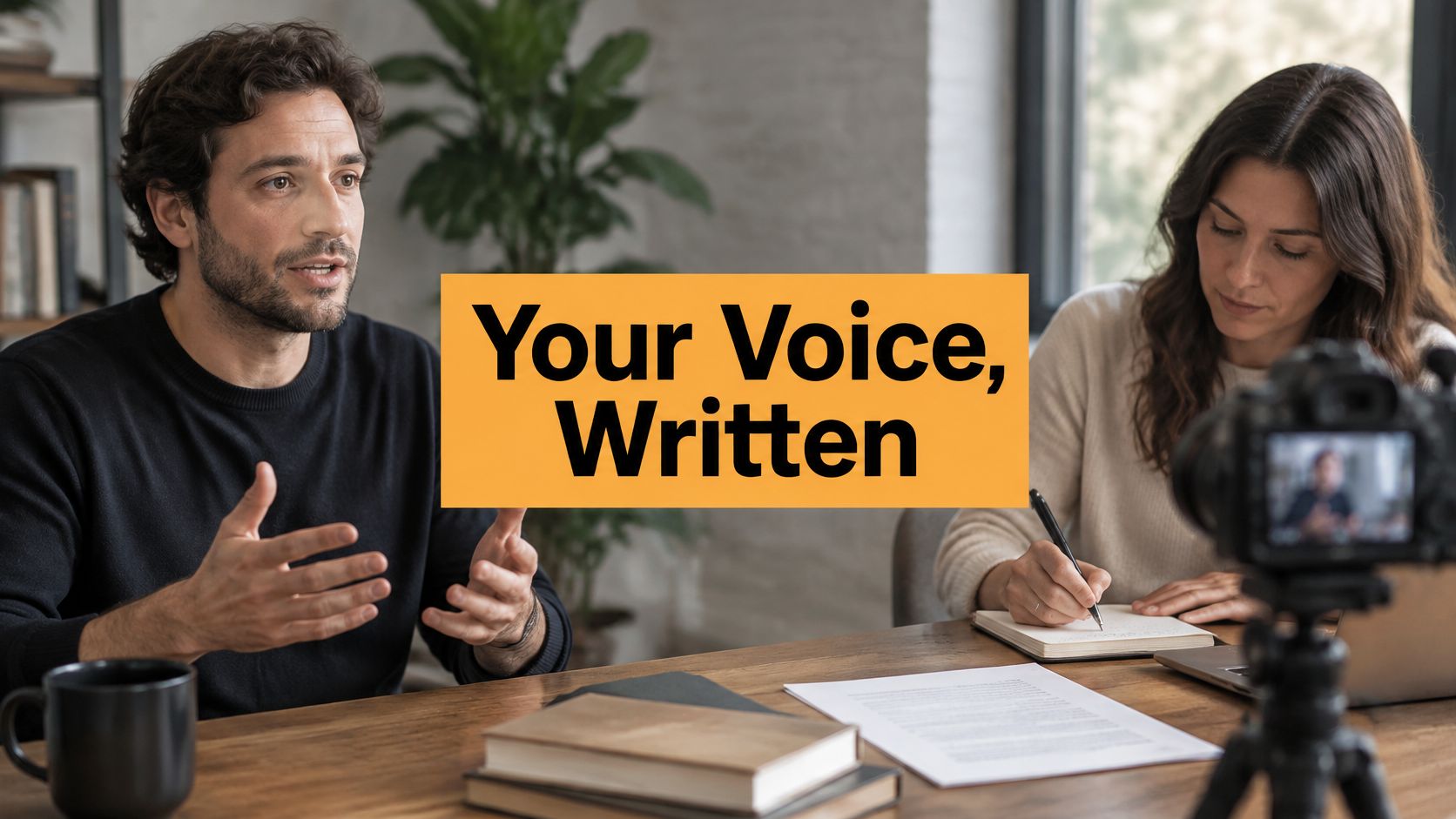
In that setup, the job splits cleanly down the middle. As the visible author, you supply the subject matter, lived experience, access to internal material, and final approval. The ghostwriter handles the research, interviewing, structural editing, drafting, and voice-matching so the finished prose reads like you wrote it on your sharpest day.
Think of a portrait painter and a sitter. The sitter chooses the pose, brings their actual face to the room, and owns the canvas when it dries. The painter holds the brush and understands how light falls across the subject.
Here's a quick visual map of how those four pieces fit together around the credited author.
A Long History of Shared Authorship
This collaborative model isn't a social-media invention. According to an Engelsberg Ideas history of ghostwriting, nineteenth-century public figures like Napoleon relied on assistants to shape personal material into publishable narratives, and Winston Churchill's memoir project depended on substantial support from researchers and writers.
The same historical record shows why clear terms matter. John F. Kennedy's 1957 book Profiles in Courage sparked a lasting authorship controversy after speechwriter Ted Sorensen's behind-the-scenes role became a subject of public debate.
Today, the same collaborative framework powers far more than political memoirs. Professionals use ghostwriters for business books, keynote speeches, executive op-eds, investor memos, and weekly LinkedIn content. In commercial publishing, tracking who supplied raw material and who cleared it for publication works much like licensing clean source records in other industries, a discipline captured in SourceX's guide with rights-cleared data delivery explained.
Ghostwriting depends less on delegating your thinking than on converting your real expertise into prose that matches how you actually speak and reason.
Even when you hire the best collaborator in your industry, four responsibilities never leave your desk:
- Your Ideas: A writer can sharpen an argument, but the core thesis and lived experience have to come from you.
- Your Claims: Every number, case study, and strong opinion goes out under your reputation, so you own its accuracy.
- Your Approval: Nothing ships until you've read the draft and confirmed it reflects what you mean.
- Your Attribution: Your name sits on the byline, which means you answer the follow-up questions when readers respond.
The Ghostwriting Process at a Glance
Before you sign a retainer or book a discovery call, you need to see where the hours go. Most first-time clients assume the writer spends nearly all their time typing, when in reality a large chunk of the calendar depends on how quickly you hand over raw material and review drafts.
| Stage | Who leads | Deliverable | What the client supplies | Share of timeline |
|---|---|---|---|---|
| 1. Kickoff and scope | Client and writer | Brief, contract, confidentiality agreement | Goals, audience, samples, approvals | 5% |
| 2. Source gathering | Client | Interview recordings, documents, notes, past posts | Time for 2 to 4 interviews, existing material | 20% |
| 3. Outline and angle | Writer | Approved outline or content map | One round of feedback | 10% |
| 4. First draft | Writer | Draft in the client's voice | A read-through within the agreed window | Largest share of the timeline |
| 5. Revisions | Client leads, writer rewrites | Revised draft, usually two included rounds | Consolidated comments, not a rewrite | 20% |
| 6. Fact-check, approval and publish | Client approves, writer or client publishes | Final approved piece and publication record | Sign-off on every factual claim | 10% |
Looking at that breakdown reveals an uncomfortable truth about how does ghostwriting work in practice. The writer only runs solo during outlining and first-drafting. Every other milestone requires your active input to keep the calendar moving.
Where Ghostwriting Projects Actually Stall
The same two bottlenecks derail otherwise promising projects over and over again. They almost never happen because the writer missed a deadline.
Stage 2 stalls when source material never arrives. A client signs the contract, gets excited on the kickoff call, and then spends three weeks promising to send over old slide decks, podcast links, and calendar slots for interviews. Without fresh material, the writer either waits around burning calendar time or guesses at your opinions, which guarantees a generic first draft.
Stage 5 stalls when the client tries to become the copyeditor. Instead of leaving margin notes about what feels off, a busy executive opens Google Docs, deletes three paragraphs, and rewrites them at midnight. That habit drags out turnaround times, confuses the voice, and burns through included revision rounds without fixing the underlying structural issue.
Practical rule: Lock two dates into the calendar before you pay the deposit. Put the source-material handoff date and the draft-feedback turnaround window right in the kickoff brief, and agree on how comments will be delivered.
A clear schedule removes the awkwardness of chasing each other over email. When both sides know that raw files are due on Tuesday and draft comments are due within 72 hours of delivery, the collaboration stays predictable instead of turning into a slow-motion standoff.
How Your Voice Gets Captured and Matched
Most clients worry about one thing above all else: sounding like a slick corporate stranger wearing their headshot. A good collaborator avoids that trap by treating voice matching as a repeatable craft rather than guesswork.
Professional guidance from Best Seller Publishing on what a ghostwriter does frames the work as a structured knowledge-transfer workflow built on interviews, outlining, drafting, and revision. Voice fidelity comes from logging observable style signals, including sentence length, vocabulary, preferred abstractions, recurring stories, degree of directness, and domain terminology, then testing every draft against authentic source material.
The diagram below traces how those raw inputs move from recorded conversations to finished copy.
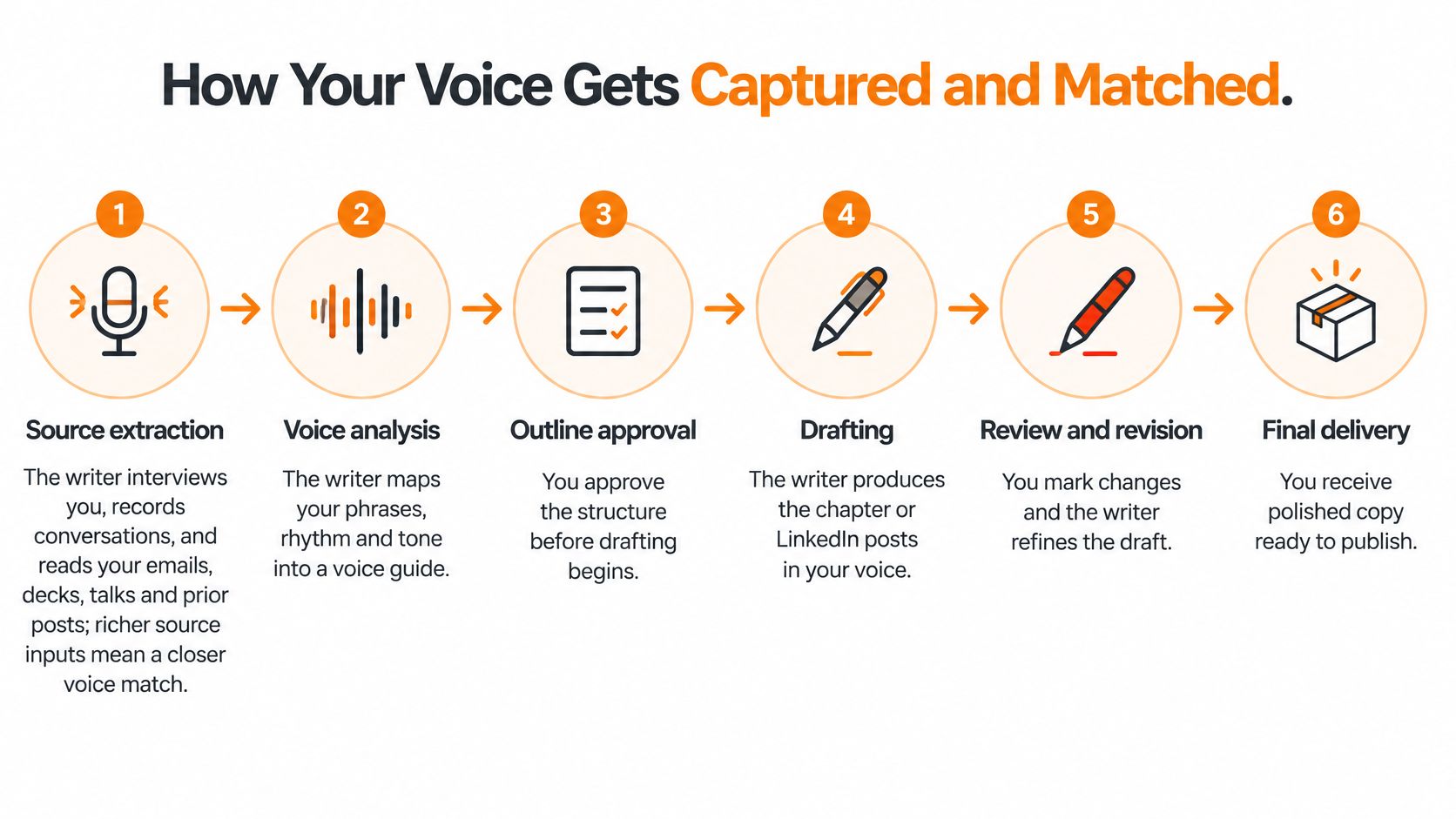
- Source extraction comes first. Your writer interviews you on recorded calls and reads your existing emails, pitch decks, conference talks, and older social posts. Richer source inputs directly cut down on invented details and generic filler because the writer pulls real phrasing straight from your mouth.
- Building the voice profile. Rather than guessing your tone, the writer audits those transcripts and notes the exact words you repeat, the jargon you refuse to touch, and whether you lead with stories or hard numbers. If you haven't nailed down your own style yet, working through a guide on how to find your writing voice before kickoff speeds this step up dramatically.
- Idea mapping grounds every piece in real proof. For a book chapter or a batch of LinkedIn posts, each topic gets anchored to a specific lesson, project, or observation you lived through. Nothing gets written in a vacuum.
- Angle generation gives you choices before drafting starts. The writer pitches two or three distinct takes on the same core idea, maybe one contrarian take and one tactical breakdown, and you pick the direction that fits your audience.
- Drafting against your samples. As the writer produces the draft, they keep your past emails or transcripts open beside the document to check rhythm and word choice line by line.
- The read-aloud voice check. Once the draft lands in your inbox, read it out loud at normal speaking speed. Anything that makes you stumble or cringe gets flagged immediately, because explicit review checkpoints stop misrepresentation before a post ever goes live.
What Voice Matching Looks Like on the Page
Say a logistics founder talks in short, blunt sentences and hates corporate buzzwords like disruption or synergy. An inexperienced writer who skips voice profiling hands over this sentence:
Before: We need to use cross-functional supply chain synergies to optimize last-mile delivery outcomes for enterprise accounts.
A ghostwriter who listened to the founder's interview recordings writes this instead:
After: Warehouse teams and dispatchers have to share one schedule. When they don't, late trucks cost you your biggest accounts.
Same business point, completely different human being. That gap is why a sharp collaborator aims for a clear, recognizable version of you rather than a smoothed-out textbook voice.
For a closer look at how interviewers pull raw stories and vocal habits out of busy authors during those early calls, this short walkthrough breaks down the conversation side of the job.
Drafts, Revisions and Who Approves What
Once a first draft hits your inbox, the collaboration shifts into its revision loop. Most commercial ghostwriting agreements include two rounds of revisions inside the base fee, with any third round or major pivot billed hourly or quoted as extra work.
That two-round default exists to protect both sides. It gives you room to dial in accuracy and tone without letting a single chapter or LinkedIn series drift into endless tinkering.
Three Rules for Giving Useful Feedback
The fastest way to ruin a good draft is to give vague or piecemeal notes. Stick to three habits during every review window:
- Flag substance and claims, not your discomfort with reading yourself. Hearing your own ideas in clean prose feels strange at first. Focus on whether the argument is true, sharp, and complete rather than whether you'd personally have picked every comma.
- Describe what feels off instead of rewriting the paragraph. Leave a margin comment like Too soft here, I'd call out the vendor pricing directly or I never use the word unpack. Rewriting the text yourself wastes your included revision round and strips out the pacing you paid the writer to build.
- Send one consolidated pass on time, with no surprise topics. Collect every note from yourself or your internal team into a single document before hitting send. Dropping a brand-new angle into round two resets the clock and changes the scope.
Not every edit belongs in the same bucket, either. Splitting revisions by ownership stops billing arguments before they start.
| Revision type | Who owns it | Included in quote? |
|---|---|---|
| Voice fix: wording that does not sound like you | Writer | Yes, within agreed rounds |
| Factual correction: wrong date, name or figure | Client, who supplies the correct fact | Yes, within agreed rounds |
| Scope change: new chapter or different angle | Client and writer agree | No, priced as new work |
Clear separation between subject-matter review and drafting works outside publishing, too. Commercial teams using bid writing tools for SMEs from Bidwell rely on the exact same boundary so technical leads verify facts and compliance without taking over the writing desk.
Why Approval Records Matter Ethically and Legally
Transparency and sign-off aren't just project-management niceties. As Tate Publishing's guide to negotiating ghostwriting contracts points out, commercial ghostwriting operates under completely different rules from academic work.
In scholarly publishing, Oxford University Press classifies undisclosed ghost authorship as unethical, and medical-publishing guidelines recommend disclosing writing assistance and funding. In business books, speeches, and executive LinkedIn accounts, hidden authorship is standard, provided the named professional owns the ideas and approves the final claims.
That's why I recommend building lightweight content approval workflows with a clear written trail. A simple email or tracked comment confirming that you verified every fact and approved the final text proves that you, not an unnamed writer, stand behind what gets published under your name.
What Ghostwriting Costs by Deliverable
Ask ten freelancers what ghostwriting costs and nine will dodge the question with a vague answer. Real market numbers exist, and they make a lot more sense once you see how deliverables scale in research, interviews, and revision load.
A 2024 Publishers Weekly survey of 269 working ghostwriters and collaborators found that one-third earned more than $100,000 annually from book ghostwriting, with fees climbing sharply by project tier.
| Deliverable | Typical fee | Share of writers at this level | What drives the price |
|---|---|---|---|
| Nonfiction book proposal | $10,000 to $20,000 | 50% charge this range | Sample chapters, market positioning, platform pitch |
| Nonfiction book proposal, premium | More than $20,000 | 11% | Big platform, heavy research, fast turnaround |
| Full nonfiction manuscript | At least $100,000 | 25% of recent manuscripts | Interview hours, research, structure, revisions |
| Full nonfiction manuscript, premium | More than $150,000 | 8% | Reputation, bestseller record, complex subject |
| Full nonfiction manuscript, top tier | More than $300,000 | 1% | Celebrity or C-suite client, full project management |
| LinkedIn posts or short-form articles | Priced per post or monthly retainer | Not tracked in book survey | Volume, research per post, approval rounds |
Track record drives the top brackets. In that same Publishers Weekly survey, 2% of respondents had written at least 10 New York Times bestsellers and charged $150,000 or more for a nonfiction manuscript. Separate 2024 figures from Gotham Ghostwriters and the American Society of Journalists and Authors, summarized in OneHour Digital's ghostwriter career statistics, report that 30% of surveyed professional ghostwriters had written at least one New York Times bestseller.
What Drives a Quote Up or Down
A professional fee pays for far more than words on a page. You're buying interview prep, narrative structure, deep research, project management, strict confidentiality, reliable deadlines, and the rare skill of capturing another person's voice.
Full manuscripts cost dramatically more than book proposals because a proposal tests the concept with sample chapters, whereas a book requires months of reporting and multi-stage rewrites. Short-form executive content sits on a totally different pricing track, usually billed per post or as a monthly retainer depending on posting frequency and interview cadence. If you're budgeting specifically for executive social content, check a breakdown of LinkedIn profile writer cost to see how short-form retainers compare.
Scope levers that push any quote higher include heavy original research, dozens of interview hours, rush deadlines, extra revision rounds, strict anonymity clauses, and starting from a blank page instead of existing speeches or articles.
Watch out for the bargain quote that sounds too good to be true. Low-ball proposals almost always assume you will hand over a finished outline and do heavy rewrites yourself, which means you pay the hidden difference in your own time.
Before you sign any proposal, put three direct questions in front of the writer:
- What sits inside the quoted revision count? Confirm how many rounds are included and what triggers extra billing.
- Who owns fact-checking and permissions? Clarify whether the writer verifies quotes, statistics, and third-party sources or expects your team to handle it.
- What happens if a deadline slips on either side? Good contracts spell out pause fees and schedule adjustments so neither party gets stuck waiting indefinitely.
Ownership, Confidentiality and the AI Question
Most clients assume that once the final invoice clears, they own everything automatically. In practice, a typical commercial arrangement does transfer rights to you after full payment, but the written contract, not your assumption, controls what happens, and local copyright jurisdiction affects how work-for-hire clauses operate.
A standard nondisclosure agreement is table stakes for books and executive accounts, stopping the writer from revealing the partnership unless you explicitly permit private acknowledgment or a portfolio credit.
What Client Ownership Doesn't Automatically Settle
Signing a simple sentence that says the client owns the finished post leaves major blind spots open. Legal guidance in Document's ghostwriting agreement and AI disclosure framework highlights that a workable contract also needs to govern drafts, research notes, interview recordings, unused ideas, portfolio rights, payment milestones, termination terms, and factual or reputational sign-off.
Owning a published article doesn't automatically answer whether the ghostwriter can reuse an anonymized framework you built together, recycle prompt templates trained on your calls, or cite your engagement metrics when pitching their next client. Spell those boundaries out upfront so nobody gets burned six months later.
Where AI Actually Sits in Modern Ghostwriting
Artificial intelligence makes those contract gaps much wider. Uploading confidential interview transcripts into a public AI tool can expose sensitive company data, and unvetted machine-generated prose can carry unattributed phrasing or factual errors that land directly on your reputation.
Yet the market isn't split into purists and prompt-jockeys. According to the Association of Ghostwriters 2025 industry report, 61% of surveyed writers relied on AI for workflow support, while only 7% said they used it to generate content. Even with broad adoption for support tasks, surveyed writers widely viewed undisclosed AI-generated prose as unethical.
There's a huge difference between using AI to transcribe a Zoom interview, brainstorm headline angles, or spot structure gaps versus pasting raw machine text into a client's chapter. Different large language models also handle tone, editing, and structural tasks very differently, as detailed in The SEO Agent's model comparison, so vague verbal assurances about using AI responsibly aren't enough anymore.
Add a dedicated AI clause to your ghostwriting agreement that covers four specifics:
- Permitted tools and stages: Name which AI tools are allowed and whether they're limited to transcription, research, or outlining, or permitted in drafting.
- Two-way disclosure: Require the writer to disclose AI assistance and require you to flag any AI-generated source notes you hand over.
- Data privacy and confidentiality: Ban uploading raw recordings or proprietary client files into systems that train public models on user inputs.
- Originality checks and liability: Define who runs plagiarism checks, who warranties originality, and who carries legal risk if an error or copyright dispute surfaces.
Human ghostwritten and AI ghostwritten are not binary categories anymore. The real governance questions are who supplied the expertise, who verified every claim, and who gave informed approval before publishing.
Decide What Fits and Take the First Step
Once you strip away the mystique, choosing a writing path comes down to what you have in short supply: time, clarity, or publishing consistency.
Hire a human book or long-form ghostwriter if you already have deep expertise, strong stories, and real access, but zero hours to draft a full-length manuscript. Make sure you can commit to the interview schedule and timely draft reviews before writing a check.
Write it yourself if your core ideas are still half-formed. Ghostwriting sharpens and multiplies clear thinking, but it can't invent a point of view you haven't figured out yet. Spend a few months testing your arguments in shorter essays or client memos until your thesis holds up under pressure.
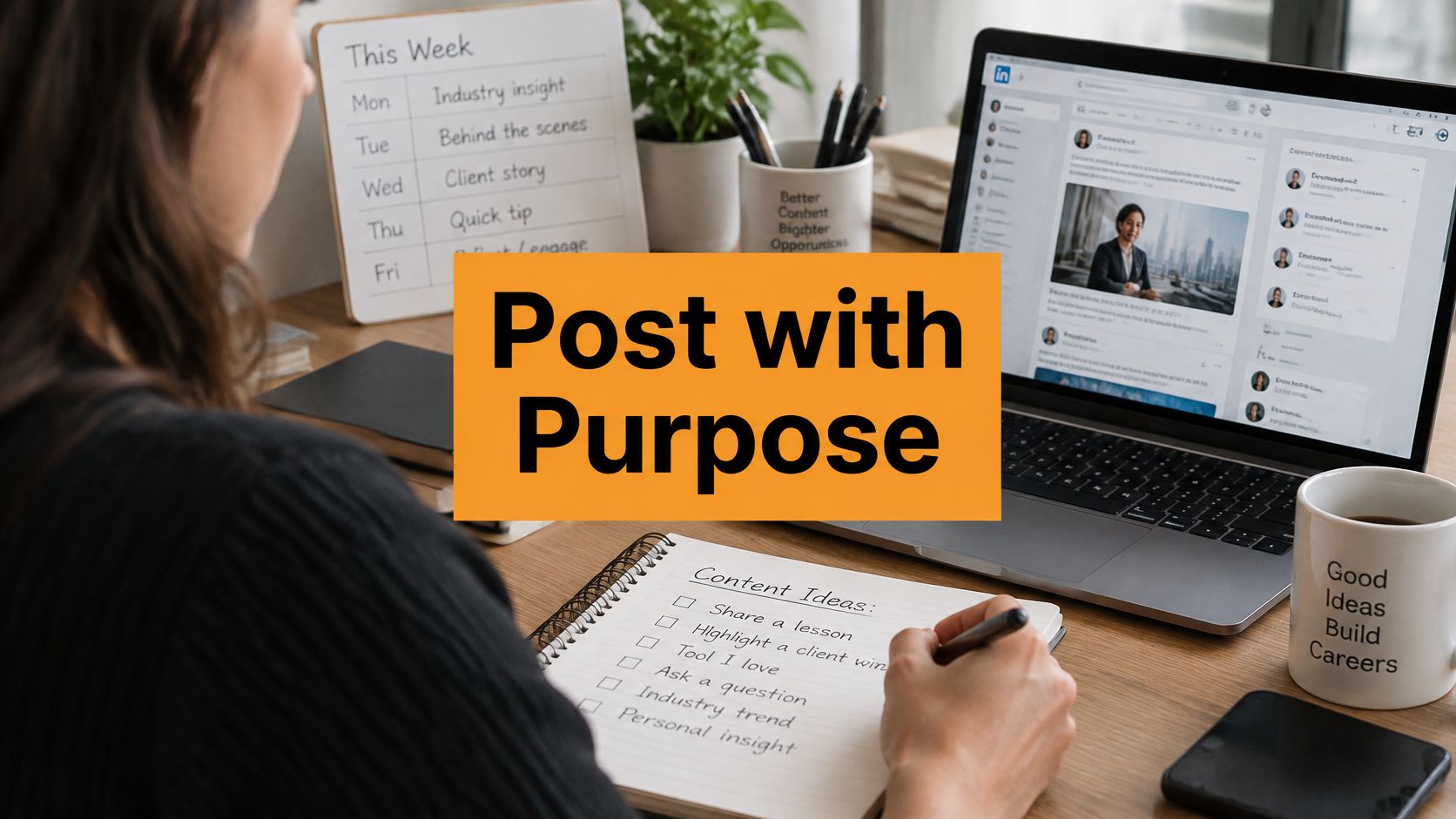
Use an AI-assisted workflow if your goal is high consistency in a shorter format like LinkedIn, where you need a steady weekly cadence without paying full book-retainer rates and you're willing to review every draft before hitting publish. If LinkedIn is your channel, our platform at RedactAI writes posts in your authentic voice learned from your previous posts, and our Done For You service delivers 3 to 4 posts per week plus a monthly performance report while keeping approval in your hands.
Your First Fifteen Minutes
Whichever path fits your budget and calendar, start with the exact same exercise today. Open the voice memo app on your phone, hit record, and spend fifteen minutes answering the single question clients or prospects ask you every single week.
Don't script it and don't try to sound polished. Run the recording through a transcription tool and read the raw text back to yourself.
That single transcript gives you immediate proof of your natural cadence, your real vocabulary, and the exact stories that anchor your authority. Whether you hand that file to a $100,000 book collaborator, feed it into an AI-assisted drafting system, or edit it yourself, you now know what you bring to the table, what you need to approve, and what your budget buys.
If you want consistent LinkedIn posts that sound like you without handing your calendar over to endless drafting, see how our voice-matched workflow handles the heavy lifting. You can generate drafts directly from a few keywords using your own posting history or let our team manage your weekly cadence while you keep full sign-off on every claim. Visit RedactAI to try it out and put your expertise on the page.