A consultant posts every weekday for three months, then disappears for six weeks when a client project lands. Her audience drifts. When she comes back, the first few posts get a fraction of the comments she used to get, and she spends a month rebuilding what she had.
Nothing was wrong with her writing. The cadence ignored her calendar.
The same thing happens to sales leaders in the final week of a quarter, to recruiters mid-hiring sprint, and to agency owners running three launches at once. Frequency alone doesn't fix it. Copying whatever number is trending this month is how people end up with a schedule they abandon in week five.
Below are eight LinkedIn cadence examples, each built around a real calendar constraint rather than a benchmark someone published. Every one includes the setup, the trade-off, and the professional it fits. If you'd rather not run the rhythm yourself, monthly social media management services can carry the publishing while you keep the ideas.
1. Daily Weekday Posting Cadence
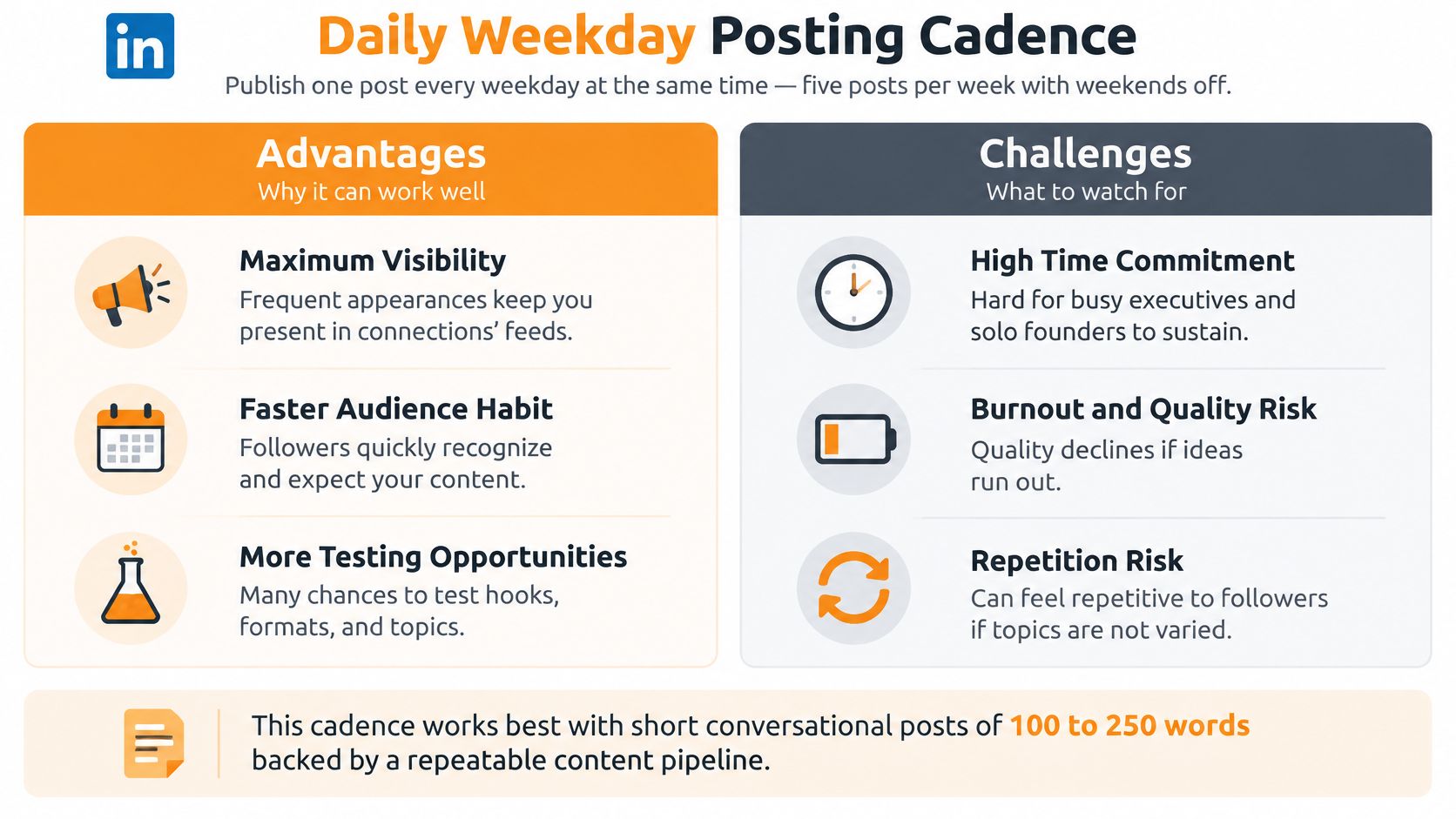
One post every weekday, Monday through Friday, at roughly the same hour.
That volume isn't exotic. In Q3 2024, businesses published an average of 8 LinkedIn posts per week, according to KeeKee 360 Design's compilation of business posting data. Eight a week is close to two a working day, so a five-day habit puts you in the same band as the companies already filling your followers' feeds.
The people who sustain it run a recurring format instead of inventing a topic each morning. A Monday question, a Wednesday lesson, a Friday takeaway. The format does the thinking; you fill the slot.
The trade-off
Daily posting compounds visibility and it compounds mistakes. A thin idea published at 8am costs the same hour a strong one would, and it teaches your audience that skimming is fine.
The rule I'd apply: if you can't hold two weeks of finished drafts in reserve, don't call it a daily cadence. Call it a streak, and expect it to break.
Setup that holds
- Batch on one day. Block 90 minutes weekly to draft five posts and keep a backlog of at least two weeks.
- Lock the format. Assign a theme per weekday so you never start from a blank page.
- Schedule ahead. Queue the week on Sunday so one bad morning doesn't break the rhythm.
- Read the day-level data. Compare comments by weekday and move your strongest material to the days that answer.
Solo consultants and founders with a steady flow of observations fit this best. Anyone whose week can be rewritten by a single client call usually doesn't.
2. Three-Times-Weekly Rhythm (Mon/Wed/Fri)
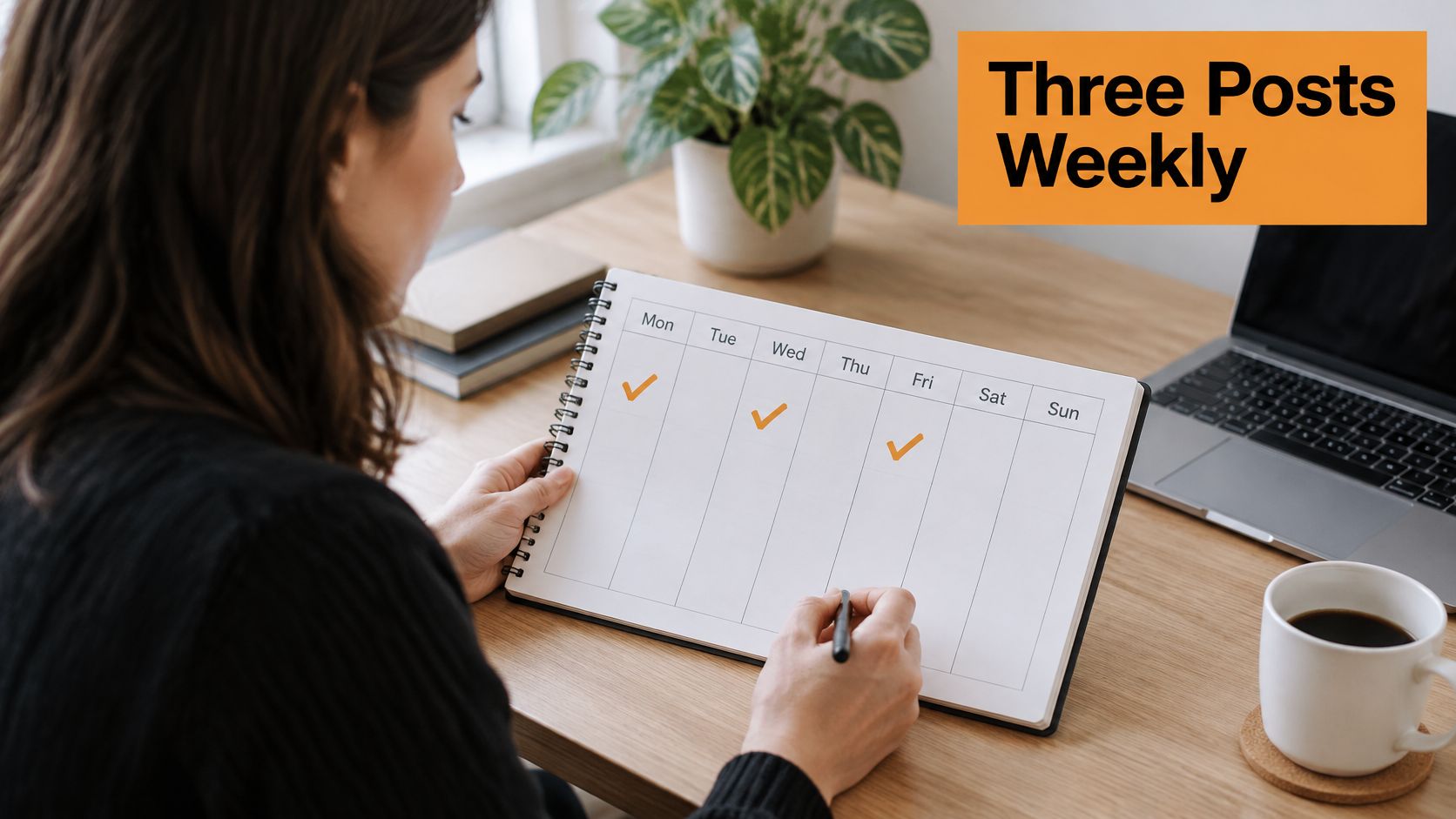
Monday, Wednesday, Friday. Three posts, one rest day between each.
This is the cadence with the clearest published evidence behind it. Buffer's analysis of LinkedIn posting frequency, drawn from more than 2 million posts across over 94,000 accounts, compared accounts posting 2 to 5 times weekly against a once-weekly baseline. Those accounts averaged about 1,182 more impressions per post and a 0.23-percentage-point higher engagement rate. Accounts posting 6 to 10 times weekly saw 5,001 additional impressions per post and a 0.76-point lift.
Three a week sits inside the first band. You get the gain without the daily grind, and you keep enough room to write something with a spine.
Why the gaps help
A day off isn't wasted. It gives comments time to finish, lets you answer the people who replied, and gives your own feed a break from the sound of your voice. The Wednesday slot also lands midweek, when a lot of professionals check LinkedIn between meetings rather than scrolling at midnight.
- Monday, industry read. A short take on something that changed in your market this week.
- Wednesday, client lesson. One problem you solved, with the specific detail that made it work.
- Friday, reflection. What you'd do differently, or a question you're still sitting with.
B2B sales leaders and HR or recruitment specialists tend to get the most from this rhythm, because their weeks already split into prospecting, delivery, and review.
3. Twice-Weekly Thought Leadership Cadence
Two substantial posts a week, usually Tuesday and Thursday, built on original frameworks, analysis, or an argument you'd defend in a meeting.
Hootsuite's reported industry data puts average business posting at 5.5 LinkedIn posts per week in Q1 2025, as compiled by Distribution.ai's B2B posting frequency breakdown. Two a week is deliberately below that. The bet is that a reader who saves your post is worth more than three who scroll past it.
What it takes to hold
Two posts a week sounds light until you try to write the second one. The consultants who make this work keep a library of frameworks they've already used with clients, then expand one per month into a post.
- Build a framework bank. Name each model you use in your work and keep a one-paragraph summary of it.
- Repurpose long-form. A newsletter or blog post usually splits into a sequence of two or three LinkedIn posts.
- Front-load the point of view. The first two lines decide whether the rest gets read, so state the claim before the context.
What separates the two posts from a diary entry: each one should carry a claim someone could disagree with. If nobody could argue with it, it isn't thought leadership, it's an announcement.
A startup CEO running this cadence might publish a founder lesson on Tuesday and a market read on Thursday, drawn from the same board deck she'd already written. The posts cost her two hours because the thinking was done.
4. Weekly Single Deep-Dive Post
One post a week, same day, same time. Sunday evening and Tuesday morning are the two slots people tend to defend hardest.
The evidence here is genuinely split, and anyone who tells you otherwise is selling something. One analysis of more than 3 million LinkedIn posts found the highest median engagement at 4 to 5 posts per week, while a separate study of 26,428 creators reported that weekly engagement kept rising as output moved toward daily posting, as SocialSprint's cadence review sets out.
Neither result says a single weekly post wins on reach. It can win on recall, which is a different asset. One post that people forward to a colleague does more for a consultant's pipeline than five that get a like and vanish.
Making one post carry the week
- Pick a fixed day and keep it. Followers who know when you publish start looking for you.
- Spend the saved time on the hook. Most readers decide whether to expand within seconds, so rewrite the first line five times.
- End with a real question. Not "thoughts?" but something specific enough that answering is easy.
- Treat comments as the second post. Your reply to the best comment often gets more reach than the original.
A weekly post that nobody remembers is a weekly post wasted. Choose the one idea you'd defend in front of a room.
Executives who publish a weekly reflection on a decision or an industry shift fit this well, and so do ghostwriters who publish one client-ready case study a week as a live portfolio.
5. Content Pillar Rotation Cadence
Each weekday or each week is assigned to a pillar: education, personal story, industry insight, client result. You rotate through them instead of chasing whatever feels urgent.

Format allocation is where most calendars tend to fail. A benchmark of 2,450,610 posts from 26,000 LinkedIn company pages found organizations published images most often, at about 7 image posts per month, and raised video publishing to roughly 4 posts per month, per SocialInsider's LinkedIn benchmarks. That works out to about two images a week plus one video, which maps neatly onto a three-pillar rotation with one slot reserved for text.
Keeping the pillars honest
- Cap it at three or four. Five pillars means none of them is distinct enough to remember.
- Review monthly, not weekly. Rebalance based on engagement, clicks, and qualified replies rather than reactions alone.
- Leave one flexible slot. Timely or reactive content needs somewhere to go, or it breaks the whole plan.
- Match production cost to the slot. Video takes far more planning than a text post, so judge it on downstream outcomes.
Agencies rotating between tactical tips, client wins, team culture, and industry trends get the most from this, and so do freelance strategists who need to signal range without sounding scattered. The broader logic of choosing pillars sits in this guide to building a LinkedIn posting strategy that survives more than one quarter.
6. Series-Based Storytelling Cadence
A connected sequence of posts released on a predictable schedule: a multi-part case study, a founder journey, a course that unfolds over six weeks.

Music theory offers a useful frame. A cadence, from the Latin "cadentia" meaning "a falling," is the closing event that signals a phrase has ended, and the overview of cadence in Western music describes how listeners learn to anticipate the endpoint and read any deviation as meaningful. A series runs on the same mechanism. Part three ends on a small resolution, and the reader who noticed it comes back for part four.
Building the sequence
- Outline the whole series first. Know the last installment before you publish the first.
- Fix the visual and title format. Followers should recognise an installment in half a second.
- End each post with a specific teaser. Not "more soon" but the actual question part four answers.
- Keep the gap short. A weekly installment holds attention. A monthly one loses it.
Write the last installment first. If you know where the series lands, the earlier parts stop meandering.
Startup founders telling a launch story over six weeks and recruiters running a weekly interview-prep series both benefit, because the format rewards people who return rather than people who happen to scroll past once.
7. Batch-and-Schedule Monthly Cadence
Every post for the month gets built in one or two focused sessions, then scheduled. The writing happens once; the publishing runs on its own in the background.
The workflow is simple enough to describe in a sentence. Two Sundays a month, four hours each, and a calendar that never opens on a blank page. The hard part is protecting the second session, because the first one always feels like enough.
Where it goes wrong
Batching removes the daily pressure and it also removes your ability to react. A month of posts written on the 1st will feel stale by the 22nd if something big happens in your industry.
- Keep 20 percent of the schedule open. That's roughly one slot a week for reactive content.
- Review weekly, adjust lightly. Check what's landing and swap the weakest planned post rather than rewriting the month.
- Separate drafting from editing. Write badly and fast in session one, edit in session two.
- Book the engagement time too. Scheduling the post is half the job; the comments still need you.
Agencies running a month of client-branded posts in a single workshop, and solo professionals who draft four weeks on one Sunday, both fit this rhythm. If you're choosing where to keep the calendar itself, it's worth comparing editorial calendar tools before you commit a quarter's worth of work to one. The mechanics of the drafting day are covered in this guide to content batching.
8. Engagement-First Cadence (Post Plus Active Commenting)
Publishing is paired with a fixed daily block of commenting, usually 15 to 30 minutes, split before and after your own post goes live.
The posts in this cadence can be fewer. Two or three a week is plenty when you're spending real time in other people's comment sections, because a thoughtful comment on a prospect's post puts you in front of their audience without asking them to click anything.
The block, in practice
- Fifteen minutes before posting. Comment on three posts from people you want to know.
- Add something specific. A number, a counterexample, or a question beats "great post" every time.
- Reply to every comment on your own post. Aim for the first hour, when the post is still being distributed.
- Keep a list of twenty names. Prospects, candidates, hiring managers, peers. Rotate through them weekly.
Fifteen minutes of real comments does more for a salesperson's pipeline than a fourth weekly post. It just doesn't show up in the post count.
Sales development reps who comment on a prospect's post before reaching out, and recruiters who engage with candidate and hiring manager content to build a talent network, get the clearest return. The same discipline applies on other platforms, and the Reddit marketing guide from Bazzly covers how to show up in conversations without spamming them. For the mechanics of the reply side, see this guide on how to respond to comments.
How the eight LinkedIn cadences compare on frequency, effort, and fit
| Item | Posting frequency | Time commitment | Best for | Main risk |
|---|---|---|---|---|
| Daily Weekday Posting Cadence | Five posts per week | High; needs a steady content pipeline | Professionals with a steady supply of ideas | Burnout or declining quality |
| Three-Times-Weekly Rhythm (Mon/Wed/Fri) | Three posts per week | Moderate and sustainable | Busy executives and specialists | Missing a post can break momentum |
| Twice-Weekly Thought Leadership Cadence | Two posts per week | Moderate; research and writing intensive | Consultants and startup CEOs building authority | Slower reach without frequent touchpoints |
| Weekly Single Deep-Dive Post | One post per week | Low; focus on one polished post | Time-limited professionals who prioritize quality | Low frequency limits visibility |
| Content Pillar Rotation Cadence | Three or four posts per week, rotating across pillars | Upfront strategy, then ongoing content planning | Personal brands and agencies with multiple expertise areas | A rigid rotation can feel forced |
| Series-Based Storytelling Cadence | Weekly or twice weekly | Requires planning and maintaining a connected story | Founders and professionals building audience loyalty | Losing momentum mid-series |
| Batch-and-Schedule Monthly Cadence | Three to four posts per week, batched twice a month | One or two focused batching sessions per month | Agencies, consultants, and busy solo professionals | Content may feel untimely |
| Engagement-First Cadence (Post Plus Active Commenting) | Two to three posts per week, paired with daily engagement | Daily 15–30-minute engagement blocks | Sales, business development, and recruitment professionals | Generic comments can harm credibility |
Read the table by constraint, not by volume. A packed travel schedule rules out anything that depends on same-day writing, which pushes you toward the weekly single post or the batch-and-schedule model, since both let the work happen before the trip does. A client-heavy month points the same way: batching concentrates the effort into one or two sessions, and the rest of the month only needs a reactive slot for timely posts.
A sales quarter flips the logic. Pipeline matters more than post count, so the engagement-first row earns its daily time blocks even though it produces fewer posts. The trade-off is real: five posts a week builds surface area fast, but the daily cadence is the first one people abandon when work gets busy, and a cadence you drop in week three does less for you than two posts a week you never miss.
Pick a Cadence You Can Keep for Twelve Weeks
The best cadence is the one you'll still be running in week twelve, not the one with the biggest number attached to it. Every example above fails the same way: it gets chosen during a calm week and abandoned during a real one.
Start with the rhythm that matches your calendar, not the one that matches your ambition. A packed travel schedule points toward a weekly deep dive or a monthly batch. A client-heavy month points toward batching with a reactive slot. A sales quarter points toward the engagement-first model, because commenting travels better than writing does.
Then measure the right things. Comments, profile visits, and direct messages tell you more about whether the cadence is working than impressions do, and they're the numbers that show up in your pipeline rather than your ego.
Change one variable at a time. Moving from two posts a week to three is a test. Rewriting your whole format, changing your posting times, and adding a video series in the same month is a guess you can't learn from.
Give each cadence a full month before you judge it. A weekly post needs four or five installments before the pattern is visible, and a series needs at least three parts before people start expecting the next one. Cutting early is how people conclude that posting doesn't work for them.
If drafting is the bottleneck rather than ideas, RedactAI can generate drafts in your own voice and schedule them ahead, so the rhythm holds through a busy week. It also helps to write down the cadence somewhere visible: the day, the format, the pillar. A rhythm you have to remember is a rhythm you'll drop.
RedactAI learns your tone from your previous posts, so the drafts it produces sound like you rather than like a template. You can generate several post options from a few keywords, schedule them across the week, and keep the same cadence even when a client project eats your mornings. If you'd rather hand the whole rhythm over, the Done For You service publishes 3 to 4 posts a week in your voice. Start for free at RedactAI and see what a month of your own cadence looks like.