You're staring at a blank LinkedIn post box at nine on a Sunday night, knowing you should publish something sharp before Monday morning. You've got three investor updates, a board deck, and a stalled enterprise deal sitting in your inbox, so the draft dies in your notes app again. By Wednesday, you're sitting on a discovery call with a personal branding agency pitching a polished deck full of viral screenshots and big promises.
Most founders walk out of that call thinking they're buying authority and warm inbound leads. Too often, they're buying a glorified ghostwriting mill that polishes a headline, feeds generic prompts into a chatbot, and ships safe posts that sound like every other executive in your feed.
Cheap AI writing has changed what makes an agency worth paying for. Volume is no longer scarce, which means strategic positioning and proof of real authenticity are the only deliverables that justify a retainer. Knowing what agencies sell, what drives real buyer trust, and how to test a partner before you sign will save you months of wasted budget.
What a Personal Branding Agency Sells and What It Costs
A real personal branding agency positions a founder or executive as a credible specialist in a narrow niche, then builds and distributes the content that backs up that claim. It isn't a profile makeover shop that swaps out your banner, tweaks your bio, and leaves you with nothing useful to say.
Demand for executive visibility has grown because decision-makers now judge individuals long before they ever read a company brochure. In a 2025 national questionnaire conducted on behalf of Aurora University, 50% of American professionals said a strong personal brand mattered more than a strong resume, and that share climbed to 61% among business executives.
When you shop for help, agencies package their work across nine common service lines. Each line carries a different deliverable and minimum commitment, so compare what's on the scope sheet before looking at a total fee.
| Service | What you get | Minimum commitment |
|---|---|---|
| Positioning and messaging strategy | Niche, point of view, pillar topics, audience map | 2 to 4 week sprint |
| Profile optimization | Headline, about section, featured section, banner, SEO keywords | One-off |
| Ghostwritten LinkedIn posts | 12 to 20 posts a month in your voice, with approval | 3 months |
| Newsletter or long-form articles | 2 to 4 pieces a month, edited, formatted | 3 to 6 months |
| Video and podcast production | Scripting, recording support, clips, editing | 3 to 6 months |
| Distribution and engagement | Comment strategy, community replies, repurposing | 3 months |
| Analytics and reporting | Dashboard, attribution, monthly review call | Included in most retainers |
| PR and speaking placement | Podcast pitches, bylines, award and conference submissions | 6 months |
| Full done-for-you program | Strategy, content, video, PR, reporting, account management | 6 to 12 months |
How Agency Pricing Structures Actually Work
Most buyers expect project pricing, yet nearly every established firm sells ongoing monthly retainers. That structure reflects how executive authority builds: one strong month rarely moves a pipeline, so shops tie staffing and account management to quarterly or semi-annual commitments.
Say you ask three different shops for sample proposals to see how scope affects cost. A focused positioning sprint comes back as a one-time fee, a core ghostwritten content retainer sits in the middle as a recurring monthly bill, and a full executive program adding video production and PR pitches lands at the top tier of monthly spend. For a closer breakdown of how retainers, project fees, and hybrid structures compare, review our guide to marketing agency pricing models.
Watch out for per-post pricing. When a shop quotes a flat rate per LinkedIn post, strategy, interview time, voice editing, and attribution reporting either disappear from the scope or show up later as surprise add-ons. Onboarding setup fees and paid promotion budgets also sit outside almost every standard retainer, so ask for those lines in writing before comparing quotes.
Agency reality check: Any shop can sell you twelve posts a month. What you're actually paying for is the editorial judgment to decide which ideas make your buyers trust you and which ones belong in the trash.
One question separates a serious strategic partner from a low-grade content mill: who owns the strategy, and will they show you the documented positioning and content calendar before you sign a long-term retainer? If the salesperson dodges that question or insists they'll figure out your point of view after onboarding, walk away.
Why Buyers Reward Thought Leadership and Who Should Hire
Senior B2B buyers don't trust polished product sheets the way they used to. They check the people running the company, read how those leaders think about hard problems, and shortlist vendors who already feel familiar before a sales rep ever gets a reply.
The reading habit among senior buyers is documented at scale. Here's how much weekly attention executives give to expert content.
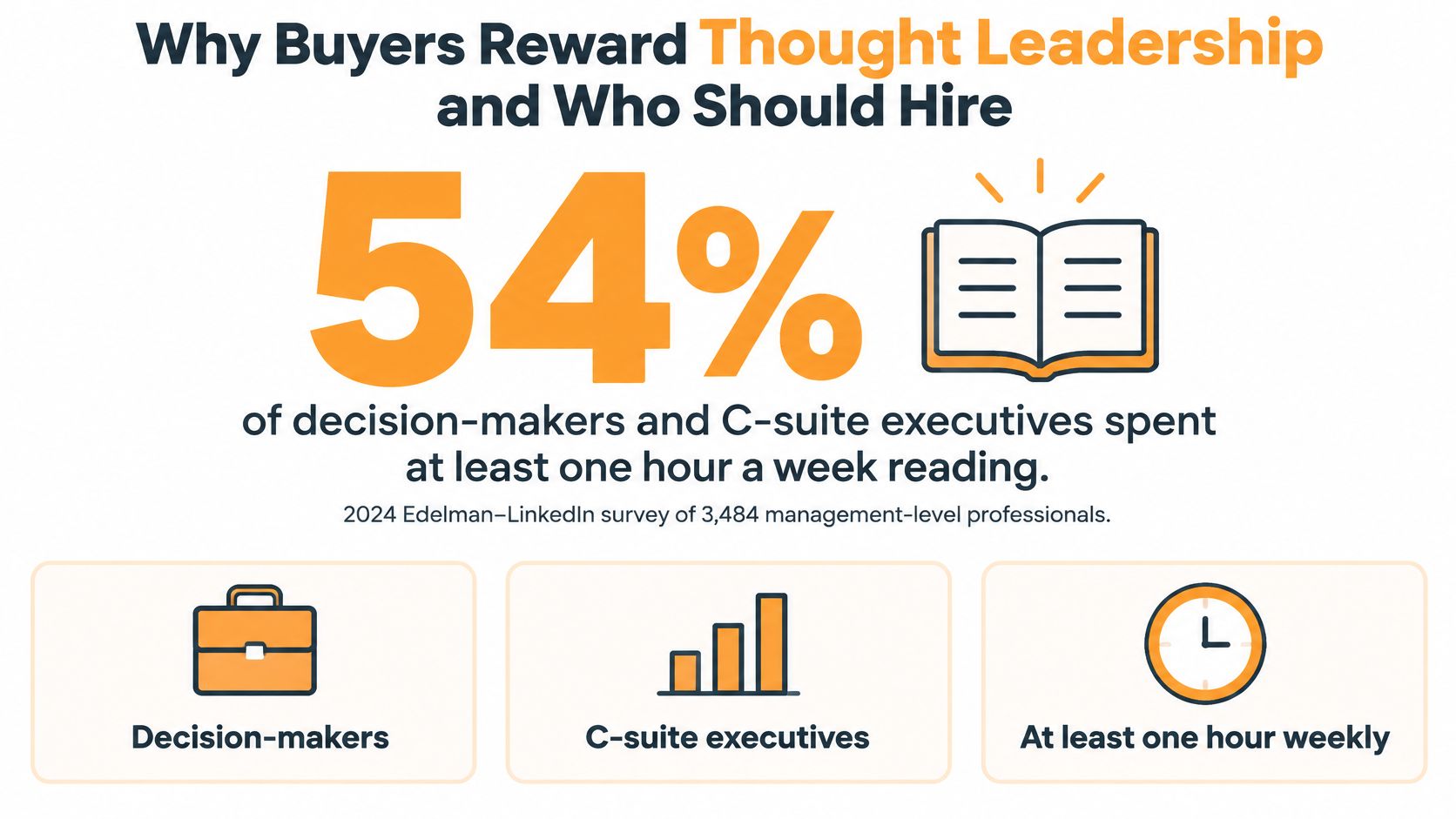
In the 2024 Edelman-LinkedIn B2B Thought Leadership Impact Report, which surveyed 3,484 management-level professionals across seven major markets, 54% of decision-makers and C-suite executives reported spending at least one hour per week reading thought-leadership content. Earlier research in that same annual series revealed a massive quality gap: only 15% of decision-makers rated most of the thought leadership they read as "very good" or "excellent".
That gap is why smart leaders treat content as a sales asset rather than an ego project. According to the 2024 Edelman-LinkedIn findings compiled by OneHour Digital, 73% of B2B decision-makers said an organization's thought-leadership content was a more trustworthy basis for assessing capabilities than marketing materials and product sheets.
Tight markets raise the stakes even higher. The 2022 Edelman-LinkedIn B2B Thought Leadership Impact Report, surveying 3,449 global business executives, found that 50% of C-suite executives said high-quality thought leadership carried more influence on their purchase decisions during economic downturns than during good economic conditions. At the same time, the 2021 edition of that report (based on 3,593 global management-level professionals) found that 38% of final decision-makers felt the market was oversaturated with more thought leadership than they could manage.
Publishing more noise won't rescue a slow quarter. Buyers reward clarity, original frameworks, and proof that you've solved their exact problem before. If you want to structure those ideas properly, map out a deliberate thought leadership content strategy and pair it with proven ways to build demand through business social so every piece reaches actual prospects.
This short walkthrough breaks down how executive content converts buyer attention into real commercial trust.
Who Should Hire an Agency and Who Should Walk Away
Not every executive gets a positive return from a retainer. Hiring a personal branding agency makes sense when your deal size justifies the investment and your expertise directly closes business.
- Founders raising capital or selling enterprise contracts: Investors and corporate buyers vet the CEO's judgment long before signing a term sheet or procurement form.
- Consultants and agency owners reliant on referrals: Consistent, specific insights remind acquaintances outside your immediate circle exactly what problem you solve.
- Sales leaders working named target accounts: Prospects ignore cold pitches from strangers, yet they reply to people whose breakdowns they've already saved.
- Recruiters, executive coaches, and market entrants: Entering a new industry without an established network requires visible proof of competence to shorten trust cycles.
Walk away from an agency retainer if any of four blockers apply to you right now. First, if you can't protect one to three hours a month for voice interviews and draft reviews, your content will turn stale fast. Second, if you refuse to narrow a broad service offering into a clear niche, no writer can make you memorable. Third, if you only want vanity follower spikes, buy ads instead. Fourth, if legal or compliance teams must redline every post for weeks, you'll burn retainer fees waiting in an approval queue.
Start before budgets tighten, not after pipeline dries up, because executive credibility takes months to build. Frame your payback clearly: if one or two retained clients or key senior hires are worth more than a year of agency fees, the economics work in your favor.
Agency Versus Freelancer Versus AI Tool Versus Doing It Yourself
You don't have to default to an agency just because you're short on time. Four realistic paths exist for building an executive presence, and the right choice comes down to cash budget, weekly hours, and how much strategic guidance you need.
| Option | Typical monthly cost | Your time per week | Strategy included | Voice fidelity | First post live |
|---|---|---|---|---|---|
| Personal branding agency | Highest (monthly retainer scaled by deliverables) | 1 to 3 hours | Yes, documented | High after voice capture | 2 to 4 weeks |
| Freelance ghostwriter | Mid-tier (monthly retainer or per-piece rate) | 1 to 2 hours | Rarely | High | 1 to 2 weeks |
| AI writing tool | Low (flat monthly software subscription) | 2 to 4 hours | No | Medium to high if trained on your posts | Same day |
| Do it yourself | $0 | 5 to 8 hours | Your own | Highest | Same day |
A full agency buys documented positioning, consistent production, distribution habits, and a single point of accountability when a campaign misses the mark. You pay top dollar and wait a few weeks for interviews and positioning work before your first post goes live, yet you protect your calendar.
A vetted freelance ghostwriter costs significantly less and often matches an agency's writing craft. The catch is scope: solo writers rarely handle commenting workflows, newsletter repurposing, PR pitches, or CRM attribution, and if your freelancer gets sick or takes a full-time role, your publishing stops overnight.
Doing it yourself costs zero cash and produces the sharpest voice because every story comes straight from your head. In practice, busy executives almost always abandon DIY writing before their first quarter finishes once a product launch or hiring sprint eats their mornings. If you do plan to keep writing in-house, studying practical personal branding strategies for creators helps you build repeatable habits rather than guessing each week.
The AI Authenticity Trap and the Hybrid Winner
AI writing tools slash drafting time and can mirror your rhythm if they're trained on your real history rather than generic templates. What they can't do is define your market positioning, pitch podcasts, or tell you when a hot take will alienate your biggest customer.
Over-relying on raw AI drafts carries a real credibility penalty. In a 2025 study of 1,100 working professionals published in the International Journal of Business Communication, managers who used heavy AI assistance were perceived as less sincere, caring, competent, and trustworthy, with only 40% to 52% rating high-AI messages as sincere compared with 83% for low-assistance messages. A separate global survey of more than 5,000 respondents cited in that same analysis found that 75% of U.S. consumers wanted to know whether content was AI-created, 61% wanted creative companies to disclose AI use, and 57% wanted visible labels indicating the level of AI involvement.
Cheapest isn't smartest when a single robotic post makes your buyers question whether they're reading your actual thinking.
That evidence points directly to a hybrid model as the strongest setup for most leaders. Keep strategy, real client stories, and final editorial judgment in human hands (either yours or a senior strategist's), use voice-trained software to accelerate drafting and repurposing, and hold final approval on every post before it goes live. Before picking any of the four paths, look at your actual calendar and decide how many weekly hours you'll protect six months from now.
Questions to Ask Before You Sign a Retainer
Sales calls with personal branding shops always feel impressive. The founder shows slick case studies, drops familiar names, and promises a painless onboarding process. Your job on that call is to ignore the hype and test the operating model underneath.
Start with the two foundational positioning questions below before discussing posting frequency or creative formats.
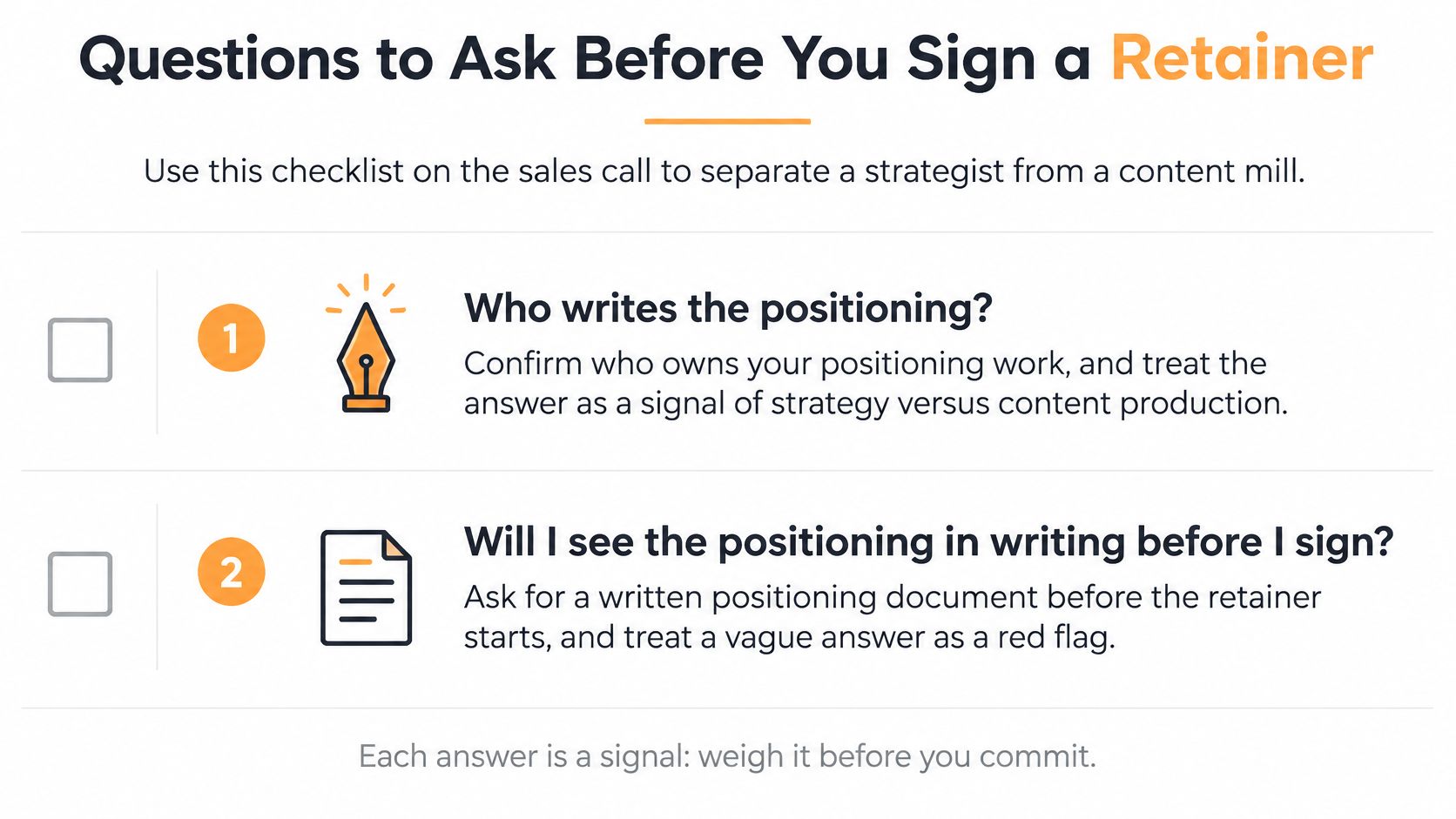
Once you've confirmed who owns the positioning document and that you'll see it in writing before content production begins, press them on how the day-to-day work runs. Treat vague answers as warning signs rather than minor details.
- How do you capture my actual voice? You want recorded interviews, voice memos, or a documented style guide built from your past talks and emails. Worry if they only send a ten-question Google Form and promise to figure out your tone from your website.
- Will the person pitching me write my posts? Senior partners love closing deals and handing accounts to junior writers the next morning. Ask to meet your assigned writer before signing, and confirm what happens if that writer leaves the agency mid-contract.
- Can I read recent posts from two current clients in my industry? Screenshots of one viral post prove nothing. Reading a client's full feed over the last month shows whether the agency sustains sharp thinking or slips into recycled platitudes, and two direct references tell you how smooth the workflow feels.
- How do approvals, revisions, and travel weeks work? Clarify turnaround speed when a draft misses your tone, confirm you hold final veto power on every post, and check whether they bank interviews ahead of time so publishing continues while you're on the road.
- How do you connect content to business pipeline? If they only talk about impression graphs and engagement rates, they're measuring reach rather than revenue. Ask whether they tag inbound leads in tools like HubSpot or Salesforce alongside monthly reviews.
- What is your exact AI workflow and disclosure policy? Ask directly whether drafts start in an AI model, whether a human editor verifies every claim and preserves your phrasing, and when they recommend disclosing AI assistance. Any agency claiming they never touch AI while offering rock-bottom pricing is usually hiding its real workflow.
- What are the cancellation terms and who owns the drafts? Make sure you own every published post, unpublished draft, interview transcript, and positioning document if you part ways, with clean exit notice rather than punitive auto-renewals.
Three Red Flags That Should End the Call
Some promises reveal a content mill immediately. Walk away if an agency guarantees a specific follower count, because nobody controls social algorithms legitimately without using engagement pods or clickbait that repels real buyers.
Per-post pricing with no strategy line item is a second dealbreaker, since it rewards output volume over buyer relevance. Finally, refuse any lock-in contract that runs longer than the agency's own results review cadence; if they claim you'll see meaningful commercial traction in ninety days, they shouldn't force a twelve-month non-cancelable commitment on day one.
How to Measure Whether the Brand Pays
Visibility is not commercial value. A post that draws fifty thousand impressions from peers and students does nothing for your business if zero target buyers read it or remember your name when budget opens up.
Before you publish your first new post under any program, record a clean baseline. Look back at your most recent twenty posts, count how many inbound conversations you're getting from target accounts each month, and tally your monthly recruiter inquiries and speaking invitations. Without that snapshot, you'll have no way to tell whether an agency moved the needle or merely took credit for referrals you were already getting.
| Metric type | What to count | How to track it |
|---|---|---|
| Vanity metric | Impressions, followers, likes | Track only as a leading indicator |
| Business metric | Inbound conversations from target accounts | Tag in CRM each month |
| Pipeline metric | Deals where the prospect cites your content | Log on discovery calls |
| Talent metric | Recruiter or hiring-manager contacts | Count each quarter |
| Trust metric | New clients who read your posts before first contact | Ask at onboarding |
Use the table above as a simple one-page monthly scorecard that you or an assistant can update in twenty minutes without hiring a data analyst. Impressions, followers, and likes belong at the top purely as early directional checks showing whether distribution is active, never as proof of return.
Accounting for Hidden Buyers and Trust Erosion
Public metrics miss most of how executive content closes deals. In the 2025 Edelman-LinkedIn study of 1,934 global business executives, researchers found that high-quality thought leadership credentials firms with less-visible "hidden" influencers who have no direct relationship with the provider. A technical evaluator or finance director will copy your post link into Slack without dropping a public like, and push your company onto the shortlist anyway.
Because B2B sales cycles stretch across months, judging attribution at thirty days leads to bad decisions. Review leading signals monthly, then evaluate pipeline and talent outcomes seriously at ninety days and six months.
You also need to monitor the other side of the ledger: trust deterioration. According to USC's global AI opinion tracker, 42% of respondents expressed strong concern about being unable to distinguish human from AI-written content, with another 27% moderately concerned. Watch closely for skeptical comments questioning authorship, factual corrections you have to issue, or a drop in replies from senior peers even while raw impressions stay flat.
Measurement rule: One discovery call where a CFO opens with "I've been reading your posts for months" outweighs ten thousand passive views every time.
Ask every new client during onboarding how they first heard of you and whether they read your content before booking a call. That single habit closes the attribution loop better than any complex software tracker, and pairs neatly with a broader framework for measuring social media ROI.
Your Four Week Starting Plan Before You Commit
Don't sign a multi-month retainer based on a pitch deck. Spend thirty days running a lightweight test that gives you hard evidence about your positioning, your audience, and your own discipline before any serious money leaves your account.
- Week 1: Lock your one-page positioning and audit your baseline. Open a single blank document and define three things: the exact buyer you serve, the expensive problem you help them fix, and three core topics you can talk about intelligently for an entire year. Then review your last twenty posts to see which topics drew thoughtful comments or direct messages from actual prospects rather than polite applause from colleagues.
- Week 2: Fix your profile and publish three posts yourself. Rewrite your LinkedIn headline so a stranger immediately understands who you help and how, update your About section with proof of real work, and pin your best case study or offer in your Featured section. Publish three posts written in your own voice based on real client conversations or operational lessons from that week to establish an honest performance baseline.
- Week 3: Test real samples instead of sales pitches. Reach out to two agencies and request a paid or scoped one-page strategy sample showing how they'd angle your expertise, or hire a freelance ghostwriter for a three-post paid trial. Put the written samples side by side and judge clarity, sharp perspective, and voice accuracy rather than deck design.
- Week 4: Run an honest rhythm check. Look back at the past three weeks. If you consistently hit your publishing cadence and enjoyed refining your ideas, you probably don't need a heavy agency retainer at all; a sharp freelancer or a focused drafting workflow will carry you further for less. If your drafts stalled by week two because client work took over, that's your clear signal to invest in dedicated support.
Picking the Middle Path Without Losing Your Voice
Between writing everything from scratch and paying for a full multi-channel agency sits a practical middle ground built around voice-trained tools and focused LinkedIn execution. RedactAI builds a personalized AI directly from your LinkedIn profile link using your name, experience, headline, description, and your last 100 posts, so you can turn rough notes into usable drafts without starting from generic templates.
Keep final approval firmly in your own hands, disclose AI assistance whenever context calls for transparency, and judge every post by qualified conversations rather than vanity likes. If week four proves you don't have the bandwidth to manage execution yourself, our Done For You service includes LinkedIn profile optimization and 3 to 4 posts per week written in your voice so your presence stays consistent while you run the company.
If you want to build a credible LinkedIn presence that sounds like you wrote every word, without burning retainer budget on generic agency templates, start with a tool built around your own history. RedactAI trains a personalized model on your real LinkedIn profile and past posts for faster drafting, and also offers a Done For You service when you want a dedicated expert handling optimization and weekly publishing in your voice. Visit RedactAI to try it free with no credit card required and see what your voice sounds like on the page.