What does a LinkedIn optimization service hand you at the end of the month? Ask a provider's sales page and you'll get a feature list: headline rewrite, keyword research, content calendar. All real, none of it answers the two questions that decide whether the money was worth it. Can you check the work before you pay? And which part of your situation will no service fix, however good the writing is?
I'd argue the second question matters more than the first, and almost no comparison page touches it. So here's the version you'd get from someone who has watched these packages succeed and stall: what's included, who benefits, how to pressure-test a provider before signing, and where the ceiling sits.
What a LinkedIn Optimization Service Covers
A LinkedIn optimization service is a paid package that works on three layers at once: your profile, your content and your measurement. The job isn't to make you sound impressive. It's to make the people who already find you read past the first line, then reply.
The scope map below is the honest version of what's on the table. Most providers do three or four of these six things properly and wave at the rest.
| Component | What the provider does | What you get |
|---|---|---|
| Profile audit | Reviews headline, About, experience, skills, featured items and photo against your target role | A ranked list of gaps |
| Headline and About rewrite | Rewrites copy with searchable terms in your own voice | Ready-to-paste profile text |
| Skills and evidence mapping | Matches each skill to an accomplishment, metric or project | Skills list with supporting proof |
| Content plan and posting | Drafts and schedules posts, often three or four per week | Approved post calendar |
| Engagement and networking | Plans comments, connection requests and outreach | Weekly engagement targets |
| Reporting | Tracks reactions, comments, reposts and profile views | Monthly performance report |
The three layers, read top to bottom
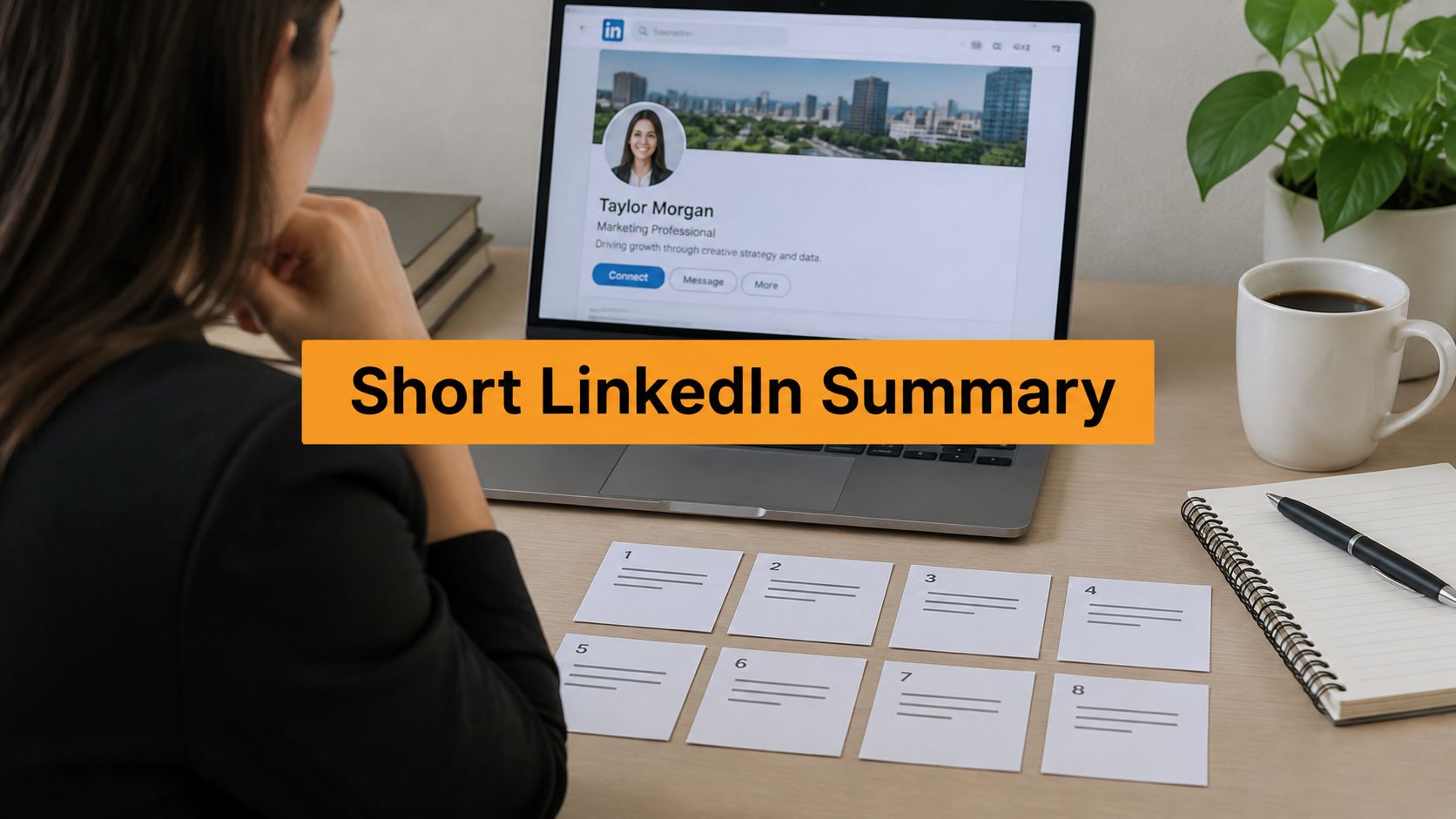
The profile layer covers the headline, About section, experience wording, skills, featured items and photo. A good audit doesn't just flag problems, it ranks them, because a muddled headline costs you more search visibility than a slightly dated certification ever will.
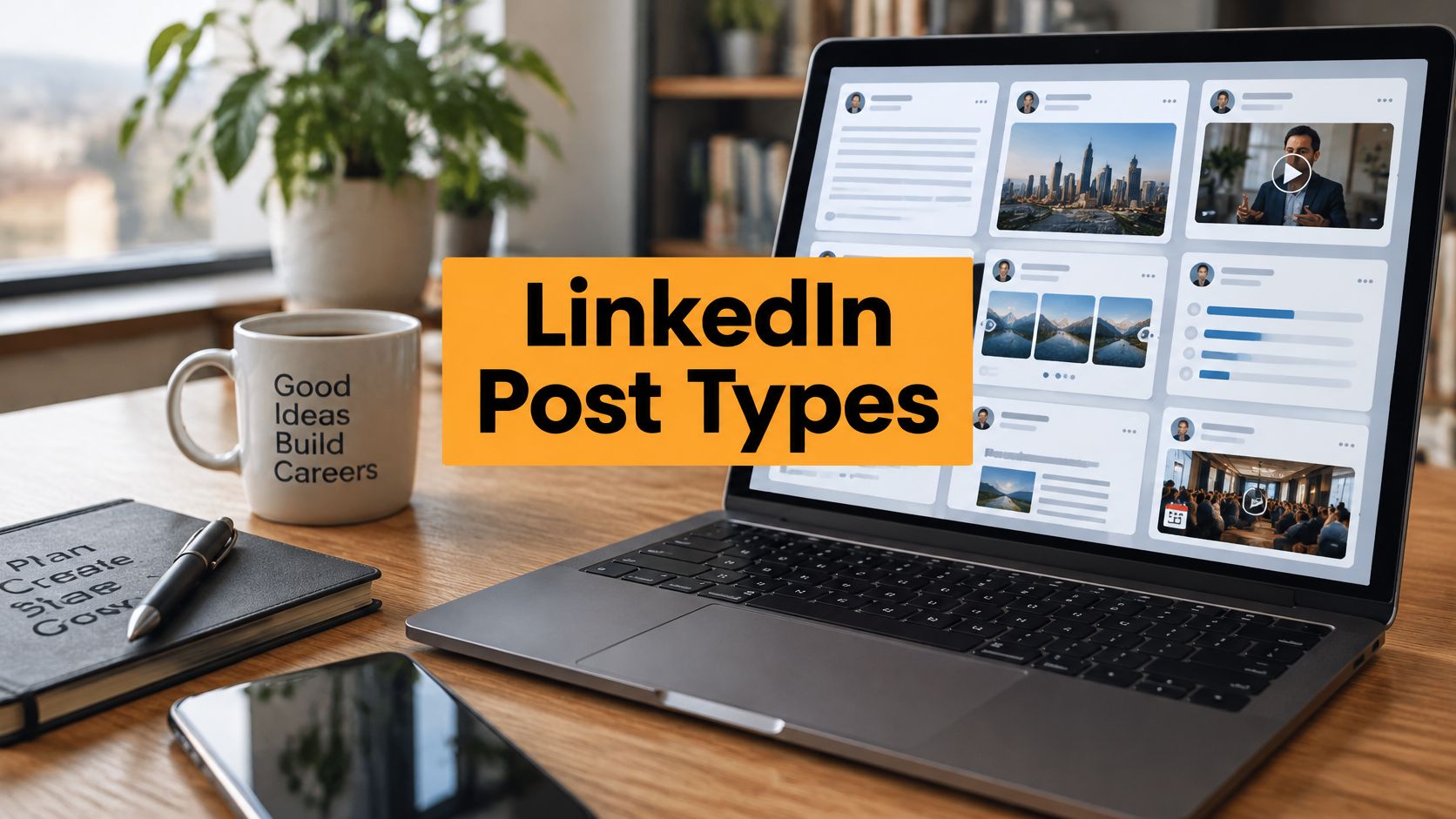
The content layer is drafting, tagging, timing and cadence. Expect a fixed weekly rhythm from anyone competent, written in your voice rather than a house style. If a provider quotes you twenty posts a month, ask who is reading them before they go live.
The measurement layer tracks reactions, comments, reposts and profile views. These figures don't move together, and a service that reports only impressions is showing you the one number that can climb while nothing else does.
The three packages you'll be quoted
- One-off audit or rewrite: the cheapest entry point. You get a ranked gap list and ready-to-paste copy, usually delivered within days.
- Content-only plan: someone drafts and schedules posts weekly or monthly. You approve, they publish, nobody touches your headline.
- Full done-for-you management: audit, rewrite, posting, engagement and reporting, priced monthly. It's the only package where consistency becomes somebody else's problem.
Turnaround is where expectations slip. A profile rewrite is a days-long job. Content management runs on a weekly or monthly cycle, so you won't know whether it's working for at least four weeks.
Do the free part first. List which of the six components you already have, mark what's missing, and decide whether you have a one-off problem or a consistency problem. Those are different purchases.
Who Benefits Most and Why Profiles Get Missed
Which profiles does a LinkedIn optimization service change? Rarely the emptiest ones. The clearest returns go to people with a reason to be found this quarter and a profile that doesn't say it yet.

Four groups fit that description.
- Executives and founders chasing inbound leads, where one clear line can replace a chunk of cold outreach.
- Consultants and freelancers whose sale depends on someone checking them out after a call and finding evidence.
- Recruiters and sales professionals who work the network daily and can't afford a profile that undersells them.
- Career changers whose last three job titles point somewhere they no longer want to go.
The scale explains why profiles get missed. LinkedIn's own company data puts the platform at more than 1 billion members across 200 countries and regions. A headline that reads like a job title disappears into that crowd, so keyword selection, positioning and publishing consistency decide whether anyone ever reaches you.
A large network also hides a quieter issue. A 2026 SAGE Open mixed-methods study of 1,001 LinkedIn posts, indexed on RePEc, found that 34% of the sampled users had never posted at all, and that 430 of those 1,001 posts were reposts. Plenty of professionals maintain a profile without ever publishing, which is exactly the habit a service is meant to build. Starting from zero is normal, and it gives a provider a clean baseline to work from.
Be honest about the ceiling, though. A service can rewrite, schedule and report, but it cannot fix a weak offer, manufacture proof you don't have, or decide who the profile is for. If your niche is muddy or your portfolio is thin, a rewrite makes the same weak pitch easier to read. That positioning work has to happen in your head before it happens on the page, and it's the first thing I'd check before paying anyone.
Three questions settle whether you need the help. Does your profile match the job you want next rather than the one you have? Do you have a reason to be found in the next 90 days? Can you review three posts a week without letting it slide? Two yeses out of three and a service is worth a closer look. Fewer than that, and a one-time profile review will do more for less.
Headline, Skills and About Section Drive Discovery
Your headline travels further than the rest of your profile. It sits next to every comment you leave, every connection request you send and every search result you appear in, so it does more filtering work than any other line on the page.
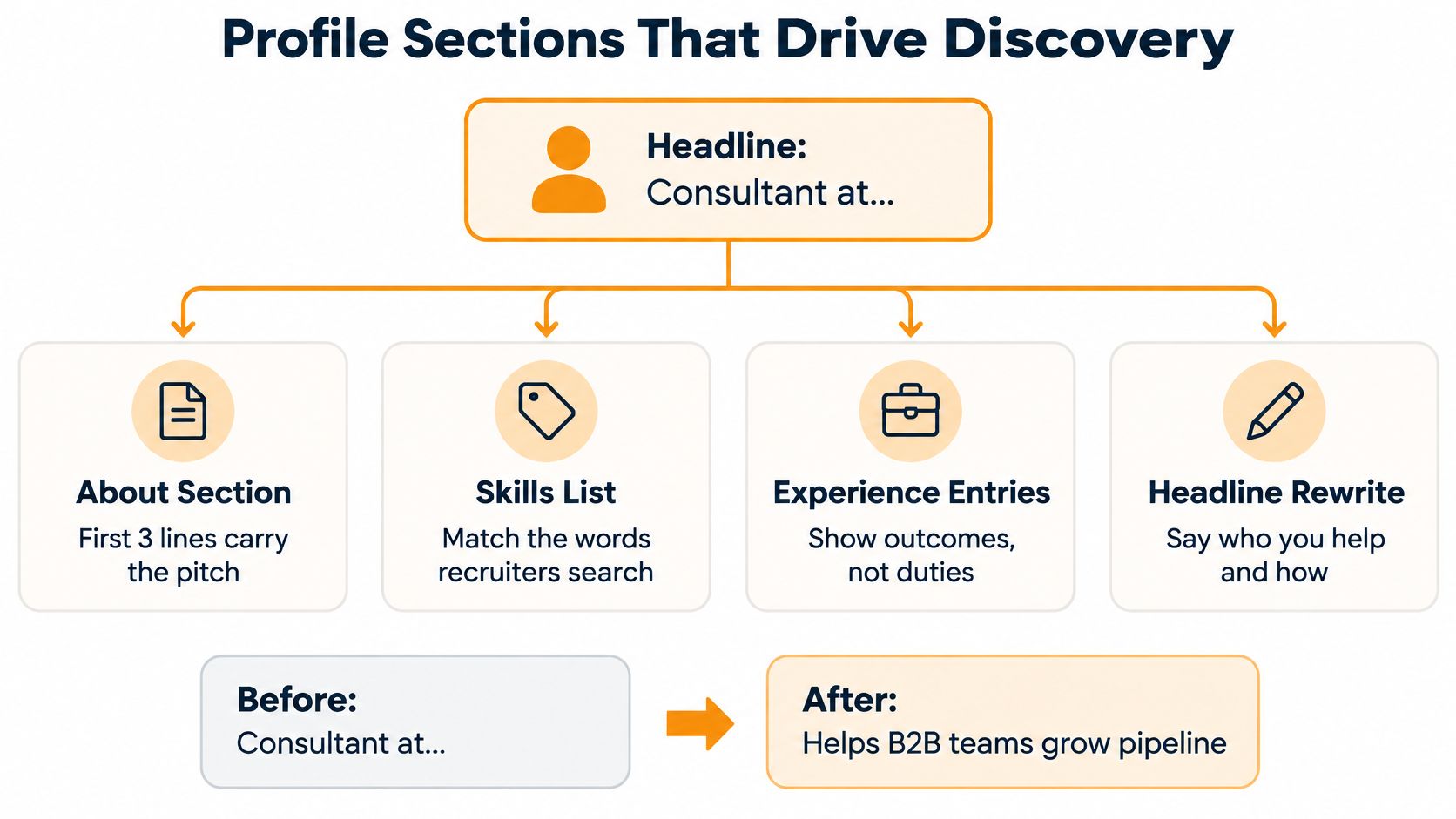
Consultant at Self-employed tells a recruiter nothing a filter can use. Operations consultant helping SaaS teams cut onboarding time gives them a role, an audience and an outcome in one line. Name those three things in that order. If the first line won't come, this guide on how to craft a standout LinkedIn headline walks through the patterns that repeat across strong profiles.
The About section has two lines before the click
Everything above the "see more" link is your entire pitch for most visitors. Write those first two lines as a claim. "Passionate professional with a proven track record" gives people a reason to leave. "I help B2B SaaS teams cut onboarding time from six weeks to ten days" gives them a reason to keep reading.
The rest of the section earns the trust. Three short blocks cover it: who you help, what you have shipped with a number attached, and how to reach you. Our post on writing a summary for LinkedIn covers the voice side of that draft if you want to write it yourself.
Skills work like a search filter
Recruiters filter by skills far more than by credentials. LinkedIn reports that 14% of recruiter searches in OECD countries are filtered by skills, against less than 2% filtered by degree, and that companies running the most skills-based searches are 12% more likely to make a quality hire (LinkedIn's business case for skills-first hiring). Your skills list is the matching mechanism behind those filters, and a list padded with adjectives matches nothing.
Run this routine in one sitting.
- Pick two or three target job titles you would accept.
- Pull the 10 to 15 skills those postings repeat.
- Attach one accomplishment, metric or project to each.
- Delete any skill you can't back with evidence.
- Move the strongest proof into your featured section.
That routine is roughly what a serious audit does, and it doubles as a test. Ask any provider which skills they would add to your profile and which they would cut. If the deliverable is a rewritten About section with no skills mapping behind it, they are selling copywriting rather than optimization. The Done For You service at RedactAI includes profile optimization as a starting point, and its free AI LinkedIn Profile Review gives you the same checklist to run on your own profile before you pay anyone.
The skills-first shift is the part profile advice still skips. A service can sharpen the wording and reorder the list, but it cannot invent the evidence underneath. If a skill has no project behind it, the honest fix is deleting it, which is why step four exists.
How Posting Habits and Tags Lift Reach
A tag isn't decoration. A 2025 negative-binomial analysis of 991 LinkedIn posts found that tags and hashtags significantly increased the expected number of reactions, and that tags also produced a substantial increase in comments (the SAGE Open study). The same model found follower count had a smaller positive effect than tagging did, and that post age pushed all three metrics down.
Read that second finding twice. Reach decays, so publish when your audience is on the platform, and check the first few hours while a post still has momentum.
Comments, reactions and reposts feed each other
The study also caught reciprocal effects. Comments raised reactions and reposts. Reactions raised comments and reposts. Reposts raised reactions. That's a feedback loop, and it's why a single metric lies to you: high likes on a post nobody argued with rarely compounds.
Practical rule: report reactions, comments and reposts as three separate lines, and treat early comments as the leading indicator rather than the trophy.
What to actually post in a week
Content type changes the result as much as volume does. A content analysis of 788 LinkedIn posts, paired with an experiment involving 334 participants, found informational content generated higher engagement than promotional content, and that employee-created posts outperformed company-page posts (the Drivers of Customer Engagement on LinkedIn study). Frameworks, quantified lessons and benchmarks travel. Announcements don't.
A workable week looks like three posts: two informational, one personal or lightly promotional. Give each one a relevant tag or hashtag where it fits, and no more than a couple. Spreading fifteen tags across a post reads as spam and buries the topic.
Say you're a sales lead launching a new product. The weak version is the launch announcement. The strong version is "three mistakes buyers make before they sign", with the product named once at the end. Same news, framed as something the reader can use. If scheduling is the bottleneck, it's worth learning to schedule social media posts so the cadence doesn't depend on your calendar.
If writing is the bottleneck rather than the calendar, the Done For You service includes 3-4 posts per week in your voice, so the weekly rhythm is handled rather than improvised. Our guide to building a LinkedIn posting strategy covers the planning side if you'd rather keep it in-house.
One repurposing rule to end on: recycle the posts that drew comments or reposts, not the ones that only collected reactions. Conversation is the signal that something is worth running again.
Keeping Your Voice Real While Using AI
The fastest way to lose a reader on LinkedIn is to sound like a language model with a growth mindset. Posts that open with "Excited to share" and pivot on "game changer" get identified as filler in under a second, and the reader is gone before your actual point arrives.
The problem isn't AI. It's AI with nothing to work from.
A five-step routine that keeps the draft yours
- Feed the tool your own material first: past posts, project notes, client results.
- Add one firsthand detail to every draft, a conversation you had or a mistake you made.
- Flag any claim you can't prove and cut it.
- Read the draft aloud. If you stumble, the sentence is wrong.
- Keep drafting and publishing as separate steps so nothing goes live unreviewed.
That last step is the one people skip. Drafting is cheap; publishing is a commitment made in your name.
Voice preservation is a build choice, not a slogan. We model it from your profile and your previous posts, and every draft arrives as three versions so you can pick the one closest to how you talk. Three options beat one, because choosing is faster than correcting.
Measure replies, not applause
Reactions are the easiest number to move and the least useful. Track replies, profile visits from people you'd want to meet, and conversations that turn into calls. LinkedIn's 2025 Future of Recruiting report found employers were 54 times more likely than the previous year to list relationship development as a required recruiter skill, and that companies whose recruiters used AI-assisted messaging most were 9% more likely to make a quality hire (LinkedIn's 2025 report). Both findings point the same way: AI helps when it supports a relationship, not when it replaces one.
Publishing less, with stronger evidence and deliberate follow-up, beats a high-frequency automated schedule when trust is the objective.
Follow-up is where the relationship forms, so it's worth comparing AI outreach software options rather than bolting outreach onto a posting tool that was never built for it.
If you want to see how the drafting side works in practice, our walkthrough of using AI to write LinkedIn posts covers the prompt structure and review loop.
One check before you approve anything: would you say this sentence out loud to a client? If not, it isn't your voice yet.
How to Choose and Test a LinkedIn Optimization Service
A good provider shows you what it will deliver before you pay. That's the whole test, and it takes about ten minutes to run against any shortlist.
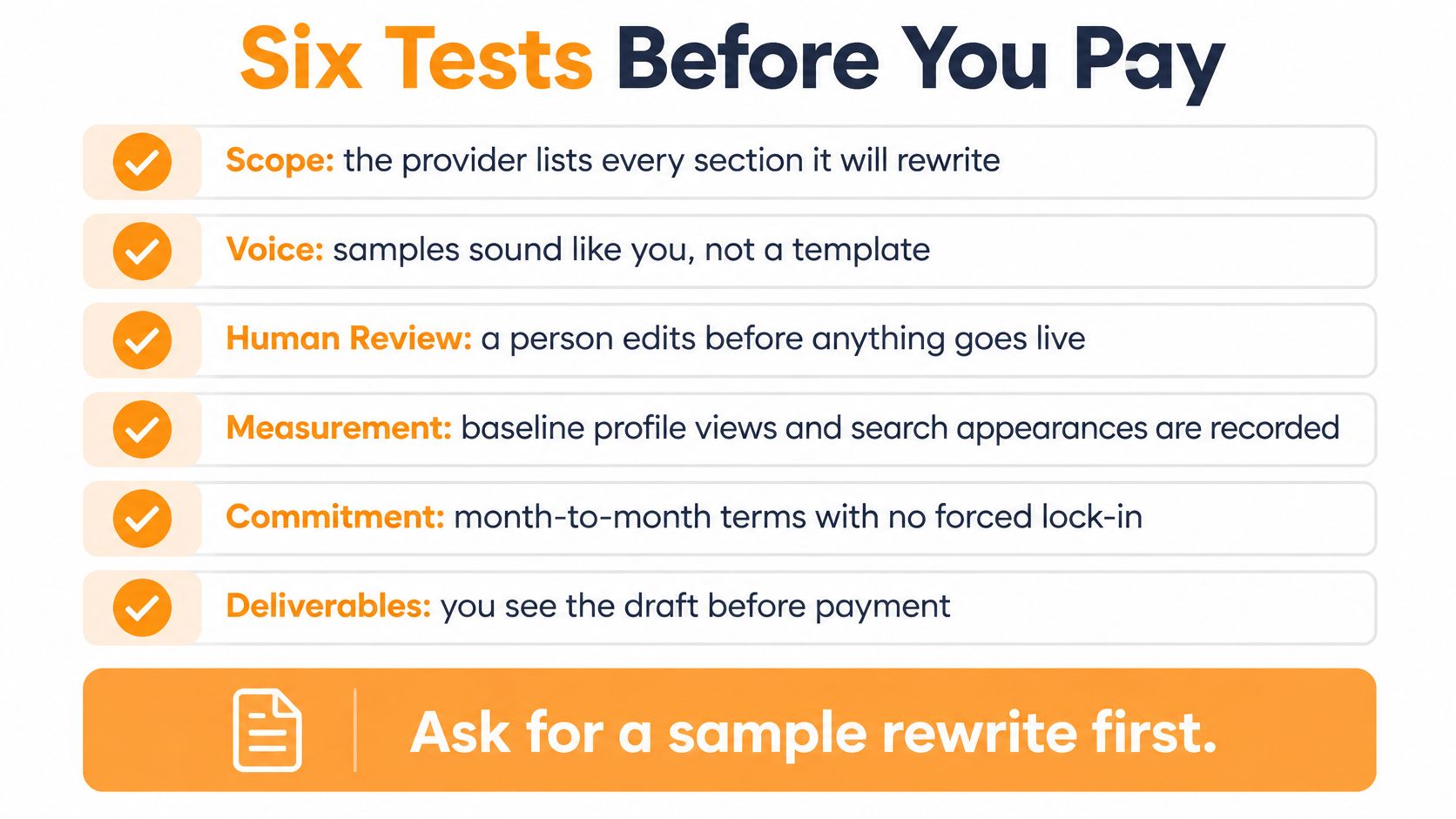
Run each provider against the six criteria below and score carefully. A provider that fails two or more is a bad fit regardless of price.
| Criterion | Look for | Red flag |
|---|---|---|
| Scope | Named deliverables such as audit, rewrite, posting and reporting | Vague promises of a brand boost |
| Voice | Drafts built from your own posts and experiences | The same template for every client |
| Human review | A named expert or editor checks each post before it goes live | Fully automated with no approval step |
| Measurement | Monthly report covering reactions, comments, reposts and profile views | Only follower counts |
| Commitment | Clear cancellation terms and a stated response time | Long lock-in before you see any work |
| Trial | A free audit or trial period before you pay | Payment required upfront with no preview |
Compare the monthly total, not the headline price
Two quotes at the same sticker price aren't the same purchase. One includes a report and an editor; the other includes a template and a scheduler. Ask what happens in month two, who writes, and what you'd receive if you cancelled tomorrow.
Ask about tax too. Our prices don't include all taxes, and sales tax is added to purchases as required, so the number at checkout differs from the number in the ad. Any provider should tell you that before the invoice lands.
Trials deserve the same scrutiny. New clients at RedactAI get an initial free 7-day trial, after which the subscription starts unless notice is given. That's a normal structure, and it's why you set a calendar reminder for day five rather than trusting memory.
Ask for a sample rewrite first. One paragraph in your voice tells you more than an hour of sales conversation.
Ask who does the work
A provider may hand parts of the job to third-party partners it doesn't control. Ours may recommend third-party services but isn't responsible for their operation or content, and that distinction matters when the deliverable is your professional reputation. Ask directly: who writes my posts, and are they employed by you?
RedactAI runs a free audit for the Done For You service, with no commitment and a response within 24 hours. Those two terms are worth demanding from anyone, because they cost the provider nothing and tell you whether the operation is organised.
What no service can fix
This is the part comparison pages skip. Three situations defeat good writing.
A thin job history. If you've held one role for eight months with no projects to point at, no advisor can manufacture evidence. The fix is time and output, not copy. Work a project, document it, then buy the rewrite.
No real results to cite. Metrics you can't support become claims you'll be asked to defend in an interview. A service should cut those, not soften them. Be suspicious of a provider who promises to "strengthen" numbers you don't have.
No time to review. If you can't read and approve three posts a week, the calendar fills with drafts you never saw, and your name sits on writing you didn't check. That's worse than silence.
If any of those is your situation, buy the one-off audit and fix the input first. Then come back for the ongoing work.
The five-step path from shortlist to purchase
- Run a free profile review to get a baseline. Ours offers three free tools for this: the AI LinkedIn Profile Review, the LinkedIn Post Formatter and the LinkedIn Summary Generator with AI.
- Request a free audit from every provider on your shortlist and compare what comes back.
- Confirm there's no commitment and a stated response time of 24 hours.
- Score each audit against the six-criterion table above.
- Buy the scope that matches the gap. A one-off rewrite if the profile is the problem, ongoing posting support if consistency is.
The 30-day test that settles it
Before you change anything, record three numbers: profile views, connection requests received and replies to posts. That's week one. Make the changes, publish on the agreed cadence, and compare at day 30.
If the numbers move, keep going and ask for more of what worked. If they stall, don't argue about it, ask which variable changed: the headline, the post mix, the timing or the tags. Any competent provider can name it. If they can't name their deliverables or the metrics in their monthly report, keep looking. That isn't a service, it's a subscription to somebody else's opinions.
RedactAI handles the full stack if you'd rather not assemble it from three vendors: profile optimization, 3-4 posts a week in your voice, scheduling at peak engagement times, audience growth and a monthly performance report, with no commitment and a reply within 24 hours. You can start with the free AI LinkedIn Profile Review, or request a free audit of the Done For You service and judge the deliverables before you pay anything. Visit RedactAI to see exactly what that audit covers.