You've opened your LinkedIn About section, typed a sentence about being passionate about your work, and deleted it. Your Experience section already covers your career, so what are you supposed to add without repeating yourself or sounding like you're accepting an award?
A good summary for LinkedIn answers what a job history can't: who should contact you, what they can trust you to do, and why working with you might make sense. You don't need a dramatic personal story. You need a clear reader, credible evidence, and language you'd use in a conversation.
Pick One Reader Before You Write a Word
Trying to appeal equally to employers, clients, and collaborators makes an opening hard to write. Their questions overlap, but their decisions are different. Choose whose decision matters most before you choose your words.
Start away from the profile editor, with a simple audience statement.

Decide Who Needs to Respond
Recruiters need role equivalence, scope, and outcomes. Make it easy to understand which job you could do, what responsibility you've handled, and what changed because of your work.
Prospective clients need a recognizable problem, evidence from comparable work, and a reason to talk. A consultant's credentials matter, but they shouldn't crowd out the client's situation.
Peers and collaborators need your point of view. Explain the questions you care about and the projects you're open to contributing to.
Practical rule: Choose the reader most likely to hire or pay you in the coming months. Let other audiences find themselves in your evidence, rather than competing for the opening.
Say a sales leader wants both a new leadership role and consulting projects. If employment is the priority, lead with sales leadership and commercial outcomes. Use the closing invitation to offer a relevant case study to potential consulting clients.
Make the Opening Earn Its Space
The About field has a 2,600-character limit, according to Foundrole's LinkedIn summary guide, so audience choices are also editing choices. You can't give every professional identity equal space.
A personal brand statement can help clarify that choice, but don't turn it into a slogan. Draft your hook for a particular person, then ask whether a stranger in that role would have a reason to reply. If you can't name that reason, sharpen the reader before polishing the sentence.
Six Steps to a LinkedIn Summary That Gets Read
Treat your summary as an evidence statement, not a miniature autobiography. Each sentence should help someone assess relevance, credibility, or fit.
A field experiment involving 24,570 fictitious resumes, reported by Fortune, found callback rates of 13.5% for full LinkedIn profiles versus 7.9% for no profile. That concerns complete profiles and interview callbacks, not proof that summary wording alone causes better hiring outcomes.
Build the Draft in Order
Name the reader before writing public-facing copy.
Write a private sentence identifying who should respond and why.Hiring managers at B2B software companies should contact me about marketing leadership roles.
The usual slip is starting with your entire career and hoping a suitable audience emerges. This sentence is your editing filter, not necessarily part of the published summary.
Write a hook that works without the rest.
Name your role, audience, and contribution in plain language.Fractional CMO for B2B software teams. I help SaaS founders turn product updates into pipeline.
Don't spend the opening on greetings or unsupported enthusiasm. Put useful information early enough that a reader viewing a shortened preview still understands your relevance. Saving your strongest differentiator for the last paragraph defeats the point.
Add proof with boundaries.
Choose achievements you can substantiate, including a starting point and timeframe when you have them.For a hypothetical logistics director: reduced order cycle time from nine days to four during a year-long warehouse improvement program.
The common mistake is an impressive number with no explanation of what was measured. Distinguish your contribution from the team's result. If figures are confidential, use an approved named outcome, such as completing an audit or launching a customer onboarding process, rather than inventing a percentage.
Describe the operating context.
Explain where your skills have been useful.My work focuses on founder-led software companies building their first repeatable demand-generation process.
Context helps someone judge transferability. Company type, market, business stage, and relevant tools can matter more than another adjective. Avoid listing every system you've ever touched.
Show how you work with people.
Add a concrete behavior, not a personality claim.I work with sales and product teams to agree on what counts as a qualified opportunity before launching campaigns.
Calling yourself collaborative tells the reader little. Describing how you handle competing priorities gives them something useful to assess.
Give the reader a specific next step.
Match the invitation to the opportunity you want.Message me if you want to discuss a content audit for your software business.
Don't finish with several competing requests. A hiring conversation, portfolio review, or project inquiry is clearer than an open-ended invitation to connect about anything.
Check the Shape Before Polishing
The five parts of a LinkedIn summary
These are hypothetical sample lines, not claims to borrow.
| Part | What It Does | Sample Line |
|---|---|---|
| Hook | Says who you help and the result you get | I help SaaS founders turn product updates into pipeline. |
| Role and audience | Names your current role and who you serve | Fractional CMO for B2B software teams in Europe. |
| Proof | Gives one number or named outcome with a timeframe | Completed the warehouse process redesign during the annual improvement program. |
| Keywords | Works role terms into full sentences | I connect demand generation with B2B SaaS go-to-market strategy. |
| Call to action | Gives one clear next step | Message me if you want a content audit. |
For applications, adapt the same evidence to improve your resume's opening summary using Underdog.io's guide. Keep the facts consistent, but let your LinkedIn version sound more conversational.
Use this video alongside your draft if a walkthrough helps.
Finish with two checks: read only the opening lines and ask whether a stranger knows what you do and why it matters. Then read everything aloud, checking that your strongest evidence and intended next step remain easy to identify.
Before and After Summaries From Real Roles
The following scenarios are hypothetical. Borrow the shape of the evidence, not the achievements.
A Career Change and a Client Offer
Consider a teacher moving into UX research. A weak opening emphasizes enthusiasm: Passionate educator seeking new challenges. A stronger version connects existing practice to the intended work: Educator moving into UX research, bringing experience designing lessons, observing learner difficulties, and adapting explanations. Now developing user-interview projects focused on fintech apps.
That rewrite doesn't pretend teaching and UX research are identical. It makes the transferable skills visible while keeping the transition honest. When translating technical or project experience into hiring language, Mojolin's tech resume guide is a useful companion.
For a freelance ghostwriter, Creative writer with a passion for storytelling leaves the service undefined. Try: I turn founder interviews into LinkedIn posts and newsletters, with approved writing samples and a case study showing consultation inquiries during a client launch.
The client can now identify the input, deliverables, and evidence worth requesting.
An Operations Leader With Something to Prove
Results-driven leader asks readers to accept your assessment. A stronger hypothetical line would be: Operations director who reduced order cycle time from nine days to four across three warehouses during a year-long improvement program.
The difference is a concrete noun, evidence, and context. Before drafting more, replace a weak line in your own summary using that pattern.
Here's a complete hypothetical operations summary, with its components labeled:
Reader: For logistics hiring managers seeking an operations director who can improve fulfillment without losing frontline support.
Hook: I help distribution teams replace slow handoffs with practical, repeatable warehouse processes.
Proof: During a year-long improvement program, our team reduced order cycle time from nine days to four across three warehouses. My responsibility covered workflow redesign and implementation.
Context: My work spans warehouse operations, order fulfillment, and coordination between distribution and customer service. I'm most useful where teams need clearer ownership rather than another reporting layer.
Working style: I involve supervisors in process design and test changes with the people doing the work.
Next step: Message me about operations leadership opportunities where fulfillment improvement is a priority.
Make It Searchable Without Sounding Like a Robot
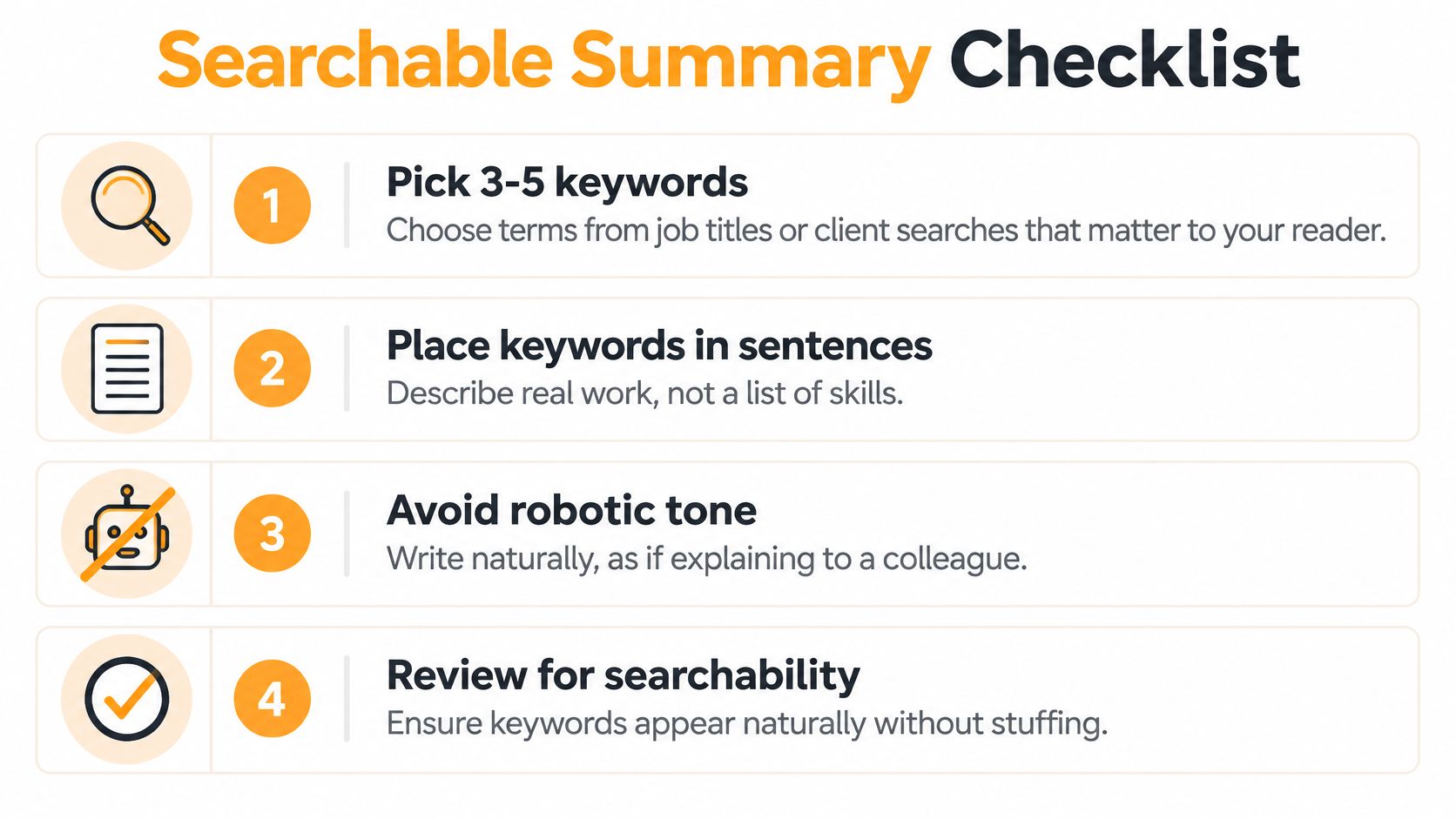
Choose role terms from relevant job descriptions or the language clients use for your service. Put those terms inside sentences about work you do, and keep your terminology consistent across your About, Experience, and Skills sections.
For example, a demand-generation specialist can describe building a campaign with sales rather than adding a detached string of marketing labels. The nexus IT group guide to the best words to put on a resume can help with action-oriented wording, while this guide to LinkedIn search optimization addresses the wider profile.
Use this checklist to keep the search work grounded in readable sentences.
Use AI for Editing, Not Evidence
AI can reorganize a rough draft, shorten repetition, and suggest clearer wording. It puts trust at risk when it supplies experience you never had, upgrades your title, or turns a shared achievement into an individual victory.
PPC Land's analysis of AI-generated LinkedIn posts concerns posts, not an experiment testing AI-written About sections. It doesn't establish a performance penalty for AI-assisted summaries. The practical standard here is verifiability, not whether a detector likes your writing.
Use AI to express your evidence more clearly, never to manufacture the evidence itself.
Supply your own stories and exact outcomes first. Reject additions you can't substantiate, preserve phrases you naturally use, and ask a colleague whether they recognize your voice after you've read the draft aloud.
For ordinary clarity editing, I'd prioritize accuracy and recognizable language over adding a disclosure label. If a client, employer, or publication requires disclosure, follow that requirement. Disclosure doesn't make fabricated expertise acceptable.
Before publishing, check:
- Relevant terms: Each describes work you want to keep doing.
- Natural sentences: You wouldn't feel awkward saying them to a colleague.
- Human ownership: You can explain and defend every claim.
For a deeper factual review, use the four-move quality check below.
Common Summary Problems and How to Fix Them
In a controlled study of 460 participants, profiles containing only basic information received lower hireability ratings, linked to reduced perceptions of trustworthiness, professionalism, warmth, and competence; a follow-up interview study also found that incomplete information increased suspicion, according to the Journal of Business and Psychology article.
That doesn't mean longer is always better. Completeness means enough relevant information to assess you, not a paragraph about every job.
Run a Four-Move Quality Check
- Map each claim: Connect it to a role, deliverable, or outcome you can explain.
- Establish scope and recency: Make clear where the work happened and whether it reflects your current capabilities.
- Reconcile the profile: Resolve contradictions between your summary, Experience, Skills, and Education.
- Remove unsupported judgments: Cut vague praise unless the next words provide evidence.
Preserve a signal of judgment or collaboration during the edit. Explaining how you resolved a handoff problem gives readers more useful information than a bare claim of leadership.
Diagnose Before Rewriting
Summary symptoms, causes and fixes
| Symptom | Likely Cause | Fix |
|---|---|---|
| Nobody views or reacts | Opening doesn't say who it's for | Rewrite the opening around one reader; check discovery separately |
| Reads like a résumé | Job titles and dates copied in | Lead with outcomes and keep history in Experience |
| Sounds generic | Adjectives such as passionate appear without proof | Replace each unsupported adjective with evidence |
| Sounds like AI | Polished language without specifics or personal voice | Add a real detail and an outcome you can substantiate |
| Shows up for the wrong searches | Keywords dropped in without context | Put relevant role terms inside evidence sentences |
| Feels too long | Summary retells the whole career | Keep the strongest proof points and cut unrelated history |
Treat these as diagnostic possibilities, not guaranteed explanations. Low profile visibility can involve more than your About section, and a quiet inbox doesn't prove your writing is poor.
Change the part connected to the problem. If unsuitable clients keep contacting you, tighten the service description and audience. If relevant recruiters visit but misunderstand your seniority, clarify your operating scope rather than adding more keywords.
Publish Your Summary This Week
Give yourself a week to publish, not a week to keep adjusting the opening. A usable summary lets you learn from actual conversations instead of guessing indefinitely.
Put the Work on Your Calendar
- Day one: Draft from your reader statement using the six-step sequence.
- Day two: Use the five-part table to identify anything missing, especially credible proof.
- Day three: Read aloud and remove wording you wouldn't use with a colleague.
- Day four: Align the summary with the rest of your profile.
- Day five: Ask a trusted colleague to flag confusing or overstated claims.
- Day six: Make the necessary corrections.
- Day seven: Publish.
If you're stuck at the blank-page stage, RedactAI offers a free LinkedIn Summary Generator with AI. Use it for a first draft, then check every claim against your own facts before anything goes live.
For broader consistency, use the guide to optimizing your LinkedIn profile while reviewing the surrounding sections. Set a reminder for a month after publication to review profile views, relevant messages, and whether the right people are contacting you.
If the audience is wrong, use the symptom table to choose a focused repair. Don't throw away accurate work because a single sentence needs adjusting. Today's action is simple: write your reader statement and book your publishing date.
RedactAI offers a free LinkedIn Summary Generator with AI to help you turn a blank About section into a workable draft. Visit RedactAI, draft for the reader you want to reach, and verify the wording before publishing this week.