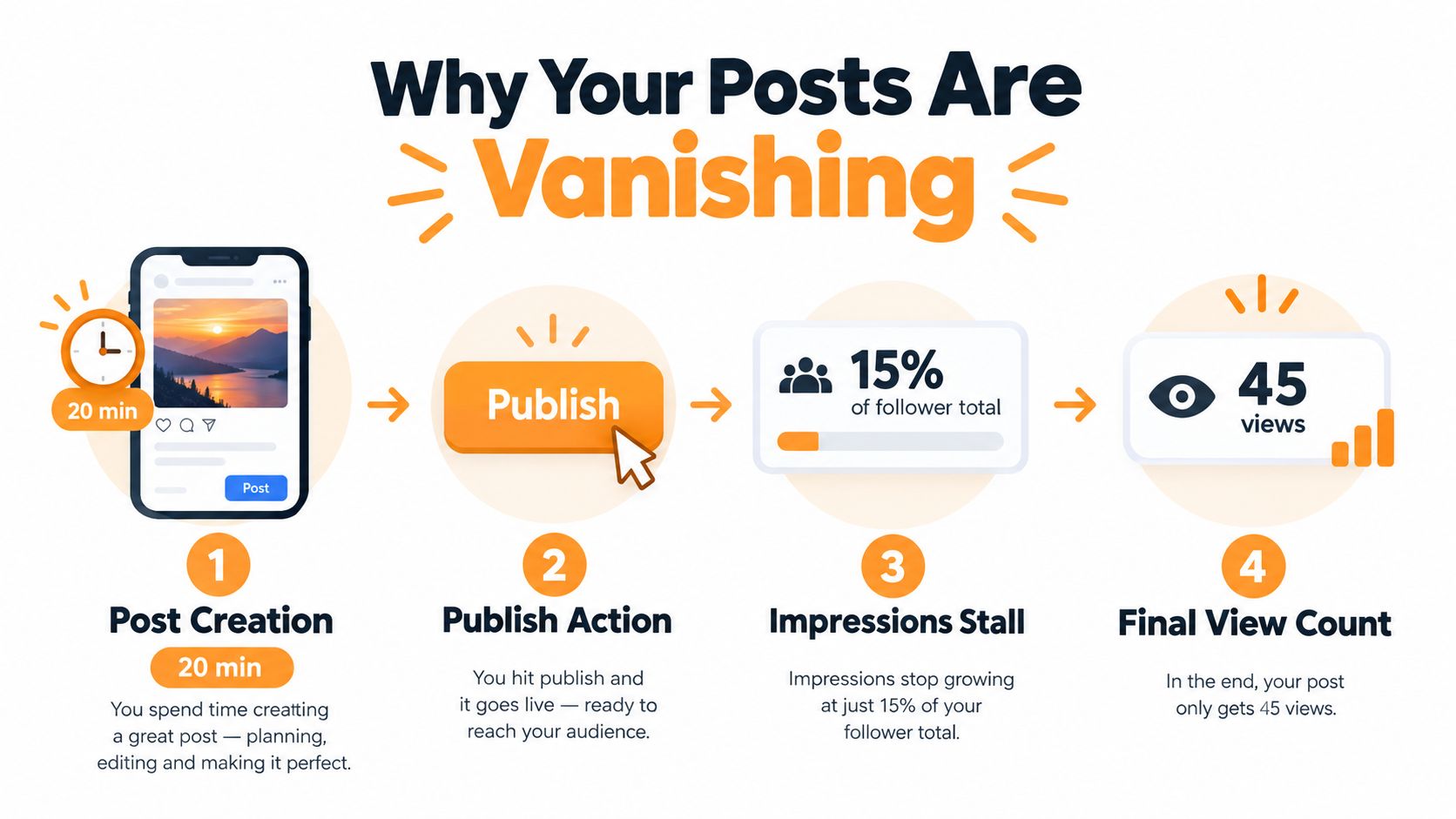
You spend twenty minutes shaping a useful LinkedIn post. The opening is clear, the lesson comes from real experience, and the final question invites discussion. You publish, refresh the page, and watch impressions stall far below your follower count.
That experience is frustrating, but it doesn't necessarily mean your content is weak. LinkedIn post visibility is a distribution problem as much as a writing problem. Your post must first be selected for a viewer, hold that viewer's attention, reach the right kind of person, and lead to a meaningful action.
Why Your Posts Are Vanishing
Consider a consultant who posts consistently about operational efficiency. The topics are relevant, the writing is polished, and the profile has a healthy professional network. Yet some posts appear to disappear almost immediately, while others continue circulating after the consultant has stopped checking the dashboard.
The mistake is assuming that every follower receives every post. LinkedIn is a global publishing environment, not a chronological inbox. The platform launched publicly on May 5, 2003, with around 2,500 users in its first week, surpassed 1 million users in August 2004, and passed 1 billion members in 2023 across more than 200 countries and territories. (LinkedIn's platform history)
| Year | Milestone |
|---|---|
| 2003 | LinkedIn launched publicly with around 2,500 users in its first week |
| 2004 | LinkedIn surpassed 1 million users |
| 2023 | LinkedIn passed 1 billion members across more than 200 countries and territories |
That scale gives each post more potential audiences, but it also makes selection unavoidable. A post can be surfaced through connections, followers, professional interests, and network activity. Your follower count matters, but it doesn't determine delivery.
Stop treating impressions as the whole story
A post with modest impressions may reach people who can hire you, recommend you, or start a valuable conversation. A post with broad exposure may attract viewers who have no connection to your work. Visibility isn't the same as reach, and reach isn't the same as business value.
That distinction is especially useful for founders and executives building a reputation around a narrow subject. A practical LinkedIn playbook for founders can help with positioning and consistency, but no playbook can guarantee that every follower sees every update.
Start by asking four questions:
- Distribution: How many people received the post?
- Attention: Did they stop, read, click, or continue quickly?
- Audience fit: Were they in the roles, industries, and markets you care about?
- Action: Did they visit your profile, follow you, message you, or take another meaningful step?
If you want a complementary guide to the mechanics behind improving exposure, this resource on how to increase post reach provides another useful perspective. The central lesson remains simple: don't diagnose a post from one number. Diagnose the path from publication to outcome.
How the LinkedIn Feed Ranks Posts
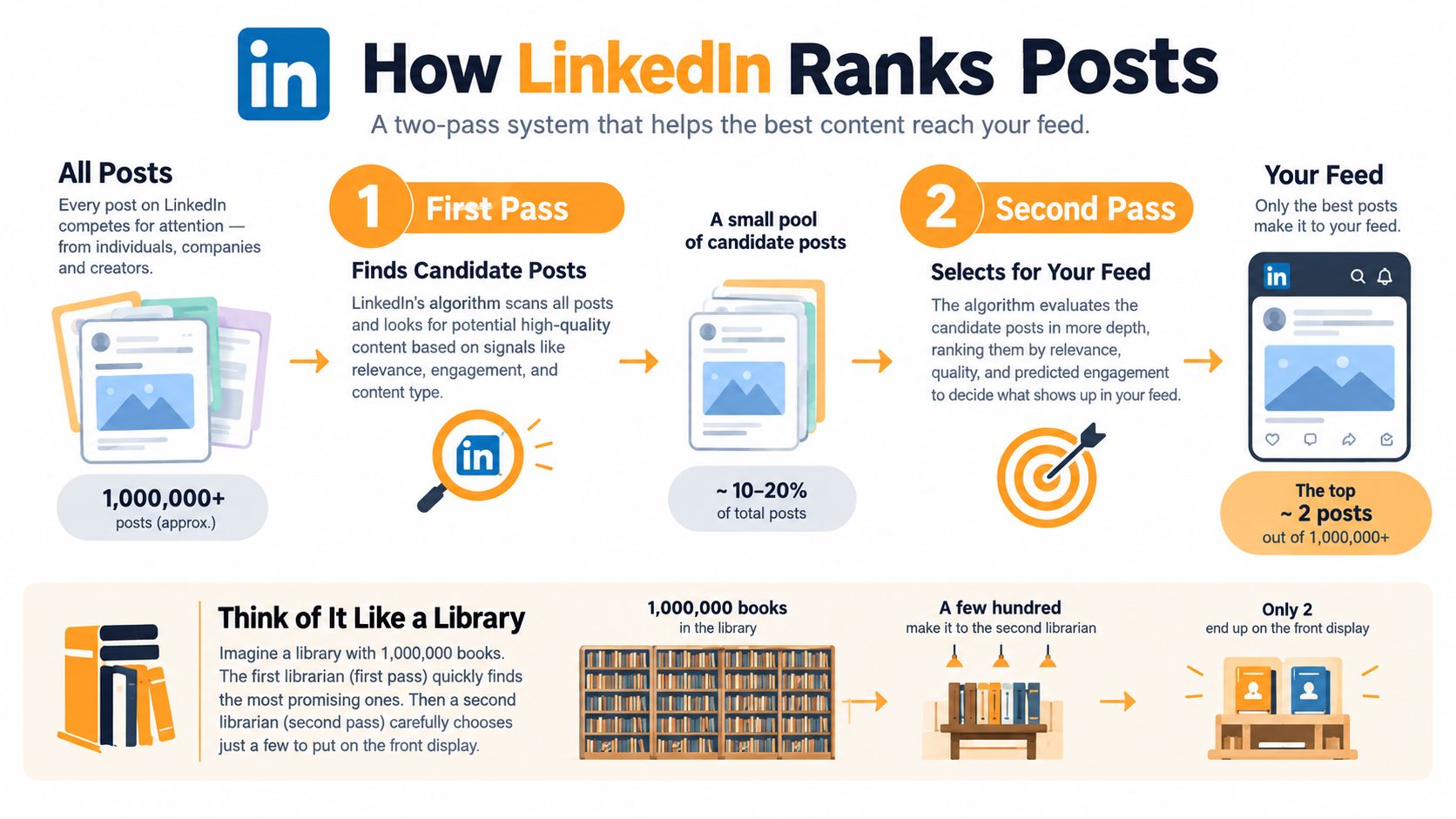
LinkedIn's feed has more eligible updates than any person can review. A selection process first identifies posts that may fit a viewer, then a ranking process orders those candidates for that specific feed. This two-stage approach explains why the same post can appear prominently for one professional and barely surface for another.
LinkedIn describes this system as a two-pass architecture. The first pass generates relevant candidates. The second evaluates and ranks them for an individual viewer, using signals connected to predicted value and attention. LinkedIn's engineering explanation of feed ranking
Pass one finds plausible candidates
Candidate generation asks which updates could matter to a particular person. The system can use professional interests, the viewer's relationship with the author, previous activity, and surrounding context.
Your post therefore competes within a wider professional network, not only among direct connections. An update about hiring might fit a recruiter, founder, job seeker, or executive who follows the subject without knowing the author personally. Candidate generation creates the pool. It does not guarantee prominent placement.
Pass two estimates value for this viewer
The ranking stage orders that pool according to several forms of feedback:
- Viewer-side value, or whether the update seems useful and relevant to the person viewing it.
- Passive signals, including clicks and dwell time.
- Active signals, such as comments and reshares.
- Network effects, including actions the post may prompt within the viewer's own network.
- Creator-side feedback, which helps the system assess how an author's content performs.
A reaction is only one visible outcome. Someone may read carefully, click through, or pause without leaving a public response. Dwell time gives the system a way to recognize that quieter form of attention.
Why the opening has technical importance
LinkedIn also describes a skip-prediction model. If the system expects a viewer to scroll past an update quickly, that expectation can work against its ranking. The first lines must therefore clarify the audience, problem, or payoff before the reader moves on.
“I've been thinking about leadership lately” gives little direction. “Most hiring delays begin before the first interview is scheduled” creates a specific information gap and signals who may benefit from reading. The goal is not to create artificial suspense. It is to make the post's relevance clear early.
Early distribution is a test, not necessarily the final result. An externally reported estimate suggests that posts may first reach roughly 8% to 12% of a creator's followers, with early reactions influencing whether distribution expands. This remains an estimate rather than an officially disclosed universal LinkedIn benchmark. An externally reported discussion of LinkedIn's feed behavior
A quiet start can therefore precede wider exposure. Read the feed as a four-layer process: distribution determines who receives the post, attention shows whether they stay with it, audience fit indicates whether the viewers matter, and action reveals whether visibility led somewhere useful. Impressions describe the first layer only.
The Four Signals That Decide Your Reach
A post can receive impressions without reaching the people who can use its idea. A clearer way to read visibility is through four signals: dwell time, engagement velocity, relevance, and relationship strength. Together, they describe whether distribution becomes attention, whether that attention reaches the right audience, and whether readers have a reason to respond.
Dwell time measures whether people stay with the post long enough to understand it. “Proud to announce our latest company milestone” is easy to skim because it gives readers little to investigate. A stronger opening explains the problem behind the milestone, the decision that changed the outcome, and the lesson another operator can apply. The structure creates a reason to continue reading.
Engagement velocity concerns the quality and timing of early interaction. It does not call for manufactured comments or messages to friends. If the first ten reactions come from people in your target role within the first hour, that is an early-response pattern worth examining and replicating. The useful question is why those readers recognized the topic as relevant.
Relevance connects the post to a specific viewer. “Marketing is changing” is broad enough for almost anyone and useful to almost nobody. “B2B demand teams are measuring branded search, sales conversations, and pipeline influence together” gives a defined professional group a reason to pay attention.
Relationship strength reflects the author's connection with the potential viewer. Someone who regularly reads your work may be more receptive to a new post than a stranger shown the same words. Follower count still affects the available audience, but it cannot show whether that audience is well matched.
The four signals work like a measurement funnel. Distribution tells you who received the post. Attention shows whether they stayed. Audience fit indicates whether those viewers matter to your goal. Action reveals whether visibility led to a reply, profile visit, conversation, or another useful step. Impressions cover only the first layer.
| Signal | What it measures | What triggers it |
|---|---|---|
| Dwell time | Whether readers stay with the post | A specific problem, useful structure, and an opening that earns attention |
| Engagement velocity | How quickly relevant interaction begins | A timely insight, clear point of view, or focused question |
| Relevance | Whether the topic fits the viewer | Concrete language tied to a role, industry, or professional problem |
| Relationship strength | How connected the author is to the viewer | Consistent expertise, meaningful interaction, and a recognizable subject area |
Use the table to diagnose the weak layer rather than chase a larger impression count. A post with attention but poor audience fit may be interesting to the wrong people. A well-matched post with no action may need a clearer question or next step.
Before publishing, read the draft from the viewer's position. Does the first line give the right audience a reason to continue? Can that audience identify itself quickly? Is the question precise enough to invite a real answer? If the only planned trigger is “please comment,” strengthen the idea first.
Timing, Format, and Cadence That Move the Needle
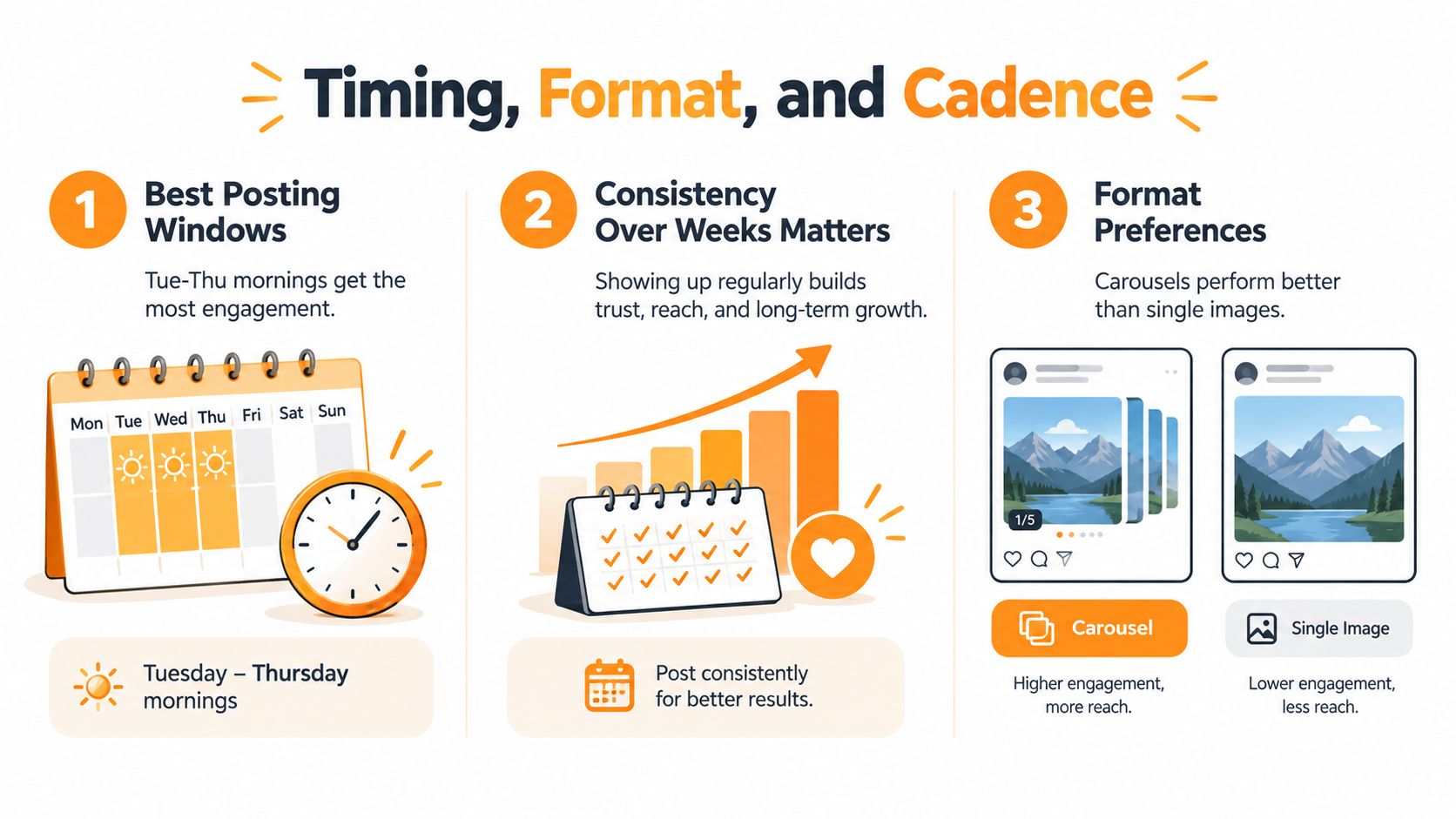
A strong post can disappear when it meets an inactive audience, while an average post may gain early attention in a busy feed. Timing helps distribution, but it cannot repair weak relevance or a poor opening. Tuesday through Thursday mornings in the viewer's local time zone are sensible starting windows for many professional audiences. Use them as test conditions, not fixed rules.
Cadence matters because it creates comparable observations. A publishing rhythm you can maintain over several weeks helps separate a repeatable pattern from an isolated result. One successful time slot cannot show whether the outcome came from the topic, format, opening, audience fit, or timing.
Match the format to the job
Choose the format based on the work the post must do. Short text posts suit a sharp observation or compact framework. Carousels support step-by-step teaching because each panel gives the reader a reason to continue. Native video can show presence or demonstrate a process, though it takes more preparation. Polls collect opinions when the question is narrow enough to produce useful responses. Articles support deeper explanations, but ask for more time from the reader.
Use different types of LinkedIn content to build a varied format mix rather than forcing every idea into one template. LinkedIn's native analytics let you compare performance by format, so use the table below to choose your first two tests.
| Format | Useful when | Watch for |
|---|---|---|
| Text post | You have a clear idea or professional observation | A weak opening makes the post easy to skip |
| Carousel | The reader benefits from progression or a framework | Production effort may exceed the value of a simple idea |
| Native video | Demonstration, explanation, or personal delivery matters | The opening moments still need a clear promise |
| Poll | You want focused responses from a defined audience | Broad questions often produce shallow learning |
| Article | The subject needs sustained context | Length alone does not create attention |
A broken posting rhythm usually signals a workflow problem. A practical guide to fix sporadic social media posting can help you create a repeatable process, so timing tests do not depend on last-minute effort.
Reusing a strong idea can work when you add a new angle, example, or conclusion. Compare the revised post with the original, then judge more than impressions. Ask whether the new version improved distribution, held attention, reached the intended audience, or prompted a useful action. Revisit the underlying problem, and make each post useful on its own.
A Better Way to Measure Whether You Are Actually Being Seen
A visibility dashboard becomes more useful when you separate four layers: distribution, attention, audience fit, and action. This model prevents a common mistake, treating every impression as equally valuable.
Layer one is distribution
Distribution includes impressions and unique viewers. It tells you how widely LinkedIn delivered the post, but not whether the audience was commercially relevant or strongly interested. A broad result can be useful for awareness, but it isn't proof that the post reached the people you wanted.
Layer two is attention
Attention asks what viewers did after receiving the post. Clicks and reading behavior offer more context than exposure alone. A post can receive many impressions but little sustained attention if the opening is vague or the structure is difficult to follow.
LinkedIn's documented use of dwell time makes this layer important. A reader who doesn't react may still spend time understanding a framework, comparing it with their experience, or deciding whether to visit the author's profile.
Layer three is audience fit
Audience fit examines the people behind the exposure. Consider job function, seniority, geography, and industry. A recruiter may value visibility among hiring leaders more than visibility among a general professional audience. A consultant serving a specialized market may prefer a smaller, concentrated audience to a large group with no buying authority.
LinkedIn's analytics guidance supports comparing audience characteristics rather than stopping at raw impressions, but its public guidance doesn't fully connect exposure with business outcomes. (LinkedIn's analytics topic guidance)
Layer four is action
Action includes profile visits, follows, messages, applications, or qualified leads. The right action depends on your purpose. An executive building authority may prioritize relevant profile visits and follows. A recruiter may look for applications or conversations. A sales professional may care about messages from qualified accounts.
Practical rule: A smaller post can outperform a viral post when its audience is more relevant and its next action is stronger.
To score your last five posts, record the distribution result, note the signs of attention, inspect the available audience characteristics, and write down the actions that followed. You don't need a universal benchmark to begin. You need a consistent way to compare your own content.
Reading Your Analytics Like an Operator, Not a Gambler
A post can attract thousands of impressions and still reach few people who matter to your work. Another can draw less exposure yet produce a relevant profile visit or inquiry. An operator studies that difference instead of treating the largest number as a win.
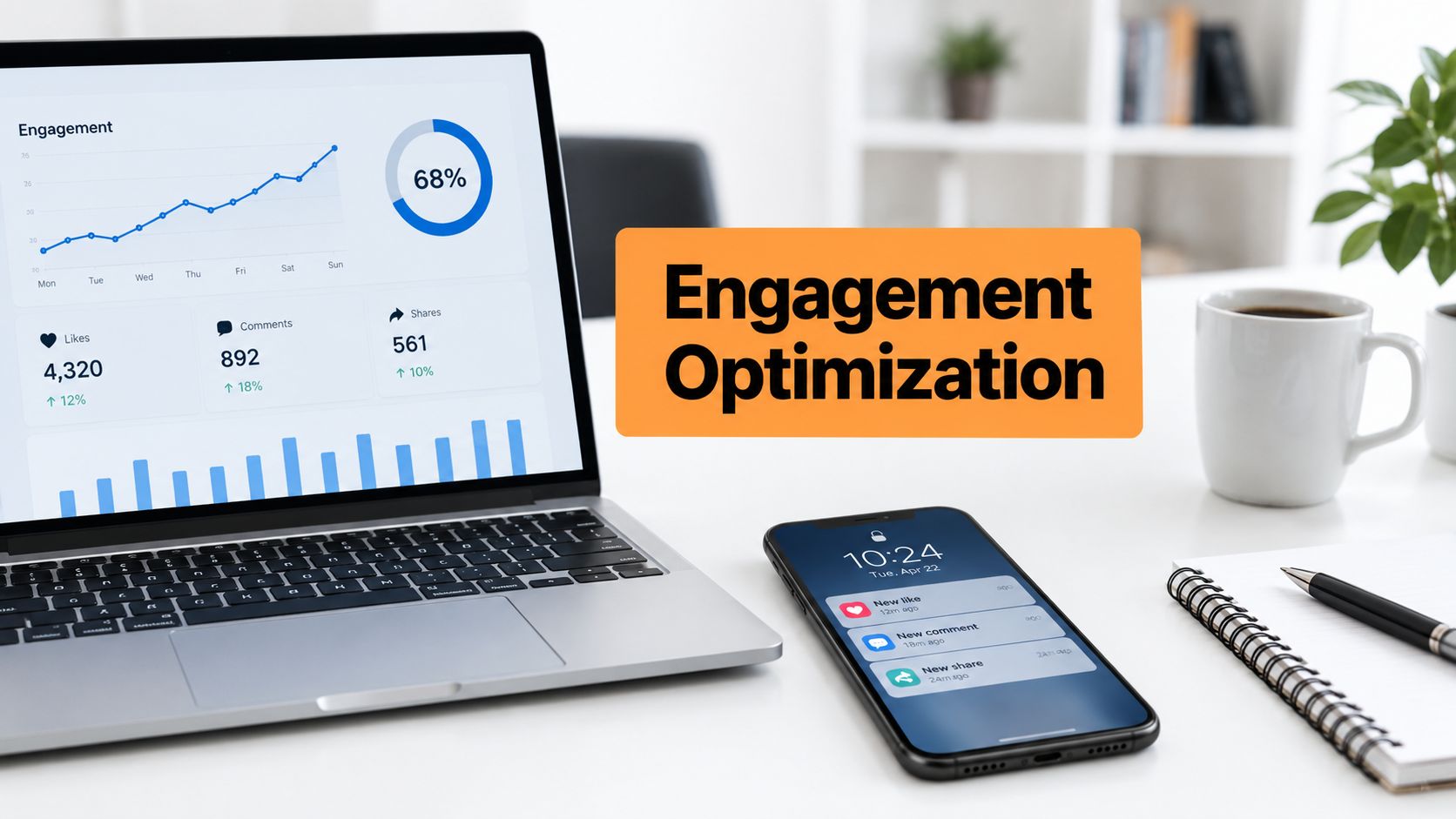
LinkedIn's creator views provide two useful lenses. Post analytics compares performance across content formats, while audience analytics shows follower growth and follower demographics. Read them together to see whether distribution reached the intended market or only expanded beyond it. Use this LinkedIn analytics guide to set up a consistent review process.
Review one entry at a time
Start with a completed log entry, not an empty template:
| Format | Topic | Hook | Time | Impressions | Result |
|---|---|---|---|---|---|
| Text post | Pricing objections | “Most proposals die in the second call” | Tue 08:40 | 2,100 | 3 profile visits, 1 inquiry |
That row gives you something to investigate. The impressions show distribution. The profile visits and inquiry show whether the post created a useful next step. Add reactions, comments, reposts, follower change, audience details, and any other outcome that fits your goal. Record the quality of comments, not only their count. A thoughtful response from a prospective buyer carries a different meaning from a brief reaction by an unrelated viewer.
A second post might receive wider distribution but attract people outside your target industry. Its opening may have generated attention while its subject failed to match the audience. A post with fewer impressions may bring profile visits from the seniority, function, or geography you serve. That is a stronger signal if your objective is qualified conversations rather than general awareness.
Use the log as an operating record. After each review, write one decision: repeat the topic, revise the opening, change the format, or stop pursuing the angle. Keep the decision tied to the next test, so analytics leads to a specific action rather than a vague judgment.
For shared terminology, Spark's guide to i KPI più utilizzati per il marketing provides broader context. LinkedIn metrics still need platform-specific interpretation. Compare several posts with similar goals, because personalization and audience composition affect the available distribution pool. One unusually strong result is evidence for another test, not a permanent benchmark.
Common Myths and a 30-Day Visibility Experiment
Myth one, posting at exactly 9 a.m. guarantees virality. A consistent morning window can make testing easier, but the feed ranks posts for individual viewers. Timing is one input, not a guarantee.
Myth two, LinkedIn always punishes external links. The available evidence doesn't establish a universal rule that every external link receives a fixed penalty. What you can test is whether the link changes attention, relevance, or action for your specific audience. Make the post valuable without requiring an immediate click, and measure what happens.
Myth three, more followers automatically means more reach. Follower count expands the possible starting audience, but distribution also depends on relevance, early response, relationship signals, and predicted attention. The externally reported test-audience estimate discussed earlier should be treated as an estimate, not a platform-wide promise.
Advice about LinkedIn often comes from marketing or software vendors, so it's difficult to separate confirmed platform behavior from anecdotal optimization advice. Track a rolling personal median and test one variable at a time rather than treating every fluctuation as an algorithm penalty. (Discussion of uncertainty in LinkedIn optimization advice)
Run the experiment
Choose one topic pillar, two formats, and a fixed weekly cadence. For each post, log the hook, timing, distribution, attention signals, audience fit, and action. At the end of the experiment, compare the posts using the four-layer model rather than selecting the winner by impressions alone.
You can start in the next ten minutes. Pick the topic your ideal audience already asks about, write one specific opening line, choose your first format, and add the post to your publishing log. A month later, you'll have evidence about your own audience and content, not another borrowed hack.
Visibility isn't a slot machine. It's a system you can observe, test, and improve.
RedactAI helps professionals turn their own LinkedIn profile, writing style, and post history into personalized drafts, while supporting idea generation, scheduling, content recycling, and performance tracking. Visit RedactAI to build a more consistent publishing workflow and connect content creation with the visibility signals that matter.