Posting every day won't automatically win a consultant better clients. It may increase exposure, but exposure isn't the same as trust, and trust isn't the same as pipeline. A high-value buyer doesn't hire you because your motivational post received attention. They hire you because your public thinking makes your judgment visible, relevant, and credible.
That's the opportunity in personal branding for consultants. Your brand should make it easier for the right people to understand which problem you solve, how you solve it, and why they should believe you. The strongest approach starts with positioning, turns expertise into useful content, and measures whether that activity creates better conversations, referrals, and opportunities.
Why Most Consultant Branding Advice Fails
The “post every day” formula is attractive because it's simple. It gives consultants a visible task, a publishing target, and a stream of numbers to check. But daily posting can produce a feed full of generic encouragement, recycled frameworks, and opinions detached from actual client work.
That approach may suit someone building a mass audience. Consultants usually need something more precise. They need decision-makers with a specific commercial problem to recognize themselves in the content and trust the person offering to help solve it.
Personal branding became a modern business idea in 1997, when Tom Peters argued that professionals should be perceived as more than a collection of skills attached to an employer, as described in this background on strategic personal branding. For consultants, the implication is practical. Your title, agency name, and résumé may establish context, but your differentiated point of view creates preference.
Practical rule: Don't publish to prove that you're active. Publish to prove that you understand an expensive problem.
Visibility without evidence creates the wrong signal
Generic content fails in three ways:
- It attracts broad attention: Large audiences can include very few potential buyers.
- It makes weak claims: Saying you're strategic, experienced, or results-oriented doesn't demonstrate those qualities.
- It trains buyers to expect free advice: Constant tips without a clear commercial point can position you as a source of information rather than a trusted adviser.
LinkedIn's guidance for thought leaders emphasizes real stories and intentional use of strengths, while the broader research cited alongside it reports that 73% of B2B decision-makers trust thought leadership more than marketing materials. The same source reports that 75% say thought leadership can prompt them to investigate an offer they hadn't previously considered. See the guidance on building a personal brand as a thought leader.
The lesson isn't to chase thought-leadership status. It's to replace unsupported self-promotion with specific problem framing, first-party lessons, and evidence-backed opinions. Consultants who want to win clients with personal branding should treat content as a trust-building system, not a volume contest.
Defining Your Consulting Positioning
Your positioning determines whether people remember you for a useful reason. If your audience can't quickly connect your expertise to a problem they're already trying to solve, more content won't fix the issue.

Start with an evidence audit
Review your previous projects, proposals, testimonials, difficult client conversations, and work you completed faster or more confidently than peers. Look for recurring patterns:
- Which problems kept appearing?
- Which buyers understood your value fastest?
- Where did clients ask for your opinion before asking for execution?
- Which part of your work produced the clearest business outcome?
- What do former clients describe when they recommend you?
Don't choose a niche because it sounds fashionable. Choose a useful intersection between your strongest evidence, a recognizable buyer, and a painful problem.
“I help businesses grow” is too broad to guide a buyer. It doesn't identify the business, the growth constraint, or your method. “I help SaaS companies reduce churn by fixing onboarding flows” gives the reader a clear customer, problem, and area of intervention.
Make the statement narrow enough to matter
A reliable positioning formula is:
I help [specific client] solve [specific problem] through [distinct approach].
You can make it more outcome-oriented:
I help [specific client] achieve [business outcome] without [common trade-off], using [methodology].
Weak examples sound interchangeable:
- “I'm a strategy consultant for ambitious companies.”
- “I help leaders achieve growth.”
- “I advise organizations on transformation.”
Stronger versions create a buying context:
- “I help founder-led professional-services firms turn inconsistent referrals into a repeatable commercial process.”
- “I help operations teams remove delivery bottlenecks before they invest in new systems.”
- “I help B2B marketing teams turn technical expertise into buyer-focused thought leadership.”
The stronger statement doesn't need to claim that you're the only person who can do the work. It needs to make your relevance obvious.
Test before you announce
Send your draft to former clients, referral partners, and people who match your intended buyer. Ask them what problem they think you solve, what words they'd use to describe your method, and whether the statement sounds specific enough to remember. Pay attention to the language they use, because positioning often improves when you replace internal jargon with the buyer's vocabulary.
Keep a simple test record:
| Question | Useful signal |
|---|---|
| Does the reader identify the target client? | They name the right industry, role, or company type |
| Is the problem recognizable? | They connect it to a current priority |
| Is your method distinct? | They can explain how your approach differs |
| Does it invite a conversation? | They ask about process, timing, or fit |
Your final statement can evolve. Public positioning isn't a permanent prison. It's a clear hypothesis about where your expertise creates the most value, refined through real market conversations.
Optimizing Your LinkedIn Profile for Inbound
A LinkedIn profile shouldn't read like an employment archive. It should function as a conversion page for people who are deciding whether your expertise is relevant enough to explore.
Start with the headline. A generic version such as “Independent Consultant | Strategy | Leadership | Growth” uses valuable space without giving a buyer a reason to contact you. A sharper version connects audience, problem, and outcome:
I help B2B founders improve sales execution when growth has outpaced their process.
Or:
Operations adviser for scaling services firms, focused on delivery capacity and margin discipline.
The headline doesn't need to explain everything. It needs to earn the next click.
Prioritize the sections buyers scan
Your About section should answer four questions in a natural sequence:
- Who do you help?
- What problem do you help them address?
- How do you approach the work?
- What should a qualified reader do next?
Write in the first person, use short paragraphs, and replace abstract claims with recognizable situations. “I work with teams dealing with unclear ownership, missed handoffs, and stalled decisions” is more useful than “I provide transformational leadership.”
The Featured section should contain proof, not decoration. Add a strong case-study article, a practical framework, a webinar, a relevant interview, or a post that shows how you think. Choose items that help the buyer evaluate your judgment before a sales call.
For more profile-specific guidance, compare your changes with this LinkedIn profile optimization guide, and use Taja AI's LinkedIn insights to think about how your profile and publishing strategy work together.
Use credibility signals carefully
Your banner should reinforce your positioning with a simple phrase, not a collage of services. Recommendations are more persuasive when you ask a former client to describe the problem, your contribution, and the value of the outcome rather than requesting a vague endorsement.
A useful before-and-after test looks like this:
| Profile element | Generic version | Inbound-oriented version |
|---|---|---|
| Headline | “Business consultant and adviser” | “I help B2B founders fix sales execution gaps” |
| About section | Career summary | Buyer problem, method, proof, next step |
| Featured section | Random activity | Selected evidence of relevant thinking |
| Experience | Duties and titles | Problems addressed and decisions influenced |
Check your public activity settings as well. A buyer may review your recent posts and comments before reaching out. Your visible activity should support the position you want to own.
Building a Sustainable Content Strategy
A consultant's content strategy should be small enough to maintain and specific enough to create recognition. Choose one primary format first, such as a case-study post, short video, or insight thread. Executive video posts on LinkedIn have been reported to generate 1.4× more engagement than text-only updates in executive-branding coverage, but the right format is still the one you can use consistently without weakening the substance. Review the executive personal branding research for the broader benchmark.

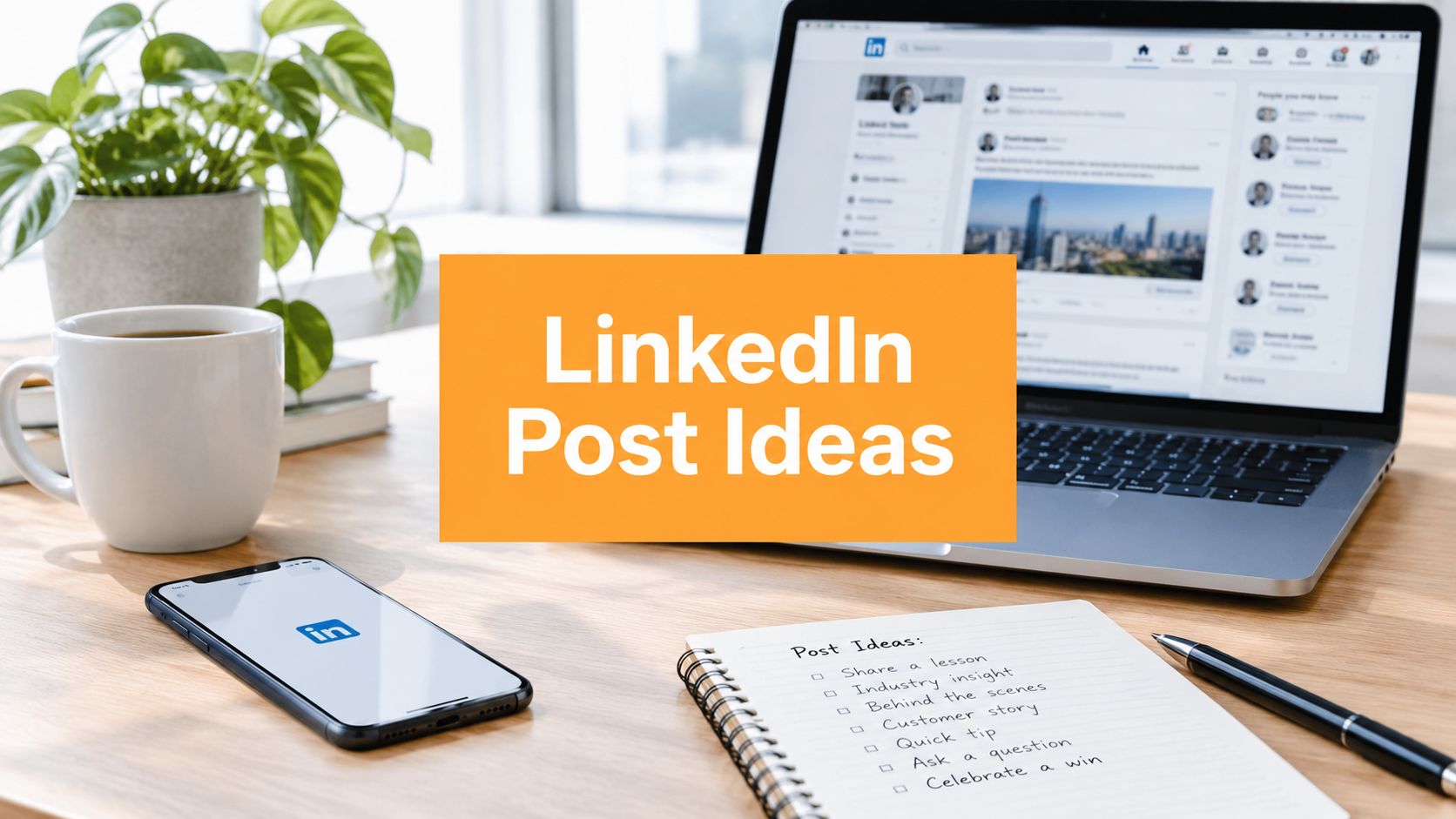
Use three dependable post types
Case-study breakdowns show judgment. Protect confidentiality, remove identifying details, and focus on the reasoning.
“The client didn't need another dashboard. They needed agreement on which decisions the dashboard was supposed to support.”
Explain the initial problem, the diagnostic step, the trade-off, and the lesson. Don't turn every post into a victory lap. A thoughtful explanation of what didn't work at first can build more trust than a polished success story.
Contrarian industry takes make your point of view visible. A useful contrarian hook challenges a familiar assumption without manufacturing outrage:
“More sales activity won't solve a positioning problem. It usually creates more conversations with the wrong buyers.”
Then support the opinion with observations from your work, a clear qualification, and a practical alternative. Strong disagreement earns attention only when the reasoning earns respect.
Tactical how-to insights let the reader experience your method. Give them a specific diagnostic question, meeting structure, prioritization test, or decision checklist. Avoid giving away an entire engagement. Show enough of the process that the reader can see why expert implementation still matters.
Choose a cadence your workload can support
There's no business reason to publish daily if daily output forces you into generic material. A selective, high-signal cadence is often a better fit for consultants who have client work, proposal writing, and delivery responsibilities. Personal-profile content has also been reported to outperform company-page content by 5× to 10× in engagement and visibility, which makes your personal profile the practical distribution channel for this work. That benchmark appears in the Richardson Search coverage linked above.
Batch the work. Keep a note on your phone or in Notion with client questions, surprising objections, decision mistakes, useful phrases, and frameworks you used during delivery. Once a week, turn one note into a draft, then edit for clarity and proof.
Track which hooks create qualified conversations, not just reactions. If a post receives attention but no relevant profile views, direct messages, referrals, or invitations, treat it as a writing signal rather than a commercial success.
Repurposing Expertise Without Burning Out
Consultants don't usually lack ideas. They fail to capture the ideas already produced during client work. A difficult workshop, diagnostic call, proposal, or implementation review contains the raw material for several useful pieces of content, provided you protect confidentiality and remove client-identifying details.
Use a “one insight, many expressions” system. Start with one durable idea, then change the format and audience context rather than copying the same paragraph everywhere.
Extract the central insight
Suppose your underlying insight is: growth problems often come from unclear decision ownership, not insufficient effort. From that single idea, you could create:
- A LinkedIn post describing the symptom and the diagnostic question.
- A short video explaining how unclear ownership slows execution.
- A carousel showing the difference between responsibility and decision rights.
- A newsletter essay exploring the leadership trade-off.
- A private follow-up message to a prospect who mentioned stalled initiatives.
The message stays consistent, but each version performs a different job. The post creates recognition, the video makes your explanation personal, the carousel makes the framework easy to save, and the newsletter gives the idea room to develop.
Document the work while it's fresh
After a client session, capture five notes:
- What problem did the client think they had?
- What did the evidence suggest instead?
- Which question changed the conversation?
- What trade-off did the team face?
- What should another practitioner notice?
These notes become a content bank without requiring a separate research project. You're not exposing confidential information. You're explaining your method at the level of patterns, decisions, and lessons.
The fear of repeating yourself is understandable, but repetition is how markets associate your name with a specific problem. Repetition becomes boring when the wording and insight never change. It becomes authority when you revisit the same core idea through different examples, objections, and practical applications.
For a deeper operational explanation, see this guide to what content repurposing means. The useful standard is simple: every repurposed asset should add a new angle, not merely occupy another channel.
Measuring What Actually Matters
Likes and followers are distribution signals. They can tell you whether a message traveled, but they can't prove that the right buyers trust your judgment. A consultant needs a measurement system that connects public expertise to private commercial movement.
Thought leadership matters partly because buyers who never comment can still influence a decision. Edelman and LinkedIn's 2025 study surveyed 1,934 global executives and found that thought leadership can build trust, align buyers, and reach silent influencers who affect decisions without appearing in the visible sales process. The 2025 client perceptions research addresses this buying dynamic.

Separate reach from trust
Reach metrics can still help with diagnosis:
- Impressions: Did the platform distribute the post?
- Profile visits: Did the message create enough curiosity to prompt evaluation?
- Follower growth: Are more people choosing to receive your future ideas?
Trust and pipeline indicators carry more commercial weight:
- Inbound inquiry quality: Did the person have the problem and authority your positioning targets?
- Referral source attribution: Did someone mention a post, profile, talk, or recommendation?
- Consultation requests: Are readers moving toward a buying conversation?
- Speaking invitations: Are organizers associating you with a defined subject?
- Partnership requests: Do complementary professionals see a credible reason to work with you?
Industry reporting also notes that personal profiles can outperform company pages by 5× to 10×, but that doesn't mean every high-performing post deserves more investment. A post that reaches fewer people yet produces a serious inquiry may be more valuable than a widely shared observation.
Build a lightweight attribution habit
Add one question to every inquiry form and first call: “What prompted you to reach out?” Record the exact answer in your CRM, spreadsheet, or project-management tool. Use source categories such as LinkedIn post, referral, event, search, partnership, or unknown.
Review the data monthly. Look for recurring topics in qualified inquiries, not isolated spikes. Also record qualitative evidence, including a prospect quoting your framework, a referral partner forwarding a post, or a buyer arriving with a clear understanding of your approach.
The global personal branding services market was valued at USD 720 million in 2025 and is projected to reach USD 1.4 billion by 2034, with a projected 7.7% compound annual growth rate, according to this personal branding services market report. That commercial growth reinforces the need for consultants to prove value. If buyers are paying for expertise packaging, visibility, and trust, your own measurement should focus on whether those assets improve the quality of opportunity reaching you.
For practical analytics workflows, use this resource on how to measure content performance. Don't expect every result to appear immediately. Brand effects can be delayed, indirect, and visible first through language, referrals, and invitations rather than a clean last-click conversion.
Your 90-Day Implementation Roadmap
A consultant I'd advise to start with a narrow positioning statement should resist the urge to redesign everything at once. The practical sequence is less dramatic and more effective.

Days 1 to 30
Audit past work, choose a narrow buyer and problem, write your positioning statement, and update your LinkedIn headline and About section. Select proof for the Featured section. Draft cornerstone posts that demonstrate your method, not your ambition.
Days 31 to 60
Publish consistently at a pace you can maintain. Rotate case-study breakdowns, contrarian opinions, and tactical explanations. Comment where your target buyers and referral partners already pay attention, but prioritize useful observations over visibility theatre. Start recording inquiry sources and the topics that prompt meaningful replies.
Days 61 to 90
Review which subjects attract qualified conversations, profile visits from relevant people, referrals, speaking invitations, and partnerships. Keep the strongest themes, rewrite weak hooks, and remove content that attracts attention from the wrong audience. If traction is limited, change the specificity of the problem before changing your entire brand.
Perfectionism will delay the launch, inconsistency will weaken recognition, and premature abandonment will hide the compounding effect of good work. Give the system enough time to produce evidence, then refine it using pipeline quality and trust signals rather than likes alone.
RedactAI helps consultants turn their own LinkedIn profile, posting history, and experiences into drafts that match their voice, while providing content ideas, post formatting, scheduling, and performance insights. Visit RedactAI to create a more consistent publishing workflow without replacing the first-party expertise that makes your brand credible.