The biggest hashtag isn't automatically the best hashtag. A broad tag can expose a post to a large professional audience, but it can also bury a specific idea among unrelated content. A niche tag may attract fewer viewers, yet those viewers can be much closer to the conversation, role, or problem you want to reach.
That's why a useful LinkedIn hashtags list shouldn't be a random collection of popular terms. It should help you choose tags according to the post's purpose, discovery source, and intended audience. A founder sharing a product lesson needs a different mix from a recruiter promoting an open role or a demand generation manager explaining a campaign.
The practical approach is simple. Pick a small, relevant set, pair it with one clear publishing goal, record the combination, and review the pattern before using it again. LinkedIn hashtagged posts still show strong visibility signals, but the available evidence points toward precision rather than volume. The following ideas organize hashtag research by where the insight comes from, from LinkedIn's own recommendations to community discussions and analytics platforms.
1. LinkedIn Official Hashtag Recommendations
LinkedIn's native recommendations are the quickest place to start because they appear inside the publishing environment where you're already writing. Use them as a relevance filter, not as an instruction to add every suggestion. The platform can surface tags connected to your profile, industry, and draft topic, which makes the feature useful when you're writing about a subject that sits between two professional categories.
Suppose you're publishing a post about a new hiring process. LinkedIn might point you toward broad career or entrepreneurship topics, alongside more specific territory such as HR leadership or talent acquisition. For a marketing post, a suggestion related to marketing technology may be more useful than a generic marketing label if the copy discusses tools, workflows, or measurement.
A practical starting range is one to five highly relevant hashtags per post, with one to three often treated as the strongest engagement sweet spot in independent 2026 analysis from ConnectSafely's LinkedIn hashtag research. Don't treat that range as a universal formula. Your post's subject and audience still matter more than filling a quota.
Use recommendations as a publishing decision
Before adding a suggested tag, ask:
- Does it describe the post's central idea? Remove suggestions that merely appear because they're adjacent to your industry.
- Would the intended reader recognize the topic? A precise professional phrase is often more useful than a vague popularity signal.
- Can you explain why it belongs there? If you can't connect the tag to a sentence in the post, leave it out.
You can also review LinkedIn-focused writing guidance in RedactAI's LinkedIn posts best practices. Save the suggestions that repeatedly fit your content pillars, then rotate them instead of copying the same group onto every post.
Practical rule: Let LinkedIn suggest the vocabulary, but let the post's purpose make the final decision.
2. Semrush LinkedIn Hashtag Database
Semrush is most useful after LinkedIn has produced several plausible tags. Use its database to compare demand, visibility, and audience fit, then make a publishing choice based on the post's purpose. A popular tag can widen discovery while attracting less relevant readers. A narrower tag may limit reach but better match the people you want to attract.
Start with the phrase that states the post's subject. Compare broad, industry, and intent-focused alternatives. An executive career-transition post may suit #CareerDevelopment more closely than #JobSearch. A B2B campaign analysis may fit #DemandGeneration and #B2BMarketing better than the broader #DigitalMarketing.
Use the database to build a small test group rather than importing a long bundle. Research examining 673,658 posts from 63,108 accounts found that posts with at least one hashtag recorded 85% more impressions than the platform average. Interaction gains were approximately 88% on Company Pages and 85% on Personal Profiles. Engagement-rate differences remained modest, so hashtags are better treated as visibility aids than as a replacement for useful content. The SAGE study of LinkedIn hashtag performance explains the methodology.
Build and measure three-tag combinations
Choose one broad tag, one industry tag, and one intent tag:
- B2B marketing post: #B2BMarketing, #DemandGeneration, #ContentStrategy
- Executive career post: #CareerDevelopment, #Leadership, #PersonalBrand
- Founder lesson: #Entrepreneurship, #StartupLife, #BusinessStrategy
Keep the same combination for comparable posts in the same content pillar, then test a different group. Record the date, format, audience, and exact tags. Compare posts with similar intent, not one unusually strong publication. RedactAI's advice on increasing LinkedIn post reach also supports evaluating the surrounding content, not hashtags alone.
3. Buffer's LinkedIn Hashtag Research Tool
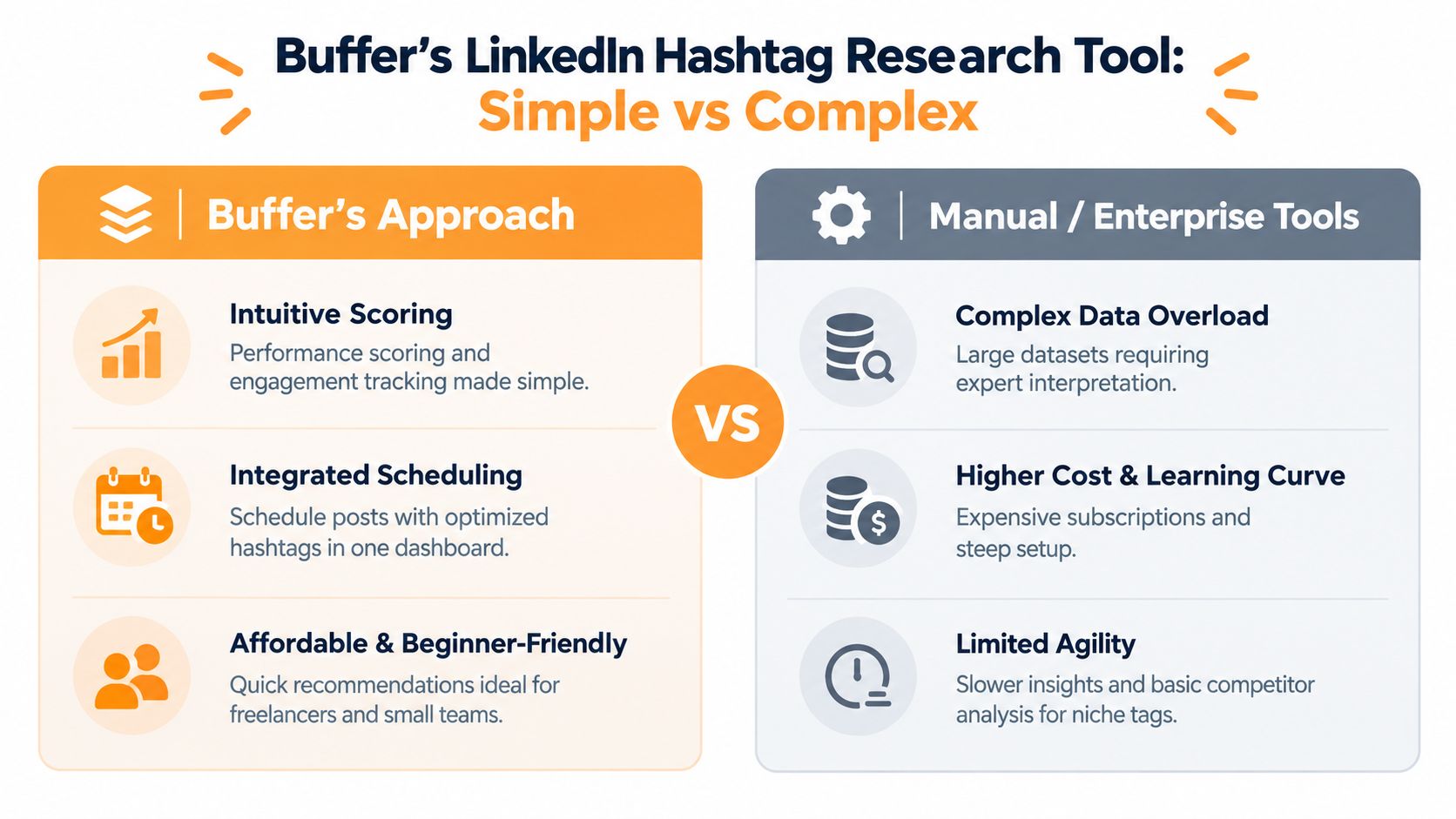
Buffer suits publishers who need a quick shortlist, not an enterprise research workflow. Use its suggestions as candidates, then make the publishing decision from your post's subject, audience, and intended action.
Start with the narrowest accurate description of the post. An executive management lesson could pair #Leadership with #TeamBuilding and #Management. A distributed-work post might use #RemoteWork, #FutureOfWork, and #WorkplaceCulture. Broad tags can extend discovery, while focused tags help filter for readers who understand the topic.
A ranking is only a prompt. If a suggested hashtag loosely matches the copy, it may attract impressions from people unlikely to read or respond. A narrower tag can produce less reach but more relevant comments, profile visits, and follows. Choose the combination that matches the publishing goal, then keep the test controlled.
Test one publishing variable at a time
Use a small set for each content type:
- Leadership lesson: #Leadership, #Management, #LeadershipDevelopment
- Technology hiring post: #Technology, #TechJobs, #TalentAcquisition
- Remote work discussion: #RemoteWork, #FutureOfWork, #WorkplaceCulture
Keep the topic, format, and audience comparable across several publishing cycles. Change one hashtag where possible, and record the exact combination. Compare impressions with interactions, profile activity, and comment relevance. A tag earns a place in the mix when it supports the intended audience, not merely because it creates attention.
4. Industry-Specific Hashtag Collections in LinkedIn Groups
Professional groups expose vocabulary that broad hashtag databases often miss. Use their discussions as a listening source, then decide whether the language fits your own audience and publishing goal. A term that signals expertise inside a niche may be less useful on a broad employer-brand post.
Start with the community's wording:
- Marketing: #B2BMarketing, #ContentMarketing, #MarketingAutomation
- HR: #TalentAcquisition, #EmployeeEngagement, #HRTech
- Startups: #StartupLife, #Founders, #TechInnovation
- Sales: #SalesLeadership, #BusinessDevelopment, #SalesStrategy
These combinations are research inputs, not fixed recipes. A marketing group may use a technical phrase that improves relevance for practitioners but limits discovery beyond that community. A broader tag may attract more impressions while producing fewer qualified responses.
Turn group language into a testable mix
Read several relevant conversations before recording a hashtag. Check whether the surrounding posts address the same subject, and distinguish thoughtful usage from a term repeated mechanically. Save pinned recommendations, recurring phrases, and the context in which each tag appears.
Then apply four checks:
- Collect recurring terms: Record tags that appear across related discussions.
- Confirm semantic fit: Reject terms whose surrounding posts do not match your topic.
- Adapt the wording: Narrow a community term if your audience needs a clearer signal.
- Contribute first: Add useful observations before using the group only as a vocabulary source.
For a talent acquisition post, test #TalentAcquisition, #HRTech, and #EmployerBrand against a broader business-oriented set. For a sales operations lesson, combine #SalesStrategy, #BusinessDevelopment, and a specific technology category. Keep the post topic and format comparable, alternate the group-derived set with your usual set across publishing cycles, and record responses, profile activity, and reach. Retain the combination that brings relevant discussion, not the largest audience.
5. Hootsuite's LinkedIn Hashtag Analytics
Hootsuite is most useful when several authors publish for one organization or an agency manages multiple accounts. Its practical value lies in comparing hashtag performance by content pillar, author, format, and audience, rather than ranking tags by popularity alone.
Start with a working set for themes such as employer brand, leadership, product education, and demand generation. Keep the same tags across comparable posts, then test one variable at a time. For example, pair a broad tag such as #Leadership with a narrower term such as #B2BLeadership, and compare the combination across a personal insight and a company update. Broad tags may increase visibility, while niche tags can produce more relevant discussion.
Review results on a consistent schedule, such as weekly or after a comparable publishing cycle. Record:
- Content pillar: Note whether the post covered hiring, sales, leadership, or another theme.
- Hashtag group: Save the exact tags, order, and any broad or niche role each tag served.
- Audience quality: Check whether comments, profile visits, and other interactions came from relevant professionals.
- Content context: Log the format, opening angle, author, timing, and publishing conditions.
Separate discovery from business relevance. Impressions and interactions show distribution, but they do not prove that a post reached a buyer, candidate, partner, or decision-maker. If audience or account data is available, compare those signals with the intended audience. Use RedactAI's guide to social media analytics tools when reviewing broader analytics workflows.

Keep the combination that brings qualified discussion and useful profile activity. Do not call hashtag performance return on investment unless it connects to a defined business outcome.
6. Sprinklr's Unified Customer Experience Platform
Sprinklr fits organizations that compare LinkedIn hashtag activity across markets, teams, and customer conversations. Its value is the connection between social activity and wider audience or customer experience data. That context changes the publishing decision. A tag can attract attention while reaching the wrong language, role, region, or customer segment.
Start with the market you want to understand, then choose tags that reflect its intent. A global technology company could compare #Innovation or #Technology with regional, product, or use-case terms. A sales team may monitor #SalesLeadership, while recruiting tracks #EmployerBrand. Keep those purposes separate. Combining them in one performance view can make a strong recruiting signal look like a sales result.
Use the platform to test market relevance
Treat AI recommendations as candidate tags, not automatic publishing instructions. Check each suggestion against brand language and audience expectations. Sentiment analysis can help sort constructive, skeptical, or unrelated discussion, but human review should guide any change to the content plan.
Apply the findings to specific decisions:
- Market comparison: Compare a broad tag with regional or industry terms before adapting a post for another audience.
- Conversation monitoring: Turn recurring questions into future post topics, then test whether the related hashtag attracts relevant replies.
- Outcome mapping: Where tracking permits, connect themes with recruitment, sales, or customer-service signals.
- Competitor observation: Review the conversations competitors join and identify topics where your brand has limited presence.
Use a small test rather than changing every post. Pair #Innovation with a specific technology, leadership, or transformation term, then compare that combination with a narrower set over a comparable publishing cycle. Review conversation quality and audience fit alongside volume. Keep the mix that supports the stated objective, even if its reach is smaller.
7. Ahrefs' LinkedIn Content Research Database
Ahrefs is most useful when hashtag research becomes content research. Examine posts connected to a topic, then identify patterns in framing, audience questions, and recurring tag combinations. A hashtag offers discovery, while the post determines whether readers stay.
Start with a topic such as career development, LinkedIn marketing, or technology leadership. Review relevant high-performing posts and classify their purpose: process explanation, personal lesson, response to change, or challenge to common advice. Choose the publishing angle first, then select tags that accurately describe it.
A crowded tag may show broad demand while making differentiation harder. A narrower topic with clear professional intent can work better when your post answers an unanswered question.
Use the reader's problem to build the mix:
- Career positioning: #CareerDevelopment with #PersonalGrowth or #PersonalBrand
- Marketing execution: #LinkedInMarketing with #B2BMarketing or #MarketingStrategy
- Technology leadership: #Technology with #TechLeadership or #DigitalTransformation
Test one combination across a small run of related posts, then compare relevant comments, profile visits, and discussion quality with a broader or narrower alternative. Keep the tags that attract the intended audience, even when they produce less overall visibility.
Study peer language without copying peer strategy. A competitor may have a different audience, format, authority, or subject focus. Use the database to find gaps, then write a post that addresses what existing discussions leave unresolved.
A hashtag can help someone find your post. The post still has to give them a reason to stay.
AI-assisted drafting works best when research shapes the brief. Specify the audience, post intent, central claim, and selected tags, then edit the draft so each hashtag matches the finished argument rather than forming an unrelated keyword list.
8. Brandwatch's Social Listening Platform
Brandwatch adds a listening source to hashtag research: live public conversation. Use it to see how language, sentiment, and topic associations change before adding an emerging tag to your regular library.
Start with a focused watchlist, such as #RemoteWork, #DigitalTransformation, and #TechCareers. When attention rises, inspect the conversations behind it. The increase may reflect an industry question, news event, product controversy, or brief spike that has no lasting value for your publishing plan.
Turn conversation into a publishing decision
Listening should answer one practical question: should you publish now, develop an explainer later, or stay out of the discussion?
- Confirm current meaning: Check how participants use the hashtag rather than relying on its label.
- Map related terms: Find narrower clusters that reveal audience and intent.
- Review sentiment manually: Automated signals can prioritize posts, but human review should guide your response.
- Assess competitive space: See whether competitors already own the discussion and identify an angle they have not addressed.
A small core watchlist keeps the process manageable. Add emerging tags only when they fit your expertise and the post's purpose. #FutureOfWork plus #DigitalTransformation could suit a workforce technology analysis. The same combination would distract from a personal promotion with no connection to transformation.
Treat each trend as a publishing decision, not an automatic assignment. If the discussion is timely, publish while it has relevance and compare meaningful reactions, comments, and audience fit with your evergreen posts. If a tag attracts attention but produces weak discussion from the intended readers, remove it from the active mix.
Test the same topic with the emerging tag and an evergreen alternative across comparable posts. Record the tag set, timing, and format, then keep the version that brings stronger conversation quality rather than broader visibility.
9. LinkedIn Creator Academy's Official Hashtag Best Practices
Official education is helpful for setting a baseline, but it shouldn't end the research process. Creator Academy guidance can clarify how LinkedIn wants creators to approach content, while your own analytics determine which combinations fit your audience and publishing style.
Start with the conservative principle supported by recent independent coverage. Use fewer, more relevant hashtags, because diminishing returns can appear after roughly three to five hashtags, as discussed in Cleverly's LinkedIn hashtag guidance. That doesn't mean every post should use the same count. It means each additional tag should earn its place by adding meaningful context.
Build an official baseline, then test
For a personal-brand post, try #PersonalBrand, #Leadership, and #CareerGrowth. For a hiring post, use #Hiring, #TalentAcquisition, and an appropriate role or industry term. For a B2B marketing lesson, combine #B2BMarketing with #DemandGeneration and #ContentStrategy.
Change one part of the set when you can. Keep the post purpose and format reasonably similar, record the publishing context, and review performance over a meaningful run of posts. Don't attribute every performance change to the hashtags, because the hook, topic, timing, author, and audience activity can all influence distribution.
Use official guidance as guardrails, not as a permanent formula.
Check LinkedIn's own updates when platform behavior changes, but don't abandon a relevant niche tag merely because a new recommendation emphasizes keywords or content quality. Hashtags now work best as contextual signals inside a broader publishing system. The evidence supports mainstream usage, while also showing that precision matters more than adding volume.
10. Community-Built Hashtag Collections
Community recommendations from Reddit, Twitter, and Substack can reveal practical experiments that formal tools don't capture. Professionals often explain why they chose a tag, which audience they wanted, and what happened after publication. That context is more useful than a bare list of supposedly popular hashtags.
Treat these discussions as hypotheses. A marketer's result may depend on their authority, audience, post quality, timing, and topic. A founder's preferred #StartupLife may fit a personal journey, while a recruiter discussing technical hiring needs #TechJobs and #TalentAcquisition. The same tag can work well in one publishing decision and feel irrelevant in another.
Separate anecdote from repeatable evidence
When you find a community recommendation:
- Capture the claim: Note the exact hashtag group and the post's purpose.
- Check the context: Identify the author, audience, format, and industry.
- Look for patterns: Search other discussions before treating one experience as guidance.
- Run your own test: Publish a comparable post with a controlled change.
- Share responsibly: If you report your result, explain the conditions instead of presenting it as universal.
Community-built combinations can be useful starting points:
- Founder story: #Entrepreneurship, #StartupLife, #FounderStories
- Career advice: #CareerGrowth, #JobSearch, #ProfessionalDevelopment
- Marketing education: #LinkedInMarketing, #ContentMarketing, #B2BMarketing
The most useful community insight often concerns language, not reach. People may reveal that their audience responds to “career development” while ignoring “job search,” or that a niche industry term attracts more thoughtful comments. Verify those observations with your own posts before making them part of your permanent list.
Top 10 LinkedIn Hashtag Resources Comparison
| Item | 🔄 Implementation complexity | ⚡ Resource requirements | ⭐ Expected outcomes | 💡 Ideal use cases | 📊 Key advantages |
|---|---|---|---|---|---|
| LinkedIn Official Hashtag Recommendations | Low, built into platform; minimal setup | None beyond LinkedIn account | ⭐ Moderate, improves visibility and algorithm alignment | Quick posts, personal branding, beginners | Real-time, platform-integrated suggestions; free |
| Semrush LinkedIn Hashtag Database | Medium, setup and analytics learning curve | Paid subscription; data interpretation skills | ⭐ High, data-driven reach and conversion gains | Agencies, enterprise content planning, competitor benchmarking | Historical metrics, competitor insights, strategic planning |
| Buffer's LinkedIn Hashtag Research Tool | Low, intuitive UI and integrated scheduling | Affordable subscription; small-team friendly | ⭐ Moderate, better engagement and consistent posting | Freelancers, small businesses, solo creators | Quick recommendations, scheduling, simple analytics |
| Industry-Specific Hashtag Collections (LinkedIn Groups) | Medium, manual joining and curation | Time investment; community participation | ⭐ High (niche), strong sector relevance, variable scale | Niche professionals, sector-focused campaigns | Community-validated, niche discovery, free |
| Hootsuite's LinkedIn Hashtag Analytics | High, enterprise setup and custom dashboards | Higher-cost subscription; team resources | ⭐ High, comprehensive ROI and multi-account optimization | Agencies, large teams, multi-client management | Enterprise analytics, forecasting, multi-account management |
| Sprinklr's Unified CX Platform | Very high, complex platform and training | Very high cost; cross-team/CRM integration | ⭐ Very high, AI-driven insights tied to business outcomes | Global enterprises, cross-functional programs | AI recommendations, sentiment analysis, CRM integration |
| Ahrefs' LinkedIn Content Research Database | Medium, data-focused with learning curve | Paid subscription; SEO/data expertise | ⭐ High, content-informed hashtag combos and gap discovery | Content strategists, SEO-focused marketers | Top-performing content analysis, content gap identification |
| Brandwatch's Social Listening Platform | High, setup for listening, filters, alerts | Enterprise pricing; analyst expertise | ⭐ High, real-time monitoring and sentiment-informed actions | PR, reputation management, enterprise comms | Real-time monitoring, sentiment analysis, custom alerts |
| LinkedIn Creator Academy's Best Practices | Low, educational resource; no technical setup | Free; time to read and apply guidance | ⭐ Moderate, aligns strategy with platform best practices | All creators seeking authoritative guidance | Official, up-to-date guidance from LinkedIn; free |
| Community-Built Hashtag Collections (Reddit/Twitter/Substack) | Medium, aggregate, verify, and test community input | Time to curate; multi-platform monitoring | ⭐ Variable, early trend detection; practical case evidence | Experimenters, rapid adopters, indie creators | Honest practitioner feedback, early trends, free sources |
Build a Hashtag Mix You Can Actually Measure
A useful hashtag strategy starts before you type the first tag. Define what the post needs to do. Are you teaching a process, sharing a leadership perspective, attracting candidates, starting a sales conversation, or documenting a founder lesson? The answer determines whether your mix should lean toward broad discovery, professional identity, industry context, or a specific intent.
Then choose a small set across those categories. One broad topic tag can provide context, an industry tag can narrow the audience, and an intent-based or niche tag can clarify why the post matters. For example, a B2B marketing lesson might use #B2BMarketing, #DemandGeneration, and #ContentStrategy. A leadership story might use #Leadership, #Management, and #PersonalBrand. Don't add a tag merely because it appears on a popular list.
Record the publishing context in a simple spreadsheet or analytics workspace:
- Post purpose: Write the intended action or reader outcome.
- Hashtag combination: Save the exact tags used.
- Content format: Note whether it was text, a document, video, or another format.
- Audience context: Record whether the post came from a personal profile or Company Page.
- Performance pattern: Review impressions, interactions, profile activity, and response quality.
- Decision: Keep, replace, or retest each tag based on evidence.
Review the results weekly, but compare like with like. A hashtag used on a highly personal story shouldn't be judged directly against the same tag on a product announcement. Look for repeated patterns across posts with similar intent, then change one variable where possible. Hashtags can amplify visibility, but they can't repair a weak opening, unclear point, or poor audience fit.
The largest LinkedIn hashtag communities show why broad tags remain tempting. In 2026, #India had 67.6 million followers, followed by #Innovation with 38.8 million, #Management with 36 million, and #HumanResources with 33.2 million, according to Meet Lea's 2026 LinkedIn hashtag statistics. Those numbers demonstrate the scale of broad professional topic channels, but they don't prove that the largest tag is best for your post. A niche audience can be more valuable when your objective depends on relevance.
Use RedactAI when you want to turn keywords and experiences into personalized LinkedIn drafts, create multiple variations, schedule updates, recycle strong content, and monitor performance while keeping your own voice in the writing. A repeatable content workflow makes it easier to test hashtag combinations without turning every post into a manual research project. For readers building a broader demand generation system, 100Signals' demand generation resource offers additional context beyond hashtag selection.
Treat every hashtag list as a starting point, not a permanent formula. LinkedIn changes, professional language changes, and your audience's interests change. Keep the tags that consistently support the right conversations, retire the ones that only add clutter, and continue testing around a clear publishing purpose.
RedactAI helps professionals turn keywords, experiences, and content ideas into personalized LinkedIn drafts, with options to generate variations, schedule posts, recycle strong content, and track performance. Visit RedactAI to build a more consistent publishing workflow and test your LinkedIn hashtag strategy with less manual work.