Social sellers are 78% more likely to outperform peers who don't use social media. A strong LinkedIn sales strategy captures that advantage through precise targeting, useful engagement, and relevant follow-up, not through a flood of connection requests.
The most popular advice about LinkedIn sales is usually some version of “send more messages.” That advice is easy to measure and easy to repeat, but it confuses activity with progress. A full inbox, a growing connection count, and a busy content calendar can still produce an empty pipeline.
LinkedIn works better when you treat it as a relationship and research channel with a sales outcome. You identify the right people, understand what matters to them, earn attention with useful ideas, and make a timely offer when the context supports it. That sounds slower than a volume campaign. In practice, it creates cleaner conversations and gives sales teams better information about where to spend their time.
Why Most LinkedIn Outreach Fails Before It Starts
A sales consultant I know once reviewed a week of outreach and found the same pattern in almost every thread. The rep had targeted relevant job titles, sent connection requests, and followed up immediately after acceptance. The first message opened with a company description and a request for a call. When prospects didn't respond, the rep increased the number of daily requests.
The problem wasn't effort. The problem was that every interaction asked the buyer to do work before the rep had demonstrated relevance.
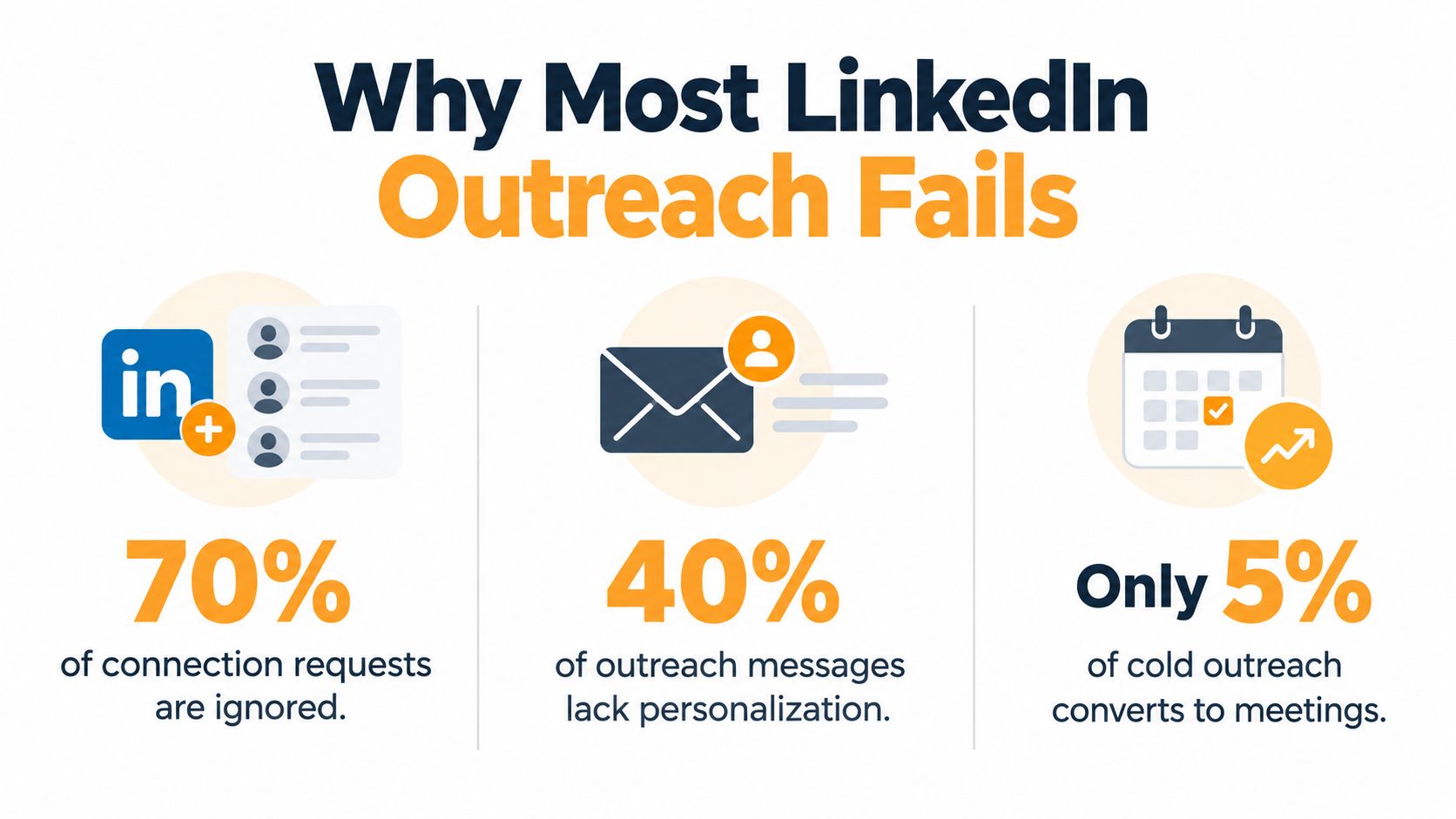
Activity isn't the same as access
LinkedIn isn't an email blast channel with profile photos attached. Buyers can inspect your profile, read your recent posts, notice your comments, and form an opinion before they answer a message. If that surrounding context feels generic, a polished pitch won't rescue the interaction.
The strongest social-selling benchmarks point to the value of the channel, not to the value of indiscriminate volume. LinkedIn-cited research says social sellers are 78% more likely to outperform peers who don't use social media and 51% more likely to hit quota (LinkedIn's social-selling benchmarks). Those results don't mean that sending more requests automatically improves performance. They support a structured approach that combines research, credibility, and conversation.
Practical rule: Treat every outbound action as a reason for the buyer to remember you, not as a demand for an immediate meeting.
A better motion starts before the connection request. The rep studies the prospect's role, company situation, public priorities, and recent activity. They then decide whether there is a credible reason to connect now. If there isn't, they engage with relevant content or wait for a stronger signal.
The shift from pitch to context
A useful LinkedIn interaction might add a thoughtful observation to a prospect's post, share a relevant operating lesson, or ask a focused question about a change in the prospect's market. None of those actions guarantees a sale. They do create context, which makes a later commercial conversation feel less abrupt.
The platform's scale makes this discipline more important. Industry summaries cited by LinkedIn audience and marketing statistics report that LinkedIn passed 1.3 billion members in 2026, after reaching 1.2 billion registered members in January 2025. The same source notes that 63 million users are decision-makers and that 80% of users drive business decisions for their companies. A large professional audience gives sellers access, but it doesn't remove the need to earn attention.
The rep in the opening example changed one thing first: they stopped measuring success by requests sent. They built smaller account lists, commented where they had something useful to add, and delayed the pitch until the prospect had a reason to recognize their name. The resulting workflow was quieter, but every conversation carried more context.
Defining Your Target Buyer and Optimizing Your Profile
Your LinkedIn sales strategy starts with a buyer definition, not a message template. “B2B leaders” is too broad to guide research. A usable target describes the type of company, the role involved, the problem that creates urgency, and the evidence that tells you the problem is active.
Build a target you can actually recognize
Start with a short ideal customer profile:
- Company context: Identify the market, business model, growth stage, and operating conditions where your offer is relevant.
- Buyer role: Separate the person who feels the problem from the person who approves the purchase. They may be the same person, but don't assume it.
- Trigger: Look for a new leadership role, expansion, hiring pattern, product launch, operational change, or public discussion of a challenge.
- Commercial consequence: Describe what remains difficult if the buyer does nothing. Use their language, not internal product terminology.
- Disqualifier: Record situations where your solution isn't a fit. Precision improves when you know whom to exclude.
Use LinkedIn search, account research, mutual connections, and public activity to test this definition. A target buyer isn't just a title. Two people with the same title can have very different priorities because their companies, mandates, and timing differ.
For a deeper process for turning market observations into usable segments, this guide to creating buyer personas can help you organize the research before you begin prospecting. The Social Search LinkedIn playbook is also useful when you need ideas for finding and qualifying prospects through the platform.
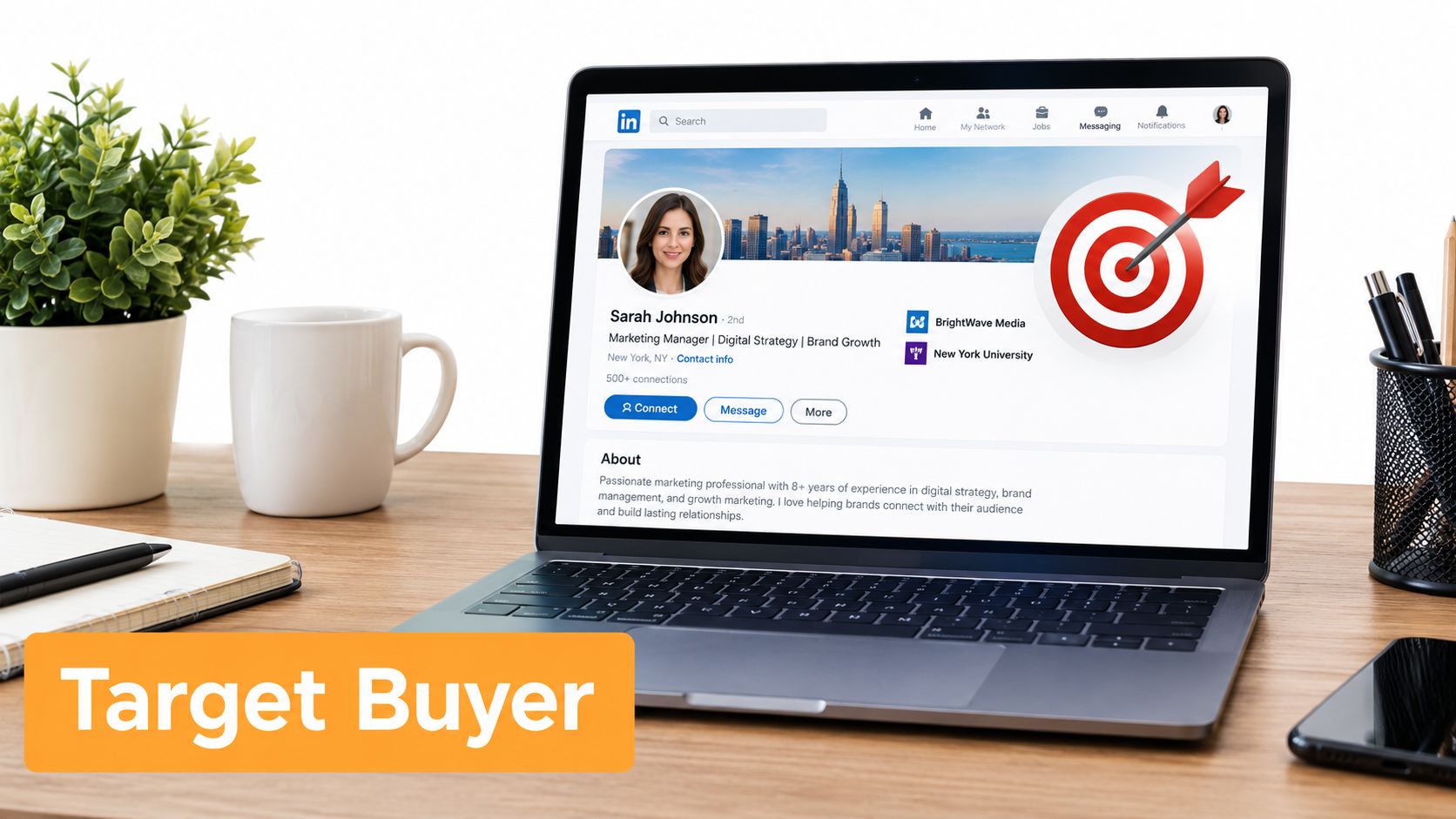
Make your profile answer the buyer's first question
Before replying, prospects often check your profile. They want to know what you understand, whom you help, and whether you're likely to waste their time. A sales profile should read like a credible introduction, not an internal résumé.
Rewrite the headline around the buyer's problem and the outcome you support. Your About section should explain your point of view, the situations you work in, and the kind of conversation you can have. Avoid filling the page with quota achievements or product slogans. Buyers care more about whether you understand their operating reality than whether your profile sounds impressive to sales management.
Your recent activity should reinforce the same positioning. If your headline says you help operations leaders simplify complex workflows, but your posts cover unrelated motivational content, the profile sends mixed signals. Consistency makes a short visit feel informative.
Use customer language in role descriptions, featured content, and recommendations. Replace “responsible for enterprise growth” with a clear explanation of the business problems you help solve. Add proof carefully, without turning every line into a claim. A profile earns trust when it gives a prospect enough context to start a sensible conversation.
Building a Content Cadence That Attracts the Right Buyers
Outbound creates an introduction. Content gives that introduction somewhere to go. A prospect who sees a useful post before or after your message has more evidence that you understand their world.
The answer isn't to publish whatever fills the calendar. Build a small set of content themes around the problems your target buyers already discuss. One theme can explain a recurring mistake, another can show a practical process, and a third can share a considered view on a change in the market. Your experience should shape the examples.
Use a rhythm you can sustain
A workable cadence has three layers:
- Publish useful thinking: Share a lesson, framework, observation, or opinion that helps a specific buyer make a decision.
- Join existing conversations: Comment on posts from prospects, customers, partners, and respected practitioners. Add an example or a useful disagreement instead of writing “Great post.”
- Capture follow-up signals: Note who asks a question, describes a related problem, visits your profile, or continues the discussion. Those actions can inform later outreach.
Quality matters more than forced daily activity. If a post takes a strong position, explains the reasoning, and gives the reader something practical to apply, it has a better chance of starting a relevant conversation than a generic quote.
A good post often follows a simple pattern: describe a familiar situation, explain what most teams get wrong, share the adjustment that worked, and end with a question that invites experience rather than a yes-or-no reaction. Keep the language natural. Sales readers can identify content written only to manufacture engagement.
For a useful explanation of how to choose and maintain a sustainable rhythm, see this guide to LinkedIn posting cadence. The tool you use for drafting matters less than the quality of your source material. Give any writing assistant your actual observations, customer questions, and working language, then edit until the post sounds like a person who has done the work.
A content system should also include engagement before publishing. Read what your target buyers say, identify repeated language, and use those observations to improve future posts. That feedback loop turns LinkedIn from a broadcast channel into a source of market intelligence.
The following video offers another visual reference for building a consistent LinkedIn presence.
Don't use content as a disguised sales brochure. Let the post stand on its own, then use the conversations it creates to understand who has a live problem and who is merely interested in the topic.
Designing Outreach Sequences That Actually Get Replies
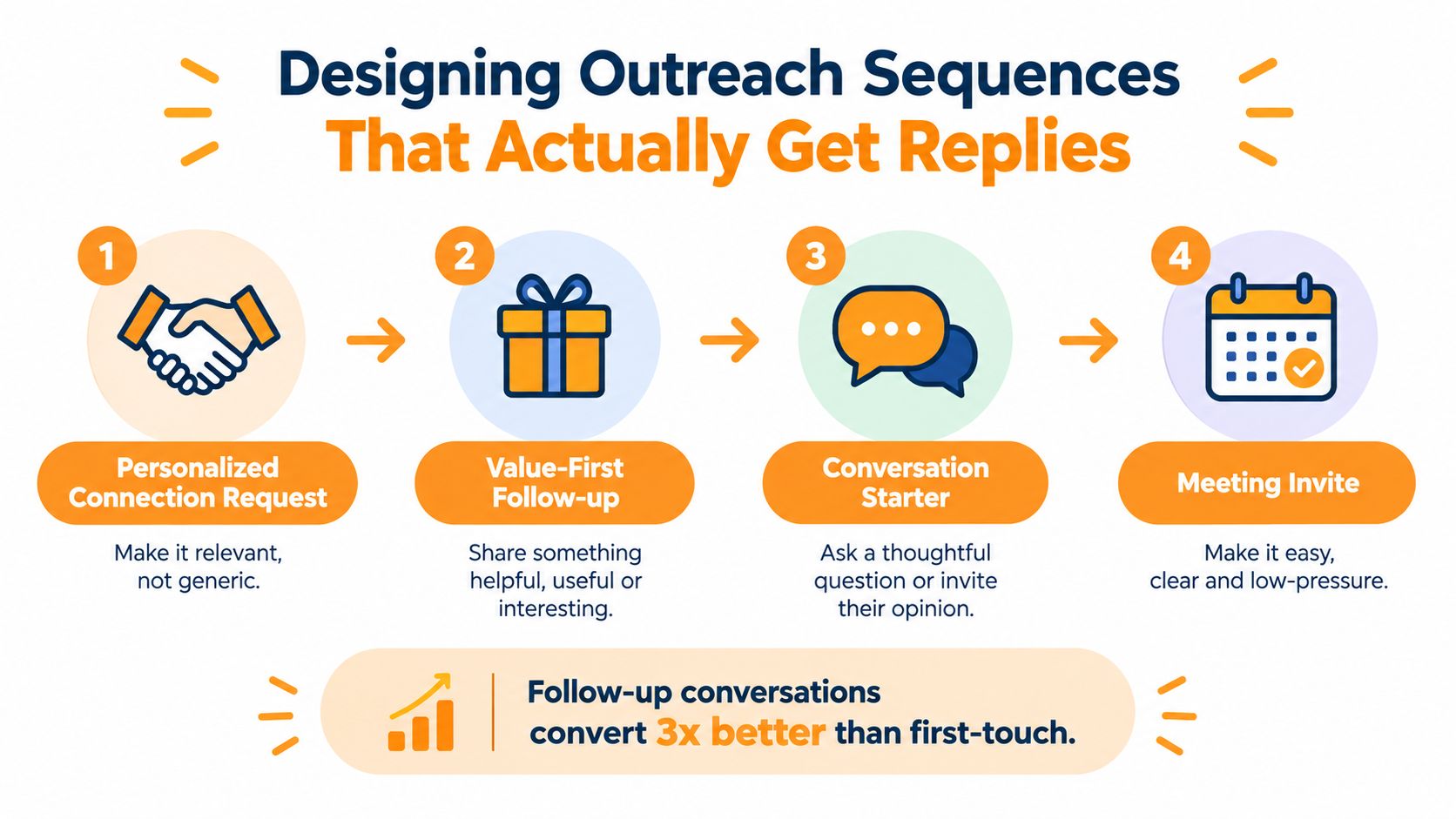
Connection requests and post-acceptance messages do different jobs. The request earns permission to enter the network. The follow-up starts a conversation. Treating both as a single pitch is one reason outreach feels intrusive.
A large 2026 benchmark analyzed 13.2 million LinkedIn connection requests and 6.7 million outbound messages across 13,302 accounts. It reported an average connection acceptance rate of 28.5%, an average outbound reply rate of 10.4%, and a reply rate of 3.0% for connection-request notes (the 2026 LinkedIn outreach benchmark). The practical distinction is clear. A note attached to an invitation shouldn't carry the entire conversion burden.
Compare the two common approaches
| Volume-first outreach | Precision-led outreach |
|---|---|
| Sends broad requests based mainly on title | Selects accounts and people using role, context, and timing |
| Puts the pitch in the invitation | Uses the invitation to establish a relevant connection |
| Follows a fixed template | Adapts the message to a real signal |
| Measures activity quickly | Measures conversation quality and progression |
| Treats silence as a reason to send more | Treats silence as information about fit, timing, or relevance |
A separate report based on more than 15 million outreach touchpoints found an overall reply rate of 7.2%. It reported 12.2% for messenger campaigns to already-connected contacts, compared with 5.3% replies for requests sent without a note (Belkins' LinkedIn outreach study). The figures vary by audience and campaign design, so they aren't promises for your market. They do show why the post-connection stage deserves more thought than a clever invitation.
Build the sequence in phases
Phase one is research. Review the person's role, company direction, recent activity, and likely priorities. Write down the specific reason this person belongs on your list. If you can't explain that reason without mentioning your product, the research isn't finished.
Phase two is the connection. Use a short, honest context statement when a note adds value. A shared professional interest, a thoughtful response to something they published, or a relevant mutual connection can be enough. Don't force a pitch into a limited space.
Phase three is the first conversation. After acceptance, thank them and reference the context that led you to connect. Offer an observation, resource, or question that relates to their work. The first follow-up should make it easy to respond without committing to a sales call.
Phase four is the commercial transition. If the prospect describes a problem, asks how you handle it, or engages with the relevant exchange, ask whether a short conversation would be useful. The invitation should connect directly to what they said. If there is no signal, continue learning rather than escalating automatically.
For more ideas on account research and research and outreach strategies, focus on the decision criteria behind each action, not on copying a sequence word for word. You can also use this LinkedIn outreach strategy guide to organize targeting, messaging, and follow-up around the same buyer context.
Measuring What Actually Moves Pipeline
Likes and profile views can reveal attention, but they don't tell you whether a buyer has a reason to talk. A useful LinkedIn sales strategy connects platform activity to conversations, opportunities, and next steps in the sales process.
Start with a simple funnel. At the top, track whether the people you target accept a connection. In the middle, track whether they respond with substance rather than a polite acknowledgment. At the bottom, track whether a conversation becomes a qualified opportunity or advances an existing deal.
Measure each stage for a different reason
| Stage | Useful question | What to inspect |
|---|---|---|
| Targeting | Are the right people entering the workflow? | Role, company fit, trigger, and account relevance |
| Connection | Does the context justify access? | Acceptance patterns by segment and reason for contact |
| Conversation | Does the message create a response? | Quality of replies, questions asked, and objections |
| Discovery | Is there a business problem to explore? | Urgency, stakeholders, current approach, and consequence |
| Pipeline | Is the opportunity progressing? | Next meeting, internal movement, decision process, and stage change |
A sudden fall in replies doesn't automatically mean your copy is weak. The cause could be a broader shift in targeting, poor timing, an exhausted account list, or a message that asks for too much too soon. Look at the change by segment. If one role responds while another stays silent, the answer may be positioning rather than volume.
Keep a feedback loop
Record the language prospects use when they describe their problem. Feed those phrases into your profile, content themes, and outreach drafts. Note the posts or topics that create thoughtful discussion, but don't treat engagement alone as proof of commercial intent.
Review stalled conversations as carefully as successful ones. Did the buyer show interest but lack authority? Did the rep send a meeting request before understanding the issue? Did the sequence continue after the prospect gave a clear no? These answers improve judgment faster than a dashboard filled with surface-level activity.
A lightweight CRM record should include the account, role, trigger, last meaningful interaction, stated problem, and next action. Keep the note factual. “Liked post” is an activity. “Asked how teams handle reporting during a merger” is a useful sales signal.
Pipeline test: If you can't connect a LinkedIn action to a buyer, a conversation, or an opportunity step, treat it as awareness rather than pipeline contribution.
Scaling Your LinkedIn Sales Strategy for Teams
A solo seller can keep context in their head. A team can't. As more people prospect, publish, and follow up, the risk shifts from weak effort to fragmented information. One rep sees a buying signal, another sends an unrelated pitch, and nobody records what happened.
Scaling starts with shared definitions. Agree on the target account criteria, the signals that justify outreach, the tone of the brand, and the point at which a social conversation enters the CRM. Give reps room to sound like themselves, but don't make every person invent the process from scratch.
Separate standards from scripts
A rigid script creates generic messages. No structure creates inconsistent experiences. Set standards for what each interaction must contain instead:
- Relevance: The rep can explain why this person and account fit the target.
- Context: The message refers to a real role, event, point of view, or business issue.
- Value: The recipient receives a useful observation, resource, or question.
- Permission: The next step matches the level of interest shown.
- Ownership: One person is responsible for the next action and the CRM record.
A team can maintain message examples for common situations, such as a new leadership appointment or a prospect engaging with a relevant post. These examples should demonstrate judgment, not become copy-and-paste templates.
The data also challenges the assumption that higher activity always produces better outcomes. A 2026 analysis found that reps sending fewer than 25 connection requests per week had higher acceptance rates than high-volume senders, and that teams using CRM sync lost fewer leads than teams relying on manual workflows (LinkedIn sales statistics and strategy analysis). The lesson isn't that every rep should follow the same weekly limit. It is that targeting quality and data capture deserve protection when activity increases.
Use automation where it reduces friction
Automation can help with research organization, reminders, scheduling, and CRM updates. It shouldn't impersonate a relationship or decide that every engagement deserves an automated message. AI-assisted drafting is most useful when it helps a rep compare account signals, identify a relevant angle, and edit a message into their own voice.
Assign clear roles where the team structure supports it. Marketing can maintain content themes, sales can add field observations, and operations can audit CRM hygiene. Leaders should review conversations for relevance and respect, not just count output.
When evaluating tools, compare how they handle research, contact management, personalization, reporting, and data ownership. A practical starting point is this guide to compare lead generation tools. The right stack should make good judgment easier to repeat, not make poor targeting faster.
Turning Insights Into a Repeatable Weekly Workflow
A LinkedIn sales strategy becomes useful when a rep can follow it on a busy week without turning the platform into a second full-time job. The routine should protect four activities: research, engagement, content, and follow-up.
On the first working day, review target accounts and identify the few prospects with the clearest relevance or timing signal. Check recent posts, role changes, company developments, and existing conversations. Remove weak-fit names instead of carrying them forward indefinitely.
Set aside another block for thoughtful engagement. Comment where you can add a practical example or a useful question. Respond to people who engage with your own posts, then record the conversations that reveal a real business issue.
A simple operating rhythm
- Early week: Research accounts, update buyer notes, and choose the prospects who deserve attention.
- Midweek: Publish one useful point of view and spend time in conversations where target buyers already participate.
- Later in the week: Send carefully chosen connection requests and follow up with accepted contacts using the context already established.
- End of week: Review replies, qualified conversations, opportunity movement, and the reasons prospects went quiet.
The exact number of actions should depend on the time available and the quality of the target list. A small group of well-researched prospects is more useful than a large list that nobody can personalize. If the routine starts to feel repetitive, inspect the research and message quality before increasing activity.
Consider a rep who used to begin each morning by clearing a queue of generic requests. Under this workflow, they begin with account signals, leave useful comments, publish an observation drawn from customer conversations, and follow up only when the context supports it. Their day contains fewer random touches, but the CRM captures more meaningful buyer information and the next conversation feels easier to earn.
That is the shift. LinkedIn becomes a relationship engine supported by sales process, not a high-volume inbox managed for its own sake.
RedactAI helps you turn your profile, experience, and topic ideas into LinkedIn post drafts while keeping your content workflow organized and consistent. Use RedactAI to support the content and engagement side of your LinkedIn sales strategy, then edit every draft so your practical judgment remains visible.