Why can you recognize a writer in your LinkedIn feed before you've read their name, yet struggle to describe your own voice beyond professional or authentic?
You're recognizing a pattern. That writer might challenge the premise before offering advice, explain technical ideas through everyday comparisons, or admit uncertainty without backing away from a recommendation. Their subjects change, but their way of thinking stays familiar.
Voice is more specific than tone. Tone changes with the situation: you wouldn't announce a promotion the way you'd discuss layoffs. Voice is the recognizable combination of language, judgment, rhythm, and perspective underneath those changes.
There's a measurable side to this. An overview of stylometry describes how writers can be compared through features including sentence length, word frequency, vocabulary richness, and grammatical preferences. You don't need statistical software to start noticing those habits in your own posts.
Practical rule: Choose a voice you can sustain when you're explaining something difficult, not just when you're writing a catchy opening.
The writing voice examples below are starting points, not costumes. Each includes recognizable traits, a useful LinkedIn application, a failure mode, and an edit you can make today. The aim isn't to sound like a different creator. It's to make your own expertise easier to recognize.
1. Professional Authoritative Voice
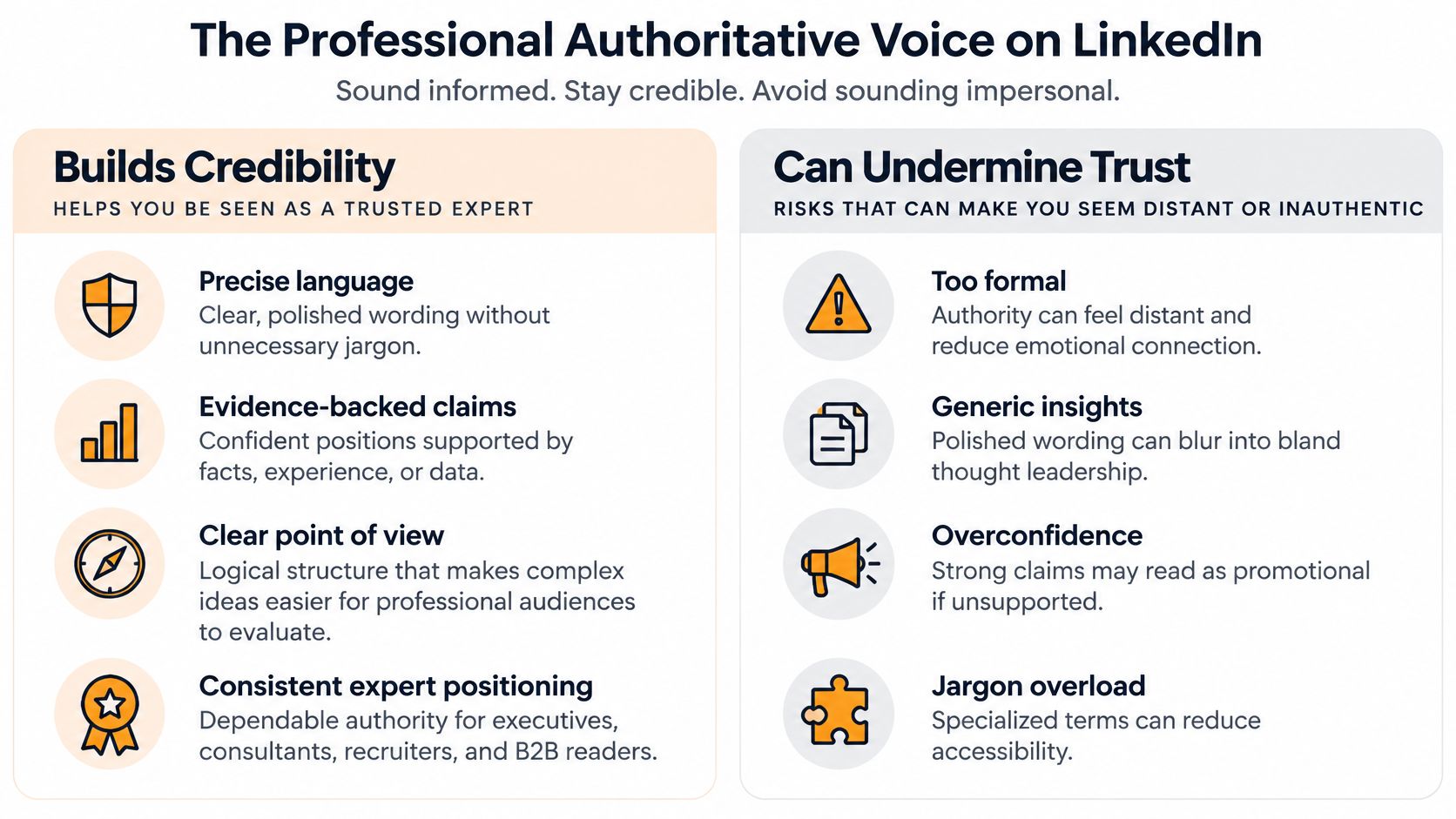
Authority comes from making a defensible judgment, not from sounding important. This voice suits executives, consultants, recruiters, and specialists who need readers to trust their reasoning.
Its recognizable traits are precise nouns, controlled confidence, clear boundaries, and explanations that connect evidence to a recommendation. You can acknowledge an exception without burying the main point under qualifications.
What It Looks Like in Practice
Say a recruiter wants to discuss interview consistency. An authoritative version might read:
Before opening a role, agree on what a strong answer demonstrates. If interviewers assess different capabilities, the hiring manager can't compare their recommendations fairly. A shared scorecard won't remove judgment, but it will make the criteria visible.
The voice works because the writer names the problem, recommends a mechanism, and limits the promise. There's no need to announce expertise.
Where it breaks down: Authority becomes stiffness when you replace ordinary verbs with corporate abstractions. Implementing interview-process optimization says less than agree on assessment criteria before interviewing.
- Lead with the decision: Tell readers what you recommend before explaining the background.
- Name the mechanism: Show how the recommendation addresses the problem.
- Keep the boundary: Explain when your advice wouldn't apply.
For a repeatable starting point, use this guide to finding your writing voice. For shorter professional exchanges, DMpro tips for personalized X messages offer another context for considering voice and tone.
Try it today: Find the broadest claim in your draft. Replace it with a recommendation that names an action, an owner, and a reason.
2. Conversational Peer-to-Peer Voice
You probably don't need another content calendar. You need to decide which customer question your next post should answer.
That's a conversational opening: direct, familiar, and useful without pretending the reader is your best friend. It suits founders explaining a decision, consultants sharing a working method, and salespeople discussing a recurring objection.

The recognizable traits are contractions, direct address, complete thoughts, and transitions you'd use with a knowledgeable colleague. The writer explains alongside the reader rather than delivering a lecture from above.
A peer-reviewed study of language-style matching found that participants automatically adjusted their writing to differently styled prompts. Its focus on grammatical patterns is a useful reminder: sounding conversational takes more than adding casual vocabulary.
Friendly Isn't the Same as Vague
Consider a consultant explaining project handoffs:
If your handoff document needs a meeting to explain it, start with the missing decision. Who owns the next action? What would stop them from taking it? Put those answers near the top.
The questions help the reader diagnose a problem. They aren't engagement bait tacked onto an otherwise finished argument.
Where it breaks down: Forced familiarity can make serious advice feel careless. Excessive slang, repeated sentence fragments, and manufactured confessions don't create a relationship with the reader.
Keep the substance; lower the distance. Replace stakeholders should undertake an assessment with ask the people doing the work, but retain the technical term when precision requires it.
Try it today: Read your draft aloud as though you're explaining it to a respected colleague. Rewrite anything you wouldn't comfortably say, then end with a question someone could answer from actual work.
3. Insightful Storytelling Voice
The useful part of a professional story is usually the moment someone's understanding changes. Start there, not with the calendar invitation or your entire career history.
Say a founder is explaining a hypothetical product-discovery lesson:
The customer didn't ask about the feature we'd prepared to demonstrate. They asked who would maintain it after launch. We'd designed for the buyer's approval, not the operator's workload.
This voice moves through situation, tension, decision, and meaning. Concrete details establish what happened; reflection explains why another professional should care.

Keep the Lesson Attached to the Event
A consultant might use this voice to explain why a launch plan changed. A recruiter might describe how a candidate's question exposed a confusing job description. In either case, the ending should follow from the event rather than attach a generic lesson about perseverance.
- Choose the turning point: Identify what the person believed before the event and what changed.
- Keep consequential details: Include the objection, constraint, or decision that explains the outcome.
- Protect confidentiality: Remove identifying details and get permission when appropriate; label composites and hypothetical scenarios.
Where it breaks down: Storytelling becomes performance when every minor inconvenience turns into a dramatic revelation. It also fails when the author takes credit for a lesson that belongs to someone else.
Use these storytelling techniques to shape the narrative without inflating the stakes. Dialogue is optional; a clearly described decision can carry the story.
Try it today: Delete the background paragraph from a story draft. Begin at the moment of friction, then restore only the context readers need to understand the choice.
4. Educational How-To Voice
Teach a task the reader can finish, not a topic they could study forever. An educational voice works well for recruiters explaining candidate communication, marketers demonstrating a content workflow, and founders sharing a customer-discovery method.
Its signature is instructional clarity: active verbs, visible sequence, examples, and enough context to prevent a predictable mistake. The writer doesn't merely say what matters; they explain what to do next.
Make the Process Usable
Suppose an HR specialist wants to explain how to improve interview invitations. A useful post could guide readers through these edits:
- State the purpose: Explain what the interview will assess.
- Name the participants: Include each interviewer's role.
- Explain preparation: Tell candidates whether they need examples, a portfolio, or a completed exercise.
- Provide an access contact: Make it clear whom candidates can contact about adjustments.
Then demonstrate the result with a short sample invitation. That example lets readers judge whether they've understood the method, rather than guessing what a good outcome looks like.
For another format to examine, watch how instruction can be presented through video.
Where it breaks down: Educational posts become thin when the steps are slogans: understand your audience, add value, stay consistent. Those are intentions, not instructions.
They can also become overconfident. A workflow that suits an internal marketing team may need changes for an agency handling client approvals, so name the conditions under which your process works.
Try it today: Circle every abstract verb in your draft, such as improve, optimize, or align. Replace each with an observable action and show what the finished work should contain.
5. Bold Opinionated Voice
A bold voice makes a clear choice about a disputed idea. It doesn't require anger, absolute certainty, or an opening that insults everyone who disagrees.
For a marketing consultant, the position might be:
Daily publishing is the wrong target when nobody owns the editorial decision. Fix the approval process before adding more posts to the calendar.
The recognizable traits are a direct thesis, contrast, an explicit standard, and willingness to explain the consequences. This voice suits professionals who can defend a position beyond the opening line.
Disagree with the practice precisely enough that someone who uses it could have a productive conversation with you.
Conviction Needs a Boundary
Follow the thesis with the mechanism: unclear ownership can leave drafts waiting, create contradictory feedback, or encourage rushed publication. Then acknowledge the valid exception: frequent publishing can make sense when the team already has editorial capacity and worthwhile material.
That boundary doesn't weaken the argument. It tells readers what you're arguing against.
There's also a difference between confidence and erased uncertainty. University of Maryland coverage of AI-assisted writing highlights how polished drafts can still diverge from a person's independent style, including changes in first-person language and expressions of uncertainty. Don't remove a meaningful I suspect merely to sound decisive.
Where it breaks down: Contrarian writing becomes predictable when the writer rejects every popular practice. Attacking people's intelligence also distracts from whether the underlying argument is useful.
Try it today: Write your position in a plain sentence. Add the strongest reasonable objection, then explain the condition under which you'd change your recommendation. If you can't do that, narrow the claim before publishing.
6. Inspirational Transformational Voice
A founder's setback isn't automatically an inspirational post. The useful material is the decision they made afterward, the support or constraints involved, and what another person can reasonably apply.
This voice combines emotional honesty with practical agency. It acknowledges difficulty without turning hardship into a personal-brand accessory.
For a hypothetical career-change post, the progression might look like this:
After leaving a management role, the professional discovers that their applications don't show the work they want to do next. They build a relevant project, ask a practitioner to critique it, and revise their positioning. The lesson is to make a career change visible through evidence, not just intention.
Show the Work Behind the Change
A strong transformational post separates the starting point from the actions taken. It doesn't jump from rejection to success while omitting the decisions that made the story useful.
- Name the constraint: Explain what made progress difficult without exaggerating it.
- Describe the response: Show the practice, conversation, request, or change in approach.
- Limit the promise: Offer a useful option rather than implying that everyone will get the same result.
Where it breaks down: Empty encouragement asks readers to feel hopeful without giving them anything to try. More seriously, a simplistic resilience story can imply that people facing structural barriers, illness, or financial pressure just need a better mindset.
Keep the invitation proportional. A recruiter can encourage candidates to document transferable skills without promising that better presentation guarantees an offer.
Try it today: Find the most motivational sentence in your draft. Follow it with the specific behavior you recommend and acknowledge a constraint that behavior won't solve. If the post still offers something useful, you've got more than a slogan.
7. Analytical Data-Driven Voice
An analytical voice separates observation, interpretation, and recommendation. Readers should be able to see where the evidence ends and your judgment begins.
Its recognizable traits include named sources, meaningful comparisons, qualified conclusions, and explicit reasoning. It suits consultants interpreting market changes, recruiters discussing hiring patterns, and marketers explaining campaign results.

Translate the Finding Into a Decision
For example, Carnegie Mellon University researchers reported in 2025 that large language models used present-participial clauses at 2–5 times the rate of human-written text.
An analytical LinkedIn post wouldn't stop at that finding. It would explain that a writer reviewing an AI-assisted draft could inspect repeated constructions such as improving efficiency or creating opportunities, then decide whether a direct clause would sound more natural.
The boundary matters: a population-level difference isn't proof that an individual post was AI-generated. A human can use the same construction, and an AI-assisted draft can avoid it.
Evidence standard: Explain what a finding lets you reasonably conclude, and what it doesn't.
For a marketing use case, distinguish a change in comments from a change in qualified inquiries. Define the metric, describe the comparison, and explain which business decision it informs.
Where it breaks down: Data-heavy writing can hide a weak argument behind charts or imply causation from a simple association. Excessive precision doesn't compensate for an irrelevant benchmark.
Try it today: Put separate labels beside the evidence, your interpretation, and your recommendation in a draft. Remove the labels before publishing, but keep the distinctions clear. If the recommendation requires an assumption, state it rather than disguising it as a finding.
8. Humorously Human Voice
The project brief was clear. Unfortunately, everyone had a different clear version.
That's a hypothetical workplace observation, not a comedy routine. It gives a consultant a natural opening to discuss approval criteria, ownership, or the difference between agreement and understanding.
This voice uses recognition, understatement, and selective self-deprecation. The humor supports the professional point instead of replacing it.
Keep the Joke Attached to the Work
A recruiter could describe an interview question so complicated that even the interviewer needs notes. A marketer could joke about a campaign deadline surviving every scope change untouched.
The useful follow-through is specific: simplify the assessment question, document the scope change, or make someone responsible for changing the deadline. Without that follow-through, the post is just a complaint with a punchline.
- Choose a safe target: Aim at an awkward process or your own mistaken assumption, not a vulnerable person.
- Keep the setup lean: Remove background that readers don't need to understand the contrast.
- Check the underlying point: The post should remain useful after you delete the joke.
Where it breaks down: Sarcasm can look contemptuous when readers don't share your context. Humor built around a recognizable colleague, candidate, or customer can also create a confidentiality problem even if you omit their name.
For more approaches, explore these funny LinkedIn posts, then adapt the mechanism rather than borrowing someone else's personality.
Try it today: Find a small contradiction in your work, such as a supposedly urgent approval that nobody owns. Describe it plainly, trim the setup, and connect it to a constructive recommendation. Read it from the perspective of the person who might feel targeted before you publish.
8 Writing Voices at a Glance
| Voice | Core Trait | Biggest Strength | Main Risk | Best For |
|---|---|---|---|---|
| Professional Authoritative Voice | Precise, evidence-backed expertise | Builds credibility and trust | Can feel distant or overly formal | Executives, consultants, and B2B audiences |
| Conversational Peer-to-Peer Voice | Friendly, collaborative language | Makes professional content approachable | Can weaken perceived expertise if too casual | Personal brands and professional peer discussions |
| Insightful Storytelling Voice | Narratives that lead to professional lessons | Makes ideas memorable and engaging | Stories can run long or reveal confidential details | Sharing lessons from real work experiences |
| Educational How-To Voice | Practical steps, frameworks, and examples | Provides immediate, actionable value | Can feel generic or oversimplify complex topics | Teaching processes, skills, and useful methods |
| Bold Opinionated Voice | Clear, conviction-led viewpoints | Signals independent thinking and sparks debate | Can polarize readers or damage credibility if unsupported | Challenging industry assumptions |
| Inspirational Transformational Voice | Grounded stories of growth and positive change | Energizes and emotionally engages readers | Can sound generic or overpromise | Leadership, mentorship, and personal-brand content |
| Analytical Data-Driven Voice | Evidence interpreted through data and trends | Makes arguments more defensible and actionable | Misleading or context-free data undermines trust | Market insights and evidence-based business commentary |
| Humorously Human Voice | Relevant wit and playful observations | Makes professional content memorable and approachable | Humor can distract or be misunderstood | Humanizing workplace, marketing, and startup content |
Pick One Voice, Master It, Then Make It Yours
Choose a default voice, not a permanent persona. Start with the approach that fits both your expertise and the reason people would follow you.
If readers need your interpretation of complex evidence, analytical may be the best foundation. If they need a reliable process, educational is a stronger fit. You can still tell stories, make jokes, or express an opinion without rebuilding your identity for every post.
The distinction is between stable principles and adaptable delivery. You might consistently be candid, skeptical of broad claims, and generous with examples while changing your vocabulary and level of explanation for different audiences.
Build From Your Own Writing
Collect authentic posts that still represent how you think. Don't select only the posts with the most reactions; include the ones whose reasoning and phrasing you'd stand behind today.
- Notice recurring habits: Compare openings, sentence length, pronouns, transitions, and endings.
- Record your judgment patterns: Note how you handle uncertainty, exceptions, disagreement, and recommendations.
- Write useful editing instructions: Prefer state the exception after the recommendation over sound authentic.
Adaptation doesn't have to mean inconsistency. A research agenda on AI-mediated writing and register variation emphasizes communication context, a useful consideration when writing for peers, executives, or global audiences. Keep your standards stable while adjusting the context readers need.
Treat Every Draft as Editable
If you use AI assistance, compare the draft with your independent writing rather than judging it only by fluency. A preregistered study of personal voice in AI-assisted writing found that human post-editing increased stylistic similarity to participants' unassisted writing, supporting a generate, compare, and revise workflow.
Check more than vocabulary. Does the draft make a claim you believe, express uncertainty where you would, and explain the decision in your usual way? A smooth sentence isn't worth keeping if it changes your position.
Test your strongest candidate on your next LinkedIn post. Watch for substantive responses from the people you want to reach, then review whether you can sustain that voice without forcing it. Recognition matters, but ownership matters more: the finished post should contain judgments you're prepared to defend.
At RedactAI, we draft LinkedIn posts in your voice, learned from your previous posts, and provide three versions for you to choose from. Visit RedactAI to develop your next draft, then use these writing voice examples to sharpen its language, check its reasoning, and make the final version yours.