Professional humor on LinkedIn doesn't have to be either polished into blandness or reckless enough to require an apology tour. The strongest funny LinkedIn posts sit between those extremes. They start with a recognizable work moment, use a deliberate comedic structure, and leave readers with a useful observation, even if that observation is just, “Apparently nobody knows what this meeting is for.”
That balance matters because LinkedIn was built around professional identity, employment, recruiting, and business relationships. The platform launched on May 5, 2003, had approximately 4,500 members after its first month, and reached 1 billion members in 2023, creating an audience that now spans more than 200 countries and territories (LinkedIn's growth history). Your joke can reach colleagues, prospects, recruiters, executives, and future employers at the same time.
So don't copy a comedian's voice or chase a supposedly viral formula. Choose a humor mechanic that fits your role, audience, risk tolerance, and objective. The eight examples below are adaptable templates. Keep the structure, replace the experience, and make the joke sound like something you would actually say. If you want to turn that approach into a broader paid acquisition strategy, you can also browse LinkedIn advertising.
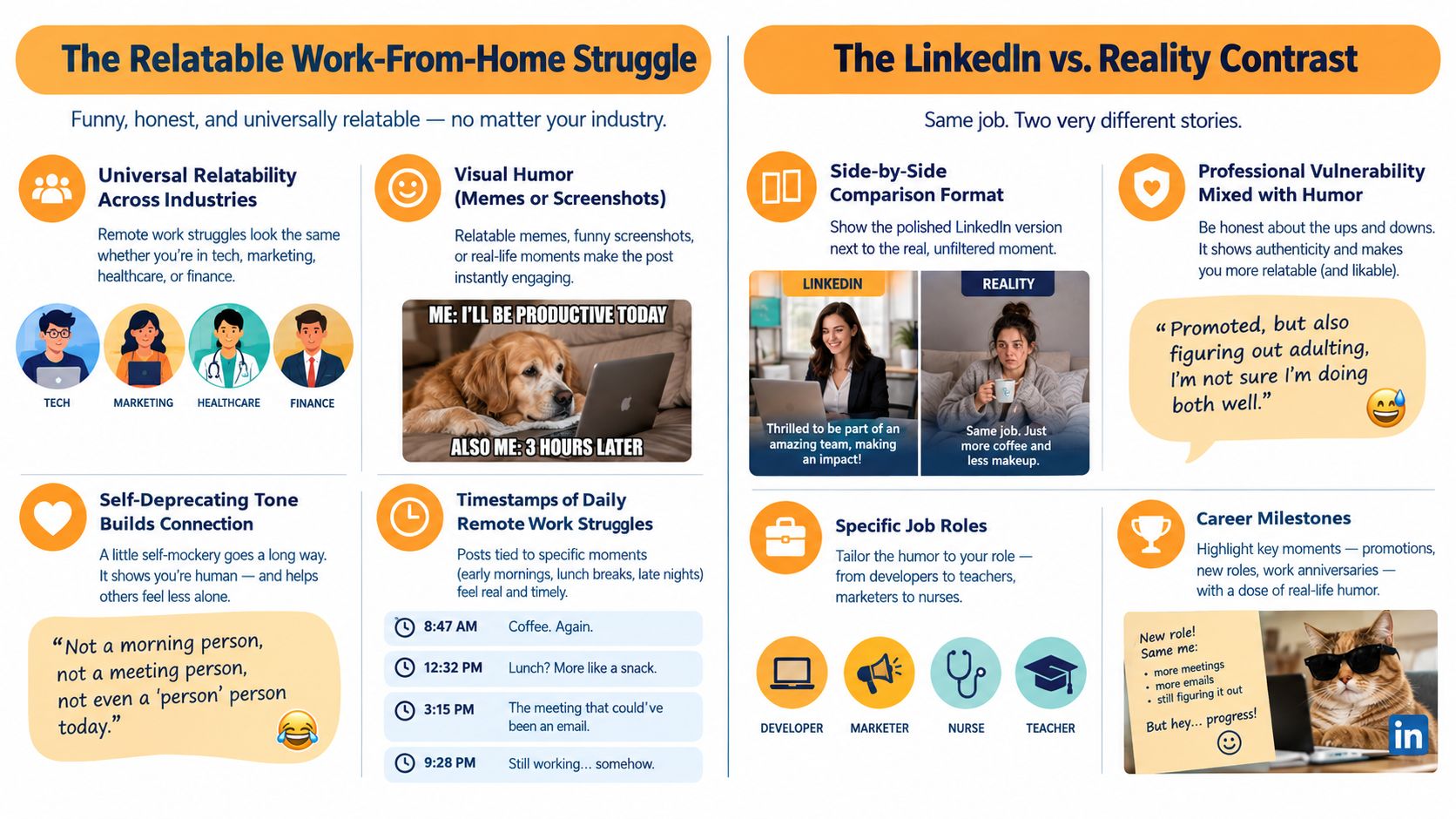
1. The Relatable Work-From-Home Struggle
Remote work humor succeeds when it captures a small, specific moment instead of making another broad complaint about “working from home.” A cat walking across a keyboard, a dog appearing during a client call, or a colleague asking whether anyone has seen the mute button gives readers something concrete to recognize.
The useful structure is simple:
Setup: “I prepared a detailed presentation for today's client meeting.”
Reframe: “My dog delivered the strongest opening argument.”
The joke works because the professional setup creates a serious expectation, while the interruption breaks it. You don't need to invent an outrageous story. The more ordinary the disruption, the more readers can attach their own experience to it.
An example might read:
“Today's remote-work agenda:
9:00, review quarterly priorities.
9:15, explain why the camera is off.
9:20, negotiate with a cat for control of the keyboard.
9:30, discover the entire presentation was shared with the wrong screen.”
Keep the laugh attached to work
The post becomes more useful when the final line adds a small professional insight. You might mention that remote meetings need clearer agendas, that teams should normalize brief interruptions, or that “always on” culture creates its own productivity problems.
A personal moment also gives you room to show personality without mocking another person. That's safer than making a colleague the punchline, especially when your audience includes clients or junior employees. A quantitative study of 494 Gen Z consumers in Vietnam found that brand humor increased perceived social presence, which then supported enjoyment and engagement. It also found that humor style mattered, with friendly, non-threatening humor working better than risky or hostile humor (the study in the Journal of Brand Strategy).
Test whether your audience responds more to meeting mishaps, home-office absurdity, or the tension between flexibility and availability. You can use these LinkedIn post ideas for professionals to develop the serious insight behind the joke, then add the remote-work twist yourself.
A photo or short clip can strengthen the setup, but don't let the media carry a joke that the caption doesn't finish. Publish when your audience is already active, then review the comments for the moments people recognize most. Those comments will give you better material than a generic list of remote-work complaints.
2. The LinkedIn Versus Reality Contrast
The contrast format works by placing a polished professional claim beside the unpolished truth underneath it. LinkedIn users recognize the language immediately: “strategic leader,” “serial entrepreneur,” “customer-obsessed,” or “passionate about operational excellence.” The joke comes from revealing what that phrase looked like on an ordinary Tuesday.
A useful version might look like this:
LinkedIn: Led a cross-functional initiative to improve communication.
Reality: Created a new group chat because nobody answered the first one.
LinkedIn: Comfortable with ambiguity.
Reality: Opened six browser tabs to decide which spreadsheet was final.
LinkedIn: Building a resilient company culture.
Reality: Remembered the team meeting only because someone sent a calendar reminder.
The format depends on contrast, so keep the two sides visually distinct. Short lines create pacing. Long explanations explain the joke before it arrives.
Make the reality specific, not destructive
Self-awareness makes this structure likable. Publicly attacking your employer, clients, or team can turn a harmless contrast into a reputational problem. Talk about your own habits, your own inflated language, or a familiar process instead.
You can also balance the joke with an actual achievement. For example, mention that the team did deliver the project, then admit that the internal process involved “three spreadsheets, two emergency calls, and one person asking whether version seven was really final.” The accomplishment protects credibility, while the honest line supplies personality.
A creator's audience doesn't need every post to sound aspirational. It does need enough evidence that the author can laugh without undermining their competence. The distinction is important for executives, recruiters, salespeople, and consultants. Vulnerability should reveal perspective, not create doubt about whether you can do the job.
Use LinkedIn post examples to study how different structures create rhythm, but don't borrow someone else's punchline or personal story. Replace the generic “reality” with a moment from your own work.
The trade-off is reach versus precision. A broad joke about corporate language may be understandable to almost anyone, but a detailed contrast about procurement, product management, or agency life will feel more personal to the right audience. Choose the narrower version when you want relevant comments from peers or buyers, not just general approval.
3. The Absurd Job Interview or Hiring Question
Interview humor gives job seekers and recruiters a shared frustration, but it needs careful handling. The safest target is the process, not a named interviewer, a specific company, or a protected characteristic.
Start with a question that sounds familiar:
“Tell us about a time you demonstrated ownership.”
Then add the absurd escalation:
“I'd love to, but the job description lists four managers, two reporting lines, and no clear owner for the question.”
Or:
“The role requires entry-level experience, advanced leadership, seven specialist tools, weekend availability, and the ability to work independently with constant supervision. I brought my résumé and a small tent.”
The joke lands because the mismatch is recognizable. Job descriptions often ask for a broad combination of skills, while interview questions can test abstract qualities without explaining how the organization defines them.
Let the punchline point toward a solution
A complaint becomes more credible when it includes a practical correction. After the joke, suggest that hiring teams publish the core outcomes for the role, separate essential skills from preferences, or explain how candidates will be evaluated. That final line turns a meme into a point of view.
For example:
“If a role needs strategic thinking, stakeholder management, and hands-on execution, say that plainly. Candidates can prepare better, and recruiters can stop asking whether someone is a ‘rockstar' who also enjoys repetitive administrative work.”
Don't use invented hiring statistics to give the post authority. A clear observation from your own industry is stronger than an unsupported trend claim. You can mention a real experience, remove identifying details, and explain what a better process would have looked like.

The tone changes depending on your role. A candidate can joke about trying to answer “Where do you see yourself in five years?” A recruiter can joke about receiving résumés with filenames such as “final_final_reallyfinal.pdf.” A hiring manager can parody the temptation to describe every vacancy as a “fast-paced environment.”
For seasonal or playful content, you can adapt the same mechanic into April Fools' Day post ideas, but keep the professional point obvious. Readers should understand where the joke ends and your hiring philosophy begins.
4. The Self-Aware Professional Burn
Self-deprecation is one of the most reliable humor mechanics for professionals because you control the target. You can joke about your title, habits, industry vocabulary, or repeated mistakes without asking the audience to laugh at someone with less power.
A marketer might write:
“I spent the morning aligning stakeholders around a shared definition of alignment. The meeting ended with a new meeting.”
A developer could write:
“The bug was caused by one missing character. I found it after reviewing the entire system, questioning my career, and asking the code to reveal its secrets.”
A consultant might write:
“My strategic recommendation is to reduce unnecessary complexity. I'll explain this in a 47-slide presentation.”
The strongest burns contain an accurate professional truth. “Marketers use jargon” is generic. “I created a campaign to explain the word ‘synergy' without using the word ‘synergy’” gives readers a scene and a contradiction.
Protect the value underneath the joke
Don't lead with a joke that makes your expertise sound fake. Lead with the work you do well, then expose the oddity around it. A sales professional can explain how a team improved qualification, then admit that every “quick call” still begins with ten minutes of calendar negotiation.
Industry language creates an insider feeling, but too much jargon narrows the audience. Use one or two recognizable terms, then make the situation understandable to an adjacent profession. That's especially useful when your audience includes prospects who know the business problem but not your internal vocabulary.
A good professional burn says, “I understand this work well enough to see its absurdity.” It doesn't say, “I have no idea what I'm doing.”
Follow the joke with a short observation. Explain what the jargon hides, why the process exists, or what you changed. This preserves authority while giving the audience a reason to save or share the post.

The risk rises when the joke targets customers, junior colleagues, or a recognizable employer. Keep the embarrassment yours. If a prospect could read the post and wonder whether you privately mock clients, rewrite it.
5. The Unexpected Plot Twist Post
A plot twist gives readers a reason to continue because the first lines create a question. The setup should point in one direction, then the ending should redirect the story without becoming random.
Try this structure:
“I thought losing that client would damage the business.
It did.
We had built the entire account around work we should never have agreed to.”
That version uses a comic or ironic twist, but it still gives the reader a useful lesson. A lighter example might begin:
“I prepared for my most difficult presentation of the year.
I rehearsed the opening.
I tested the slides.
I planned answers to every difficult question.
Then the client asked whether I could send the deck as a PDF.”
The surprise doesn't need to be dramatic. It can be a small reversal that exposes the difference between how professionals prepare and what happens.
Control the pause before the turn
Line breaks create timing. Put the setup in short paragraphs, then leave space before the punchline. If you bury the twist in a dense block of text, the reader may miss the change in direction.
The setup should also contain enough truth to earn attention. “I was nervous about a major career decision” works when followed by a real choice, such as leaving a role, changing a niche, or saying no to unsuitable work. “I almost lost everything” followed by a minor inconvenience feels manipulative.
End with a lesson that grows naturally from the story. A career rejection can reveal a better direction. A difficult client can expose a weak qualification process. A failed launch can show that the team validated the wrong assumption. The twist earns the laugh, while the lesson earns trust.
A documented example from Accelity shows why context matters. CEO Jackie Hermes reported that a humorous work-from-home video generated 1,553 reactions and 282 comments, and MarketingSherpa reported that the agency attributed more than $1 million in business to its broader viral-marketing efforts (the Accelity case study). That outcome doesn't make every humorous post a pipeline machine. It does show how a timely workplace situation can connect entertainment with a credible business identity.
6. The Dead-Serious Professional Observation
Deadpan humor presents an absurd conclusion in the language of a formal business update. The writer sounds calm. The observation sounds measured. The content is ridiculous enough that the contrast does the work.
For example:
“After extensive internal research, I've confirmed that meetings become shorter when someone writes down the decision before the meeting starts.”
Or:
“Our latest productivity initiative has delivered a major breakthrough. We now move the same unfinished tasks between three project-management tools instead of one.”
The joke depends on restraint. Don't add several exclamation marks or explain that you're being sarcastic. The more seriously you present the observation, the clearer the contrast becomes.
Use the language of business sparingly
Words such as “findings,” “alignment,” “optimization,” and “operational efficiency” can create the right tone, but too much corporate language makes the post unreadable. One formal phrase followed by an ordinary truth is often enough.
A useful pattern is:
- State an obvious workplace discovery.
- Describe it as a major professional insight.
- Add a real implication.
Example:
“I've discovered that employees respond faster when the request includes the deadline, the owner, and the actual question. This finding may challenge several established communication practices.”
The final line gives the joke an edge because it points to an avoidable problem. It doesn't need a fabricated study or fake source. Present your own observation as your own observation.
This format suits analytical professionals because it preserves a controlled voice. A data leader can parody dashboards. A lawyer can mock the complexity of a simple email. An operations manager can report on the miraculous discovery that a process improves when someone documents it.
You can pair the post with a serious-looking chart, office photograph, or simple text graphic. The visual should support the deadpan setup, not turn the joke into a meme that ages quickly. If readers understand the point without a long explanation, the format is working.
7. The Relatable Failure and Vulnerability Post
Failure stories attract attention because they challenge the polished image of professional success. Humor makes the story easier to enter, but the lesson keeps it from becoming a confession with no value.
Lead with the failure rather than hiding it behind several paragraphs of achievement:
“I once sent a proposal to the wrong client. It contained the correct pricing, the wrong company name, and enough confidence to suggest that I had no idea what was happening.”
Then explain what happened next. Did you admit the mistake immediately? Did you build a review step? Did you discover that the proposal process had too many manual handoffs?
The detail creates the laugh. The consequence creates the credibility.
Vulnerability needs a clear boundary
Don't publish a failure while you're still trying to assign blame or repair the damage. Avoid identifying a client, colleague, or employer unless you have clear permission. The audience doesn't need every private detail to understand the lesson.
A strong structure looks like this:
- Failure: State the mistake plainly.
- Comic detail: Add the specific moment that makes it memorable.
- Response: Explain what you did after discovering it.
- Lesson: Give readers a principle they can use.
- Question: Invite them to share a related experience.
The question should be narrow enough to answer. “What mistakes have you made?” is broad. “What small process saved you from repeating an embarrassing client-email mistake?” gives readers a clear opening.
This format can build trust, but it can also backfire if every failure magically produces a heroic success story. Not every mistake needs a triumphant ending. Sometimes the honest lesson is that you now check the recipient list, ask better questions, or pause before replying. Practical growth is more believable than a perfect redemption arc.
Use your comments as a second act. Readers often share better examples than the original post, and your replies can add context without turning the post into a lecture. Keep the tone generous. If people disclose their own mistakes, don't use the comment section to prove that your process is superior.
8. The Absurdist Professional Hypothetical
An absurd hypothetical starts with a real workplace frustration, then pushes it through an impossible rule. The humor comes from escalation, while the underlying point remains familiar.
For example:
“What if every meeting required participants to bring one physical object that represented the decision they wanted?
The product team would bring a roadmap.
Sales would bring a contract.
Finance would bring a calculator.
Someone would bring a plant and say it represents ‘long-term growth.’”
The scenario is clearly fictional, but it exposes how different teams describe the same priority. That gives the reader more than a random joke.
Escalate in visible steps
Numbered lines and short bullets work well here because each step adds another layer. Start with the actual problem, introduce the rule, then show how different professional personalities respond.
A sales version might ask:
“What if every cold message had to be approved by the person receiving it?
The opening would become shorter.
The personalization would become real.
The phrase ‘quick question' would disappear.
Several automation platforms would experience a period of reflection.”
The absurdity stays attached to a recognizable issue, in this case low-quality outreach. That's what separates workplace satire from random nonsense.
You can also use the format to discuss AI, office policies, performance reviews, or company rituals. Just don't make a sensitive group the subject of the absurdity. The safest target is an incentive, process, or habit that affects everyone.
End with a tongue-in-cheek observation that states the actual issue without flattening the joke:
“We probably don't need one-leg meetings. We may need fewer meetings with unclear decisions.”
A GIF or image can heighten the escalation, but clear formatting matters more. Readers should be able to follow the premise while scanning. If the hypothetical takes too long to explain, simplify the rule or cut the weakest escalation.
8-Style Comparison of Funny LinkedIn Posts
| Post Type | 🔄 Implementation Complexity | ⚡ Resource Requirements | 📊 Expected Outcomes | 💡 Ideal Use Cases | ⭐ Key Advantages |
|---|---|---|---|---|---|
| The Relatable Work-From-Home Struggle | Low, simple captions + visuals | Low, phone screenshots or memes | High engagement (15–25%) via comments & shares | Humanize personal brand; peak scroll times (mid-morning/lunch) | Relatability, easy repurposing, community building |
| The LinkedIn vs. Reality Contrast | Medium, craft clear side-by-side juxtaposition | Medium, images or templates, light design | Very High engagement (20–35%) with viral potential | Break highlight-reel culture; show authenticity | Strong shareability; positions poster as genuine |
| The Absurd Job Interview or Hiring Question | Low–Medium, collect quotes and punchlines | Low, text/images, optional data | High engagement (18–28%) especially HR/tech audiences | Recruiter conversations; talent-acquisition thought leadership | Appeals to HR & job seekers; sparks constructive debate |
| The Self-Aware Professional Burn | Low, short, insider-focused jokes | Low, text, occasional image | Medium–High engagement (15–22%) with quality replies | Industry peers; networking and rapport building | Shows confidence, builds insider rapport while staying professional |
| The Unexpected Plot Twist Post | High, requires tight narrative and pacing | Medium, time for drafting and editing | Very High engagement (22–32%), memorable and shareable | Storytelling, founders' origin stories, long-form posts | Demonstrates creativity and storytelling skill; high recall |
| The Dead-Serious Professional Observation | Medium, tone must be precisely calibrated | Low, text or subtle image | Medium engagement (12–18%) with high-quality interactions | Sophisticated audiences, satire, thought leadership | Witty, intellectual humor that signals sophistication |
| The Relatable Failure/Vulnerability Post | Medium, careful framing to protect reputation | Low–Medium, detailed narrative, optional imagery | Very High engagement (25–40%) with supportive responses | Leaders, founders, coaches sharing lessons learned | Builds deep trust, credibility, and teaching moments |
| The Absurdist Professional Hypothetical | Medium, layered escalation and comedic timing | Low–Medium, formatted lists or GIFs/images | High engagement (18–28%) often through shares | Creative commentary, satirical takes on workplace norms | Stands out in feeds, meme-able, highlights real issues via humor |
Turn the Joke Into a Repeatable Content System
Funny LinkedIn posts become easier to create when you stop treating humor as a personality test. You don't need to be the funniest person in your industry. You need to notice a specific professional moment, choose the right mechanic, and present it with enough restraint that the reader can recognize the truth underneath the joke.
Start with one experience, not one topic. “Remote work” is too broad. “I joined a client call from a room where my child had arranged every stuffed animal behind me like an executive board” gives you a scene. “Hiring” is too broad. “The role required independent decision-making but listed four approval layers” gives you a contradiction. Specificity supplies the raw material.
Then choose the structure that suits the material:
- Use relatable struggle when the audience shares the same daily irritation.
- Use contrast when your professional image hides an ordinary reality.
- Use an absurd question when a broken process is the target.
- Use a self-aware burn when you want to show expertise without sounding stiff.
- Use a plot twist when the story contains a genuine reversal.
- Use deadpan observation when the absurdity becomes clearer through formal language.
- Use vulnerability when a mistake produced a useful lesson.
- Use a hypothetical when escalation can expose a workplace habit.
Write the setup in one or two clear beats. Add the punchline, reversal, or escalation. Finish with an observation that gives the post a reason to exist beyond the laugh. That final line might be a lesson, a better process, or a focused question.
The audience determines how far you can push the tone. A joke about your own calendar is usually portable. A joke about politics, religion, protected characteristics, layoffs, clients, or identifiable colleagues carries more risk and less control. Humor also travels differently across cultures. Sarcasm and irony can lose their meaning when readers don't share the same context, so observational humor and self-deprecation are usually easier to interpret.
Measure the right outcome. Reactions show lightweight approval. Comments reveal conversation. Neither proves that the post reached relevant buyers, improved recruiting, or created pipeline. Separate broad reach from commercially useful signals such as relevant profile visits, messages from target accounts, qualified conversations, applicant quality, and sentiment. Compare humorous posts with serious posts that address similar topics and audiences. Don't promise an engagement lift you haven't measured.
Your comments matter too. Reply to a useful observation, extend a joke, or ask a sharper follow-up question. Don't turn every response into a sales pitch. A funny post can open a relationship, but your expertise and conduct determine whether that relationship develops.
RedactAI can support the workflow without replacing your judgment. It can analyze your posting history, surface niche-specific inspiration, generate multiple drafts from keywords, adapt ideas to your personal voice, schedule updates, recycle strong posts, and help you review analytics. Use it to find recurring themes in your content, then choose the humor mechanism that fits your actual experience. Treat the generated draft as raw material, especially when the joke depends on a personal detail only you can verify.
The best system is small enough to repeat. Keep a running note of awkward meetings, strange requests, contradictory processes, and professional phrases that accidentally sound absurd. Once a week, turn one note into a setup, one comedic turn, and one useful observation. Review the draft as a client, colleague, recruiter, and future employer might read it. If the joke still feels human, relevant, and safe, publish it and let the response guide the next one.
RedactAI helps professionals turn real work experiences into funny LinkedIn posts that still sound like them, with personalized drafts, niche-specific inspiration, scheduling, recycling, and analytics in one workflow. Visit RedactAI to develop sharper ideas without losing the professional voice your network already trusts.