You've finished a LinkedIn post with a useful lesson, a concrete example, and advice someone could use. Then you reread the opening: a polite announcement that you've been thinking about leadership. The interesting part is buried below the point where a scrolling reader would stop.
You don't need a louder opening. You need a clearer reason to continue. A strong hook in writing tells the right reader what's at stake and sets up a promise the rest of the post can keep.
What a Hook in Writing Does for Your Reader
A reader scrolls past an opening about how important communication is. Nothing in that line tells them whether the post concerns hiring, sales calls, or an awkward conversation with their manager. They can't judge its usefulness, so they move on.
A hook is the opening sentence or short passage that gives someone a reason to keep reading. Think of a shop window: it should reveal enough of what's inside to attract the right visitor. A beautiful display that misrepresents the shop only creates disappointment.
The connection to journalism is useful. Poynter's discussion of leads explains the importance of the opening and the choices writers make between direct and delayed approaches. With the inverted pyramid, journalists put essential information first, allowing readers to understand the event quickly and editors to cut supporting material from the bottom.
Feature writers can take a different route. They might start with a scene or withhold a key detail, giving readers a reason to discover what happened rather than delivering the entire answer immediately.
Why the opening deserves extra work
A qualitative-empirical study of literary attention found that beginnings and endings receive heightened attention under the rules of position. Your opening arrives before readers have settled their expectations about your subject or voice.
On LinkedIn, write the opening lines as a self-contained invitation. Don't assume the same amount of text will remain visible on every screen before see more.
Every hook has three jobs:
- Earn the next line. Introduce a question, consequence, or useful discovery.
- Signal the topic. Help the intended reader recognize relevance.
- Make a specific promise. Establish what continuing will give them.
Read only the opening lines of your last post aloud. Would someone unfamiliar with your work know why it matters?
Eight Hook Types and Real Examples to Copy
A hiring manager asks for a shortlist by noon, but the role's criteria are still unclear. A scenario hook puts the reader inside that pressure. A question, statistic, story, or other opening can work just as well if its promise matches what the post delivers.
| Hook type | How it works | Example opener | Best for |
|---|---|---|---|
| Question | Raises a puzzle the post will answer | Why do your best posts get the fewest comments? | Discussion-led posts |
| Statistic | Uses a number to establish contrast | Our demos doubled, but pipeline fell 18%. | Results and data |
| Story | Begins at a consequential moment | The client ended our call by firing me. | Lessons and personal wins |
| Contrarian | Challenges a familiar belief | Stop posting every day. Post when you have something useful to say. | Opinion pieces |
| Bold claim | States a specific, arguable position | Your opening line is making your cold email harder to answer. | Authority building |
| Scenario | Places the reader in a recognizable situation | Your CEO asks for revenue numbers before the board meeting. | Practical advice |
| List promise | Previews a defined payoff | Hiring mistakes to fix before your next interview. | Quick tips |
| Confession | Admits a mistake or failure | I kept rewriting the opener because I hadn't decided what the post meant. | Trust-building |
These are illustrative openers, not reported events. The statistic example is hypothetical and is not a result you should adopt as your own.
Choose the mechanism, not the costume
Question hooks work when the reader recognizes a real puzzle. Answer it in the post; an unanswered question can make the opening feel like bait.
Statistic hooks establish contrast quickly, but they also create an evidence obligation. Explain what was measured, what the comparison means, and where the number's limits lie.
Story hooks start near a consequential moment. Use storytelling techniques to connect the moment to a decision and lesson, rather than stretching an anecdote into suspense.
Contrarian hooks need a recognizable belief to challenge. “Stop posting every day” has force, but the post must explain when daily posting is a poor priority without implying that consistency never matters.
Bold claims suit posts with a clear argument. Keep the claim within the reach of your evidence. A point about one outreach sequence cannot support a sweeping claim about every sales process.
Scenario hooks let readers rehearse a problem. They work well for leadership and operational advice when the post moves from the situation to a practical response.
List promises make the reading commitment visible. Group the items around a meaningful outcome, not whatever advice happens to fit.
Confessions can build trust, but the mistake alone is not the payoff. Explain what changed and what the reader can apply.
Choose for fit: A hook introduces your evidence. It cannot replace it.
An AuthoredUp analysis of 309,614 personal-profile posts found that story openers had the highest median engagement rate among the styles studied, at 2.60%. Question hooks ranked last among five styles, at 2.16%. That comparison does not establish a universal winner for every audience or topic.
For a contrasting medium, StreamGen's opening scripts for gaming highlights show how an opening can set up an imminent payoff. Borrow the setup-and-reward relationship, not the entertainment voice.
Draft two or three types for the same post idea. Keep the version whose promise the body can fulfill, even if a more dramatic option sounds catchier. A hook has to hold up when readers scan it and when the LinkedIn “see more” cut-off separates it from the rest.
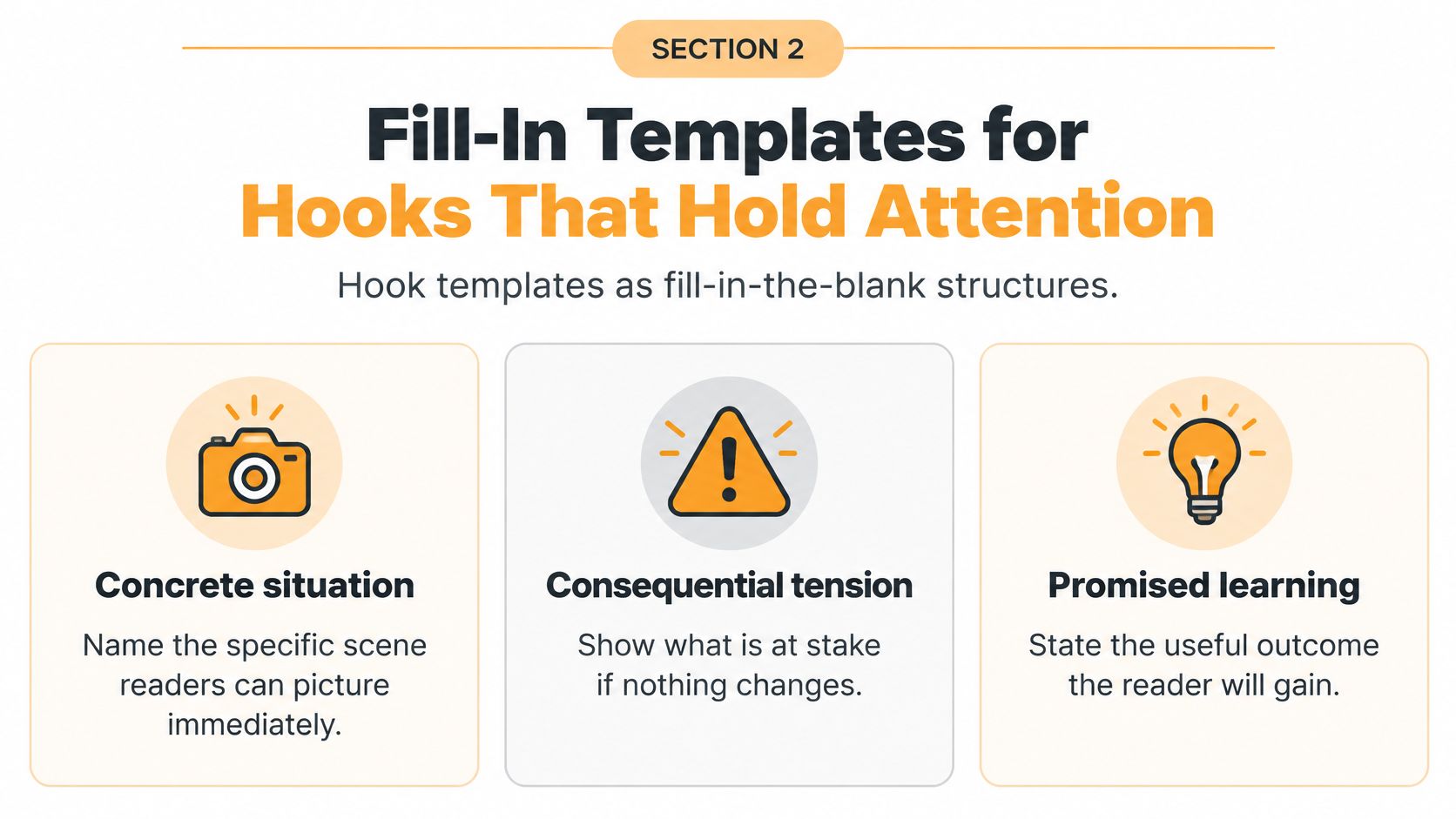
Fill-In Templates for Hooks That Hold Attention
Templates work best as fill-in-the-blank structures, not finished copy. Begin with a concrete situation, add consequential tension, and identify the learning readers can expect.
Nielsen Norman Group's guidance on succinct web writing describes how readers scan for relevant words, sentences, and paragraphs. Put recognizable concepts such as hiring, pricing, pipeline, or customer handoffs near the beginning instead of hiding them behind an abstract reflection.
Start with the business tension
[Concrete situation] + [consequential tension] + [promised learning].
Illustrative example: Our sales team booked more demos, but fewer opportunities reached proposal. Here's how we'd investigate qualification before increasing demand.
The reader can identify the sales problem immediately. The tension isn't merely that something went wrong; it's that a seemingly positive activity didn't produce the expected business result.
Adapt the structure to your evidence
I did [action] and [unexpected result]. This is what changed.
Illustrative example: I shortened the hiring brief, and the interview panel disagreed more. Here's the context I'd restore.
Use this when you can distinguish the action from other possible explanations. If you can't establish causation, describe the sequence without claiming the action caused the outcome.
Most [audience] believe [belief], but after [relevant experience], I see [reality].
Illustrative example: Founders often treat onboarding as documentation. Reviewing the handoffs can reveal a different problem: nobody owns the unanswered questions.
This fits a reasoned challenge. Replace broad claims about what everyone believes with the specific assumption your post addresses.
[Number] things that [outcome], in the order that matters.
Illustrative example without an invented count: The checks to run before approving a discount, ordered by how much they affect the decision.
Add the actual count after writing the body. Use this structure when sequence matters, rather than presenting interchangeable tips.
[Time] ago, [event], and I learned [lesson].
Illustrative example: During our last planning cycle, an unanswered customer question changed how we'd prioritize product requests.
Use a real time reference when you have one. Don't manufacture precision to make the anecdote sound credible.
Swap a single blank at a time. Changing the audience may sharpen relevance; changing the promised outcome may require rewriting the body.
Dozens of Real Hook Examples by Business Context
Use these illustrative business openers as patterns, not testimonials or reported results. Each leaves room for an explanation, decision, or practical lesson. Replace the situation with something you can document.
Sales and hiring
- Sales diagnosis: Our pilot won customers, but not through the channel we'd expected.
- Sales messaging: Adding the price changed who replied to our outreach.
- Sales process: The buyer's objection was already sitting in an unread slide.
- Discounting: The discount made our proposal easier to approve and harder to trust.
- Discovery: The prospect answered every question. We still missed the buying constraint.
- Hiring criteria: We kept interviewing because we hadn't agreed what good looked like.
- Offers: Our preferred engineer rejected the offer over something outside the salary.
- Job descriptions: Publishing the salary range changed the conversations with applicants.
- References: The most useful reference answer wasn't about performance.
- Interview design: Our interview rewarded confidence in a role that required careful listening.
Leadership and founder decisions
- Meetings: Cancelling the status meeting exposed a decision nobody owned.
- Retention: Your one-on-ones might leave no room for the concern employees need to raise.
- Priorities: A manager who accepts every request makes the team choose what to abandon.
- Feedback: The team understood the feedback but couldn't act on it.
- Delegation: We delegated the task and kept control of every decision.
- Cash flow: The product had customers. The payment terms still put the business under pressure.
- Pricing: The pricing page answered what it cost, not which plan a buyer needed.
- Fundraising: The investor's first objection revealed the missing premise in the pitch.
- Positioning: We described more features when buyers needed a clearer comparison.
- Strategy: The roadmap included every priority except the trade-off.
Marketing, operations, and customer success
- Content: The blog attracted readers who would never need the product.
- Headlines: The headline that attracted attention set the wrong expectation.
- Attribution: The campaign looked weak until we checked what happened after the form.
- Handoffs: Everyone completed their task. The customer still waited.
- Documentation: The process was documented, but the exception wasn't.
- Customer success: A customer's unanswered question changed what belonged in onboarding.
- Renewals: The renewal conversation exposed a promise we'd never defined.
Don't copy the implied conclusion unless you can explain it. A credible post might show a decision record, a revised interview question, or the exact handoff that failed.
Matching Your Hook to What the Post Delivers
Maximum mystery isn't the goal. Readers need enough information to decide whether your unanswered question deserves their time.
A 2025 meta-analysis of 8,977 headline experiments found a curvilinear relationship between concreteness and click-through rate: adding specificity helped when headlines were too vague, but hurt when they became overly explicit. That finding concerns headlines, not a guaranteed formula for LinkedIn posts, but it offers a useful editing principle.
Reveal the context, reserve the discovery
Compare these illustrative alternatives:
- Too vague: You won't believe what happened with our outreach.
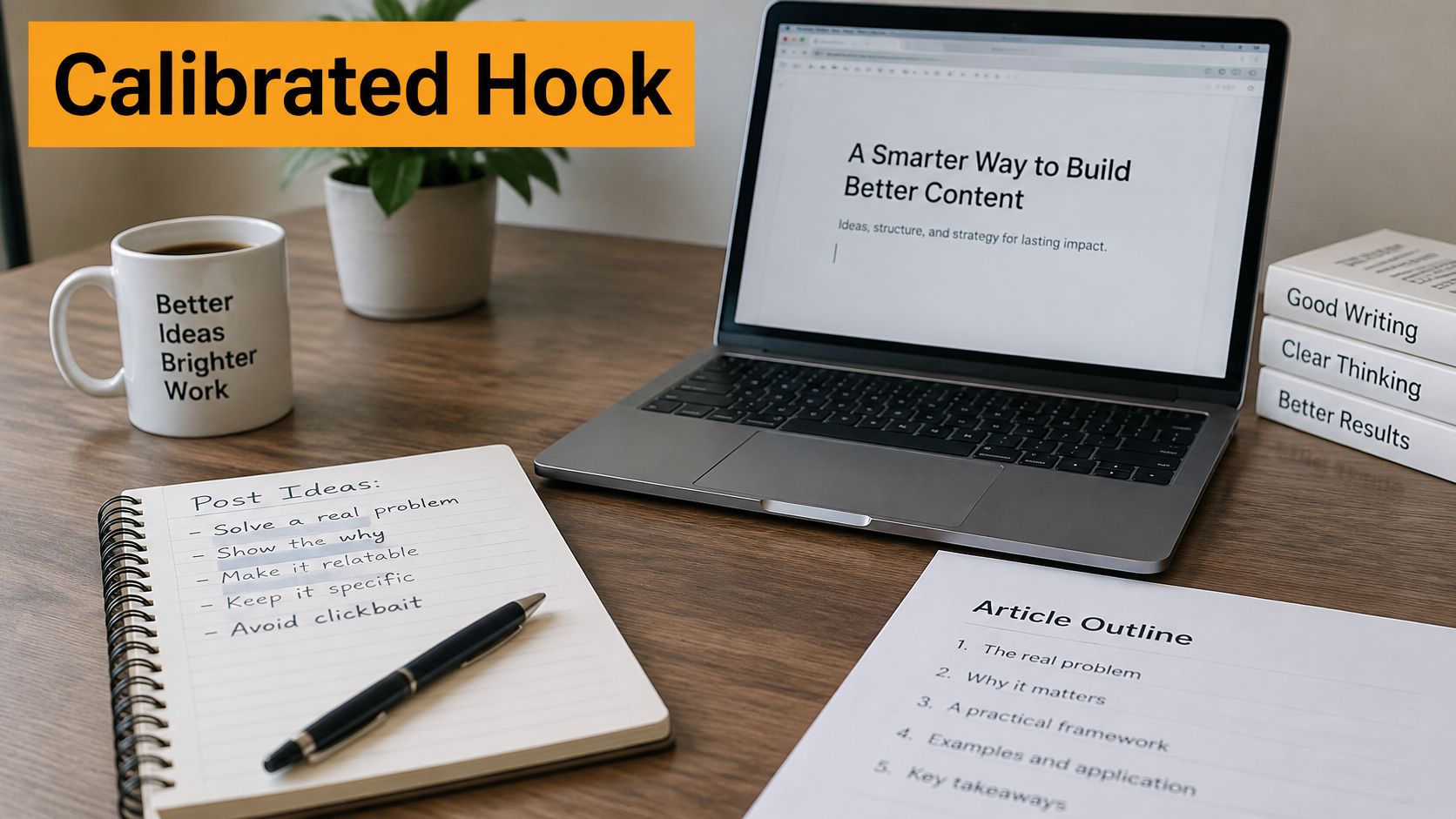
- Calibrated: Replies fell during our cold-outreach test. The change we'd made wasn't in the subject line.
- Too complete for a diagnostic story: Replies fell after we removed the sentence explaining why we'd contacted each buyer.
The middle version identifies the domain, the disappointing outcome, and a precise unresolved cause. The last version may still suit a direct teaching post, but it leaves less discovery for a narrative.
Make the body earn the opening
Ask what the next paragraph must establish. A claim about revenue needs more than a screenshot of impressions; a claim about hiring quality needs more than a busy applicant inbox.
For executives, recruiters, and B2B buyers, an exaggerated opening creates another question: can they trust your judgment?
A modest claim supported by a useful example is stronger than a sweeping claim followed by a disclaimer.
Use a hook-to-body alignment check:
- Payoff: Can the reader identify what they'll learn?
- Support: Does the next paragraph supply evidence, context, or a concrete example?
- Fairness: Would a skeptical reader consider the opening an accurate description?
Rewrite an overhyped draft by removing the superlative and adding the actual constraint. Replace an announcement about transforming leadership with the specific decision you changed, then explain its limits.
Quick Tests to Judge Hook Strength Before You Post
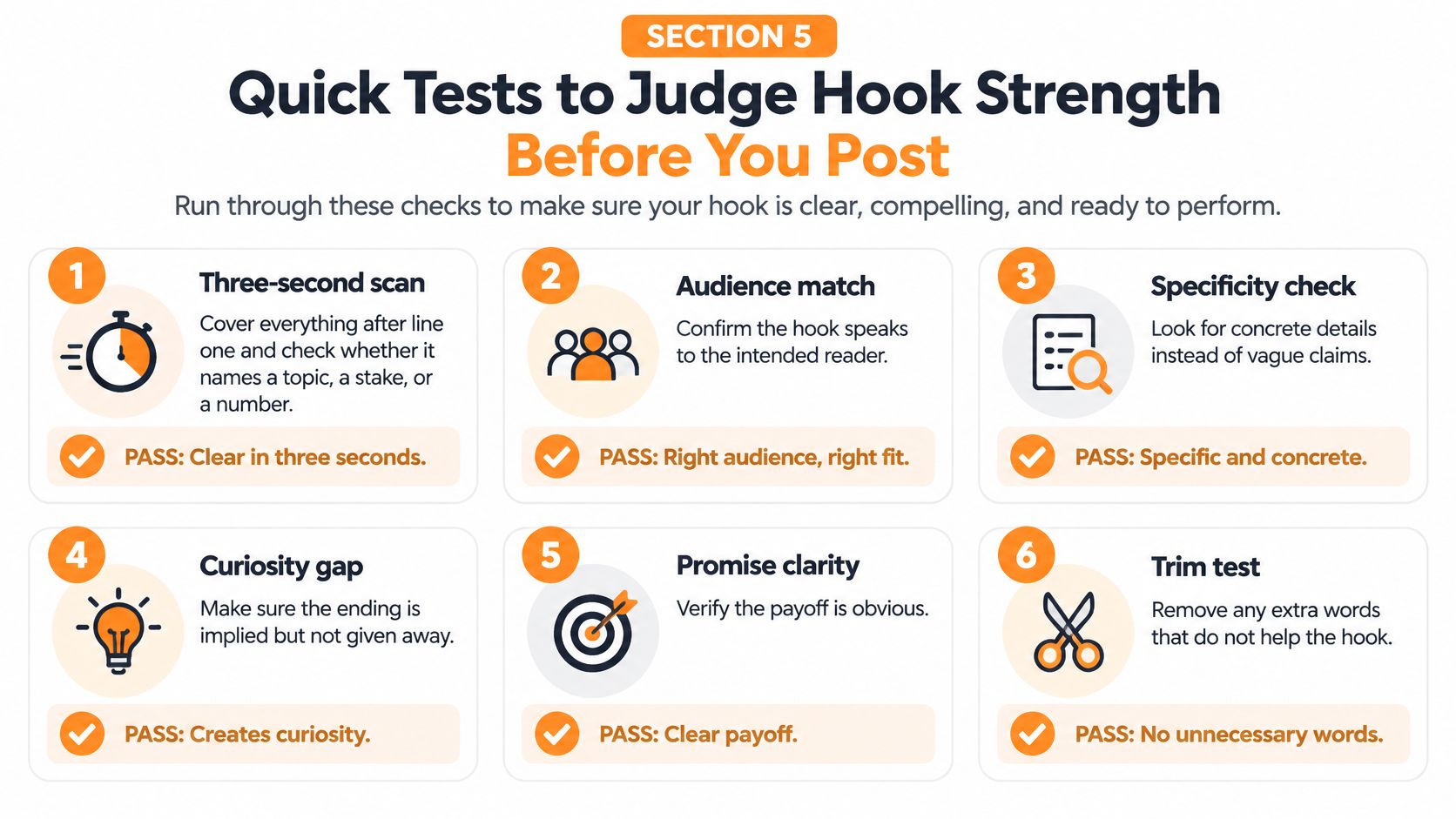
Treat this as an editorial checklist, not a prediction of engagement. Score each test pass or fail, and note the actual wording that caused a failure.
Run the checks on the finished opening
Three-second scan. Cover everything after the opening line and read it without the surrounding context. Pass sign: it names a topic, a stake, or a meaningful number.
Specificity swap. Replace generic wording such as better results with the actual outcome or business noun. Keep the detail only if it's accurate and helps the intended reader. Pass sign: the line becomes clearer and stronger.
Read-aloud test. Say the opener at conversational speed, especially if you'll reuse it in a video. Cut nested clauses and words you'd never naturally say. Pass sign: it flows without stumbling.
Promise test. Check whether the next paragraph substantiates the opening rather than postponing the explanation again. Context can qualify a claim, but shouldn't reverse it. Pass sign: the claim receives immediate support.
Substitution test. Ask whether a competitor could publish the same line unchanged. Add a relevant decision, constraint, or observation grounded in your actual work. Pass sign: the opening reflects your particular material.
Truncation test. Preview the draft in its publishing format and inspect what appears before expansion. Don't rely on a fixed line count across devices. Pass sign: the visible opening makes sense on its own.
| Test | How to run it | Pass sign |
|---|---|---|
| 1. Three-second scan | Cover everything after line one | Names a topic, stake, or number |
| 2. Specificity swap | Replace generic words with the actual figure or noun | The line gets stronger |
| 3. Read-aloud test | Say the hook out loud | Flows without stumbling |
| 4. Promise test | Check paragraph two against line one | The claim is substantiated |
| 5. Substitution test | Ask whether a competitor could use it unchanged | Reflects your particular evidence |
| 6. Truncation test | Inspect the visible opening before see more | Makes sense independently |
As a working editorial rule, aim for at least four passes before publishing. Always fix failures of truthfulness or promise alignment, regardless of the total.
Keep alternative openers with your LinkedIn post analytics. Recording which version you published prevents you from attributing a result to an opening you only considered.
Adapting Your Hook for Carousels, Videos and Newsletters
| Format | Hook job | Next lines should | Example opener |
|---|---|---|---|
| Text post | Make a complete claim that survives truncation | Support it with a concrete example | Our cold email asked buyers to do too much work. |
| Carousel | Promise a framework | Preview the framework on the opening slide | A client introduction that makes ownership clear. |
| Video | Work when spoken aloud | Show the evidence on screen | Watch what changes when we remove this sentence. |
| Newsletter | Establish the issue's payoff | Deliver the promised example early | This week, a hiring brief that resolves panel disagreements. |
These are illustrative versions of practical teaching posts. The underlying lesson can remain the same while the route into it changes.
Match the opening to the reader's next action
For a text post, follow the opening with enough evidence to establish credibility. Avoid spending the next paragraph announcing that you'll explain something later.
For a carousel, give readers a reason to advance. An opening slide can promise a decision framework; the following slide should establish its categories or show the starting problem. Compare LinkedIn post types by what the material needs, not by which format looks fashionable.
For video, edit for the ear. Replace a complicated setup with a spoken instruction and show the relevant document, screen, or example as you explain it.
For a newsletter, make the subject line and opening complementary. The subject identifies the useful issue; the first paragraph explains why it deserves attention now.
Judge relevance beyond the format
A LinkedIn content-trends analysis reports text-only posts averaging about 4% engagement, compared with roughly 6.1–6.6% for carousel documents. Those comparisons don't isolate the hook's effect: topic, creator reputation, timing, and visual structure can all influence results.
Audience selection matters too. A founder using Gritt.io to find US content creator investors needs an opening relevant to potential investors, not merely an entertaining creator anecdote.
Track saves, profile visits, and qualified replies, plus dwell time where your tools provide it. Publish a text version and a carousel treatment of a comparable idea, then examine which prompted more relevant conversations. Treat the comparison as directional, not a controlled experiment.
Write Your Next Hook and Test It This Week
Choose a drafted post and write three opening variants using different templates. Keep the body unchanged initially so you can judge which opening accurately introduces the material you already have.
Run the variants through the checklist and retain the strongest eligible version. If a story opening passes more checks than a question, don't keep the question just because it sounds conversational.
Publication rule: Publish when the opening is clear, credible, and supported. Rewrite when it depends on exaggeration or leaves the intended reader guessing about the topic.
For sales content, use The Social Search's guide to test signal-driven sales messaging as a companion when connecting an opener to a specific buyer situation.
Keep a simple log over the coming weeks: topic, hook type, checklist failures, saves, and qualified replies. Add dwell time only if it's available, and compare with your own previous posts rather than treating likes as the entire result.
If no opening works, rewrite the hook first. If every version promises something the body can't substantiate, revise the body too.
Pick the draft today and publish the strongest honest version this week. The hook earns attention; the body must justify it.
RedactAI helps you generate and refine LinkedIn hooks, then build supporting posts in your own voice. Our Done For You service also includes scheduling posts at peak engagement times. Visit RedactAI to turn your next idea into a draft with an opening you can test and a body that keeps its promise.