Your last four posts are a blur. One of them pulled a message from a prospect you'd like to work with. Another got a thoughtful comment from someone senior. The other two did nothing you can name, and if someone asked you this morning which post did what, you'd be guessing.
That isn't a discipline problem. It's a record-keeping problem, and it's the reason a search for a content calendar template usually ends with a spreadsheet full of dates that goes quiet by week three. Dates alone tell you nothing. A calendar earns its keep when every row states what the post is testing, so six weeks later you can look back and see which bets paid off.
The template below is built that way. It's an experiment log wearing a planner's clothes.
A Content Calendar Template You Can Copy Today
Copy the columns first. Arguing about Notion versus Google Sheets can eat an afternoon you could spend planning four weeks of posts. Ten columns, one row per planned post or asset, and each row answers a question you'd otherwise answer badly at 11pm.
| Column | What to Enter | Example Entry |
|---|---|---|
| Publish date | Calendar date of the post | Tue 24 Nov |
| Scheduled time | Exact posting time in your audience's time zone | 08:30, before the commute scroll |
| Audience segment | The one reader this post is written for | Sales directors at mid-size software firms |
| Content pillar | The recurring theme the post belongs to | Client results |
| Post hypothesis | What the post is testing, in one sentence | A short client story gets more profile visits than a tips list |
| Firsthand evidence | The real example, number or experience behind the claim | Onboarding cut from 3 weeks to 9 days |
| Format | Text post, carousel, short video or newsletter tie-in | Text post with one image |
| CTA | The single action you want | Comment with your onboarding checklist |
| Owner and reviewer | Who writes it and who approves it | Writer: you; reviewer: your operations lead |
| Draft status | Idea, drafting, in review, approved or scheduled | In review |
Scheduled time deserves its own note. Write a clock time in your audience's time zone, not "morning" and not "when I get to it". A fixed slot is the only thing that makes an 08:30 post comparable to next Tuesday's 08:30 post.
Set this up in Google Sheets in about ten minutes. Paste the headers into row 1, freeze that row, then add data validation to the draft status column so the only options are Idea, Drafting, In review, Approved and Scheduled. Conditional formatting by status turns the sheet into something you can read from across the room without opening a single cell. Notion works the same way if you prefer a database view, but the frozen spreadsheet wins on speed.
A calendar that records only dates is a diary. A calendar that records bets is evidence.
Leave audience segment and content pillar blank until you've read the next section. Owner and reviewer applies to solo creators too, because a second look, whether from a peer or against a written checklist, catches the unverifiable claim before your name is on it. That matters more as teams shrink. The 2025 B2B content marketing benchmark coverage from Recognition reports that 76% of surveyed organizations had a dedicated content team, yet 54% of those teams were only two to five people, and around 24% had no dedicated team at all. The same analysis found 55% of marketers struggled to create content that drove desired actions. One person handling ideation, drafting, approval and reporting is the normal case.
A spreadsheet costs nothing. If you'd rather start from a designed layout, Ruth LovettSmith's annual calendar template, a Canva PLR product, was priced at $21.97 in 2025. And if part of your output feeds a visual channel, this content planning template for creators from Gainsty uses a layout built around image-led posts, with column logic you can transfer to LinkedIn without much work.
For the first month, fill only the first six columns. Rhythm beats completeness.
Set Your Audience and Pillars Before Any Dates
A calendar fails from the top down. The Content Marketing Institute and MarketingProfs 2025 benchmark research, which analyzed responses from 980 B2B marketers, found that 95% had a content marketing strategy but only 29% rated it extremely or very effective. Just 47% had a documented strategy at all. Among marketers who rated their strategy moderately effective or worse, 42% attributed the weakness partly to a lack of clear goals.
None of those figures is really about calendars. All of them describe purpose dissolving somewhere between the strategy deck and the posting schedule. If your rows don't point back to a named reader and a named theme, you're publishing into a void and calling it consistency.
Three decisions before you touch the sheet
Name one primary reader, in a sentence. Not "B2B decision-makers". Write: a sales director at a mid-size software firm who needs help with outbound messaging. One person. Every row in the sheet gets that reader's name in the audience column, and any idea that doesn't serve them waits in an ideas tab.
Convert their recurring problems into pillars. List the three or four problems that reader brings you every week, then name a pillar for each one. "Pipeline without cold calls" is a pillar. "Thought leadership" is a category nobody can plan against, because it describes a vibe rather than a problem.
Write one editorial mission line. A sentence like "help sales directors replace cold outreach with inbound conversations" settles most scheduling arguments in ten seconds. If an idea doesn't move that line forward, it doesn't get a row.
The mapping is mechanical once the thinking is done. The pillar "pipeline without cold calls" produces audience segment values like sales directors at mid-size software firms, and pillar values like client results or outbound teardowns. A durable LinkedIn posting strategy rests on exactly these two choices, which is why they're worth an hour before you type a single date.
Rule of thumb: if you can't name the reader in one sentence, no amount of scheduling will rescue the post.
How to Fill the Calendar in Five Steps
A finished row reads like a bet. "Competitor teardown, LinkedIn, carousel, due the 14th, owned by Priya, testing whether teardowns beat tip posts." Compare that with the row an empty sheet invites: "post something Tuesday." Five steps turn the second into the first. Each comes with the reason it exists and the slip that kills it.
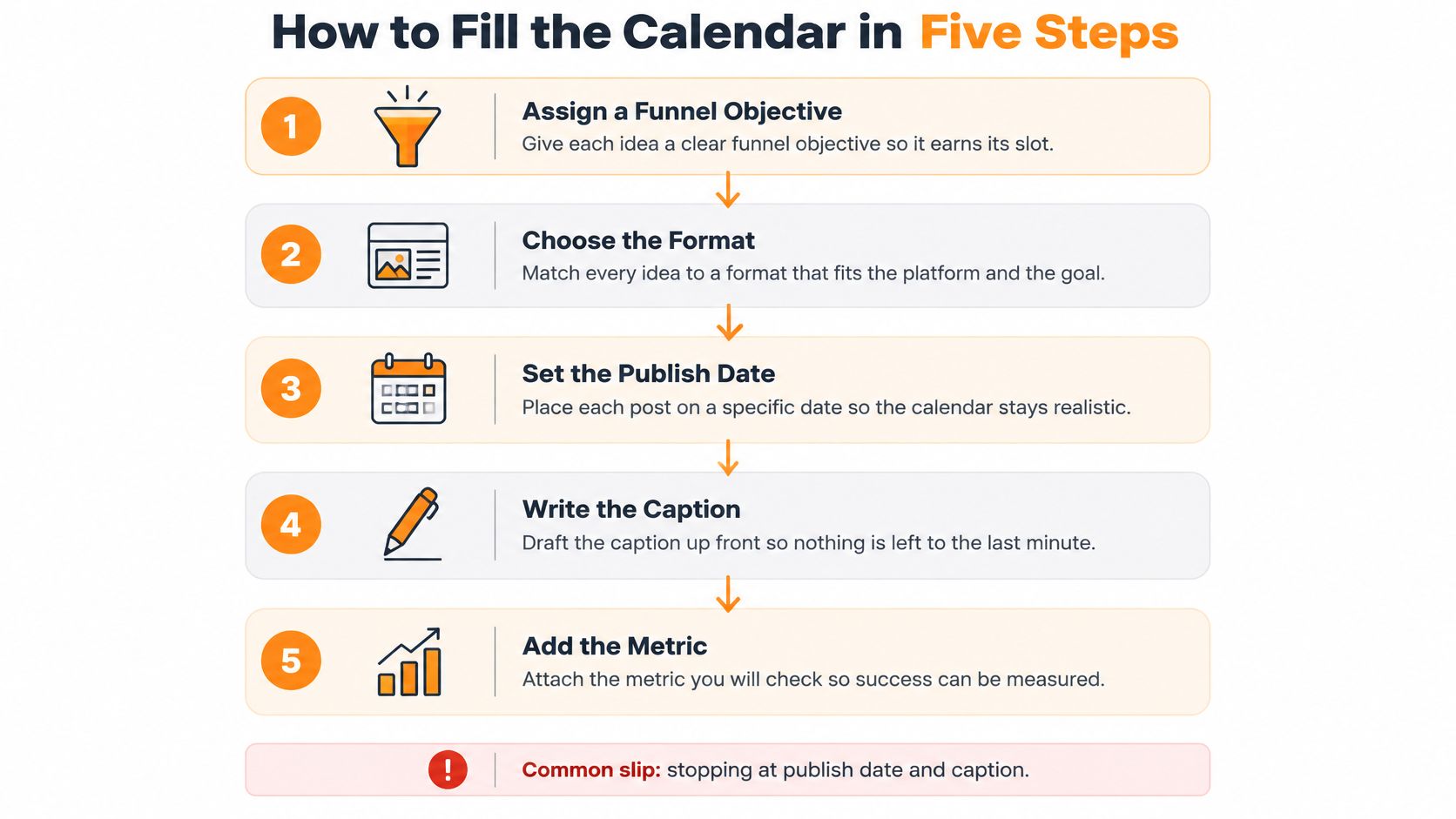
Fill every field before the row earns a date. Objective, format, owner, deadline, channel, success metric and hypothesis. A row with a date but no owner is a wish, and a row with no hypothesis is a post you'll never learn from. The hypothesis is one typed line, something like "carousels hold attention longer than text posts with this reader." The usual slip is attaching the deadline to the idea instead of the person, so the date arrives with nobody accountable for it.
Book the production milestones as their own dated rows. Research, drafting, review, approval, publication and repurposing each get a slot on the sheet. Leave them in your head and drafting collides with approval on the same afternoon, which is how rushed claims get published.
Hold three or four pillars, no more. Pillars are what let a reader recognize your beat after six posts. They also make the experiments readable. When every row sits inside a stable pillar, a winning post means something because the losing rows give it context. The slip is inventing a new pillar for every shiny idea, which scatters the sheet into unrelated fragments that can't be compared.
Review on a fixed cadence and score the predictions. Pick one 30-minute slot, weekly or monthly, and defend it. The session exists to mark each hypothesis right or wrong and write one line on why, so next month's rows start smarter. Skipping one review rarely hurts. Reviewing only after a bad week turns the session into a post-mortem instead of a planning habit.
Gate every row before it moves to drafting. It needs an owner, a date, a pillar, a measurable goal and a stated test. Rows missing any of the five go back to the ideas tab. The slip is dragging unfinished rows forward week after week and calling it progress.
None of this is bureaucracy for its own sake. CMI's 2024 B2B research found that 31% of respondents had no structured content-production process and 29% lacked an editorial calendar with clear deadlines. Those are exactly the gaps that owners, milestones and gates exist to close.
Here's the walkthrough if you'd rather watch the process than read it.
Adjust the columns to your situation. A solo creator can drop the funnel objective and keep the hypothesis and the metric. An agency adds a client field and a separate approval date, because the client's sign-off is a real dependency. For a broader look at how pillars, formats and channels hang together, these content strategy template resources from Silva Marketing pair well with the sheet. Whichever columns you cut, keep the hypothesis field. It's what turns next quarter's calendar into a record of what worked.
Which Numbers to Track and When
Likes are the easiest thing to count and the least useful thing to defend in a budget conversation. Most templates stop at publish date, caption and channel, which leaves you unable to explain why a post mattered when a prospect saw it three weeks before converting. That gap is common. The CMI 2025 B2B trends research reports that 56% of B2B marketers have difficulty attributing ROI to content, and 44% cannot tie performance to business goals.

The fix is to split the numbers by how fast they arrive. Leading indicators tell you within a week whether the post did its job. Lagging indicators tell you whether it mattered commercially.
| Metric | Signal Type | When to Check |
|---|---|---|
| Publishing consistency | Leading | Every week |
| Approval time | Leading | Every week |
| Engagement rate | Leading | 7 days after each post |
| Profile views | Leading | 7 days after each post |
| Qualified conversations | Lagging | Monthly |
| Pipeline influence or hires | Lagging | Quarterly |
One rule that makes review fast
Every hypothesis in the calendar should name the number it expects to move. "A short client story gets more profile visits than a tips list" is testable. "Share a client win" is not, and it will survive three reviews without anyone deciding whether it worked.
When you sit down to review, compare the result against the test in that row, not against a general feeling about how the month went. Judge each post against your rolling baseline, meaning the average of your last eight posts on the same pillar, before you touch your publishing cadence. One strong post is a data point. Eight on the same theme is a pattern. If you want a deeper walkthrough of the numbers, this LinkedIn analytics report template shows how to lay them out so a monthly review takes minutes.
Keeping Consistency Without Repeating Yourself
Consistency earns attention, and repetition burns it. An analysis of 1 million LinkedIn posts from 9,000 active business pages put the average engagement rate at 5.00% in 2025 reporting and found that businesses posting weekly received twice the engagement of inconsistent publishers. Frequency still has a ceiling. Cramming a second post into the same day means the two compete for the same feed, so a weekly rhythm you can hold beats a daily one you abandon by week three.
The goal is a cadence you can sustain with ideas you can defend. Repurposing does the heavy lifting: one solid idea carries several weeks of posts, and building that sequence well is the part B2B content teams usually find harder than the writing itself.
One idea, five posts
Take a single source idea, say a lesson from a project, and run it through a controlled sequence over six weeks. Each version changes at least two things, so the reader gets novelty rather than a rerun, and each row in the calendar records what that version is testing.
- Version one, the original lesson. The story as it happened, with the concrete detail and the number attached. This row is your control.
- Version two, the contrarian follow-up. Same audience, different hook, arguing against the obvious conclusion people drew from version one. It tests whether the angle or the story did the work.
- Version three, the checklist. Format shifts to a list, evidence shifts to a process you can copy. It tests format alone.
- Version four, the personal case. Narrower audience, more specific evidence, one clear takeaway you paid for in time. It tests how far specificity travels.
- Version five, the results update. What happened after the first four posts ran, with whatever changed. It tests whether reporting your own log earns engagement.
Then install fatigue controls, because repeating one idea five times invites lazy overlap. Keep a minimum gap of about five days between related posts, and maintain a repetition tracker listing the claims and hooks you have already used, so a familiar opening never slips through. Any AI-assisted draft gets a review checkpoint: Google's guidance on creating helpful content asks whether the reader leaves with a useful answer, which is a fair filter for a recycled post too.
Fatigue check: if you can predict the last line of your own draft before you write it, so can your reader.
A documented content repurposing framework saves time because the sequence and the tracker run as one system. Leave one slot a week empty for a reactive post. A fully packed calendar breaks the first time industry news, a client call or a compliance review changes your week.
Schedule Your First Four Weeks This Week
Copy the template, add two pillars, and fill four weeks of rows in one sitting of about an hour. Roughly two posts a week, each with an audience, a hypothesis, a named metric and an owner. That's eight rows, and eight rows is enough to learn something.
Then hold one variable still for the whole month. Same pillar, same format, same CTA for four weeks, so the results are comparable and the comparison means something. Change everything at once and you'll finish the month with four opinions and no evidence.
If you'd like the calendar and the publishing to live in the same place, the Essential plan includes post scheduling, post preview and styling, and statistics and insights, so planned rows go live at the times you chose and the results sit next to the plan. Recycling helps too: we can turn a YouTube video or a blog post into LinkedIn drafts in seconds, which is exactly the sequence from the previous section.
Start the four-week plan today, and let the log prove what your calendar is worth.
RedactAI is built for the version of this that sticks. It learns your voice from your profile and past posts, drafts multiple options from a few keywords, and then schedules them at the times you blocked out in the sheet, with the results landing beside the plan so your weekly review takes minutes instead of guesswork. When you're ready to stop rebuilding the calendar from scratch every month, visit RedactAI and start with the four-week rhythm above.