Post every day and the clients will come. That's the most popular advice on LinkedIn for consultants, and it's mostly backwards. Daily posting into a vague profile, with no named buyer and no way to book a conversation, just trains you to produce content nobody can buy from. I've watched smart consultants burn months on reach while referrals, the channel that actually pays them, went quiet. Don't start with frequency. Start with positioning, proof, and a way to tell which activity created a real conversation.
The Six Steps to Build Your LinkedIn Presence in Order
The useful question is which stage of your pipeline each LinkedIn action feeds. Your audience there is not random: it includes executives, procurement leaders, founders, recruiters, and investors who list their industry, function, seniority, and geography.
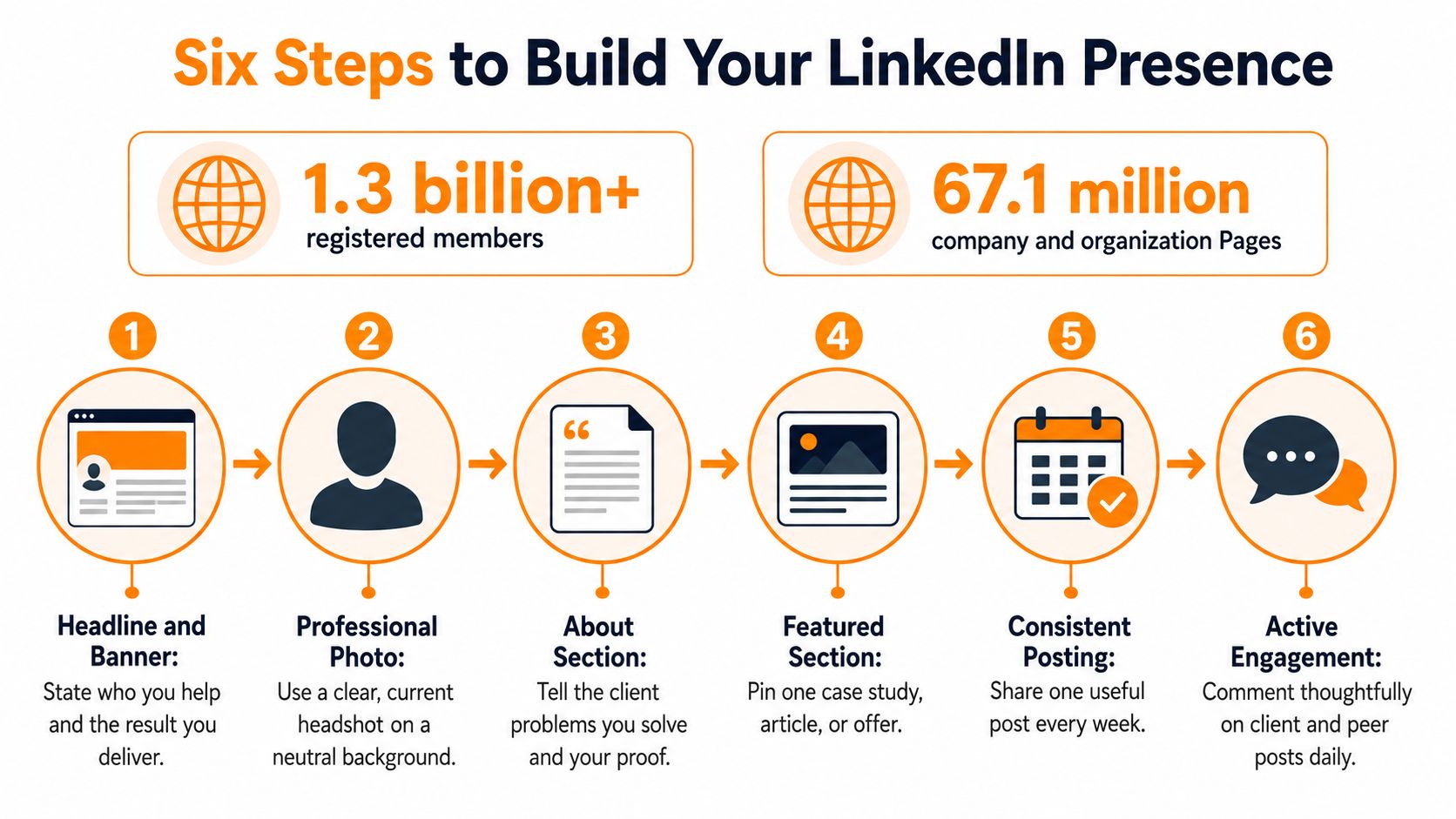
The Working Order
- Pick one buyer, one problem, one result. This is pipeline targeting. Choose a buyer title, the problem they will pay to solve, and a result you can prove. Give it one afternoon and write it in one sentence.
- Rewrite the profile around that result. This is conversion. Fix the headline, banner, About section, and Featured area before you ask for attention. As a working example, budget two to three hours and do not post until it is done.
- Build a proof stockpile. This is trust. Over one week, in short sessions, draft 20 to 30 hooks and proof points from proposals, debriefs, and delivery notes you have already written.
- Start a fixed weekly rhythm. This is awareness. Use set slots you can keep during busy client weeks, because a rhythm you abandon teaches the market nothing.
- Run a daily outreach block. This is conversation creation. Spend 15 minutes commenting on buyers' posts with something specific, then send connection notes that reference the problem, not your bio.
- Log everything from day one. This is attribution. Track profile views, inbound messages, referrals, and meetings in a simple sheet. If you do not log the source, you cannot tell what worked.
Your stage changes the weighting. In the first couple of years, outreach and referral follow-up usually carry more revenue than posting, so steps five and six deserve extra discipline. With a deeper client history, your proof stockpile is thicker and step three gets faster.
Practical rule: Don't publish to fix a positioning problem. Fix the positioning, then publish to distribute it.
If AI helped draft a post or note, run a human pass before it goes out: read it aloud, cut claims you cannot defend on a client call, and keep specifics that came from your work. This week, finish steps one and two before anything else goes live.
Headline, Banner and About Lines That Name a Buyer and Result
Run the three-second test first. A first-time visitor should identify your buyer, problem, proof, and next step within seconds. Most consultant profiles fail here because they list roles, employers, and service menus. Buyers hire a person who clearly solves their problem, and a stack of job titles doesn't tell them whether that's you.
How much this matters depends on your stage. In the first few years of a practice, referrals still carry the pipeline, and the profile's job is to confirm what a referrer told the buyer about you. Later, when posting generates inbound on its own, that same profile becomes the conversion point for people who have never heard your name. Either way, it sits at the same pipeline stage: the moment interest becomes a decision to reach out or move on.
Pick a Headline Formula
| Headline formula | Example headline | Use when |
|---|---|---|
| Outcome first | Helping logistics directors cut late deliveries by a fifth within one quarter | You can prove a measurable result |
| Buyer and problem | Pricing consultant for B2B software firms stuck below 40% gross margin | Your niche is narrow and named |
| Credential plus outcome | Former audit partner now fixing month-end close for private equity portfolios | Your background is recognizable to buyers |
| Role title only | Senior Consultant, Strategy, Transformation | Avoid, it fails the three-second test |
The first three work because a buyer can self-identify in them. The fourth could belong to thousands of people and gives a visitor no reason to keep reading. If you're rebuilding your wider positioning at the same time, this guide to personal branding for consultants covers the identity work behind the headline.
Treat the profile as a trust-and-conversion funnel rather than a CV. A small exploratory study mixing platform analytics, profile surveys, and a readability audit suggested that profile clarity and focused communication matter for results on LinkedIn, as described in the study on profile clarity and funnel design. Take it as a useful signal rather than proof, though it matches what I've watched happen when a strong post sends a buyer to a vague profile and the click dies there.
Build the Rest in Order
- Banner. One line naming the outcome plus one proof point, such as a client logo or a result you've delivered. Don't turn it into a menu of services.
- About opening. Two sentences describing the buyer's situation in their own words. Skip your job history, they'll find it further down.
- About middle. Three short proof blocks, one client result, one method, and one credential. Keep each block tight enough to scan on a phone.
- About close. One call to action, such as booking a 20-minute diagnostic, with one link. Two competing calls to action usually means neither gets clicked.
- Featured section. Three items only, a diagnostic checklist, a written case study, and a booking link. This is your shop window, not an archive.
If you drafted any of this with AI, run a human pass before publishing. Read it aloud, cut claims you can't back with a real project, and make sure the phrasing sounds like something you'd say on a call. Buyers who meet you after reading the profile will notice a gap, and trust is hard to rebuild at that point.
Test two outcome-focused headlines over several weeks before changing anything else. Hold your audience and call to action constant so you know what moved the numbers. Consultants who change the headline, banner, and posting topics in the same week learn nothing, and then they blame the platform.
The usual failures are predictable. Generic titles like Senior Consultant, About sections that read like a CV, and topic lists so broad that nobody can tell who you help. A profile that passes the test gives every post a destination worth landing on.
Post Types, Hooks and a Cadence You Can Keep
Twenty content ideas will bury you. Six post types will not. Each one proves something different about how you work, and the mix repeats without much thinking.
| Post type | What it proves | Example angle | Posts per ten |
|---|---|---|---|
| Case-led story | Your method under a real constraint | How a proposal cycle dropped from six weeks to nine days | 2 |
| Diagnostic checklist | How you spot the problem | Seven signs your pricing review is really a volume problem | 2 |
| Contrarian point of view | Judgment on a common belief | Why annual planning in Q4 locks in last year's mistakes | 2 |
| Framework breakdown | Your repeatable method | The three-question scoping call | 2 |
| Client-safe lesson | Honesty about what went wrong | The project we should have declined | 1 |
| Offer or booking post | The next step | Diagnostic slots open this quarter | 1 |
The mix shifts with your years in practice. Early on, checklists and contrarian points carry the weight, because they fill the top of the pipeline without needing a client story you may not have yet. With a longer track record, case-led stories and the occasional offer post take over the middle and bottom of the funnel. At every stage, referrals still close more work than any posting schedule.
Every post should lead to one low-friction action, such as a diagnostic conversation or a downloadable checklist. The pitch stays soft and the next step stays visible. Posts without that path collect reactions and strand interested buyers.
There is room to stand out. Edelman and LinkedIn surveyed 1,934 global business executives for the 2025 Edelman and LinkedIn B2B Thought Leadership Impact Report. Earlier editions of the same research found buyers giving thought leadership real time each week while rating most of it poorly. Specificity beats volume. Explain why a familiar problem persists, show your decision logic, and say plainly when your approach should not be used.
Hooks That Earn the Click
- A specific result with a twist. A real number plus a turn. As an example of the pattern: a proposal cycle falls from six weeks to nine days, and the fix turns out to be something other than the proposal. Hooks like this only work when the numbers come from your own engagements.
- A common belief you think is wrong. Name the belief, then give your reasoning. Faked controversy reads as bait.
- A decision question. Ask about a choice your buyer faces this quarter, not a generic opinion poll.
Keep one fixed slot per post type and test posting times for four weeks instead of guessing. A cadence you keep during a heavy delivery month beats an ambitious one you abandon. Skip engagement bait and unsupported hot takes, which bring reactions without purchase intent. Buyers scrolling your profile later can tell the difference.
Earning Visibility Through Comments, Connections and Pitches
Outreach works as a sequence, not a blast. Most consultants either pitch strangers cold or never reach out at all. Both waste the asset you've built with your profile and posts. The middle path is slower, and it's the one that produces meetings.
Build Two Lists First
- Buyers. 20 to 30 people whose titles match your buyer exactly. These are the posts you'll comment on.
- Referrers. 10 to 15 former clients, accountants, lawyers, and partner firms who already trust your work.
Run a daily block. Comment on three to five buyer posts, ideally within the first hour, in two or three sentences each. Add a specific observation or a real question. Never pitch in a comment. A comment that reads like a mini case note makes buyers curious enough to check your profile, and now your profile does the selling.
Messages in the Right Order
Your connection note should reference shared context, nothing more.
Hi Dana, your post on delayed month-end close matched what we see in mid-size distributors. Glad to connect.
That works because it's about her post, not your services. After acceptance, send thanks plus one question about their current priority, with no offer attached. You're learning whether a real problem exists.
Pitch only after two real exchanges, and keep it low pressure.
Would a 20-minute call on the warehouse backlog be useful? If not, no problem at all.
The easy exit is deliberate. It protects the relationship if the timing is wrong, and timing is usually the issue, not interest. For referrers, ask a former client to introduce you to one named person, and give them a two-line blurb they can forward. Don't ask anyone to keep you in mind. That's homework you're assigning to a busy person.
Watch the edge cases. Don't message profile viewers with an offer, don't tag senior names on posts to borrow reach, and in regulated sectors like finance or health keep every example fully anonymized. Track which stage of the sequence produces your meetings. If comments start conversations but connection notes don't, spend more time commenting and less time connecting. Let your own funnel tell you where the advantage is.
Repurposing and Drafting With AI Without Losing Your Credibility
One validated idea should feed a week of content. Start with a client-safe insight from real work, write a 600 to 800 word long-form draft in your own words, then cut it into four to six posts. A case story, a checklist, a contrarian take, and a short video script can all come from the same draft. If you want the wider system, this content repurposing framework maps the full chain.
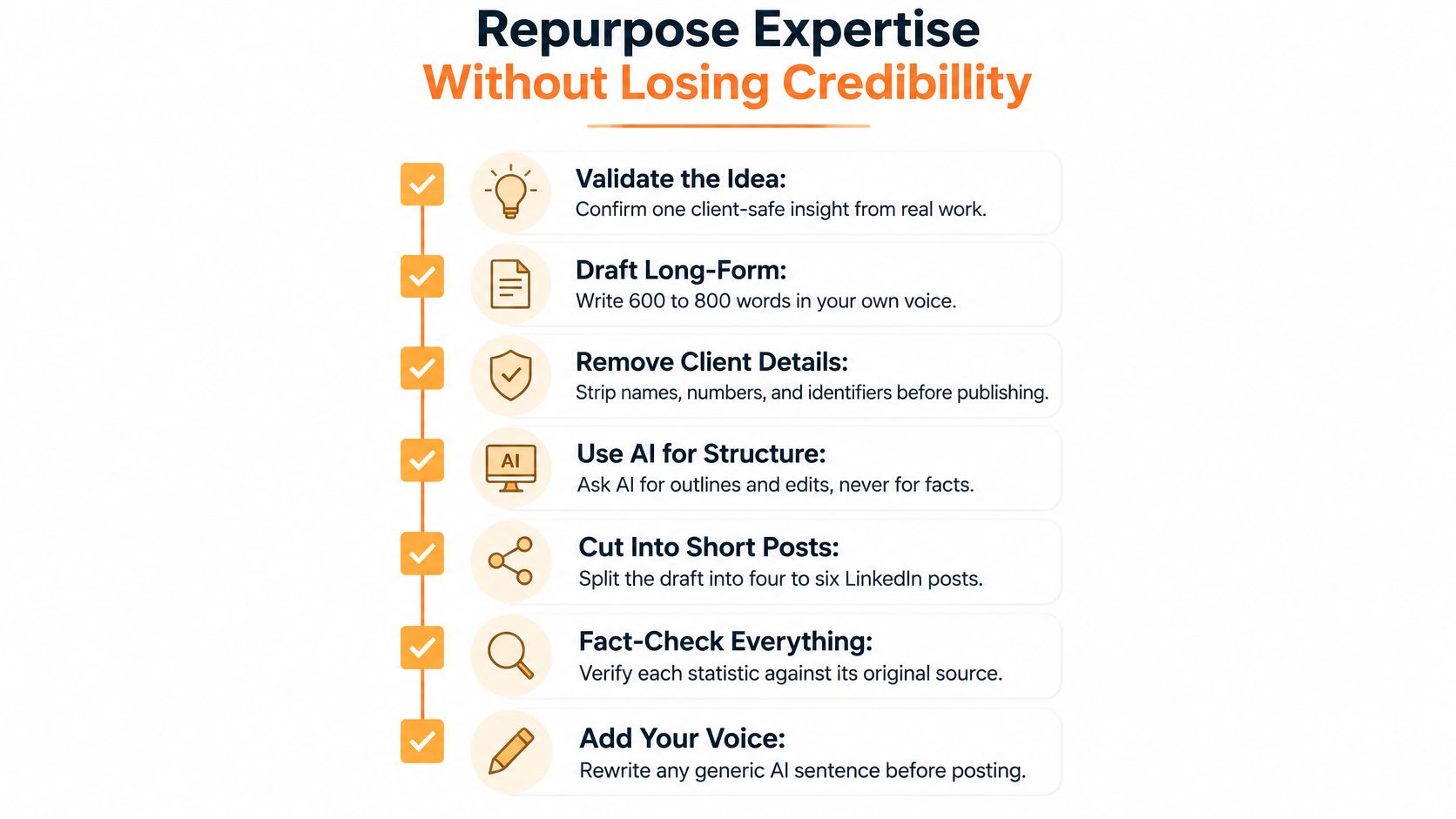
AI earns its place at the drafting step. The thinking stays yours. RedactAI builds a personalized language model from your profile, post history, and experience, generates drafts from keywords, suggests hooks, schedules upcoming posts, and recycles top performers. You spend review time instead of blank-page time, and the judgment, evidence, and point of view still come from you.
Format mechanics do move engagement, within limits. A 2025 analysis of 991 LinkedIn posts measured how tags and hashtags affected post performance and found both significantly increased expected reactions, while tags also increased comments, as reported in the 2025 analysis of 991 LinkedIn posts on tags and reactions. The study counted reactions and comments on the post itself. It did not measure what a tag signals to the person tagged. Tagging a co-panelist or a client who agreed to be named tells a real participant the conversation is live. Tagging a senior name to borrow their reach asks a stranger to carry your distribution, and the stranger can see that even when the reaction count can't.
How much that reaction bump is worth depends on your stage. Early in practice, when LinkedIn carries most of your inbound, take the format gains where they exist. Once referrals carry the pipeline, one misplaced tag costs more credibility than the extra reactions earn.
The Human-Verification Layer
- Remove client-identifying details. Names, numbers, timelines, and anything a reader could reverse-engineer.
- Separate experience from reading. Mark what you did, what you observed, and what you only read about. Never let a draft invent an anecdote.
- Verify every number. Check each claim against its original source before it goes near your name.
- Keep stated uncertainty. If evidence is mixed, say so. Buyers trust consultants who show their limits.
- Rewrite to your actual view. If you wouldn't defend a sentence on a sales call, cut it.
- Protect confidentiality. Never paste confidential client material into prompts.
Keep the tool stack simple. A scheduler for timing, a shared document as your idea bank, and a spreadsheet or free CRM tier to tag each post by offer, buyer, and source. If your work is regulated, add a second reviewer before anything goes live. That one extra pair of eyes is cheaper than one compliance conversation.
Metrics and Benchmarks by Practice Stage
A benchmark that ignores how long you have been independent will mislead you. Two years in, LinkedIn often has to carry real inbound weight because the referral network is still thin. Fifteen years in, referrals usually close most of the work, and LinkedIn's job shifts to warming introductions that already exist.
The image below suits this section because this is desk work, comparing your sheet against your pipeline.

| Practice stage | LinkedIn's main job | Metric to watch first | Illustrative first milestone |
|---|---|---|---|
| Under 3 years independent | Primary inbound source | Qualified inbound messages per month | Example: 2-4 discovery calls a month |
| 5+ years with content library | Supports blog and referrals | Profile-view-to-call rate | Example: beat your own baseline each quarter |
| Agency or firm partner | Team visibility and partner referrals | Referral-partner introductions per quarter | Example: a steady flow you can name by source |
| Referral-first specialist | Warms existing introductions | Introductions turned into proposals | Example: conversion rate before volume |
Treat that right-hand column as worked examples, not researched targets. To set your own baseline, pull the last 90 days of leads from your CRM, count them by source, and take your median month. Your first milestone sits one step above that number, not at a figure borrowed from someone else's table.
Referrals still beat posting for established practices, and your stage decides which metric leads. Early on, count inbound messages. Later, count introductions converted into proposals. If referrals already deliver most of your revenue, LinkedIn's role is keeping those introductions warm rather than generating cold demand from scratch.
Whatever the stage, track the same funnel: profile views per week, qualified inbound messages, conversation-to-meeting rate, meeting-to-proposal rate, and closed revenue by source. For a plain definition of what each of those counts, this walkthrough of LinkedIn analytics for consultants explains the standard terms.
The short video below shows one way to build that tracking sheet from scratch, so watch it before you design your own columns.
Tag each lead by source in your CRM, post, comment, referral, or direct message, then compare against closed revenue after 90 days. Reactions and impressions are weak signals on their own. Treat video watch time as a secondary check, useful for judging attention, never demand.
Run a Six-Week Positioning Test Before You Scale
Run the test for six weeks and let it answer one question: do you scale posting, or change the offer? Pick the decision before you collect a single number, then judge it by stage. A consultant under three years in is usually chasing first inbound conversations, while a referral-heavy practice is testing whether LinkedIn can add a second source without stealing partner time.
- Week 1, baseline. Record profile views, inbound messages, calls, and source tags from the sheet you started in step six.
- Weeks 2 and 3, headlines. Test an outcome-led headline against a buyer-and-problem headline with the same audience and call to action.
- Weeks 4 and 5, pillars. Test case stories against diagnostic checklists, again with one call to action.
- Week 6, read the numbers. Compare qualified messages, calls, and meetings by source against Week 1. If one option produced a clear rise, keep it and give it a larger share of the calendar.
If nothing moved, revisit the offer and buyer before touching cadence. If most leads still arrive through referrals, protect that channel and use LinkedIn to stay visible to referrers. If comments started more conversations than posts, shift hours toward outreach. Change one variable at a time, date every edit, and ignore reactions when they fail to become qualified conversations.
On Monday, open the tracking sheet, tag last month's leads by source, and write the baseline before changing a single headline.
If drafting is where the week slips, RedactAI can turn validated ideas, your profile, and past posts into on-voice drafts; run each one through your human-verification check before scheduling. Let qualified conversations decide whether the test worked.