You're probably here because you typed some version of “how do I open my LinkedIn profile,” clicked into settings, and realized LinkedIn uses several different switches that sound similar but do very different things.
That confusion is normal. One setting affects what people can see. Another affects who can message you. A third affects recruiter signaling. If you turn on the wrong one, you can end up disappointed, thinking LinkedIn “didn't work” when setup was the issue.
The practical fix is to treat your LinkedIn presence like a system, not a single toggle. You need the right visibility settings, the right profile copy, and a way to stay active enough that people have a reason to reach out. Get those three pieces aligned, and your profile stops acting like a static resume and starts acting like a real career asset.
What Does "Open LinkedIn Profile" Really Mean
Individuals often use open LinkedIn profile as shorthand for “make me easier to find and contact.” The problem is that LinkedIn splits that idea across separate features.
That's why someone can turn on one setting and still not get the result they expected. They made themselves more contactable, but not more findable. Or more visible, but not easier to message.

Public visibility is not the same as messaging access
The first meaning of “open” is public profile visibility. This controls what people outside LinkedIn, including search engines and non-logged-in visitors, can see. If your goal is discoverability through Google or a shareable public profile, this is the setting that matters.
The second meaning is Open Profile, which is a LinkedIn Premium messaging feature. It lets anyone on LinkedIn message you for free even if they aren't connected to you first, according to Valley's walkthrough of LinkedIn Open Profile settings. That changes the workflow from “send connection request and wait” to “send direct message now.”
A third idea people often bundle into this is Open to Work. That's a recruiter signal, not a visibility or messaging control. It helps communicate job-search intent, but it doesn't make your profile public and it doesn't create the same inbox access as Open Profile.
Open Profile helps you be contactable, not necessarily findable.
That distinction matters because many users expect one switch to do all three jobs. It won't. As LinkedHelper's explanation of Open Profile points out, people often confuse profile visibility with Open Profile messaging access, even though LinkedIn treats them separately.
A simple way to think about it
Use this framework when deciding what to change:
| Setting | What it changes | Best for |
|---|---|---|
| Public profile visibility | What outsiders and search engines can view | Personal branding, search discoverability |
| Open Profile | Who can message you on LinkedIn without connecting first | Sales, consulting, recruiting, partnerships |
| Open to Work | Recruiter-facing job interest signal | Active job seekers |
If you want inbound opportunities, don't ask “How do I open my LinkedIn profile?” Ask three better questions:
- Can people find me
- Can people message me easily
- Does my profile make them want to contact me
That last one is where most profiles fall apart.
Mastering Your Public Visibility and Privacy Controls
LinkedIn privacy settings aren't just administrative housekeeping. They shape how discoverable, approachable, and visible you are in daily networking.
Start with the controls that affect your public footprint.

Set your public profile intentionally
Inside LinkedIn's visibility settings, review your public profile visibility first. This governs what appears when someone finds you outside the platform.
For most professionals, the smart move is to make the core sections visible enough to establish credibility. That usually means your headline, summary, current role, and relevant experience should be available publicly if you want search visibility and easy sharing.
Then check the smaller controls that people ignore:
- Connections visibility matters if you don't want your network exposed.
- Email visibility should be a conscious choice, not an accidental one.
- Activity broadcasts should match your comfort level. Some people want profile edits announced. Most don't.
Private mode has a real trade-off
The next setting that deserves more thought is profile viewing mode. This controls what other people see when you visit their profile.
If you browse in private mode, you gain anonymity. You also give up some reciprocal visibility. That trade-off matters more than most tutorials admit. A useful explanation from this video on LinkedIn private viewing trade-offs notes that private mode can limit signals like who viewed your profile, which weakens the networking feedback loop many job seekers and sales professionals rely on.
Practical rule: If you're in a visibility-building season, don't hide by default.
That doesn't mean you should never use private mode. It means you should use it deliberately. If you're researching sensitive targets, anonymity can make sense. If you're trying to get noticed, it often works against you.
If you want a deeper breakdown of that trade-off, this guide on LinkedIn private mode and visibility strategy is worth reviewing alongside your own settings.
Here's a clean decision filter:
- Use open viewing when you want warm profile visits to create curiosity.
- Use semi-private settings when you want some discretion without going fully dark.
- Use private mode selectively for specific research sessions, not as your permanent default.
A lot of networking on LinkedIn is subtle. Someone sees you looked at their profile, clicks back, scans your headline, and starts a conversation. If you remove that signal entirely, you remove one of the platform's easiest openings.
A quick walkthrough helps if you want to see the menu flow before changing anything:
Unlocking Inbound Messages with Open Profile
This is the setting generally understood when a desire for an open LinkedIn profile is expressed.
Open Profile is a Premium feature that allows anyone on LinkedIn to send you a free message without being connected first. That matters because LinkedIn's network is massive, with more than 1 billion members worldwide, 70 million businesses, and reach across 200 countries, according to Business of Apps' LinkedIn statistics roundup. If the right person can message you directly, you remove a lot of friction.
Who should turn it on
Open Profile is especially useful if your work benefits from inbound conversations.
A recruiter can make it easier for candidates to reach out. A consultant can lower the barrier for discovery calls. A founder can open the door to partnership interest. A sales professional can make it easier for prospects to ask a question before they're ready to connect publicly.
If that's your use case, Open Profile is one of the simplest advantages on the platform.
Here's the key operational point: this setting changes messaging access, not search visibility. It won't magically make your profile rank better or appear more often. It allows interested people to act faster once they land on your profile.
How to turn it on without overthinking it
The activation path is straightforward for Premium users:
- Go to your LinkedIn settings.
- Open the profile visibility area.
- Enable the Open Profile option.
- Check your profile page for the Open Profile badge.
That last step matters. Don't assume it's live just because you toggled a setting.
If you want more conversations, remove the invitation gate.
This works well when your profile already speaks clearly to a specific audience. If you're in business development, pair it with a profile that tells prospects what kinds of problems you solve. If you're in recruiting, make it obvious what roles or domains you work in. If you're in consulting, make your call to action easy to spot.
For professionals using LinkedIn as a prospecting channel, it also helps to align your profile with your outreach process. This article on how to use LinkedIn for sales conversations complements Open Profile well because it forces you to think beyond the setting itself and into the buyer journey.
One caution. Open Profile is not a substitute for positioning. If strangers can now message you, your profile has to answer the silent question they ask before sending that message: “Is this person relevant to me?”
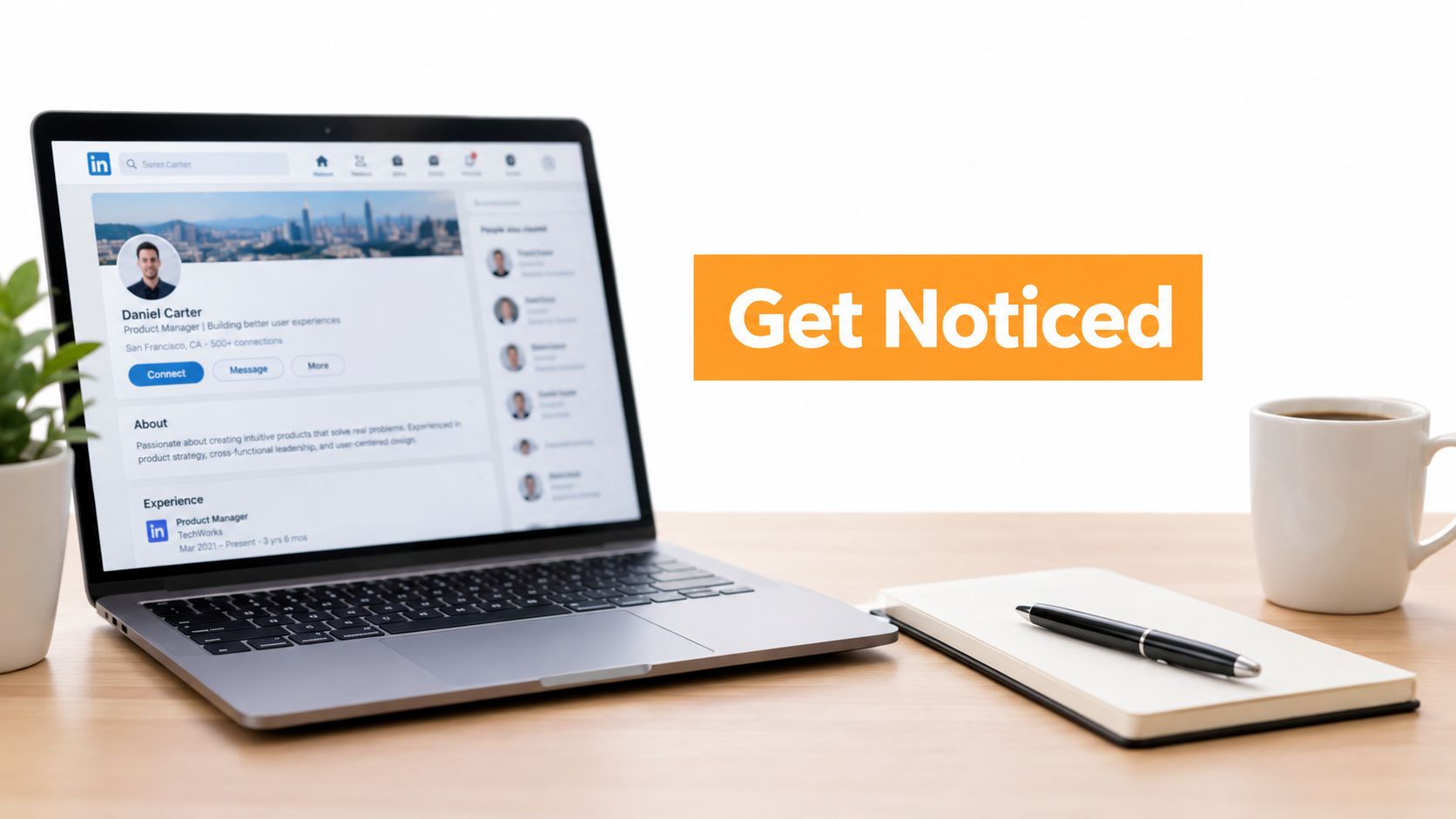
Crafting a Profile That Converts Clicks to Conversations
Turning on settings is easy. Writing a profile that earns replies is harder.
Recruiters and prospects don't study your profile like a novel. They skim it fast. One LinkedIn optimization source says recruiters often make an initial judgment in 6 to 10 seconds, and that the most important elements are the headline, the first 300 words of the About section, and keyword-rich experience entries, according to Nigel Frank's LinkedIn profile guidance.

Fix your headline first
Most weak profiles waste the headline on a job title alone.
That's not enough. Your headline should tell people what you do, who you help, and what kind of value they can expect. It also needs the right keywords so the profile is easier to match with relevant searches.
Compare these:
Weak: Marketing Manager
Better: B2B Marketing Manager | Demand Generation | Content Strategy | Helping SaaS teams turn expertise into pipeline
Weak: Software Engineer
Better: Software Engineer | Backend Systems | Cloud Infrastructure | Building reliable products for high-growth teams
The better versions are clearer, more searchable, and more useful to a stranger scanning fast.
Make the About section scannable
The biggest About section mistake is writing a biography when you need a value proposition.
Don't open with your life story. Front-load the first lines with what you do, what problems you solve, and who you work with. Since only the beginning appears before “See more,” that opening has to carry real weight.
A solid structure looks like this:
- Line one: State your professional value clearly.
- Middle: Add selected proof, themes, or specialties.
- Ending: Give a simple next step.
Your profile isn't a memoir. It's a landing page for professional interest.
Here's the difference in tone.
Before
I've always been passionate about business and communication. Over the years, I've had the opportunity to work in many environments that helped shape who I am today.
After
I help B2B teams turn complex ideas into clear messaging, practical content, and stronger client conversations. My work sits at the intersection of strategy, writing, and enablement. If you're building thought leadership or tightening go-to-market messaging, feel free to message me.
The second version respects the skim.
Experience should show outcomes, not job-description filler
A lot of profiles read like HR templates. Responsible for this. Assisted with that. Supported various initiatives.
That language doesn't create momentum. Focus your experience entries on outcomes, specialties, and the kind of work you want more of. You don't need to stuff every bullet with metrics if you don't have public numbers to share. Qualitative specificity still beats vague responsibility language.
Try this checklist:
- Name the scope clearly so the reader knows what kind of work you own.
- Use keyword-dense phrasing that reflects how recruiters and clients search.
- Show results or role impact in plain language.
- End your profile with a contact cue so interest turns into action.
If you've enabled Open Profile but your headline is generic and your About section rambles, you've opened the door without telling visitors why they should walk through it.
From Optimized Profile to Active Voice with RedactAI
You turn on Open Profile, tighten your headline, and start getting profile views. Then nothing happens.
That gap usually comes down to proof. Your profile explains what you do. Your posts show how you think, what you notice, and whether a conversation with you would be useful.

A strong profile and active posting should support each other. If they do, visitors get a clear message twice. First from your profile copy, then from your recent posts. That consistency builds trust faster than a polished profile sitting alone.
The good news is you do not need a separate content identity. Your profile already gives you material to work with:
- positioning from your headline
- core themes from your About section
- patterns from your Experience section
- recurring problems you solve
- opinions shaped by client work, hiring, leadership, or execution
I often see professionals freeze because they treat LinkedIn posting like performance. It works better as documentation. Pull one useful idea from the work you already do, then turn it into a short post with a clear point.
A simple example. If your profile says you help SaaS teams clarify messy product messaging, your next posts can cover unclear homepage copy, sales calls that reveal positioning problems, or the small wording changes that improve demos. If your profile centers on operations, your content can focus on handoff failures, reporting habits, or the warning signs of process drag.
Here is a practical weekly workflow:
- Review your headline and About section for two or three themes you want to be known for.
- Pick one recent lesson, client question, mistake, or win from your work.
- Write a short post around that single idea.
- Edit it until it sounds like you speak, not like a brand deck.
- End with a specific takeaway or question that gives the right people a reason to reply.
RedactAI for LinkedIn post drafting helps speed up that process by using your profile, posting history, and experience to generate drafts that reflect your tone. The value is not automation for its own sake. The value is reducing the time between expertise and expression.
Use it with judgment. Drafts still need your standards, your examples, and your point of view. But for busy consultants, operators, recruiters, and founders, that kind of support can make consistent posting realistic instead of aspirational.
One line matters here. A visible profile gets clicks. An active voice gives people a reason to remember you and message you later.
That is why Open Profile should not sit in a silo as a settings decision. The technical setup gets you discoverable. Profile copy tells people why you matter. Content keeps reinforcing that message after the visit.
Say your profile positions you as an operations leader who fixes messy handoffs between sales and delivery. Your content plan is already sitting there. Write one post about a handoff mistake that keeps costing teams time. Write another about a process change that improved accountability. Write a third about how leaders can spot operational friction early.
Done well, your profile stops acting like a static résumé and starts acting like the front door to an ongoing professional conversation.
Your LinkedIn Action Plan Going Forward
An effective open LinkedIn profile isn't one setting. It's a working combination of visibility, accessibility, and credibility.
If you want a practical next move, keep it simple.
Your short checklist
- Check visibility settings so your public profile reflects what you want outsiders to see.
- Review profile viewing mode and decide whether privacy or networking signal matters more right now.
- Enable Open Profile if inbound messages would help your role and you have Premium.
- Rewrite your headline so it communicates value, not just title.
- Tighten the first lines of your About section so a fast scanner gets the point immediately.
- Refresh experience entries to emphasize outcomes, specialties, and relevance.
- Post from your real expertise so your profile isn't the only proof of your thinking.
The bigger shift
The professionals who get the most from LinkedIn usually stop treating it like a profile database and start treating it like an active communication channel.
That doesn't mean posting every day or turning yourself into a creator. It means reducing friction for the right people, giving them a clear reason to reach out, and showing enough ongoing signal that they trust what they see.
Do that well, and “open LinkedIn profile” stops being a settings question. It becomes a career strategy.
If you want help turning your LinkedIn profile into a steady stream of post ideas, RedactAI is a practical option. It uses your profile and experience to generate LinkedIn drafts in your tone, which makes it easier to stay active without starting from a blank page every time.