Ever feel like your best LinkedIn posts just vanish into the digital ether? You pour your heart and mind into creating something genuinely useful, hit "post," and... crickets. It's a maddeningly common problem, but the fix is often less about what you post and more about when.
Think of it like a food truck. You wouldn't park in a business district at 10 PM on a Saturday and expect a lunch rush. You go where the people are, when they're hungry. LinkedIn is no different. You have to show up when your audience is there, ready to consume content.
Why Timing Is Your Secret Weapon
Posting at the right time isn't just a minor tweak; it's a fundamental part of the game. The goal is to land your content at the very top of your audience's feed the moment they log on.
The LinkedIn algorithm gives a huge boost to posts that get a quick burst of likes, comments, and shares right after they go live. Nailing the timing dramatically increases your chances of getting that initial engagement, which tells the algorithm, "Hey, people like this!" and pushes it out to a much wider audience.
This chart breaks down the peak days and times, and you'll see a clear pattern emerge right in the middle of the work week.
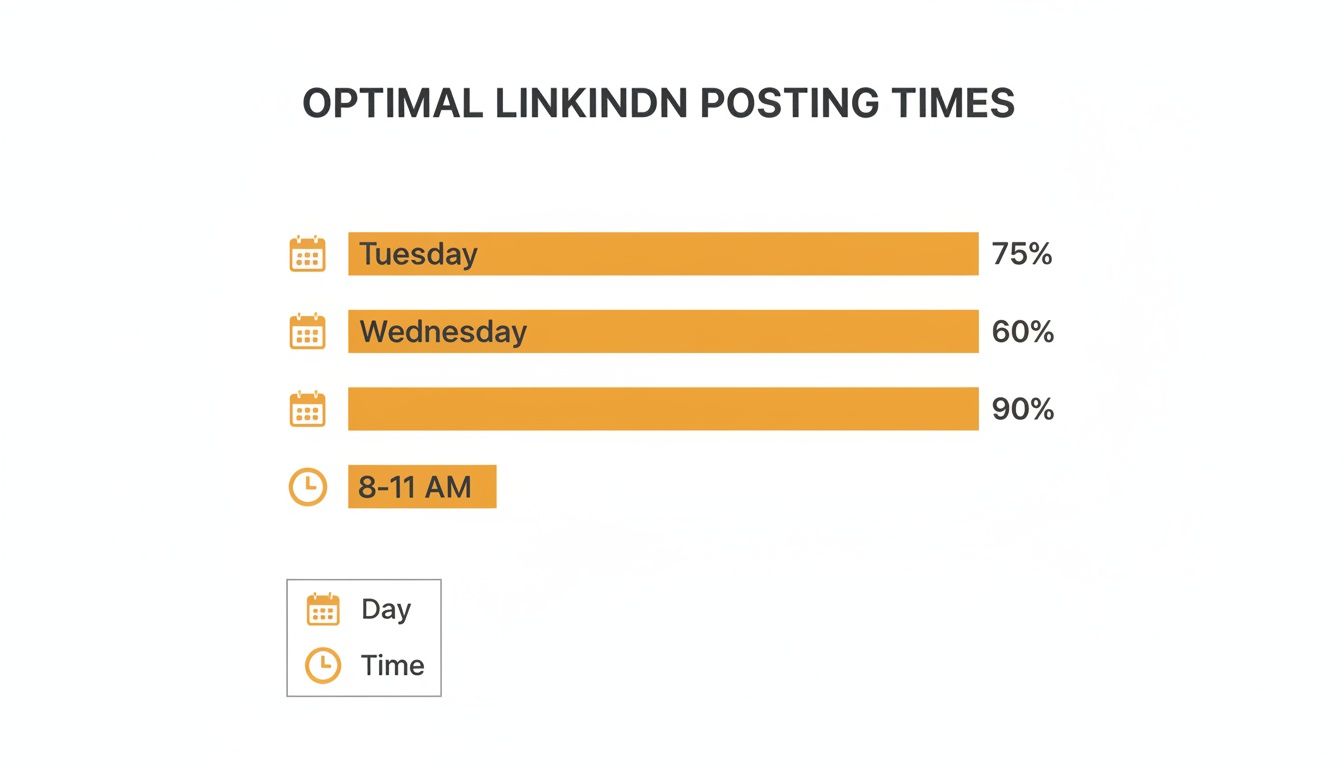
As you can see, Tuesday and Wednesday mornings are the undisputed champions for getting your content seen and engaged with.
The Data-Backed Sweet Spot
So, what's the magic window? The consensus from tons of research points to Tuesday and Wednesday between 8 AM and 11 AM. This is prime time. Professionals are settling in with their morning coffee, scrolling through their feeds for industry insights before the day's meetings take over.
Drilling down even further, 8-9 AM tends to see the highest overall engagement across all types of content. If you're sharing in-depth thought leadership pieces or carousels, the 10-11 AM slot often performs exceptionally well.
Here’s a quick reference guide to help you remember these key windows.
LinkedIn's Prime Time Posting Windows at a Glance
| Day of the Week | Best Time Slots | Why It Works |
|---|---|---|
| Tuesday | 8 AM - 11 AM | The most popular day. People are back in the work groove and actively catching up on industry news. |
| Wednesday | 8 AM - 11 AM | Engagement remains high as professionals are deep into their workweek and looking for solutions and insights. |
| Thursday | 9 AM - 12 PM | Still a solid choice, but engagement starts to dip slightly as the weekend approaches. |
These timeframes are a fantastic starting point, giving you the best statistical chance for your content to land with impact.
While we're zeroing in on LinkedIn here, understanding the broader patterns for the best time to post on social media can give you great context for your entire digital strategy. And to make this all easier, you might want to check out some of the top social media scheduling apps to manage your content calendar efficiently.
Why Mid-Week Mornings Are LinkedIn's Prime Time
So, why does everyone say to post on Tuesday, Wednesday, and Thursday mornings? It's not just a hunch; it's all about tapping into the typical rhythm of the professional workweek.
Think about your own Mondays. They're usually a blur of catching up, digging out from under a mountain of emails, and just trying to get your bearings for the week. Most people are "heads-down," focused internally. They're not leisurely scrolling their LinkedIn feed.
But once Tuesday rolls around, things change. The Monday madness has subsided, and people start looking for industry news, fresh ideas, and what their connections are up to. They've settled in and are ready to engage.
The Commute and Coffee Ritual
Picture the first hour of the workday. It's almost like a digital version of the morning commute. Before diving into the deep work, a lot of professionals grab their coffee and spend a solid 15-30 minutes scrolling through LinkedIn to see what's happening.
This window, usually between 8 AM and 11 AM, is pure gold. Your audience is alert, receptive, and actively looking for valuable content that can help them get a leg up.
This predictable morning routine creates a daily surge in activity. Posting right when this happens means your content lands in front of people when they're most ready to engage. Getting those initial likes and comments is exactly what the LinkedIn algorithm loves to see.
That early traction is a huge signal to LinkedIn. It basically tells the algorithm, "Hey, people like this!" which prompts it to push your post out to a much wider audience. This is the secret to getting real organic reach.
Aligning Content with Mindset
You can get even more strategic by thinking about the type of content you post within this prime window.
- Early Morning (8 AM - 9 AM): This is the time for quick hits. Think of a surprising statistic, a thought-provoking question, or a quick industry update. People are just easing into their day, so easily digestible content works best.
- Mid-Morning (9 AM - 11 AM): Now that people are in the groove, they're willing to spend a bit more time on something substantial. This is your chance to share in-depth articles, detailed case studies, carousels, or longer videos that provide real value.
The data backs this up time and time again. A big cross-platform analysis recently showed that while Monday at 10 AM can be good, the most reliable engagement happens mid-week. You can check out more of these cross-platform posting trends at WordStream.com.
Contrast that with Friday afternoon. People are winding down, wrapping up tasks, and already thinking about the weekend. Engagement drops off a cliff as everyone mentally checks out. By sticking to that mid-week sweet spot, you're putting your message out there when it has the best possible chance to land.
How Your Industry Shapes the Best Time to Post
Think of those broad "best time to post" stats as a world map. It's a great starting point, but if you're looking for a specific coffee shop in a neighborhood, you need a much more detailed local map. That's what industry-specific timing is all about.
The daily routine of a software engineer looks nothing like that of an emergency room nurse. A sales exec's LinkedIn habits are worlds away from a creative director's. Understanding these day-to-day rhythms is the difference between shouting into the void and starting a meaningful conversation with the right people at the right time.
Let's zoom in and look at a few key industries.
Optimal LinkedIn Posting Times by Industry
Before we dive deep, here's a quick comparison table to give you a bird's-eye view of how different professional worlds operate on LinkedIn. Notice how the "when" is directly tied to the "who" and "what" of their work life.
| Industry | Peak Days | Optimal Time Slots | Content Focus |
|---|---|---|---|
| B2B Tech & Software | Tuesday, Wednesday, Thursday | 8 AM - 11 AM & ~3 PM | Innovation, deep-dives, product updates |
| Marketing & Advertising | Tuesday, Wednesday | 9 AM - 2 PM | Case studies, creative trends, brand strategy |
| Sales & Business Dev | Tuesday, Wednesday, Thursday | 8 AM - 10 AM & 4 PM - 5 PM | Industry reports, solutions, success stories |
| Healthcare & Medical | Tuesday, Thursday | 6 AM - 8 AM & 3 PM - 5 PM | Medical research, policy updates, patient success |
This table shows just how much nuance there is. Now, let's explore the "why" behind these numbers.
B2B Tech and Software Companies
Folks in tech and SaaS live by their calendars. Their days are often blocked out for sprints, coding sessions, and team stand-ups, so they tend to check LinkedIn first thing in the morning to get a read on the industry before the real work begins.
- Peak Days: Tuesday, Wednesday, and Thursday.
- Optimal Time Slots: The sweet spot is between 8 AM and 11 AM. You might also catch a smaller wave of activity around 3 PM when they surface for a quick break.
- Content Focus: This is your window to share posts on new tech, deep-dives into code, product updates, and insightful industry analysis.
Posting then means your content about a new API or a software integration lands right when they're in the mindset to absorb that kind of information.
Marketing and Advertising Agencies
The marketing world is always on. For these professionals, LinkedIn isn't just for networking; it's a constant stream of inspiration and a way to keep a finger on the pulse of what's new and creative.
They’re hunting for the next big campaign idea, fresh strategies, and juicy analytics insights. While mid-week mornings are still a great bet, their activity is often spread throughout the day as they look for a creative spark.
Marketers don't just log on and log off. For them, LinkedIn is a wellspring of ideas. You'll find them scrolling for inspiration not just in the morning, but also during that mid-day slump when they need a break from client work.
- Peak Days: Tuesday and Wednesday.
- Optimal Time Slots: The window is much wider here, with strong engagement from 9 AM to 2 PM. This covers both the morning rush and the post-lunch browse.
- Content Focus: A perfect time to roll out your best case studies, highlight creative campaigns, break down new marketing trends, or share your thoughts on brand strategy.
Sales and Business Development Professionals
For a salesperson, LinkedIn is their office. It's where they find prospects, build relationships, and close deals. They are on the platform all day, but their most focused activity happens when they're prepping for a call or doing follow-ups.
Their schedule usually mirrors a typical business day because they're trying to reach their own prospects during work hours. You want to show up right when they're researching or warming up a new lead.
- Peak Days: Tuesday through Thursday.
- Optimal Time Slots: Hit them between 8 AM and 10 AM as they plan their day, and again from 4 PM to 5 PM when they're wrapping things up and scheduling their next moves.
- Content Focus: Post things that make them look good to their prospects—think industry reports, solutions to common business problems, and powerful success stories.
Healthcare and Medical Industries
Healthcare professionals have schedules that throw the traditional "9-to-5" out the window. Their workday might be a 12-hour shift from 7 PM to 7 AM. This means your standard mid-week, mid-day post will completely miss them.
You have to think differently. They're most likely to catch up on industry news and professional networking during their off-hours, or right at the start or end of a grueling shift.
- Peak Days: Tuesday and Thursday.
- Optimal Time Slots: Try posting very early, between 6 AM and 8 AM, or later in the day from 3 PM to 5 PM.
- Content Focus: This is the time to share new medical research, updates on healthcare policy, and inspiring stories about patient outcomes.
Finding Your Personal Best Time to Post
Those industry benchmarks and general data? Think of them as a map of the world. They show you the continents and oceans, but they don't give you the street-level directions to your specific audience's front door. Sure, posting on a Tuesday morning is a solid starting point, but what if your network is full of West Coast night owls or European early birds?
The only way to know for sure is to roll up your sleeves and become a bit of a data detective. This is where you stop guessing and start knowing. It's like a musician tuning their guitar by ear—the general advice gets you in the right key, but the real magic happens when you listen closely and make those tiny adjustments that create perfect harmony.

Unlocking Insights in LinkedIn Analytics
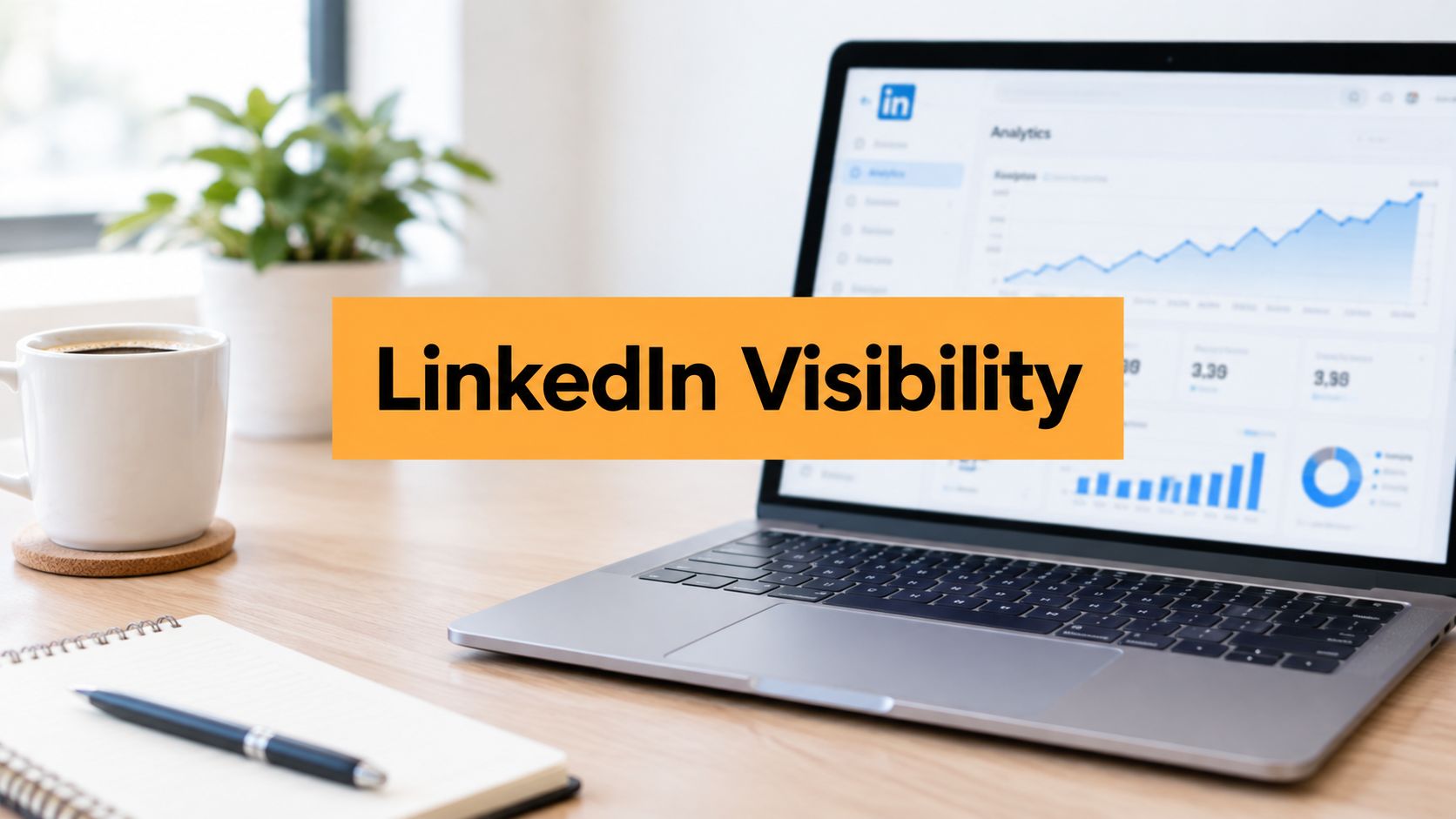
LinkedIn actually gives you the tools you need to get started. Don't let the word "analytics" intimidate you; we're only going to focus on a couple of key numbers. You can find them right on your profile page, just under your bio—click on "Analytics" to see your dashboard.
For every post, keep an eye on these two metrics:
- Impressions: This is simply how many times your post was shown on someone's screen. A high number here means you nailed the timing and got your post into people's feeds while they were actively scrolling.
- Engagement Rate: This is the golden metric. It’s the percentage of people who saw your post and actually did something—liked, commented, or shared. This tells you if your content and your timing resonated. To get a better handle on this, check out our deep dive into what makes a good LinkedIn engagement rate in our comprehensive guide.
By tracking these two data points along with the day and time you posted, you'll start to see patterns emerge from the noise.
Running the A/B Time Slot Test
Ready to get some real, actionable data? Let's run a simple experiment called the A/B Time Slot Test. It sounds technical, but it’s not. All you’re doing is pitting two different posting times against each other to see which one gets better results with your followers.
Here’s how you do it:
- Choose Your Variables: Pick two promising time slots based on the general advice. For example, let's test Tuesday at 9 AM vs. Thursday at 10 AM.
- Prepare Similar Content: This is key. You need to create two posts that are very similar in topic and format—maybe two text-and-image posts that each share an industry tip. This ensures you're testing the time, not the content itself.
- Publish and Wait: Post the first one at your "A" time and the second at your "B" time, all within the same week. Give each post at least 24 hours to collect data.
- Analyze the Results: After a day or two, jump into your analytics for each post. Compare the impressions and engagement rate. Was there a clear winner?
Repeat this process for a few weeks, and you’ll methodically weed out the bad times and hone in on your personal engagement hotspots.
Key Takeaway: Your best time to post isn't a "set it and forget it" kind of thing. It’s a moving target that can change as your network grows or industry habits shift. Consistent testing is what keeps you on top of your game.
Creating a Simple Tracking System
You don't need any complicated software for this. A basic spreadsheet is your best friend here and is what separates the pros from the amateurs.
Just set up a sheet with these columns:
| Date | Day of Week | Time Posted | Post Topic/Format | Impressions | Engagement Rate | Notes |
|---|---|---|---|---|---|---|
| 10/15 | Tuesday | 9:00 AM | Tip post (image) | 2,150 | 4.2% | Strong initial comments |
| 10/17 | Thursday | 10:00 AM | Tip post (image) | 1,890 | 3.1% | Slower start |
| 10/22 | Tuesday | 9:00 AM | Carousel post | 3,500 | 5.5% | Carousel performed well |
| 10/24 | Thursday | 10:00 AM | Carousel post | 2,900 | 4.8% | Good, but Tuesday was better |
After just a month of this, you’ll have a personalized roadmap based on your own data. This simple habit takes the guesswork out of the equation and gives every single piece of content you create the best possible shot at making an impact.
You've Nailed the Timing, But What About Frequency?
Figuring out when to post is a huge win, but it's only half the battle. The other crucial piece is consistency. Think about it like any professional relationship—if you only show up randomly, it's tough to build a real connection. But when you're a consistent presence, people start to trust you and remember you.
The LinkedIn algorithm is no different. It loves creators who show up regularly and consistently offer value. Posting here and there makes it impossible to gain any real traction. A steady, predictable rhythm, on the other hand, tells the algorithm you're a serious voice worth listening to. This isn't about spamming your network all day; it's about finding a rhythm you can actually stick with.
It’s Not Quality vs. Quantity
A lot of people get hung up on the idea of "over-posting." They're worried that if they post too often, they'll annoy their followers and engagement will drop. On LinkedIn, that's rarely the case. The platform is actually built to reward a higher volume of good content.
Instead of seeing it as an either/or, think of it as quality at scale. Every single post is another chance to connect with your network, another data point for the algorithm, and another shot at hitting that perfect time slot you've been testing. You don't have to choose between going deep and being frequent. In fact, you can learn how to get more mileage out of every piece of content in our guide on reposting on LinkedIn for better reach.
How More Posts Drive More Reach
The data doesn't lie: posting more often directly leads to more visibility. It's a simple compounding effect. More posts create more impressions, which leads to more engagement, and the cycle continues. And when you combine this with optimal timing, the results are amplified.
The numbers are pretty staggering. Posting just 2-5 times per week can give you an average boost of +1,182 impressions per post. If you kick that up to 6-10 posts a week, you're looking at +5,001 impressions for each one. And for the heavy hitters posting 11 or more times? The average jumps to nearly 17,000 impressions and triples the engagement rate. You can dig into more of these stats yourself and see that there's really no such thing as an "over-posting" penalty.
This is fantastic news for RedactAI users—especially freelancers, consultants, and ghostwriters. It confirms you can use AI to keep up a powerful, consistent posting schedule without completely burning out. The tool helps you create posts in your unique voice, schedule them for the right time zones, and see what's working, all from one dashboard.
Finding a Rhythm That Works For You
So, what's the magic number? It’s whatever you can commit to while still creating great content. There’s no one-size-fits-all answer.
Here are a few common approaches to consider:
- The Starter (2-3 posts per week): This is a great place to start. You’re building a habit, staying on people's radar without getting overwhelmed, and you can really focus on making those few posts count.
- The Professional (4-5 posts per week): Posting almost every business day positions you as a reliable authority. It’s perfect for anyone serious about building a strong personal brand and staying top-of-mind.
- The Power User (6+ posts per week): This is for the dedicated creators and thought leaders. This high-frequency approach maximizes your algorithmic reach and captures attention across different days and times, seriously speeding up your growth.
Don't feel pressured to jump to daily posts overnight. Start with a schedule that feels manageable, watch your analytics, and slowly ramp up as you get more comfortable. Consistency will always beat short-term intensity.
Common LinkedIn Posting Mistakes to Avoid

So, you’ve figured out the "perfect" time to post on LinkedIn. That's great, but it's only half the battle. A few simple missteps can completely tank your efforts, no matter how perfectly you time your content.
Think of it like telling a great joke but messing up the punchline. The potential was there, but the execution fell flat. Avoiding these common blunders is just as crucial as nailing your posting window.
The Dreaded Post and Ghost
The absolute biggest momentum killer? The "post-and-ghost." This is when you share a brilliant piece of content and then immediately vanish, letting comments pile up without a response. That first hour after you hit "post" is everything.
Key Insight: Engaging with comments within the first 60 minutes sends a massive signal to the LinkedIn algorithm. It sees this immediate back-and-forth as a sign that your content is sparking a real conversation and rewards it by showing it to more people.
Your job isn't over when you publish your post—it's just getting started. Seriously, block out time in your calendar to stick around and be present right after your content goes live. Acknowledge every comment, answer questions, and actually talk to the people taking the time to engage.
Ignoring Time Zones and Consistency
Another classic mistake is posting according to your schedule, not your audience's. If you’re in New York, but your target audience is mostly on the West Coast, a 9 AM post from you lands at 6 AM for them. That’s way too early to catch them scrolling during their coffee break.
Always, always schedule your posts for your audience's prime time.
Consistency is the other silent killer. If you post five times one week and then go quiet for two, you're sending confusing signals to both your followers and the algorithm. A steady, reliable rhythm—even if it's just two or three times a week—builds momentum and keeps you on people's radar.
To get this right, you have to:
- Engage Immediately: Set aside time to reply to comments as soon as they come in.
- Know Your Audience: Dive into your LinkedIn Analytics to see where your followers live and post for their time zones.
- Stay Consistent: Pick a posting frequency you can actually stick with and make it a non-negotiable part of your routine.
Sticking to a Rigid Schedule
Finally, don’t treat the best time to post on LinkedIn as a sacred, unbreakable rule. It’s a starting point, not a forever strategy. Think of that initial schedule as a paper map—it gets you headed in the right direction, but a live GPS with real-time data is way more effective.
You have to keep testing. Try out different time slots, experiment with different days, and see how your audience responds. What worked like a charm last quarter might be a dud today. By constantly checking your analytics and tweaking your approach, you ensure you're always finding the fastest route to your audience.
A Few Lingering Questions Answered
Even with the best game plan, a few questions can pop up. Let's tackle some of the most common ones about LinkedIn posting times so you can schedule your content with total confidence.
Think of this as the final check-in before you hit "publish." You've got the strategy down, but these quick answers will iron out any last-minute wrinkles.
Does My Time Zone Really Matter When I Post?
Absolutely. This is probably one of the most critical details people overlook. You should always post based on your target audience's primary time zone, not your own. Your content has to land in their feed when they are scrolling, not just when it’s convenient for you.
So, if your network is mostly on the US East Coast, scheduling posts for their morning commute (say, 9 AM ET) is the smart play, even if it's lunchtime where you are. If you’re trying to reach a global audience, look for the sweet spot where time zones overlap—like late morning in Europe, which happens to be early morning in North America.
How Quickly Will I See Results After Changing My Posting Times?
You'll probably notice an initial bump in engagement within the first week or two. A quick jump in impressions or a few extra likes right after you post is a fantastic sign that you're heading in the right direction.
But don't get ahead of yourself. To know for sure if you've found a winning formula, you need to test and track your results for at least a full month. This gives you enough solid data to smooth out any random weekly weirdness and confirm the improvement is because of your new schedule, not just a one-off post that got lucky.
The goal here is to spot a consistent trend, not just celebrate a single successful post. A month's worth of data gives you a much clearer picture of what your audience actually responds to, creating a reliable foundation for your content strategy.
Should I Bother Posting On Weekends Or Holidays?
Honestly, it's usually not the best move for your best content. The data is pretty clear: LinkedIn engagement takes a nosedive over weekends and major holidays. People are unplugging, and rightfully so.
Saturdays and Sundays are the quietest days on the platform by a long shot. It's much smarter to save your heavy hitters for those peak mid-week windows to make sure they get the eyeballs they deserve. Weekends are perfect for planning out and scheduling your posts for the week ahead.
Morning Or Afternoon: Which One Is Better?
Mid-week mornings—generally between 8 AM and 11 AM in your audience's local time—are the consistent champs for engagement. This is when people are easing into their workday, sipping coffee, and are most open to new ideas.
That said, don't write off the early afternoon. It can be a great secondary slot, especially if you're posting something more interactive like a poll or a question to spark conversation. The best way to know for sure is to test both time slots with similar types of content and see what your own analytics tell you.
Juggling high-quality posts and nailing the perfect schedule can feel like a full-time gig. RedactAI uses AI to get to know your unique voice, brainstorm on-brand post ideas in seconds, and schedule them when they'll get the most traction. You can build a powerful presence without the burnout. Start creating with RedactAI for free.