Let’s get real for a second. Your brand voice is simply your professional personality, expressed in words. It’s not about what you say, but how you consistently say it everywhere—from a quick LinkedIn comment to a major client proposal.
What Is Your Brand Voice, Really?
Think about how you can tell who's texting you without even seeing their name. You just know. Maybe it's their dry wit, their signature emoji, or the way they always use (or skip) punctuation. That's their "voice."
A brand voice is the exact same idea, but for your business or professional presence. It’s the unique, recognizable personality that shines through in all your communication, making you sound like a human, not a corporation. This is what separates a faceless "expert" from someone people actually trust and want to listen to.
Your brand voice isn’t a marketing buzzword; it’s the most powerful tool you have for building a memorable identity. It’s the consistent thread that connects every piece of content you create, making you instantly recognizable in a crowded digital space.
When people know what to expect from you, they start to trust you. That consistency is the bedrock of building a solid reputation, whether you're looking for new clients, a better job, or just a loyal audience.
The Power of Voice: What It Is and Isn't
To really nail this down, it helps to see the components side-by-side. Your voice is the strategic foundation—the "how"—that guides all your communication.
Brand Voice At a Glance
| Core Component | What It Is (The 'How') | What It Is Not |
|---|---|---|
| Personality | The consistent traits and character you embody. Example: Witty, authoritative, empathetic. | A random persona you put on for the day. |
| Language | Your specific word choice and vocabulary. Example: Using simple, direct terms instead of jargon. | Just a list of keywords to include. |
| Rhythm & Pace | The flow and structure of your sentences. Example: Short, punchy sentences or longer, narrative ones. | The topic or message itself. |
| Purpose | The underlying intention behind your words. Example: To inspire, to educate, to challenge. | The specific call to action in one post. |
This table shows that your voice is a deliberate choice. It's the consistent personality that informs every piece of content, not just the content itself.
Why Your Voice Is a Non-Negotiable Asset
Carving out a distinct brand voice isn't just a "nice-to-have" branding exercise. It’s a strategic move with real-world payoffs. In a world where everyone seems to offer the same services or has the same job title, how you show up and communicate is often your only true differentiator.
Here’s why it’s so critical:
- It Builds Unbreakable Trust: When you sound like the same person everywhere, people learn what you stand for. That consistency signals professionalism and reliability, which is the foundation of trust.
- It Drives Real Results: A strong voice isn't just about feeling authentic; it directly impacts your growth. Brands that maintain a consistent voice have been shown to increase revenue by 23% to 33%. Authenticity literally pays off.
- It Creates Lasting Connections: Let's be honest, people don't form relationships with logos or sales pitches. They connect with other people. Your voice gives your brand that human touch, making it possible for your audience to feel a genuine bond with you.
A well-defined brand voice is essential for forging this connection and trust, especially when trying to build brand awareness with your content. At the end of the day, a powerful voice makes sure your message isn’t just heard, but that it's felt, remembered, and acted on.
Untangling Brand Voice, Tone, and Messaging
It’s way too easy to get these marketing terms mixed up, but nailing the difference between brand voice, tone, and messaging is a game-changer.
Let's break it down with a simple analogy. Think of your brand voice as your core personality—it's who you are, and it doesn't change day-to-day. Your tone is the mood or emotion you express in a specific conversation. And your messaging is the actual topic you're talking about.
For instance, maybe your brand's voice is "friendly and witty." That's your personality, your foundation.
But your tone has to adapt. When you're handling a customer complaint, that witty personality takes on a more empathetic and helpful tone. When you're celebrating a huge company milestone on LinkedIn, your tone shifts to be energetic and celebratory. The witty personality is still there underneath, but the emotional delivery changes to match the situation.
Voice vs. Tone: A Quick Breakdown
Think of it like this: your voice is the constant, while your tone is the variable.
- Brand Voice (The Who): This is your brand's unshakeable personality. Are you the wise, authoritative expert? The quirky, fun-loving innovator? The dependable, supportive friend? This is the consistent character you always embody.
- Tone of Voice (The How): This is the emotional flavor you apply to your voice based on the context. It’s how you adjust your personality for a specific channel or moment—like the difference between a professional LinkedIn post and a playful Instagram Story.
Voice is who you are all the time. Tone is how you express that personality in a specific conversation. One is your identity; the other is your mood.
Getting this right is what allows you to build a genuine connection. You can stay true to your brand's core self while still reading the room and responding appropriately.
This is how a solid personality becomes the engine for building trust, creating memorable moments, and ultimately, driving real results.
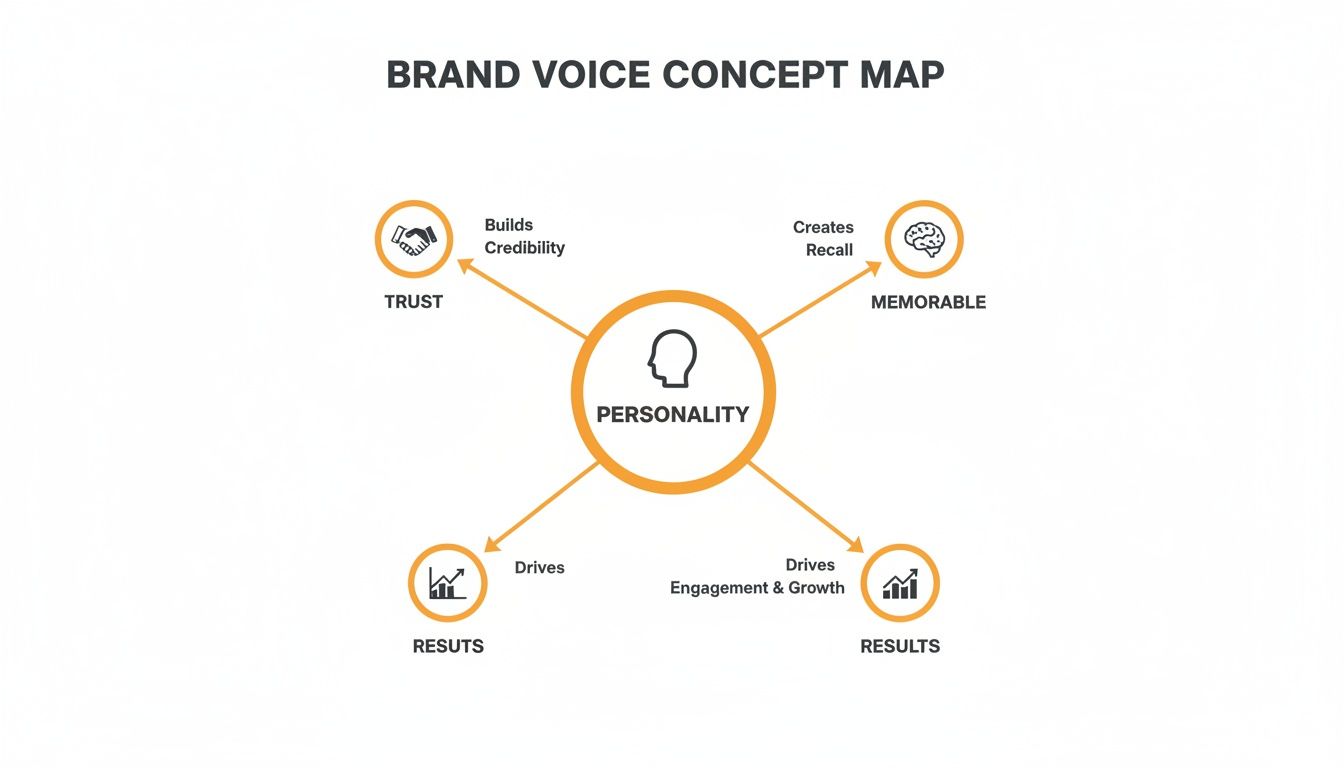
As you can see, a distinct personality isn't just a "nice-to-have"—it's the core component that powers every aspect of a successful brand voice.
So, Where Does Messaging Fit In?
Okay, so if voice is your personality and tone is your mood, then messaging is what you actually say. It’s the core idea, the story, or the key information you want to get across. Your voice and tone are the vehicles that deliver that message.
Let's say your brand’s core message is, "We make complex data simple."
Here's how it all comes together:
- Voice: Authoritative and clear.
- Tone (for a tutorial blog post): Educational and patient.
- Message: "Our new dashboard transforms messy spreadsheets into beautiful, easy-to-read charts in just three clicks."
When these three elements work in harmony, you get communication that’s not just clear, but also powerful and consistent. Of course, none of this works unless you know who you're talking to. The first step is always to identify your target audience so you can align your voice, tone, and message for the biggest impact.
Powerful Brand Voice Examples in Action

Talking about brand voice in theory is one thing, but seeing it out in the wild is where it all starts to click. The best part? There’s no single “right” way to do it. Authenticity is the secret sauce.
A great voice feels like a natural extension of the brand's personality, connecting perfectly with its audience and goals. It turns a simple message into something people actually remember.
Let's look at a few real-world examples to see how it’s done. We'll break down their word choice, sentence structure, and general vibe to see what makes them so effective.
The Direct and Disruptive Tech Founder
You’ve probably seen this person on LinkedIn. They’re the tech founder who cuts right through the noise. Their posts are short, punchy, and almost always challenge the status quo. No corporate jargon, no fluff—just straight-to-the-point insights.
This voice is built on a bedrock of confidence and clarity. The goal isn’t to be liked by everyone; it’s to attract the right people who value a no-BS approach to building things.
- Word Choice: Strong verbs, simple words, and hard data. You won't find buzzwords like "synergy" or "paradigm shift" here.
- Sentence Structure: Mostly short, declarative sentences. They often use single-sentence paragraphs to make a point land with a thud.
- Overall Feel: Confident, direct, and a little bit contrarian. It’s a voice that says, "I know my stuff, and I’m not here to waste your time."
This style is powerful because it screams expertise and builds trust through radical transparency. It’s the perfect answer to the what is brand voice question—not with complexity, but with bold simplicity.
The Encouraging and Empathetic Career Coach
Now, picture a career coach whose entire brand feels like a warm hug. Their voice is approachable, supportive, and always puts the reader's potential front and center. They use personal stories to build an emotional bridge, making their advice feel like it’s coming from a friend who just gets it.
The goal here is to create a safe space. This voice validates people's struggles while giving them real, actionable hope, which turns a passive audience into a loyal community that feels truly seen.
This empathetic approach is fantastic for building deep, lasting relationships. It's less about flexing authority and more about fostering genuine connection.
Here’s their playbook:
- Relatable Storytelling: They often kick off posts with a personal story or a common client frustration, which immediately creates a "me too!" moment for the reader.
- Inclusive Language: You’ll see lots of "we," "us," and "you're not alone." It’s all about building a sense of community and shared experience.
- Positive Framing: Even when talking about tough stuff like layoffs or burnout, the focus is always on growth, solutions, and what’s next.
The Witty and Playful Marketer
Finally, think of that marketing expert whose content is actually fun to read. They use clever analogies, pop culture references, and a bit of self-deprecating humor to make dense topics feel light and easy to grasp. Their voice is engineered to be memorable and shareable.
This works because it completely disarms you. By making learning enjoyable, this marketer comes across as an expert who doesn't take themselves too seriously. Their wit isn't just a gimmick; it's their unique selling point, helping them stand out in a feed full of dry, textbook advice.
Ultimately, these examples show that the best brand voice is the one that is most authentically you.
A Simple Framework to Define Your Brand Voice

Let’s get out of theory and jump into action. Defining your brand voice doesn’t need to drag on for weeks—it’s really about a few smart choices that shine through every message you send.
This four-step approach will give you a clear, hands-on plan you can start using today. Ready? Let’s dive in.
Step 1: Brainstorm Your Three Core Words
Pretend you have to sum up your professional vibe in just three words. Not what you think you should be, but who you genuinely are.
- Jot down all the adjectives that feel true to your style.
- Circle your top three.
- Use these as your compass—if a piece of content doesn’t reflect at least two, it’s off-brand.
These words become your north star. When you’re in doubt, let them guide your tone and phrasing.
Step 2: Analyze Your Role Models
You don’t have to reinvent the wheel. Pick 2–3 professionals or brands whose voice you admire.
- What storytelling tricks do they pull off?
- How do they simplify complex ideas with real-world analogies?
- Which bits make you sit up and pay attention?
Break down what clicks for you, then mix those proven methods with your three core words. It’s not copying—it’s inspiration.
Step 3: Align Your Voice With Your Audience
Great brand voice doesn’t broadcast at people; it has a conversation with them. A handy tool here is the marketing positioning matrix. It helps you zero in on exactly who you want to reach.
Ask yourself:
- What keeps them up at night?
- Which words feel familiar when they read or hear them?
When you mirror their language, trust follows. In fact, brands that speak in a conversational, human tone see a 22% bump in trust scores. Discover more about how a natural communication style builds trust on jacobtyler.com.
Step 4: Create a Simple Voice Chart
Now let’s lock in those decisions. A straightforward “Do and Don’t” chart turns your abstract ideas into crystal-clear guidelines.
A voice chart isn’t a creativity straitjacket. It’s the solid ground that lets your creativity roam without confusing your audience.
Keep this chart handy so everyone on your team knows exactly how to sound like “you.” For more depth, check out our guide on how to find your writing voice.
Simple Brand Voice 'Do and Don't' Template
Use this mini chart to nail down what to lean into—and what to leave out.
| Voice Characteristic (e.g., Witty) | Do (Example) | Don't (Example) |
|---|---|---|
| Insightful | Use data-backed points and specific examples. | Make generic, surface-level statements. |
| Approachable | Write in a conversational style, using “you” and “I.” | Use overly formal language or corporate jargon. |
| Witty | Use clever analogies or a bit of self-aware humor. | Tell cheesy jokes or use sarcasm that could be misread. |
Keep this chart close. It’s your quick-reference cheat sheet whenever you’re writing or briefing someone else. By following these four steps, you’ll have a clear, authentic brand voice that stands out—and stays consistent.
How to Maintain a Consistent Brand Voice
Alright, so you’ve defined your brand voice. That’s a huge win, but the real work starts now: actually using it, every single time. Consistency is what separates a one-off great post from a recognizable, trusted identity. It’s how your audience starts to feel like they truly know you.
The good news? This doesn't have to be a grind. The trick is to pull your voice out of the abstract and make it a practical, everyday part of your workflow—whether you’re firing off a quick LinkedIn comment or drafting a long-form article.
Turn Your Guide into a Daily Habit
That brand voice guide you worked so hard on? It’s your new best friend for staying consistent. Don't let it collect digital dust in some forgotten Google Drive folder. You need to make it an active, living part of your content process.
- Create a Quick-Reference Checklist: Boil your detailed voice chart down to a simple checklist. Before you hit “publish,” give it a quick scan. Does this sound approachable? Is it direct enough? Did I avoid that corporate jargon I hate?
- Share It With Everyone: Consistency is a team sport. If you have a team, a VA, or a ghostwriter, they need to live and breathe this guide. Make sure they not only have it but actually get it.
- Review and Refine: Brands evolve, and so should their voices. Pencil in a check-up every six months or so. Reread your guide and ask yourself if it still feels authentic and lines up with where your business is headed.
If you want to go deeper on creating this essential document, check out our guide on building a business writing style guide.
Use AI to Operationalize Your Voice
Let's be real: manually checking every single post against your voice guide can be a drag. This is where smart AI tools can step in and make a massive difference, basically acting as a personal editor that keeps you on brand.
Modern AI platforms can actually learn your specific style by analyzing your past writing—your unique quirks, vocabulary, and rhythm. So instead of spitting out generic text, they help you draft posts that already sound like you, which speeds things up big time.
For example, here's how RedactAI helps you brainstorm on-brand post ideas in a snap.
This kind of feature turns your established voice into a creative engine, making sure that what you create next is already aligned with what you know works.
When you operationalize your voice with AI, your brand guide transforms from a static PDF into a dynamic, automated part of your daily workflow. The result? Perfect consistency with way less effort.
This system becomes absolutely critical when you start to scale. Think about taking a brand global—you need a voice that’s flexible enough for different markets but still grounded in the same core identity. Apple is a master at this, tweaking its voice for diverse cultures while always feeling like Apple. You can dig into more on these global strategies over on lionbridge.com. With the right tools and systems in place, you can achieve that same level of consistency, no matter how much content you’re putting out there.
Common Questions About Brand Voice
Even after you’ve nailed down a solid framework, you’ll still hit a few roadblocks when you start using your brand voice every day. Defining it on paper is one thing; making it breathe life in your content is another.
Below are quick, practical answers to the “what if” scenarios that tend to slow people down. Use them to build confidence and keep your momentum going.
How Long Does It Take To Develop A Strong Brand Voice?
There’s no one-size-fits-all answer, but think of the process in two stages. First, you can sketch out your core words and a simple “do/don’t” chart in just a few focused hours. That’s the quick win.
Then comes the real work—practicing it, getting feedback, and refining over the next few months. It’s like learning an instrument: you know the chords, but you don’t nail the melody without consistent practice.
Can My Brand Voice Change Over Time?
Yes—and that’s a good thing. Your voice should grow right alongside your expertise and goals.
The goal isn’t to be rigid; it’s to be consistent in the moment. Plan to revisit your voice guide once a year to make sure it still rings true for where you are professionally.
These check-ins keep your voice fresh and aligned with who you’ve become.
What If My Authentic Brand Voice Feels Too Boring?
Trust me, professionalism and clarity can be far more compelling than fireworks. In many industries—especially technical or trust-driven ones—your audience craves straightforward, reliable guidance.
Being “boring” often translates to being the go-to expert. That consistent dependability builds stronger connections than flashy gimmicks ever could.
How Do I Measure If My Brand Voice Is Working?
Evaluating your voice is part art, part data. Blend both for the full picture:
Qualitative Feedback:
Scan comments and DMs. Are people saying, “You always break this down so well”? That’s a clear sign your voice is landing.Quantitative Metrics:
Track engagement rates over time. As your voice sharpens, you’ll notice more likes, shares, and saves from followers who connect specifically with your style.
Ready to stop second-guessing and craft LinkedIn posts that sound exactly like you? RedactAI analyzes your unique style and helps you generate high-impact content—every single time. Start for free at RedactAI.