Let's be honest: calling executive communication a "soft skill" is a thing of the past. It's now a core competency, one that's directly wired to your company's performance, profitability, and ability to keep its best people. We're talking about giving leaders the tools they need to inspire action, cut through complexity, and build real trust. This is what turns a good manager into a truly influential leader.
So, Why Is Executive Communication a Non-Negotiable Skill?
In the business world we live in today, the way a leader communicates is the engine that drives results. It's the stark difference between a team that just does what it's told and one that's genuinely all-in.
The problem is, there's often a huge disconnect between the clarity people are desperate for and the messages they actually get from the top. And this isn't just a minor annoyance—it has a staggering financial impact.
Poor communication costs U.S. businesses an unbelievable $1.2 trillion a year. That's not a typo. In many big companies, a shocking 86% of employees and leaders say ineffective communication is the root cause of most workplace failures. This isn't just about messy email chains; it's about projects derailing, big initiatives failing, and your best talent walking out the door because they feel completely out of the loop.
The Real Price of Bad Leadership Communication
When communication from the top breaks down, the fallout hits every single part of the organization.
Imagine a fast-growing tech company where a VP drops a bombshell about a major strategic pivot in a town hall. If that message is fuzzy or doesn't explain why it's happening, you've just created a wave of confusion and anxiety. Suddenly, you have teams pulling in opposite directions, burning through weeks of precious engineering time on the wrong things.
Or think about a finance director presenting quarterly numbers. If they just throw a bunch of dense spreadsheets on the screen without telling the story behind the data, the board completely misses the point. That failure to connect the dots between numbers and strategy can lead to bad decisions and shaken investor confidence.
"Effective communication is 20% what you know and 80% how you feel about what you know." — Jim Rohn
This really gets to the heart of it. Leadership communication is all about making a connection, not just dumping information.
Core Competencies in Executive Communication
Closing this communication gap means leaders need to master a specific set of skills that go way beyond just public speaking. These are the building blocks of any worthwhile executive communication program. It’s critical to understand what makes for effective executive communication skills training because it’s about creating a complete toolkit, not just patching one or two weaknesses.
The table below breaks down the essential skills that any solid executive communication training should cover.
Core Competencies in Executive Communication
| Skill Area | What It Looks Like in Practice | Why It Matters |
|---|---|---|
| Strategic Messaging | Clearly articulating the "why" behind decisions, not just the "what." | Builds buy-in and ensures everyone is pulling in the same direction. |
| Audience Analysis | Tailoring the message, tone, and medium to who you're speaking to (e.g., board, engineers, all-hands). | Makes the message resonate and land with maximum impact. |
| Storytelling & Narrative | Using stories and anecdotes to make data and complex ideas memorable and relatable. | Turns dry information into a compelling vision people can connect with. |
| Active Listening | Asking insightful questions and demonstrating genuine understanding in high-stakes conversations. | Fosters trust, psychological safety, and uncovers critical insights. |
| Non-Verbal Cues | Using confident body language, tone, and pace to reinforce the message. | Conveys authority and authenticity, making the message more believable. |
| Crisis Communication | Delivering clear, calm, and empathetic messages during times of uncertainty or crisis. | Maintains stability and trust when it's needed most. |
| Digital Savvy | Communicating effectively across different channels, from Slack and email to video calls. | Ensures clarity and presence in a hybrid work environment. |
Mastering these areas is about much more than just sounding confident; it's how you build the credibility and influence that leadership demands. In fact, these skills are directly tied to what we call "executive presence." You can learn more about this in our guide on https://redactai.io/blog/how-to-build-executive-presence.
Here's a look at what the research says are the most sought-after communication skills for leaders today.
As you can see, while the classics like verbal and presentation skills are still vital, the need for modern digital communication skills has become undeniable.
Ultimately, investing in these competencies isn't just an expense line on a budget. It's a direct investment in your organization's performance, culture, and future success.
Designing a Training Program That Actually Delivers
Let's be honest, throwing a few workshops on the calendar and calling it a day just doesn't cut it. If you want to create an executive communication training program that genuinely moves the needle, you have to start with a solid, strategic foundation. That means getting to the root of the real challenges your leaders are up against.
Forget those generic, multiple-choice surveys. To find out what’s really going on, you need to roll up your sleeves and dig a little deeper.
- One-on-One Interviews: This is where the magic happens. Sit down with your executives and the people who report to them. Ask pointed questions about how meetings are run, whether strategic goals are crystal clear, and what the feedback culture actually feels like on the ground.
- Observational Feedback: Be a fly on the wall. Sit in on team meetings or all-hands calls. Watch how leaders present their ideas, how they field tough questions, and where the energy in the room starts to dip. This is where you'll spot the disconnects that never show up on a survey.
This hands-on approach helps you get past assumptions and zero in on the specific skills that need work. You might find your leaders are fantastic motivators in a one-on-one setting but fall flat when trying to inspire a large audience—or maybe it's the other way around.
This simple diagram shows just how quickly a communication gap can snowball from a leader's intent into a real, negative business impact.
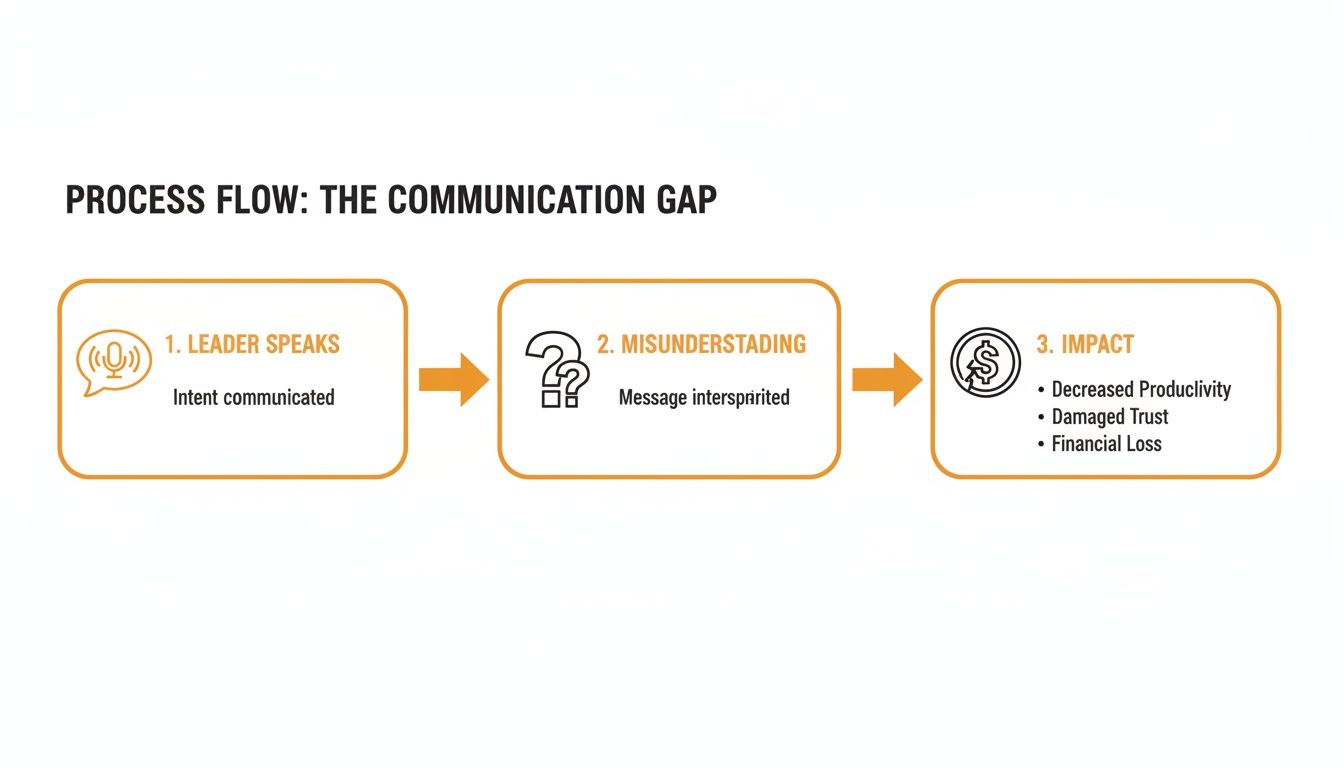
As you can see, a slight misunderstanding isn't just a small hiccup; it's the first domino in a chain that can lead to tangible, costly problems for the business.
Setting Goals You Can Actually Measure
Once you have a clear picture of the gaps, you can set goals that have some teeth. Vague objectives like "improve communication" are basically useless because you can't measure them. Instead, you need to focus on specific, quantifiable outcomes.
For instance, swap out that fuzzy goal for something concrete:
- Slash meeting times by 15% by coaching leaders on how to create tight agendas and deliver concise updates.
- Lift employee engagement scores on communication-related questions by 10 points after the training.
- Drive up the adoption rate of a new strategic plan by making sure leaders can sell the "why" behind it, not just the "what."
Goals like these give your program a clear sense of purpose. More importantly, they allow you to prove a tangible return on investment, which makes getting buy-in and budget a whole lot easier. To get more ideas on structuring these initiatives, check out our guide on effective leadership development programs.
Picking the Right Format for the Job
How you deliver the training is just as critical as what you teach. The old-school, one-size-fits-all workshop isn't the only game in town anymore, especially with so many teams working in a hybrid model.
The training world has shifted dramatically. A whopping 72% of organizations have moved to digital or hybrid training since 2020—a huge leap from just 34% before. This makes sense when you consider that for 2025, 64% of leaders see a direct line between strong communication skills and productivity.
So, what's the right fit for your team? It really depends on your goals, budget, and how packed your executives' calendars are.
| Training Format | Pros | Cons |
|---|---|---|
| In-Person Workshops | Amazing for engagement, builds team chemistry, and allows for intense role-playing with immediate feedback. | Can be expensive, a nightmare to schedule for busy execs, and isn't ideal for distributed teams. |
| Virtual Coaching | Super personalized, flexible scheduling, and laser-focused on an individual's real-world challenges. | You lose out on peer learning, it’s harder to scale for large groups, and it requires a lot of self-discipline. |
| Blended Learning | The best of both worlds—online modules for the theory, paired with live sessions (virtual or in-person) for practice. | Can be tricky to coordinate and you need a good tech platform to make it feel seamless. |
For a lot of companies right now, a blended learning model hits that sweet spot. It gives leaders the flexibility to learn foundational concepts on their own time, which frees up valuable face-to-face time for what really matters: interactive practice, peer feedback, and expert coaching.
The point of all this isn't just to teach theory; it's to build muscle memory. The right format creates a safe space for leaders to practice, mess up, and refine their approach before they’re in a high-stakes situation.
At the end of the day, the best executive communication skills training is never off-the-shelf. By starting with a real needs analysis, setting firm goals, and choosing a format that fits your culture, you'll build a program that doesn't just inform—it transforms.
Picking the Right Stuff for Your Training Curriculum
Once you’ve got the blueprint for your program, it's time to get into the good stuff: the actual content. A top-notch curriculum isn’t just a jumble of communication topics. It's a carefully curated set of modules that build on each other to tackle the real challenges leaders face every day.
Think of these modules as the core building blocks that turn a competent manager into a truly influential leader. Let's dig into the essentials that absolutely have to be in your program.

Mastering the Art of Influence and Persuasion
At the end of the day, real leadership is about influence, not just authority. This module goes way beyond basic presentation skills and gets into the psychology of persuasion. The whole point is to teach leaders how to actually move people to action, not just spit out information.
Here’s what you need to cover:
- Nailing the Core Message: Teach them how to boil down a complex idea into one powerful, memorable sentence.
- Building a Case That Sticks: Use classic frameworks like "Problem-Agitation-Solution" to show them how to construct an argument that truly connects with an audience.
- Storytelling with Data: This is a big one. It’s not about just reading off a chart. It’s about weaving numbers into a narrative that explains the stakes, uncovers insights, and pushes for a decision.
A fantastic practical exercise for this is the "Boardroom Pitch." You give participants a real-world scenario—say, asking for a massive budget increase for a new project—and they get five minutes to build and deliver a persuasive pitch. The rest of the group then gives honest feedback on what landed and what didn't.
Leading with Real Empathy and Active Listening
So many leaders are trained to talk, but almost none are trained to really listen. This module is designed to flip that script entirely. It's all about developing the skill of listening to understand, not just waiting for your turn to speak.
This one skill is the foundation for everything from navigating tough conversations to building a culture of psychological safety. It’s where genuine trust is born.
Empathy isn't just about being "nice." It's a strategic leadership tool. It helps leaders find hidden roadblocks, figure out what truly motivates their team, and build the kind of loyalty that gets everyone through the tough stretches.
Focus on hands-on skills they can use immediately, like:
- The Power of a Clarifying Question: Show them how to ask questions that cut through the noise and get to the heart of an issue.
- Paraphrasing for Clarity: A simple but incredibly effective technique to confirm you’ve understood someone correctly and make them feel heard.
- Reading the Room: Help them tune into the non-verbal cues that tell the real story, whether they're in a physical boardroom or a Zoom call.
Staying Cool During Crisis Communication
When things inevitably go sideways, a leader's communication skills are thrown into the spotlight. This module is all about preparing them for those make-or-break moments.
It needs to provide a clear, step-by-step playbook for communicating with calm and authority during a crisis. This could be anything from an internal issue like layoffs to an external one like a product recall. The focus has to be on transparency, empathy, and decisiveness.
Building a Strong Digital Executive Presence
In today's world, a leader's influence isn't just limited to meetings and town halls. Their digital footprint, especially on platforms like LinkedIn, is a massive part of their leadership platform. But it's shocking how often this gets ignored in executive communication skills training.
This module isn't a "nice-to-have" anymore; it's absolutely essential. You've got to cover:
- Defining Their Personal Brand: Helping them articulate their unique expertise and leadership philosophy online.
- Engaging Like a Pro: Walking them through the best ways to share valuable insights, comment on industry trends, and build a meaningful professional network.
- Turning Presence into Impact: Showing them how to use their digital platform to attract amazing talent, forge new partnerships, and amplify the company's message.
Recent data tells a pretty clear story here. While verbal skills (55%) and presentations (47%) still lead the pack, digital communication skills are right behind at 31%. This shows just how critical it is for leaders to be savvy online. It’s even more urgent when you realize that a tiny 9% of first-time managers ever get any leadership training before they’re thrown into the role. You can check out more of these communication training statistics on amraandelma.com.
Prioritizing Modules for Maximum Impact
Let's be realistic—you probably can't teach everything all at once. That's why prioritization is your best friend. The right modules for your organization are the ones that solve your most immediate and painful business challenges.
To help you decide where to start, I've put together a simple table that connects common business problems to the training modules that will give you the biggest and fastest return on your investment.
Prioritizing Training Modules By Business Need
| Business Challenge | High-Priority Module | Expected Outcome |
|---|---|---|
| Low team morale or high turnover | Leading with Empathy and Active Listening | Increased psychological safety, higher employee engagement scores, and improved retention rates. |
| Strategic initiatives fail to get traction | Mastering Influence and Persuasion | Better buy-in from teams and stakeholders, leading to faster and more successful project execution. |
| Reputation is at risk or company is in flux | Navigating Crisis Communication | Maintained trust with employees and customers during turbulent times, protecting the company's brand. |
| Struggling to attract top-tier talent | Crafting a Digital Executive Presence | A stronger employer brand and a more visible, attractive leadership team that top candidates want to work for. |
By tailoring your curriculum this way, you make sure your training program isn't just some theoretical exercise. It becomes a powerful tool that directly solves real problems and drives results you can actually measure.
Delivering Training That Actually Sticks
Let’s be honest. Most corporate training is a waste of time. You can have the most brilliant curriculum in the world, but it’s worthless if everyone forgets it the second they walk out the door. This is the dreaded "forgetting curve" in action, and it's the biggest reason so many training initiatives fail.
If you want your executive communication skills training to have a real impact, you have to design it so the lessons stick. This means getting people out of their seats and turning passive lectures into active, hands-on practice that embeds new habits directly into their daily work.
It’s all about building muscle memory, not just filling notebooks.

Making the Content Engaging and Memorable
Nobody learns anything from a dry, theory-heavy PowerPoint deck. To make the learning stick, you have to connect with people on an intellectual and an emotional level. This is where you get creative.
- Tell a good story. People don’t remember data points; they remember stories. Instead of listing persuasive techniques, tell them about the time a leader won over a skeptical board with a single, powerful narrative. A good story is 73% more memorable than just throwing stats at people.
- Get them role-playing. Don't just tell leaders how to handle a tough conversation—make them do it. I like to set up real-world scenarios, like giving tough feedback to a rockstar employee or navigating a tense negotiation. This is where the magic happens—practicing in a safe space builds real confidence and skill.
- Let them coach each other. Pair up your participants and have them practice on each other. It’s amazing what happens when you do. They’re often more candid and vulnerable with a peer than they are with a facilitator, leading to some serious breakthroughs. Plus, it builds a built-in support network.
These aren't just fun activities; they shift the entire dynamic from passive listening to active doing. That’s how you get lessons to stick.
Building a Lasting Communication Culture
A one-off workshop is just a blip on the radar. If you want to see real, lasting change, you have to bake these skills into the company culture itself.
That means creating an environment of psychological safety where leaders feel comfortable practicing, messing up, and asking for help without feeling judged.
The ultimate goal isn't just to train individuals; it's to create a 'communication culture' where practicing new skills is encouraged, feedback is welcomed, and continuous improvement is woven into the fabric of leadership.
This culture needs to live outside the training room, too. Modern tools can be a huge help here. For example, AI-powered platforms can help an executive take what they learned about messaging and apply it directly to their LinkedIn profile. A tool like RedactAI can analyze their personal style and help them write posts that sound authentic while still reflecting their new communication authority.
How to Reinforce Skills After the Training Ends
The real work starts when the workshop is over. Without a solid plan to reinforce the learning, all that initial momentum will fizzle out. You have to keep the conversation going.
Here are a few things I’ve seen work wonders for making skills stick long-term:
- Schedule quick coaching follow-ups. A few weeks after the training, set up short one-on-one sessions to check in on how things are going. What's working? Where are they stuck?
- Assign accountability partners. Pair leaders up and give them a simple task: check in on each other's progress toward one specific communication goal they set.
- Launch simple 'communication challenges'. Keep it fun and light. Think weekly emails with a small challenge, like: "This week, start every team meeting with a clear, one-sentence objective."
- Tie it to performance reviews. If you’re serious about it, add a communication competency to leadership performance reviews. It sends a clear signal that this stuff matters.
- Share the wins. When you see a leader nail a new skill and get a great result, shout it from the rooftops! Sharing those success stories is contagious and inspires everyone else.
When you combine an engaging delivery with a smart reinforcement plan, you're no longer just running a training event. You're kickstarting real, lasting change.
Measuring the Real ROI of Communication Training
So, how do you actually prove that your investment in executive communication skills training is paying off? If you’re just handing out a smiley-face survey after the workshop, you’re only scratching the surface. Real measurement goes way beyond "Did you like the session?" and gets into the nitty-gritty of business impact.
To truly prove the return on investment (ROI), you need to look at this from two angles. You've got the hard numbers, of course, but you also have to account for the subtle—but incredibly powerful—shifts in behavior and team culture. Putting both together is how you build a rock-solid case that better communication isn't just a "nice-to-have" thing; it's a direct line to a healthier bottom line.
Tracking the Hard Numbers
Let's start with the quantitative stuff—the objective data that leadership loves. These metrics are what connect the dots between the training room and real-world business outcomes. The trick is to get a baseline before the training kicks off. Without it, you can't really show how far you've come.
Here are a few KPIs I always recommend tracking:
- Employee Engagement Scores: Don't just look at the overall score. Zero in on the questions about leadership communication, trust, and how clearly the company's vision is being shared. A bump in these specific areas after training is a huge win.
- Retention Rates: It's simple: people don't leave managers who communicate well. In fact, employees who say their company's internal communication is 'Excellent' are 76% 'very likely' to stick around. Compare that to the tiny 20% of those who rate it as 'Poor'. You can see more of these findings on the impact of employee communication from Staffbase.
- Project Completion Times: Clear goals and expectations from leaders mean projects get done faster and with fewer headaches. Start tracking the average time from project kickoff to completion and see if that timeline starts to shrink.
The image below from that Staffbase study really drives this point home. It shows just how much communication quality impacts an employee's decision to stay.
As you can see, people who feel informed and connected are wildly more loyal. That's a direct hit on your retention numbers and the costs associated with turnover.
Uncovering Qualitative Wins
Numbers tell a great story, but they don't tell the whole story. Qualitative feedback is where you discover the how and why behind the data. This is how you measure the actual behavioral changes that are driving those numbers up. It adds the rich, human context that a spreadsheet just can't provide.
The real magic of communication training isn't just in what leaders learn, but in how their teams feel the change. It's the shift from confusion to clarity, and from apprehension to trust.
Here’s how you can capture that magic:
- 360-Degree Reviews: Before and after the training, gather anonymous feedback on a leader from their direct reports, peers, and managers. You're looking for specific comments about their clarity, how well they listen, and their ability to get people fired up.
- Behavioral Observation: This is one of my favorite methods. Have HR partners or facilitators sit in on a few team meetings. Are agendas clearer now? Is there more open discussion? Do leaders handle tough questions without getting flustered?
- Focus Groups: Get small groups of employees in a room and just talk. Ask open-ended questions like, "What's one thing that has changed about how your team leader communicates?" The stories you'll hear are pure gold.
When you connect these observations back to your hard data, you create an incredibly compelling narrative. You’re showing that companies with effective communication aren't just anecdotally better—they are 3.5 times more likely to outperform their peers.
If you're looking for more ideas on this, check out our guide on how to measure content performance; a lot of the same principles apply. When it's all said and done, a smart measurement strategy proves that investing in your leaders' communication skills is one of the best financial decisions a company can make.
Still Have Questions About Executive Communication Training?
Even the best-laid plans come with a few lingering questions. It’s totally normal. Let’s walk through some of the most common ones I hear from L&D leaders so you can move forward with confidence.
How Do I Get Executive Buy-In?
This is probably the biggest hurdle. You know the training is essential, but getting leadership to sign off, especially with tight budgets, can feel like a tough sell.
My advice? Stop using the term "soft skills." It makes the training sound like a nice-to-have, not a need-to-have. Instead, start speaking their language: ROI. Frame this entire initiative as a direct, powerful solution to a real business problem.
Show them the numbers. Connect the dots between better communication and metrics they actually care about—like lower employee turnover, faster project completion, or higher employee engagement scores. When leaders see data that proves a clear financial return, the conversation changes completely.
What's the Ideal Training Duration?
I get this question all the time, and the honest answer is: there's no magic number. It really depends on what you're trying to achieve. One thing I can tell you for sure is that a single, one-off workshop is a waste of time and money. It creates a temporary buzz but doesn't lead to real, lasting change.
If you want to see actual behavior change, you need reinforcement over time. A blended approach works wonders.
- Kick-off Workshop: Start with an immersive half-day or full-day session. This builds a solid foundation and gets everyone energized.
- Follow-up Sessions: Schedule 90-minute check-ins every month or so. This is where the real work happens—leaders can practice their new skills and troubleshoot challenges they're facing on the job.
- 1:1 Coaching: Offer some targeted, individual coaching for leaders who need a little extra help in specific areas.
This kind of spaced-out learning prevents people from getting overwhelmed and gives them the chance to actually apply what they've learned in their day-to-day roles.
How Does This Work for Remote or Hybrid Teams?
With so many teams spread out, in-person training just isn't an option for everyone. But here’s the good news: virtual training can be just as effective, if not more so, when you do it right. And "doing it right" means more than just streaming a workshop on Zoom.
The key is to make your virtual sessions feel just as interactive and engaging as an in-person one. I'm talking about using breakout rooms for small-group practice, running live polls to keep energy up, and dedicating plenty of time for real Q&A. Shorter, more focused sessions also help fight that dreaded screen fatigue.
A lot of companies I work with are now using a blended model that mixes self-paced online learning with live virtual coaching sessions. This gives busy execs the flexibility to learn on their own schedule, no matter where they are.
It’s clear this is a priority across the board. In fact, 40% of HR leaders are planning to focus on communication training in 2025. Businesses that formalize this training spend about $1,200 per employee each year, and a whopping 83% of learning leaders plan to maintain or even increase those budgets. If you want to dive deeper, check out these communication training statistics and trends.
Ready to elevate your own executive presence? RedactAI helps you craft high-impact LinkedIn posts that reflect your leadership style and build your authority online. Start creating compelling content in minutes and see the difference it makes. Join over 21,000 professionals and get started for free at https://redactai.io.