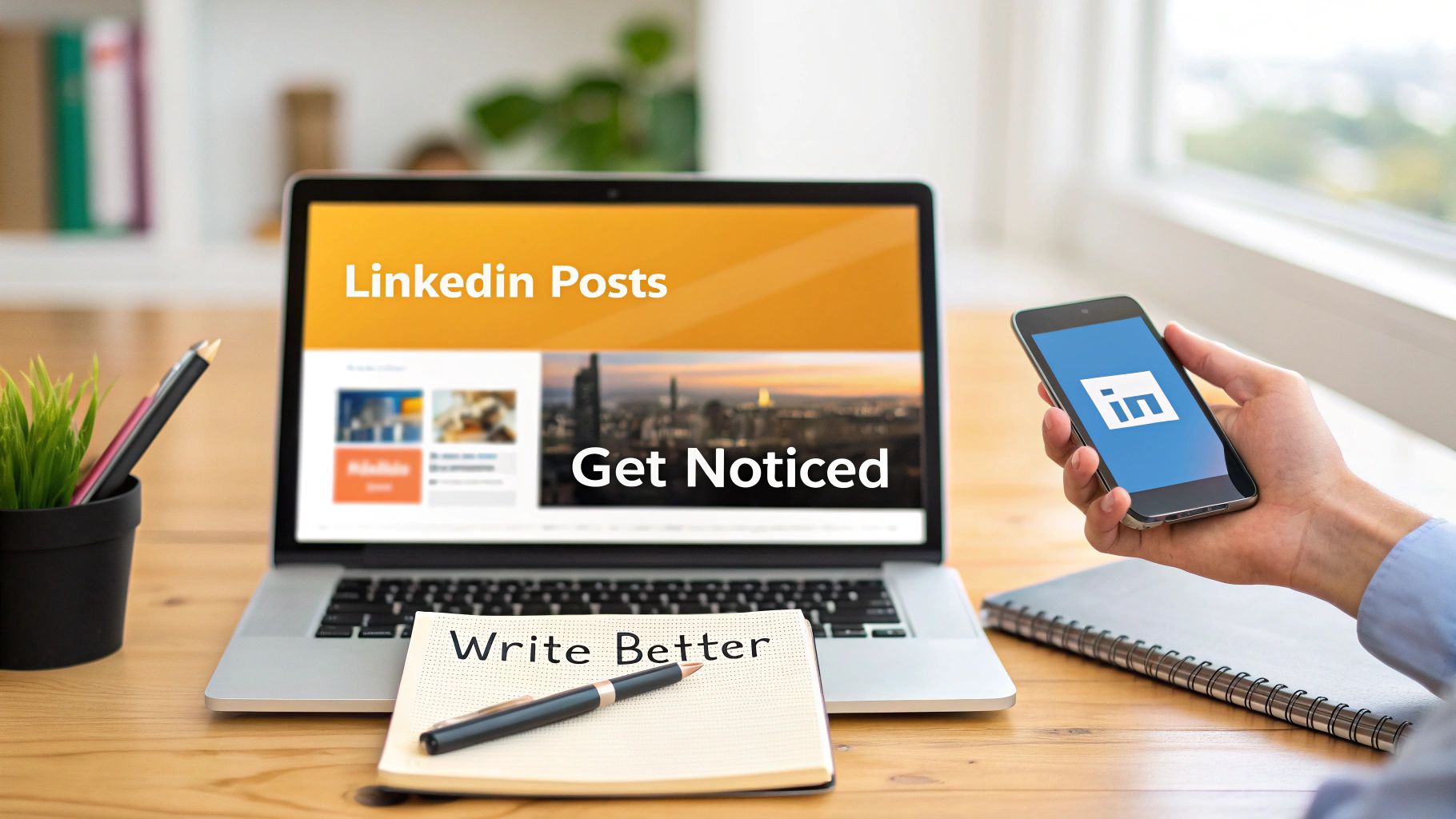
Don't make the classic mistake of treating your LinkedIn presence like just another social media profile. Your personal profile is you. A LinkedIn business page is your brand’s digital headquarters, and it opens up a whole suite of tools for advertising, analytics, and community building that you simply can't get with a personal account. For anyone serious about growth, that difference is everything.
So, Why Does Your Brand Actually Need a Dedicated LinkedIn Page?
Before we get into the nitty-gritty of setting one up, let’s talk strategy. I see it all the time: entrepreneurs and small business owners trying to run everything through their personal LinkedIn profiles. It makes sense at first—you're tapping into the network you already have. But you'll hit a ceiling, and fast.
A personal profile is built for one-on-one connections. A dedicated Company Page, on the other hand, turns that personal handshake into a global broadcast. It’s the difference between networking in a small breakout room and owning the main stage.
Go Beyond Networking and Start Building a Real Brand
Think of it this way: your personal profile tells your story. Your business page tells your company’s story. Keeping those separate is crucial for building credibility in your industry. When a potential client or a future star employee looks you up, they're expecting to find an official, polished home for your brand—not just your personal work history.
A Company Page gives you a central hub to:
- Showcase what you stand for: Clearly lay out your mission, vision, and values.
- Spotlight your products and services: You can even create dedicated pages to detail what you offer.
- Build a genuine community: People who follow your page want to hear from you. You’re building a pre-qualified audience.
- Become a thought leader: This is your official channel for dropping industry knowledge and company news.
A polished LinkedIn presence immediately signals you're a serious, established business, not just a side hustle. It's often that first impression that counts.
Unlock the Tools That Actually Drive Business
Here's the real game-changer. Creating a LinkedIn business page unlocks powerful tools you can't access otherwise. These are the features built specifically for marketing, hiring, and finding new customers. Your page is the key to unlocking LinkedIn’s true B2B power.
For starters, you get LinkedIn Analytics. This gives you a treasure trove of data on your followers and page visitors—their job titles, industries, seniority levels, you name it. This stuff is pure gold for figuring out who your audience really is and what content they actually want to see.
More importantly, a business page is mandatory for running LinkedIn Ads. Without one, you can't launch targeted campaigns to get your message in front of specific decision-makers. If you plan on scaling beyond your immediate network, this is non-negotiable. If you're curious about this, you can learn more about how to generate business leads in our guide, which covers tactics that work hand-in-hand with a strong LinkedIn page.
Your personal profile builds your reputation. Your Company Page builds your legacy. It’s a strategic asset that validates your brand, attracts top talent, and becomes a powerful engine for growth.
Your Pre-Launch Checklist for a Flawless Setup
Jumping into LinkedIn page creation without a plan is a classic mistake. It's how you end up with a half-finished page that looks amateur and, frankly, repels the very people you want to attract. To avoid that, let’s run through a quick pre-flight checklist.
Getting these key assets and bits of info together before you start will make the whole process smoother and ensure your page looks professional from the moment you hit "publish." This isn't just about having files on hand; it's about getting your brand's story straight before you even log in. A well-prepared page instantly builds trust and signals to the LinkedIn algorithm that you're a serious player.
To make this super simple, I've put together a table summarizing everything you'll need. Think of it as your cheat sheet for a perfect launch.
LinkedIn Business Page Pre-Launch Checklist
| Asset / Information | Best Practice Tip | Why It's Important |
|---|---|---|
| High-Resolution Logo | Use a 300 x 300 pixel PNG or JPG. Keep it simple and recognizable, even when small. | This is your profile picture. A fuzzy or cropped logo looks unprofessional and hurts brand recognition in a crowded feed. |
| Branded Cover Image | Design an 1128 x 191 pixel image that shows your value proposition or company tagline. | This is prime real estate. It’s the first thing visitors see, making it a powerful tool for communicating your brand's essence. |
| Punchy Tagline | Draft a clear, keyword-rich sentence (under 120 characters) that says what you do. | This sits right under your company name. It’s your chance to grab attention and explain your purpose in a nutshell. |
| 'About Us' Summary | Write up to 2,000 characters telling your story. Focus on who you help and how. | This is your elevator pitch, optimized for search. It’s crucial for both human visitors and the LinkedIn/Google algorithms. |
| Website URL | Choose a specific URL, like a services page or a dedicated landing page. | Don't just dump traffic on your homepage. A targeted link improves user experience and can boost conversion rates. |
| Verified Personal Profile | Ensure your profile is at least 7 days old with an "All-Star" strength and several connections. | LinkedIn requires this to prevent spam. You can't create a page without a credible personal profile linked to the company. |
With these assets gathered, you’re not just ready to build a page—you’re ready to build one that actually works.
Nail Your Visuals First
Let's get your brand’s look and feel sorted out. These are the visual elements that make you instantly recognizable.
- Your Logo: This is your digital handshake. It needs to be crisp and clear, even as a tiny circle next to your posts. Aim for 300 x 300 pixels in a high-quality PNG or JPG format.
- Your Cover Image: This is the big banner at the top of your page (1128 x 191 pixels). Please, don't just slap a generic stock photo here. Use this space to communicate your core message or show off your company tagline.
Getting these right from the start avoids that sad, "under construction" vibe and tells visitors you mean business.
Pro Tip: Your cover image is a free billboard. I've seen companies use it brilliantly to announce a new product, showcase their team culture, or highlight a key benefit. I recommend updating it every quarter to keep your page looking fresh and relevant.
Get Your Company Story Straight
Next up, the words. Trying to write your company copy on the fly during the setup process is a recipe for disaster. Take a few minutes now to craft these key pieces.
You’ll want to have these three things ready to copy and paste:
- The Tagline: A short, snappy sentence (120 characters max) that sits right under your name. Instead of something vague like "Innovative Solutions," try something specific like, "AI-Powered Content Creation for B2B Tech." See the difference?
- The 'About Us' Summary: You get 2,000 characters here to tell your story. I always advise clients to draft this in a Google Doc first. Focus on who you help, the problems you solve, and what makes you the best choice. Sprinkle in keywords your ideal customers would actually use to find you.
- The Website URL: Have the exact link ready. Linking to your homepage is fine, but linking to a specific services page or a landing page made just for LinkedIn visitors is so much smarter.
This prep work ensures your messaging is tight and optimized for search. Don't forget, Google indexes LinkedIn pages, so the words you choose here can help you get found beyond the platform.
Check Off LinkedIn’s Basic Requirements
Finally, there are a few hoops LinkedIn makes you jump through. This is to make sure legitimate people are creating pages for legitimate businesses.
Before you can even see the "Create a Company Page" button, your personal LinkedIn profile must be:
- At least 7 days old.
- Rated as "Intermediate" or "All-Star" profile strength.
- Connected to a decent number of people. LinkedIn is vague on the exact number, but a brand-new profile with only five connections is a red flag.
You also have to be a current employee listed in the "Experience" section of your personal profile. This is how LinkedIn keeps things accountable and cuts down on spam. So, give your own profile a quick once-over before you get started.
Creating Your LinkedIn Business Page Step by Step
Alright, you've got your assets ready to go. Now for the fun part: actually building your page. This isn't just a matter of filling out a form; every choice you make here lays the groundwork for attracting the right audience from the get-go.
Let's walk through exactly how to do this. The entire journey starts from your personal LinkedIn profile, which is a requirement. LinkedIn wants to see a real person behind a real business, which is a good thing for keeping the platform authentic.
Kicking Off the Creation Process
First things first, head over to your LinkedIn homepage. In the top-right corner, you’ll see a little grid of nine dots labeled “For Business.” Give that a click. A menu will drop down, and you'll want to scroll all the way to the bottom to find and select “Create a Company Page +”.
That one click gets the ball rolling and brings you to your first important decision.
Choosing the Right Page Type for Your Business
LinkedIn will immediately ask what kind of page you want to create. The options are pretty clear, but your choice does matter for how you’re categorized on the platform.
- Company: This is the one for most of us, from small businesses to major corporations.
- Showcase page: Think of these as sub-pages that attach to an existing Company Page. They're perfect for highlighting a specific brand, a new product line, or a special initiative.
- Educational Institution: Exactly what it sounds like—for schools, colleges, and universities.
For almost everyone reading this, “Company” is the right move. After you select it, you'll be asked to pick a company size. This just helps LinkedIn tailor some of the features and analytics it shows you. If you have fewer than 200 employees, the "Small business" option is what you're looking for.
Don't sweat this step too much. The page type is mostly for LinkedIn's internal sorting. All the core features you need to grow are available on a standard "Company" page.
Once you’ve made your choice, you’ll land on the main setup screen where all that prep work you did earlier will pay off.
Filling in Your Core Company Details
This next form is where you build the foundation of your page's identity. Let's break down each field and how to get it right.
1. Name and Public URL
Pop in your official company name here. Keep it clean and precise—don't add taglines or extra keywords. You want brand consistency across all your online profiles, and this is where it starts.
Next up is your LinkedIn public URL. By default, LinkedIn assigns a messy string of numbers. You absolutely have to customize this. A clean URL like linkedin.com/company/your-brand-name just looks more professional and is way easier to share than linkedin.com/company/12345678. If your first choice is taken, try a logical variation like adding your industry or city.
2. Website and Industry
Add your website link. Simple, right? But here’s a pro tip: instead of just linking to your homepage, consider sending people to a more valuable page. Maybe it's your main services page, a portfolio of case studies, or even a custom landing page just for people coming from LinkedIn.
Choosing your Industry is another surprisingly important step. Try to think like a potential customer. What industry would they search for to find someone like you? This choice has a real impact on who sees your page in search results and who LinkedIn suggests should follow you.
3. Company Details and Logo
This is where you'll select your Company size (e.g., 1-10 employees, 11-50 employees) and Company type (e.g., Public Company, Partnership, Self-Employed) from dropdown menus. Be honest here; it helps set the right expectations for potential clients or new hires.
Finally, it’s time to upload that sharp, high-resolution logo you prepared. Remember, this is your brand’s face on LinkedIn, so make sure your 300 x 300 pixel image looks fantastic, even when it’s shrunk down to a tiny circle in someone's feed.
Finalizing and Verifying Your Page
The last thing to do is check a box confirming you’re an authorized representative of the company. Give everything one last read-through to catch any typos, then hit the “Create page” button.
And just like that, your LinkedIn Business Page is live! But your work isn't done. The page is just a skeleton at this point. LinkedIn will immediately guide you through a setup wizard to add the really important stuff—your tagline, cover image, and that all-important 'About' summary.
For a deeper dive into the setup process and tips on making your page pop, check out this great guide on how to create a LinkedIn Company Page to stand out. It has some extra insights that can give you a real edge. The goal isn't just to have a page, it's to build a compelling digital storefront for your brand.
Getting Your Page Noticed: Optimization and Engagement

So, you've hit "Create Page." Great. But right now, your new page is like a brand-new shop on a quiet side street with no sign out front. Nobody knows you're there. The real work begins now: turning that empty storefront into a place that attracts the right people.
This is all about making your page discoverable. When you fill out every single field, you're sending little signals to the LinkedIn algorithm that your page is legit and worth showing to people. It's these small, intentional tweaks that separate a dead page from a lead-generating machine.
Don't just take my word for it. The numbers are clear. Companies that get this right see 7 times the impressions and a whopping 11 times the clicks per follower compared to pages that are left incomplete. Even better, fully fleshed-out pages pull in 30% more weekly views. You can dig into more of these LinkedIn statistics on The Social Shepherd if you're curious.
Write an "About" Section That Actually Works
Your 'About' section is the most valuable piece of real estate on your entire page. Think of it as your digital elevator pitch, but it has to work for two very different audiences: real people and the LinkedIn search algorithm. This is your chance to tell your story while weaving in the exact keywords your ideal clients are tapping into the search bar.
Don't just list what you do. Talk about who you help and the problems you solve for them.
My Go-To Tip: Start your 'About' section with a strong hook that addresses a pain point. Instead of "We are a full-service marketing agency," try something like, "Most B2B companies find it impossible to generate consistent leads online." See the difference? One is a statement, the other starts a conversation.
Here’s a simple structure I always recommend to make it scannable and effective:
- The Hook: Kick things off with the problem you solve.
- Your Solution: Briefly explain what you do and for who.
- The Proof: Drop in your years of experience, a key result, or what makes you different.
- The Next Step: Tell them what to do next. "Visit our site for a free demo" is way better than just ending.
This simple formula ensures your message is clear, persuasive, and loaded with the terms that will get you found.
Claim Your Custom URL and Add a Call to Action
Nothing looks more amateur than a default URL packed with random numbers. One of the quickest wins is to create a custom URL for your page. Make it clean and simple, like linkedin.com/company/your-brand-name. It looks professional on business cards, in your email signature, and is just plain easier for people to remember.
Next up, you have to add a custom call-to-action (CTA) button. LinkedIn gives you a prime spot right under your cover photo to guide visitors toward the one thing you want them to do.
You have a few options for the button:
- Visit website: The classic choice for driving traffic to your homepage or a specific landing page.
- Contact us: A must-have for any service-based business.
- Learn more: A great, low-commitment option to send people to a case study or resource hub.
- Register: Perfect for getting sign-ups for your next webinar or event.
- Sign up: Use this to grow your email list or get people into a free trial.
Picking the right CTA turns your page from a static brochure into an active part of your sales funnel.
Use Every Feature LinkedIn Gives You
LinkedIn's algorithm loves a complete profile. It sees it as a sign of an active, committed business and is more likely to show your content to others. Go through every single section and fill it out.
- Services Page: This is your chance to really elaborate. Don't just list "Consulting." Detail what that means, explain the process, and—most importantly—ask past clients to leave reviews right on the page.
- Industry & Location: Be specific here. Don't just pick "Marketing and Advertising." Think about the niche your clients are in. Adding your location is also a no-brainer for getting found in local searches.
- Hashtags: You get to add three hashtags that act as core themes for your page. This helps LinkedIn understand your content and suggest your page to people following those topics.
Every field you complete is another clue you're giving LinkedIn to help it connect you with the right audience. Spending a little extra time on these details will make a huge difference in your page's performance and help you boost your LinkedIn engagement rate over time.
Building Your Initial Content and Growth Strategy
An empty page doesn’t exactly scream "industry leader." Once you've got your page looking sharp, the very next thing you need to do is post something. Anything. Those first few posts are crucial because they signal you’re open for business and ready to add value.
Honestly, don't overthink it. The goal is just to break the silence and give your first visitors something to connect with. Start with the basics: a warm company introduction, a behind-the-scenes look at your team, or a quick post celebrating a recent win. This initial content is what turns your page from a static brochure into a living, breathing part of your brand.
Kickstarting Your Content Journey
Your first handful of posts should feel authentic and welcoming. This isn't the time for a hard sell; it's about building a foundation of trust and showing off your personality. Think of it as a digital open house for your company.
Here are a few simple but effective ideas to get you started:
- The "We're Officially Here!" Post: Announce your new page! Briefly re-introduce your mission and tell people you're excited to build a community right here on LinkedIn.
- Meet the Team: I love this one. Feature a key team member with a professional photo and a short, fun Q&A. It humanizes your brand in an instant.
- A Peek Behind the Curtain: Share a photo or a quick video of your workspace, a team meeting, or your product in development. People are naturally curious and love seeing the real work that happens off-screen.
- Share Your Origin Story: Why did you start your company? Briefly tell the story of the problem you set out to solve.
These initial posts are low-pressure and high-impact. They give you a nice runway to build out a more structured content plan down the road.
Your LinkedIn page is your brand's official headquarters, and a consistent content strategy is how you keep the lights on. It shows potential clients, partners, and employees that your business is active, engaged, and invested in its community.
Developing a Sustainable B2B Content Plan
Once you've broken the ice, it’s time to think long-term. A content strategy that actually works on LinkedIn is all about providing consistent value to a professional audience. This means you need to shift your focus from "what we sell" to "what we know."
To keep the ideas flowing and maintain a consistent posting schedule, learning how to use AI to write blog posts can be a total game-changer, helping you repurpose deeper insights into bite-sized LinkedIn content.
I've found that the best content usually falls into a few key pillars:
- Educational Content: Share industry insights, how-to guides, or quick tips that solve a common headache for your target audience.
- Company Culture & News: Post about team achievements, new hires, and company milestones. This is fantastic for attracting talent and showing your brand's human side.
- Industry Commentary: Offer your perspective on recent news or trends in your field. This is how you position yourself as a thought leader who's actively part of the conversation.
- Client Stories & Case Studies: Showcase your success stories (with permission, of course!). This provides powerful social proof and demonstrates the real-world impact of your work.
LinkedIn's professional ecosystem is massive, with over 1.3 billion members. By posting just once or twice a week, you can start tapping into that audience and see a real difference in follower growth and engagement.
Ultimately, your goal is to turn your page into a dynamic hub that attracts your ideal audience and sparks real business conversations. For a deeper look into creating posts that actually get results, check out our complete guide on building a winning https://redactai.io/blog/linkedin-content-strategy that covers everything from content pillars to performance tracking.
Got Questions? Let's Troubleshoot Common LinkedIn Page Hiccups
Even with a perfect setup, a few questions are bound to pop up. It’s totally normal to hit a snag or two as you move from building your page to actually using it to grow your business. Let's walk through some of the most common issues people run into.
Getting your page live is just the first step. The real magic happens when you start managing it effectively, from growing your follower count to figuring out a posting rhythm. Nailing these details early on really sets you up for success down the road.
How Do I Get My First 100 Followers?
That initial push to get your first followers can feel like a grind, but the trick is to start with the people who already know you—without being annoying about it.
- Invite Your Connections (Strategically): LinkedIn lets you invite people you're connected with to follow your page. But don't just spam your entire network. Hand-pick colleagues, clients, and other professionals who you genuinely think will get value from your content. A quick, personal note can make all the difference.
- Plug It Everywhere: Drop your new LinkedIn page link into your email signature, the footer of your company website, and your other social media bios. It’s a super easy, set-it-and-forget-it way to let people know you exist on LinkedIn.
- Rally the Team: Get your employees on board! Ask them to add the new page to the "Experience" section of their personal profiles and to share your first couple of posts. Think of their networks as a massive, untapped extension of your own.
This early stage is all about tapping into the relationships you've already built to create a strong starting point.
Why bother? The business case for building a following on LinkedIn is huge. It's a B2B beast, driving 75-85% of all B2B leads from social media. Plus, people on the platform are 6 times more likely to convert, turning each follower into a real opportunity. You can dig into more of these powerful LinkedIn conversion statistics on Martal Group's site.
What If LinkedIn Won't Let Me Create a Page?
Hitting a wall during the setup process is frustrating, but it's almost always a simple fix. LinkedIn has a few ground rules in place to keep spammy or fake pages off the platform.
First, take a look at your personal profile. It has to be at least 7 days old and have a profile strength of "Intermediate" or "All-Star." You also need a decent number of connections—if your profile is brand new with only a handful of friends, it looks suspicious to the system. The final, and most common, culprit is making sure you are listed as a current employee at the company in your own "Experience" section.
When Is the Best Time to Post on LinkedIn?
There’s no single "golden hour" that works for everyone, but the data is pretty clear: B2B audiences are most tuned in during the standard workday. Just think about when your ideal customer might be taking a coffee break or scrolling through their feed to catch up on industry news.
As a general rule of thumb, the sweet spots for posting on LinkedIn are:
- Mid-mornings (around 9 AM - 12 PM) on Tuesdays, Wednesdays, and Thursdays.
- Early afternoons (around 1 PM - 3 PM) on those same days.
Engagement tends to take a nosedive on weekends and late at night. My advice? Start by posting within these windows, then dive into your page's analytics to see what resonates with your specific audience. Ultimately, consistency beats perfect timing every single time, so just find a schedule you can maintain.
Tired of staring at a blank screen wondering what to post? RedactAI uses AI to analyze your personal style and generate engaging post ideas in seconds. It's how over 21,000 creators are building their brands on LinkedIn without the writer's block. See how it works at https://redactai.io.