Let's be real: when it comes to B2B, lead generation on LinkedIn isn't just another option on the menu—it's the main course. Forget what you think you know about it being just a digital resume file. It's the most powerful B2B sales and marketing engine you can get your hands on, full of professionals actively looking for answers, new ideas, and partnerships.
This isn't about spamming connection requests. It’s about strategically connecting with an audience that’s already clocked in and thinking about business. While other platforms are great for building general brand awareness, they're designed for casual doomscrolling. LinkedIn is where the real industry talk happens, where executives share what's on their minds, and where your perfect clients are doing their homework before they buy.
That difference in user intent makes every interaction count for so much more.
A Quick Look at the Numbers
Don't just take my word for it. The stats behind LinkedIn are what really drive the point home. Here's a snapshot of why this platform is an absolute must for anyone serious about B2B growth.
LinkedIn by the Numbers
A quick look at the stats that make LinkedIn an essential tool for lead generation.
| Metric | Why It Matters for You |
|---|---|
| 900+ million members | A massive, global pool of potential clients, partners, and talent right at your fingertips. Your ideal customer is almost certainly here. |
| 65 million decision-makers | You get direct access to the people who hold the purse strings and make the final call, cutting through the usual gatekeepers. |
| 4 out of 5 members drive business decisions | The people you're talking to have real influence and buying power within their organizations. |
These aren't just vanity metrics; they represent a tangible opportunity to connect with the right people in a professional context. You can dig deeper into these kinds of powerful LinkedIn statistics to see the full picture.
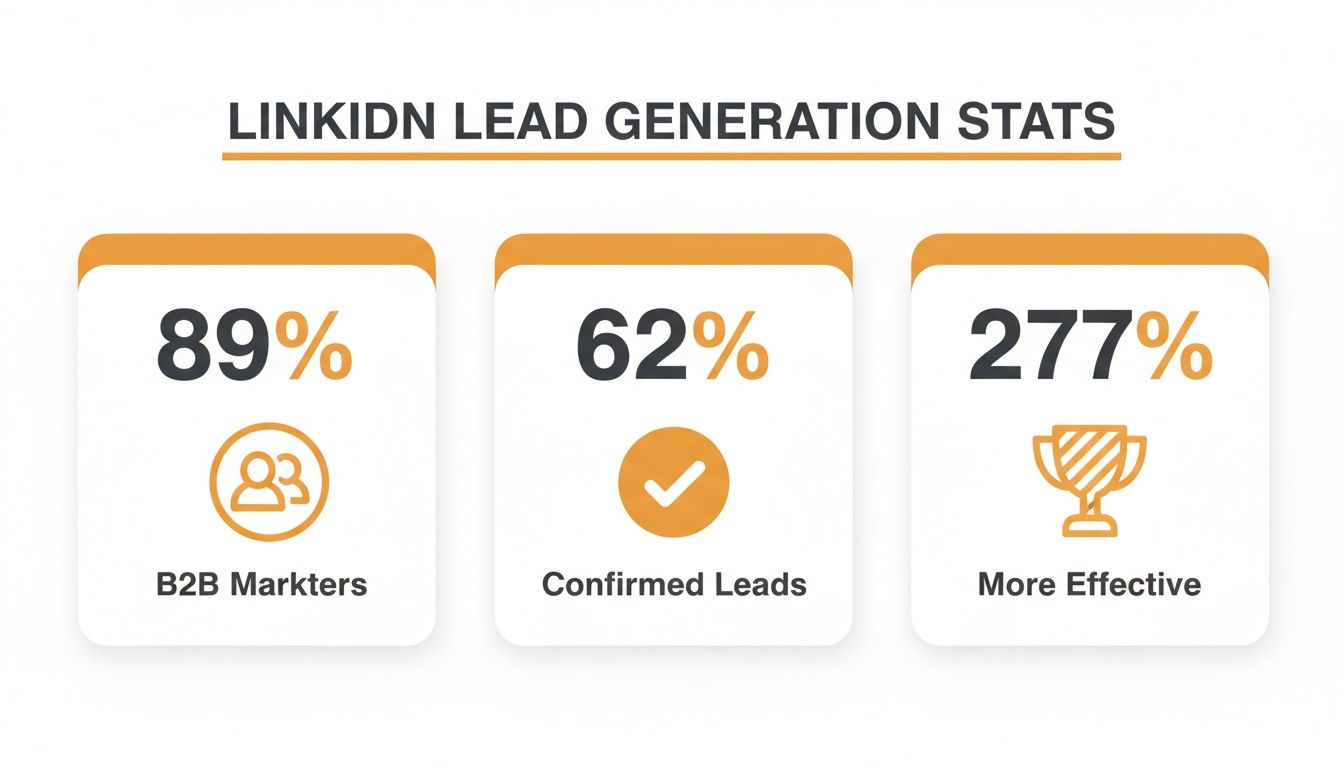
The bottom line is that LinkedIn's scale and the quality of its audience are unmatched. An incredible 89% of B2B marketers use it specifically for lead generation, and 62% say it's the platform that brings them leads. It's not a fluke—it’s proven to be 277% more effective than its closest competitors.
The data is crystal clear. The B2B world is all-in on LinkedIn because it flat-out works.
It's About Conversations, Not Just Connections
At the end of the day, successful lead generation on LinkedIn is all about turning those digital handshakes into real conversations. This is the heart of a modern sales strategy known as social selling. It’s about building genuine trust and positioning yourself as the go-to expert in your field, not just another person trying to sell something.
The goal isn't to collect connections like trading cards. It's to build a real network of potential clients and even fans who see you as a valuable resource. That mental shift is what separates the pros from the amateurs.
When you consistently share valuable insights, you start attracting prospects naturally instead of constantly chasing them. If you want to dive deeper into this philosophy, a great starting point is understanding what social selling is and why it's so powerful. Getting that 'why' down will make the 'how' we're about to cover feel much more intuitive.
Turn Your Profile Into a Lead Conversion Engine
Before you even think about sending a single connection request or writing a post, we need to talk about your LinkedIn profile. It’s the foundation for everything. Think of it less like a resume and more like a dedicated landing page. It’s your always-on salesperson, making a first impression on every single person who clicks your name.
If a potential client lands on your profile, they should know three things almost instantly: who you help, what problem you solve for them, and why they should listen to you over anyone else.
Too many people treat their profile like a dusty old trophy case of past jobs. That's a huge mistake. To actually generate leads on LinkedIn, you have to flip the script. Your profile isn’t really about you—it's about your ideal customer and the transformation you can bring to their business.
From your headshot to your headline, every single piece needs to work together to build instant credibility and make people genuinely curious. That’s how you turn a passive profile view into an actual conversation.
Craft a Headline That Stops the Scroll
Your headline is easily the most important part of your entire profile. It shows up everywhere on LinkedIn—when you comment, send a request, or appear in a search. It absolutely cannot just be your job title.
A killer headline is all about the benefits. It has to immediately answer your prospect's favorite question: "What's in it for me?"
Let's look at the difference:
- Weak Headline: "Founder at ABC Solutions"
- Strong Headline: "I Help B2B SaaS Founders Cut Customer Churn by 30% with Data-Driven Retention Strategies"
See how the second one just pops? It calls out the exact audience (B2B SaaS Founders), hits on a major pain point (customer churn), and dangles a specific, juicy result (a 30% reduction). It's a mini-pitch that works for you around the clock.
Tell a Compelling Story in Your About Section
The "About" section is where you get to expand on the promise you made in that killer headline. Please, don't just write a dry, third-person bio here. Instead, tell a story. Write in the first person and speak directly to your ideal client about their real-world headaches and what they hope to achieve.
Here's a simple framework I've seen work time and time again:
- Lead with their problem. Hook them right away by describing a pain point they're feeling right now. Show them you get it.
- Introduce your solution. Briefly connect the dots between their problem and how you solve it. What's the transformation you deliver?
- Flash some social proof. Drop in some real results, mention the types of clients you work with, or briefly outline a case study. This builds trust fast.
- End with a clear CTA. Don't leave them hanging! Tell them exactly what to do next. Should they book a call? Visit your site? Connect with you?
A quick tip: Don't be afraid to let your personality show through. People do business with people, not with robotic corporate-speak. Sharing a bit of your "why" can be way more powerful than just listing your skills.
Getting this part right is crucial for a profile that actually converts. For a much deeper dive, check out our complete guide on how to optimize your LinkedIn profile for peak performance.
Use Visuals and Featured Content to Build Trust
The words on your profile are only half the battle. The visuals matter just as much, often giving that first gut-check impression of professionalism.
- Professional Headshot: This is non-negotiable. Get a clear, high-quality photo where you look friendly and approachable. No vacation photos!
- Custom Banner: This is prime real estate. Use it to reinforce what you do. Add your value proposition, company logo, or a tagline that echoes your headline.
And don't sleep on the "Featured" section. It's basically your personal portfolio. This is the perfect spot to show off your best stuff—link to a powerful case study, an article you wrote that got a ton of engagement, or even a short client testimonial video. It gives people tangible proof that you know your stuff and a reason to stick around.
With over 1 billion members globally and 69 million companies on the platform, according to data from sopro.io, just "being on LinkedIn" isn't enough. You have to stand out. By treating your profile as a dynamic, lead-generating asset, you’re setting the stage for every other activity to be that much more effective.
Get Into a Content Rhythm That Pulls in Your Ideal Client
Okay, your profile is looking sharp. Now it’s time to stop lurking and start talking. This is where you shift from being a spectator to being an active, influential voice in your industry. Think of it this way: consistent, valuable content is what makes people come to you, turning your profile into a go-to resource instead of just a digital business card.
This isn’t about just throwing random updates out there to meet a quota. It’s about strategically sharing what you know, helping your audience solve their problems, and sparking real conversations. The whole point is to be so consistently helpful that when your ideal client runs into a problem you can solve, your name is the first one that pops into their head.
Find a Content Mix That Feels Like You
There’s no magic bullet for the "best" type of content on LinkedIn. The secret is actually variety. Different formats do different jobs and click with different people. Mixing things up not only keeps your feed interesting but also lets you see what your ideal clients actually respond to.
Here are a few core content types you can build your strategy around:
- Text-Only Posts: These are fantastic for sharing a quick thought, a strong opinion, or a personal story. They feel raw and authentic, making them super easy for people to read and jump into a conversation.
- Carousels (Document Posts): Got a complex idea? Break it down into simple, visual steps with a carousel. They’re brilliant for educational content—think mini-guides or checklists—and they keep people hooked as they swipe through.
- Polls: A seriously underrated tool for both engagement and market research. A simple, relevant poll can pull in hundreds of votes and comments, giving you a direct line into what your audience is thinking.
- Video Content: Short, native videos (meaning you upload them directly to LinkedIn) are amazing for building a personal connection. Use them to share a quick tip, give a behind-the-scenes peek at your work, or recap a key insight from a project.
The secret isn't about becoming a master of every single format. It's about finding two or three that fit your personality and what your audience likes, and then just crushing those consistently. Your authenticity is your biggest advantage—let it shine through in your content.
Build a Posting Schedule You Can Actually Stick To
Consistency is what fuels your entire content strategy. When you post regularly, you're sending a signal to the LinkedIn algorithm that you're an active contributor, which helps get more eyes on your stuff. Even more importantly, you're building a habit for your audience—they start to expect and look forward to hearing from you.
But let’s be real, "consistency" doesn't mean you have to post five times a day. For most of us, a realistic and powerful cadence is 3-5 times per week. That’s frequent enough to stay on people's radar without burning yourself out. I've seen this work wonders for solo entrepreneurs, marketers, and recruiters using RedactAI to create AI-generated content that still sounds just like them.
It's a proven fact: companies that post frequently get way better results. A steady flow of content really does drive business.
This is where smart tools come in. Something like RedactAI is designed to eliminate that "what on earth do I post today?" feeling. It can help you brainstorm ideas based on what's trending, draft posts in your own voice, and schedule everything ahead of time. Suddenly, content creation goes from a daily headache to a manageable part of your strategy.
Seriously, planning your content is a total game-changer. If you want to dive deeper, check out our guide on how to create an editorial calendar for your social media.
Turn Engagement into Genuine Opportunities
Putting content out there is only half the battle. The real magic? It happens in the comments. Every single comment is a chance to build a relationship, prove you know your stuff, and grow your network.
Your work isn't done when you hit "post." You’ve got to get in there and manage the conversation.
- Respond to Every Comment: Someone took the time to engage? Acknowledge it. A simple "thanks for sharing your thoughts" or "great point" goes a surprisingly long way.
- Ask Follow-Up Questions: Don't just leave it at "thanks." Pull on that conversational thread. If someone shares an opinion, ask them, "That's interesting, what makes you say that?" or "Have you seen that work well in practice?" This turns a simple comment into a real dialogue.
- Engage on Other People's Turf: Your content rhythm should include jumping into conversations elsewhere. Leaving thoughtful comments on posts from potential clients and industry peers is one of the best ways to get on their radar without being pushy or salesy.
When you actively join the conversation—on your posts and on others'—you’re not just shouting into the void. You're building a community around your expertise, and that is the absolute best foundation for bringing in leads naturally on LinkedIn.
Mastering Outreach and Smart Ad Strategies
 Okay, so your profile is looking sharp and you've got a solid content rhythm going. Now it's time to get proactive. This is where we blend the "pull" of your great content with the "push" of direct, intelligent engagement.
We're going to dive into two of the most effective ways to crank up your lead generation on LinkedIn: personalized outreach that actually works and paid ads that don't just burn cash.
Forget the old "spray-and-pray" nonsense. Modern outreach is all about quality over quantity, turning a cold connection into a warm conversation. And when you pair that with a smart ad strategy, you can get your best stuff in front of your ideal clients at scale—something organic content just can't do on its own.
The Art of Personalized Organic Outreach
Let’s agree to kill the spammy, automated connection requests for good. That generic "I'd like to connect" message? It’s a massive wasted opportunity. The point of a connection request isn't just to bump up your network numbers; it's to open the door to a real conversation.
Your outreach has to feel personal and relevant. Seriously, before you even think about hitting that "connect" button, spend two minutes on their profile. What have they been posting about? Did they just get a promotion? Do you share a group or a connection?
Find a real reason to connect. Here’s a simple, non-sleazy way to do it:
- Reference a recent post: "Hey [Name], I really enjoyed your post on the challenges of team scaling. Your point about asynchronous communication really hit home for me. Would love to connect and keep up with your insights."
- Mention a shared group or connection: "Hi [Name], I saw we're both in the 'SaaS Growth Hackers' group and I'm always looking to connect with other leaders in the space. Open to connecting?"
- Compliment their work: "Hi [Name], just came across the case study your team published on [Project]. Those results were incredibly impressive. I'm connecting with experts in [Your Industry] and would be honored to have you in my network."
The secret is to make it about them, not you. That one personalized sentence proves you're not a robot and dramatically increases the odds they'll not only accept but actually reply.
And once they accept, don't immediately dive in with a pitch. That's the fastest way to get ignored. Just nurture the conversation. A simple "Thanks for connecting!" followed by an open-ended question works wonders.
Demystifying LinkedIn Ads for B2B
While organic outreach is fantastic for building one-on-one relationships, LinkedIn Ads are your engine for scaling up. They let you jump the line, bypass the algorithm, and guarantee your message gets to the right eyeballs. But, and this is a big but, you can burn through your budget in a heartbeat if you're not careful.
The name of the game is precision. LinkedIn’s targeting is an absolute powerhouse for B2B. You can zero in on people by:
- Job Title and Seniority: Go straight to the decision-makers.
- Company Size and Industry: Filter out any business that isn't a good fit.
- Member Skills and Interests: Reach people based on their professional expertise.
This kind of detail means you stop wasting money on clicks from people who will never buy. For companies wanting to really dial in their paid campaigns, getting expert help from a Social Media Agency LinkedIn Ads B2B can make all the difference in navigating these powerful but complex options.
Supercharge Conversions with Lead Gen Forms
One of the best tools in the LinkedIn Ads toolbox is the Lead Gen Form. Instead of sending someone to your website's landing page where they can get distracted or bail on the form, you capture their info right there on LinkedIn.
Here’s how it works: a person clicks your ad's call-to-action, and a form instantly pops up that's pre-filled with their profile information—name, email, job title, you name it. All they have to do is tap "Submit." This tiny change removes so much friction and can make your conversion rates soar.
Just how good is it? LinkedIn's own data shows Lead Gen Forms boast an average 13% conversion rate. That’s more than five times the typical landing page average of 2.35%. Imagine one in seven prospects converting instantly. It's a game-changer.
Here's a quick and dirty campaign idea to get you started:
- The Offer: Create a high-value asset. Think an industry report, a comprehensive checklist, or an exclusive webinar recording.
- The Audience: Target a super-specific audience of professionals who would find that content irresistible.
- The Ad: Run a Sponsored Content ad promoting your offer with a clear CTA like "Download the Report."
- The Capture: Use a Lead Gen Form to grab their details in exchange for the download.
With this strategy, you’re not just getting clicks; you're building a list of highly qualified leads who have literally raised their hands to say they're interested in your expertise. From there, it's so much easier to nurture them toward a real sales conversation.
How to Measure and Scale Your LinkedIn Success
 Let's be honest: you can't improve what you don't measure. All the profile tweaks, content creation, and outreach in the world are just shots in the dark without good data telling you what's actually hitting the mark.
This final piece of the puzzle is what turns your daily LinkedIn grind into a predictable, repeatable system for bringing in high-quality leads. It's about ditching the guesswork and making decisions based on cold, hard facts. When you know your numbers, you can confidently double down on what works and cut what doesn't. This is how effort turns into real, tangible results.
Key Metrics to Track for Your Content
Think of your content analytics as a direct feedback loop from your audience. LinkedIn’s own analytics are a goldmine if you know what to look for. The trick is to ignore the vanity metrics and focus on the numbers that signal genuine interest.
Here are the content metrics that actually matter:
- Impressions vs. Engagement Rate: Impressions show you how many eyeballs saw your post, but the engagement rate (likes, comments, shares divided by impressions) tells you how many people cared. A high engagement rate is your sign that the message is landing perfectly.
- Comment Quality: Don't just count the comments; read them. Are they from people who fit your ideal client profile? Are they sparking actual conversations? One thoughtful comment from a key decision-maker is worth a hundred generic "great post!" comments.
- Follower Demographics: Take a peek at who's following you. LinkedIn breaks down their job titles, industries, and locations. If that list looks like your target audience, you know your content strategy is on the right track.
The goal isn't to go viral; it's to be visible to the right people. Who is engaging is far more important than how many.
Evaluating Your Outreach Effectiveness
Your outreach metrics tell a simple story: are you connecting with the right people, and are they responding? This is where your lead generation efforts become real. It’s a numbers game, sure, but it's one you can definitely win by staying focused.
Here’s what you should be measuring:
- Connection Request Acceptance Rate: This is your first major hurdle. If your acceptance rate is dipping below 30-40%, it's a huge red flag that your profile or your personalized message isn't resonating. Time to go back to the drawing board.
- Reply Rate to Follow-Up Messages: Once someone connects, how many actually reply to your first message? This tells you if your opening is building genuine rapport or just coming off as another generic sales pitch.
- Meetings Booked: This is the bottom line. How many of these conversations are turning into actual sales calls or demos? Track this number religiously—it's how you'll calculate the real ROI on your time.
People on LinkedIn are engaged—they stick around for an average of 10 minutes and 48 seconds per session. It's no wonder that 40% of B2B marketers see it as the number one channel for high-quality leads. By tracking your outreach, you're tapping directly into that focused audience. You can dig deeper into these powerful LinkedIn lead generation statistics to see just how much potential is there.
Scaling Your Efforts Without Burning Out
Once you’ve figured out what works, the next challenge is doing more of it. But you can't just work more hours; you have to work smarter. This is where you bring in systems and tools to amplify your impact without cloning yourself.
A great starting point is to create content pillars. Just pick three to five core themes that your audience consistently responds to and build all your content around them. This instantly simplifies brainstorming and cements your reputation as an expert in those specific areas.
From there, you can bring in a tool like RedactAI to streamline the whole workflow. It can help you spin up multiple post ideas from a single keyword, draft content that sounds just like you, and get everything scheduled ahead of time. Suddenly, content creation goes from a daily chore to a manageable, strategic task that keeps your lead generation engine running smoothly.
Got Questions About LinkedIn Lead Generation? We’ve Got Answers.
Jumping into LinkedIn for lead generation always brings up a ton of questions. It's a goldmine, for sure, but you want to make sure you're digging in the right spot.
Let's cut through the noise and tackle some of the most common questions I hear. This is your quick-fire guide to getting your strategy right and clearing any roadblocks holding you back.
Should I Focus on My Personal Profile or Company Page?
This one comes up all the time, and the answer is almost always: your personal profile. Hands down. People want to connect with other people, not a logo. Your company page is great for brand credibility and running ads, but your personal profile is where the real magic happens.
Think of your profile as your personal HQ for building relationships. It's your digital handshake. You'll see way higher engagement on posts from a personal account because it feels genuine and real. Use the company page for big announcements, but make your personal profile the engine of your lead-gen machine.
How Much Time Should I Actually Spend on LinkedIn Every Day?
Good news: you don’t need to live on the platform. Consistency trumps volume every single time. For most people, a focused 20-30 minutes a day is the sweet spot for making a real dent.
Here’s what that could look like:
- 5-10 Minutes: Jump into your notifications. Respond to comments on your latest post and handle any new DMs.
- 10 Minutes: Go engage with others. Drop thoughtful comments on posts from your ideal clients and people you admire in your industry. Get on their radar.
- 5-10 Minutes: Send out a handful of highly personalized connection requests. Quality over quantity.
A short, strategic burst of activity is so much more effective than hours of mindless scrolling.
The secret is making LinkedIn a habit, not a chore. Block out a small chunk of time in your calendar, and you'll be amazed at the momentum you build.
Is LinkedIn Premium or Sales Navigator Worth the Money?
For anyone who’s truly serious about generating leads on LinkedIn, the answer is a hard yes. The free version is fine to get your feet wet, but the paid tools give you a level of precision that can put your results on fast-forward.
Let’s break them down.
| Tool | The Real Benefit | Who Needs It |
|---|---|---|
| LinkedIn Premium | See who’s checking you out, get more InMails, and access better data. | Individuals looking to grow their network and personal brand. |
| Sales Navigator | Insanely detailed search filters, lead recommendations, and custom prospect lists. | Sales pros, founders, and anyone running dedicated outreach campaigns. |
Sales Navigator is the real game-changer here. It lets you build hyper-targeted lists of your dream clients and keep an eye on what they’re up to. This means your outreach is always timely and relevant. If you're going to spend time on outreach, Sales Nav makes sure it’s time well spent.
How Long Does It Take to See Real Leads Coming In?
This is where you need a little patience, especially with an organic strategy. You're building trust and authority, and that doesn't happen with the flip of a switch.
Here’s a realistic timeline:
- Paid Ads: If you have a great offer and dialed-in targeting, you can see leads coming in within a few days.
- Organic Content & Outreach: This is a slow burn. Expect it to take 60-90 days of consistent, daily activity before you start seeing a steady flow of inbound messages and warm replies.
This isn’t about getting rich quick; it’s about building a predictable pipeline for the long haul. The leads you get from showing up consistently are often the best ones because they already feel like they know you. That foundation is worth the wait.
Ready to stop guessing what to post and start building a content rhythm that actually attracts leads? RedactAI crafts high-impact LinkedIn posts in your authentic voice, giving you a steady stream of ideas and drafts in minutes. Start for free and see how over 21,000 creators are winning on LinkedIn.