Let's be honest, we've all been there. Staring down that mocking, blinking cursor on a blank page. It feels personal, like it's taunting you, a silent declaration that you've officially run out of ideas.
But here’s the thing: that feeling isn't a true measure of your talent. It’s a completely normal, universal hurdle every single creator faces. The trick is to shift your thinking from, "Ugh, what's wrong with me?" to a more practical, "Alright, what's one tiny thing I can do right now?" That simple switch is your first real step to taking back control.
This guide isn't about wallowing in self-doubt. It's about giving you a practical toolkit to get moving again, especially when you need to create content for a platform as demanding as LinkedIn.
You Are Not Alone in This Struggle
Seriously, you're in good company. Writer's block doesn't discriminate; it trips up everyone from first-year college students to seasoned pros penning their life's work.
- Students Feel the Pressure: A study out of Turkey found that a staggering 94% of first-year students struggled with some form of writer's block.
- Experts Get Stuck Too: Even at the highest academic levels, people get stuck. Data shows that 55-64% of PhD candidates haven't finished their dissertations even a decade after starting, often because they hit a wall and couldn't get past it.
The big lie is that writing should be easy. It's not. It's hard work. The moment you accept that getting stuck is just part of the process, you free yourself from the paralysis and self-doubt.
This isn't meant to be a downer. It’s proof that hitting a creative roadblock is completely normal. The real goal isn't to never get stuck—it's to get unstuck faster each time.
For a deeper dive into this, you can explore some additional strategies for overcoming writer's block and build out your own personal toolkit for those moments.
What’s Really Happening When Your Brain Gets Stuck
Ever feel like your brain just slams on the brakes the moment you sit down to write? It’s not just in your head—there’s real science behind why your creative engine suddenly stalls. Staring at that blinking cursor can kickstart a nasty cycle of anxiety and self-doubt, effectively building a wall between you and your ideas.
This mental freeze-up isn't a sign you've lost your touch. It's usually just a biological reaction to pressure. The demand to be brilliant, especially when you’re trying to nail a LinkedIn post, can flood your system with stress. That pressure triggers a physical response that puts a chokehold on your creative and problem-solving skills.
How Stress Kills Your Creativity
When you’re stressed, your body pumps out cortisol, the famous "fight-or-flight" hormone. It’s great for outrunning a bear, but absolutely terrible for writing. Research shows that high cortisol levels, paired with an overactive analytical prefrontal cortex (the part of your brain that judges everything), can literally shut down the neural pathways responsible for imagination. You can read more about these fascinating brain findings here.
In simple terms, your brain switches from an open, curious mode to a rigid, critical one. Instead of exploring "what if," it starts shouting "this is terrible!" This neurological battle is why figuring out how to overcome writer's block is more about managing your mindset than just trying to muscle through it.
This flowchart maps out the mental crossroads writers often face when that blank page looms.
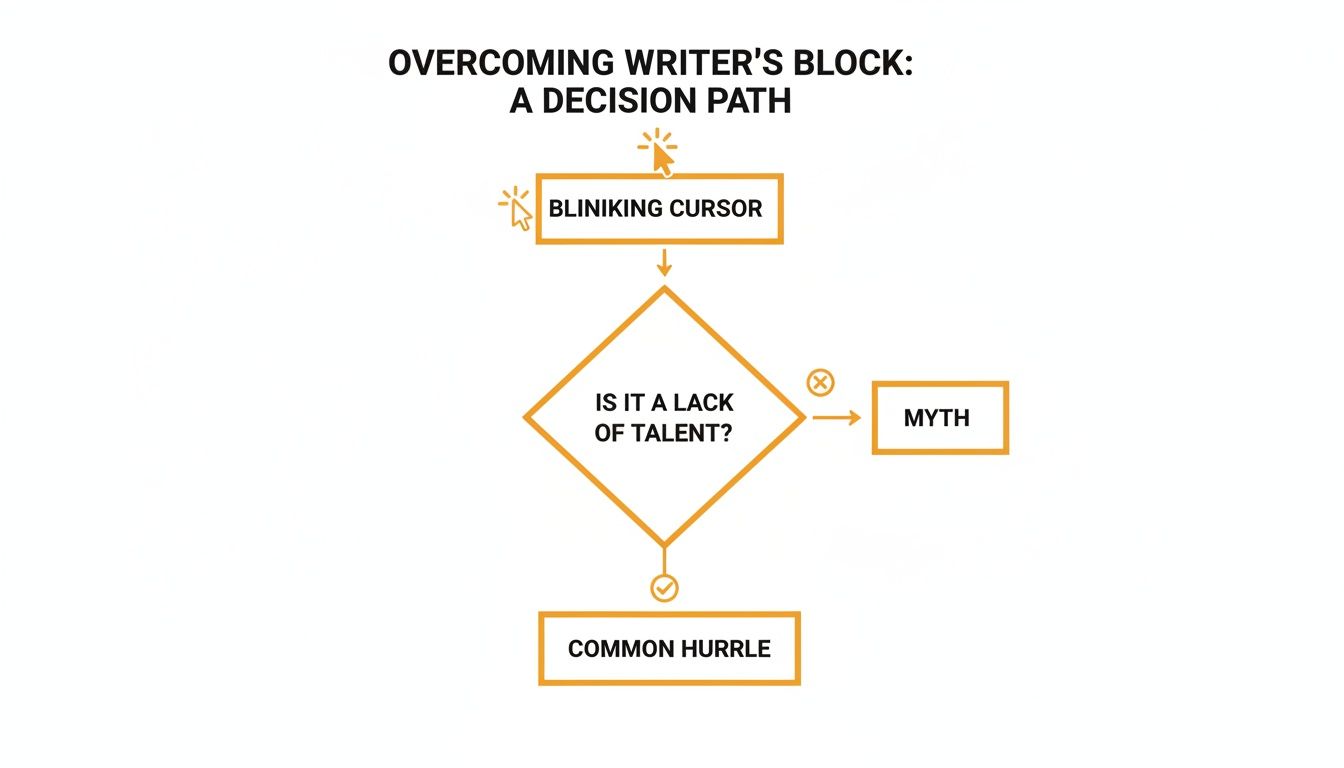
As you can see, the trick is to recognize writer's block as a simple hurdle to clear, not a verdict on your ability.
Common Writer's Block Triggers and Quick Fixes
Here’s a breakdown of what might be causing your writer’s block and a simple, actionable fix you can try right now.
| The Trigger | What It Feels Like | A Quick Fix to Try Today |
|---|---|---|
| Perfectionism | "I can't start until I know exactly what to say, perfectly." | Write the absolute worst, most ridiculous first sentence you can think of. Give yourself permission to be bad. |
| Decision Fatigue | "I have too many ideas and can't pick one. I'm overwhelmed." | Set a timer for 3 minutes. Write down every idea. When the timer goes off, circle the one that feels easiest. Start there. |
| Fear of Judgment | "What if people think this is stupid? What will my boss say?" | Write the post just for one person—a friend or a supportive colleague. Forget everyone else. |
| Mental Exhaustion | "My brain feels like mush. I just can't focus on words." | Close the laptop and do something physical for 10 minutes. Walk around the block, do some stretches, or tidy up your desk. |
Don't overthink it. Just pick one of these triggers that resonates with you and give the quick fix a shot. Sometimes, a tiny shift is all it takes to get things moving again.
Practical Ways to Break the Freeze
The best part? You can fight back against this biological response. Since we know stress and overthinking are the villains here, the solution is to calm your brain and snap it out of that analytical loop. Small actions can create a huge neurological shift.
When you realize writer’s block is often just a physical stress reaction, you can stop fighting it with force and start treating it with practical, calming techniques. You can’t out-think a chemical reaction, but you can change the conditions that created it.
Here are a few science-backed ways to get your head back in the game:
Change Your Scenery: Just getting up from your desk for five minutes can break the stress cycle. A quick walk introduces new sensory information, which helps pull your brain out of its rut.
Try Mindful Breathing: Take a few slow, deep breaths. It sounds simple, but it boosts oxygen to your brain and kicks on the parasympathetic nervous system, which tells your body it’s safe to chill out. This is a direct way to lower those cortisol levels.
Switch to a Different Creative Task: Do something completely different. Doodle, listen to a new playlist, or even organize your bookshelf. This engages other parts of your brain and gives the language-focused areas a much-needed break.
Practical Exercises to Get the Words Flowing Again

It's one thing to talk about writer's block, but it's another thing entirely to actually do something about it. So, let's move past the theory and get our hands dirty with some practical, muscle-building exercises to get words on the page.
The goal here isn't to write a masterpiece. It's to build momentum.
Each of these mini-exercises is designed to take 15 minutes or less, so you can easily squeeze them into a busy workday. They work by lowering the stakes and reminding your brain that writing doesn't have to be a high-pressure performance.
The Terrible First Draft Challenge
Let's be honest: perfectionism is one of the biggest reasons we get stuck. We freeze up trying to write the perfect sentence on the very first try, which is an impossible task. The "terrible first draft" method is your permission slip to be messy.
For your next LinkedIn post, I challenge you to intentionally write the absolute worst version you can think of. Go wild with clichés, write clunky sentences, and forget about grammar. Just get the main idea out of your head and onto the screen.
Remember, writing and editing are two completely different functions of the brain. Trying to do both at once is like trying to build a car while you're driving it down the highway. Write first, edit later.
Once your "terrible" draft is complete, walk away. Seriously. Go make a coffee, take a five-minute walk, and then come back with fresh eyes. You'll be amazed at how much easier it is to polish a messy draft than it is to stare at a blank page.
Start Writing in the Middle
The introduction is often the hardest part. It has to hook the reader, set the stage, and be brilliant right out of the gate. That's a lot of pressure. So, don't write it first.
Instead, jump right into the easiest part of your article or post—the section where your ideas feel the strongest.
- Have a killer example? Write that part out first.
- Got three main tips? Flesh out the second one.
- Already know your conclusion? Start there.
By tackling the part you're most confident about, you build momentum and a sense of accomplishment. Once the core of your piece is on the page, circling back to write an introduction that actually reflects the content becomes so much easier.
Of course, once you start piecing these sections together, maintaining a consistent voice is crucial. If you're creating content for a professional audience, you can learn more about crafting a cohesive narrative in our guide to creating a business writing style guide: https://redactai.io/blog/business-writing-style-guide
Set a Timer and Just Write
Freewriting is a classic for a reason: it flat-out works. The rules couldn't be simpler. Set a timer for 10 or 15 minutes, pick a topic (or even just the first word that pops into your head), and start typing.
The only rule is you cannot stop until the timer goes off. Don't go back to fix typos. Don't delete that awkward sentence. If you get stuck, literally type "I don't know what to write" over and over until a new thought arrives.
This exercise is brilliant because it forces your inner critic to take a back seat, reconnecting your brain to your fingers. If persistent brain fog is a big part of your writer's block, exploring strategies to improve mental clarity and focus can also be a huge help in getting your mind ready for these sessions.
Building a Routine That Keeps Writer's Block Away
The best defense against writer's block is a good offense. Instead of waiting for it to strike and then fighting your way out of a creative slump, you can build a system that pretty much stops it from showing up in the first place.
This isn’t about magically finding more hours in the day. It’s about being smarter with the time you already have and getting rid of the mental roadblocks before you even sit down to type. The idea is to make writing feel like a natural, predictable part of your day, not some dreaded chore.
Find Your Golden Hour
Forget the myth that you have to be an early bird to be a good writer. Your "golden hour" is simply the time of day when your mind is sharpest and the world is quietest for you. For some, that’s the peaceful stillness of 6 AM. For others, it’s that focused burst of energy after lunch when the office buzz finally dies down.
Play around with it. Try writing for just 20 minutes at different times throughout the day for a week. See when the words come easily and when it feels like you're wading through mud. Once you find that sweet spot, guard it on your calendar like it’s a meeting with your most important client.
When you treat your writing time as non-negotiable, you train your brain to show up ready to work. It turns a "maybe I'll write" activity into a reliable habit.
Create a Designated Writing Space
Our brains are big on cues. Having a dedicated spot for writing—even if it's just the right-hand corner of your kitchen table—sends a powerful signal that it's time to get down to business. When you sit there, your mind automatically starts to switch into creative gear.
Keep this space as clean and distraction-free as possible. The fewer decisions you have to make about where to sit or what to move, the more mental bandwidth you have left for the actual writing.
Your environment shapes your mindset. A cluttered desk often leads to cluttered thoughts. By carving out a calm, predictable nook, you’re giving your ideas the quiet they need to surface.
This simple act of conditioning makes it so much easier to get into a state of flow because the space itself becomes a trigger for creativity.
Systemize Your Writing with a Workflow
That "blank page" anxiety is usually just a symptom of not having a plan. A solid editorial workflow is your roadmap, breaking the journey from a vague idea to a published post into small, non-scary steps. A structured approach like this gets rid of the decision fatigue that so often leads to just giving up.
Here’s what a simple, effective workflow can look like:
- Ideation: Spend one session brainstorming a big list of topics for the upcoming month.
- Outlining: Before you write, create a quick bullet-point structure for your next post.
- Drafting: Get the words down. This is the "messy first draft" stage—no judgment allowed.
- Editing: Step away, then come back with fresh eyes to polish and refine.
When you systemize your process, you always know what comes next. You're never just staring at a blinking cursor, wondering where on earth to start. If you want to build an even more detailed system, checking out a complete content creation workflow: https://redactai.io/blog/content-creation-workflow can give you a great framework to stay consistent and keep the words flowing.
Let AI Be Your Creative Co-Pilot

Sometimes the best way to get unstuck is to simply bring in a partner. What if you had an assistant who was available 24/7, never ran out of ideas, and could instantly turn a half-baked thought into a solid outline?
That's not science fiction anymore. That's what it's like to use AI as a creative co-pilot.
The trick is to stop thinking of AI as a replacement for your own voice and start seeing it as a powerful collaborator. It’s a tool designed to smash through that initial roadblock—the intimidating blank page—so you can get to the fun part: refining, editing, and adding your unique human touch.
Ditch the Blank Page with Smart Drafting
Let's be honest, a huge part of writer's block is just the sheer pressure of starting from scratch. That blinking cursor can feel like it's mocking you. AI tools are fantastic at breaking this initial inertia. Instead of staring into the void, you feed it a simple prompt and get back multiple starting points in seconds.
This is a game-changer if you’re trying to stay consistent on a platform like LinkedIn. A tool like RedactAI isn't just another generic text generator; it can actually learn your unique voice from your past content and create drafts that sound like you. You're not starting from zero; you're starting from a place that's already 70% of the way there.
AI for Brainstorming and Finding Your Next Topic
There are days when the block isn't about the writing itself, but about having absolutely no idea what to write about. This is another place where an AI partner really shines. It can be your personal trend-spotter and idea machine.
- Topic Ideas on Tap: It can scan your niche and spit out relevant topics people are actually talking about right now.
- Deconstruct What Works: It can pull inspiration from top-performing posts in your industry, showing you the hooks and formats that are getting traction.
- Explore Different Angles: Give it a single keyword like "productivity" and ask for ten different ways to tackle it for a LinkedIn post—from a personal story to a data-backed analysis.
The biggest unlock AI provides for writer's block is transforming the question from, "What could I possibly write?" to "Which of these great ideas should I write first?" That shift in perspective is everything.
You’re no longer responsible for pulling a brilliant idea out of thin air. Instead, you get a menu of solid options to choose from. For anyone trying to build a presence, using a dedicated LinkedIn post generator with AI can put this whole brainstorming process on autopilot.
Don't Worry, Your Authentic Voice Is Still the Star
The fear that AI will make your content sound robotic is totally valid. We've all seen those soulless, generic posts. But this just highlights why you need the right tool and, more importantly, the right workflow. The goal is a partnership, not a hostile takeover.
Think of the AI-generated text as a lump of clay. You're still the sculptor.
- Generate the Draft: Give the AI a core idea, a key stat you found, or the bones of a personal story. Let it do the heavy lifting of getting words on the page.
- Inject Your Personality: Now, go through it. How would you say that? Change clunky phrases to match your natural speaking style. Add your own opinions and experiences.
- Add Your Human Insight: What’s the personal anecdote the AI could never know? What’s the unique conclusion you can draw from the information? This is where your magic comes in.
- Polish and Refine: Finally, give it a good old-fashioned edit. Check the flow, trim the fat, and make sure every sentence earns its spot.
This approach keeps you firmly in the driver’s seat. The AI handles the grunt work of structure and initial phrasing, which frees up your brainpower to focus on what really matters: adding the depth, personality, and human connection that makes people want to read your stuff in the first place.
Still Have Questions About Writer's Block?
Alright, even with a solid game plan, some nagging questions about writer's block can still creep in and mess with your head. Let's tackle a few of the big ones.
Getting some straight answers can take the mystery out of the whole thing and remind you that you're the one in charge, not the blinking cursor.
Is Writer's Block Even a Real Thing?
Yes, but probably not how you're picturing it. It's not some official medical condition you get diagnosed with. Instead, think of it as a well-known psychological speed bump where you just can't seem to produce new work or everything feels like it's moving in slow motion.
I like to see it as my brain's "check engine" light. It’s not the problem itself, but a symptom telling me something else is off. Maybe it's burnout, maybe it's stress, or maybe I'm just trying way too hard to be perfect.
Can This Last Forever?
For almost everyone, the answer is a hard no. It can feel like an eternity when you're in the thick of it, but writer's block is almost always a temporary jam. Ask any professional writer—we don't really have the luxury of a permanent block. Deadlines and projects force you to build systems to muscle through.
The real risk isn't that the block will stick around forever. It's that a short slump can crush your confidence so badly that you're scared to even try again. That’s exactly why having go-to strategies is so important—it helps you break the cycle before it even starts.
The fear of writer's block is often more paralyzing than the block itself. Acknowledging it as a temporary and solvable problem is the first step toward reclaiming your creative momentum.
Once you see it as just another hurdle to clear, it loses a lot of its power.
Does This Mean I'm a Bad Writer?
Absolutely not. If anything, it usually means you care a whole lot about the quality of what you're creating. I mean, some of the most famous authors in history have been brutally honest about their battles with writer's block.
It has zero to do with your actual skill and everything to do with the mental gymnastics of creating something from nothing. It’s usually triggered by very human things, like:
- Fear of being judged or failing to meet impossibly high expectations (especially our own).
- Crippling perfectionism that tells you every single word has to be perfect the first time.
- Plain old exhaustion from being overworked, stressed out, or just mentally fried.
Hitting a wall is a sign that you're a human being, not a bad writer. It’s just your cue to take a breath, get your head straight, and give yourself permission to not be perfect.
Feeling stuck on your next LinkedIn post? RedactAI can help you bust through that block by generating personalized drafts that actually sound like you. Stop staring at a blank page and get back to creating. Start for free on RedactAI.