Think of social selling as the modern playbook for sales. It’s all about using platforms like LinkedIn to find the right people, build real relationships, and, eventually, hit your sales numbers. Forget cold calling; this is about earning trust and showing your value before you even think about making a pitch.
Redefining Sales for the Digital Age

Let's be honest, the old-school image of a salesperson hammering the phones is dead. Today’s buyers, especially in the enterprise world, have already done most of their homework before they ever talk to someone in sales. They're scrolling through reviews, asking for recommendations, and seeing who the real experts are on social media.
Social selling is simply the art of meeting them right where they are.
It’s a complete shift from interrupting people to interacting with them. Instead of pushing a product, you’re pulling people in by being a helpful, credible voice in their online world. The whole idea is to build genuine connections first. You do this by sharing useful content, jumping into relevant discussions, and showing you know your stuff. Over time, that builds trust.
This isn't just about having a profile and logging in occasionally. It's about being actively and purposefully engaged. The goal is to build relationships so that when someone is finally ready to buy, you're the first person they think of. It completely changes the game.
Social selling turns the sales process from a transactional pitch into a value-driven conversation. You stop being just another vendor and become a trusted advisor.
And the results speak for themselves. Sales teams who get social selling right are 51% more likely to hit their sales quotas. It makes sense, right? You're building a pipeline full of warm, informed prospects who already see you as a credible expert. It’s the long game, but it creates a powerful sales engine fueled by real relationships.
To quickly see how this approach stacks up against older methods, check out this table.
Social Selling At A Glance
| Aspect | Key Point |
|---|---|
| Focus | Relationship building before selling. |
| Method | Sharing value, engaging in conversations. |
| Buyer Interaction | Meets buyers where they are (online). |
| Pace | Long-term, trust-based nurturing. |
| Role of Sales Rep | Trusted advisor and industry resource. |
| Outcome | Warm, informed leads who trust you. |
This table highlights the core philosophy: it's a strategic move from pushy tactics to building genuine rapport that leads to better, more successful business.
Understanding the Heart of Social Selling
Let's break down social selling with a simple analogy. Think about the classic door-to-door salesperson. They show up unannounced, interrupt your day, and launch straight into a canned pitch. It’s disruptive, often unwelcome, and all about the immediate transaction.
Now, picture a different scene. Instead of knocking on doors, you host a genuinely helpful online workshop. You share your expertise freely, answer questions, and teach people something they can actually use. They show up because they want to learn, and they walk away viewing you as a credible, helpful expert. That’s the soul of social selling.
It’s a fundamental shift from a "what can I get?" mindset to a "what can I give?" one. You stop just trying to close a deal and start building a reputation as the go-to person in your field.
Becoming a Resource, Not a Pitchman
The whole strategy hinges on one thing: consistently providing value long before you ever ask for a sale. On a platform like LinkedIn, this can look like a few different things:
- Sharing insightful articles that actually solve a common headache for your ideal customer.
- Writing short, punchy posts that offer a fresh take on a trending topic in your industry.
- Leaving thoughtful comments on a prospect’s post—adding real substance to the conversation, not just a thumbs-up.
When you do this consistently, something powerful happens. You become a familiar, trusted name in their feed. So, when the day comes that they actually need what you offer, you’re not a stranger. You’re the helpful expert they already know and respect.
The real goal of social selling is to make the cold call a thing of the past. When you build trust and authority first, every conversation you initiate is already a warm one.
Why This Works So Well on LinkedIn
This approach is especially potent on LinkedIn, which has completely changed the game for B2B sales. It’s not just another social network; it's where business gets done. In fact, a staggering 75-85% of all B2B leads from social media come directly from LinkedIn.
Even more telling, sales pros who get social selling right see double the ROI compared to those still relying on old-school cold outreach. It’s not just about being present; it's about being actively helpful.
By focusing your energy on building a real network and sharing content that matters, you’re plugging into an incredible engine for growth. The trick is learning how to network effectively, turning those simple connections into legitimate business relationships. Social selling is about playing the long game—and it pays off way more than any single cold pitch ever could.
Social Selling vs. Traditional Sales Methods
To really get what social selling is all about, it helps to put it up against the old-school sales playbook. Think of traditional selling as a guy with a megaphone on a street corner—it’s loud, it’s one-way, and it blasts the same message to everyone, just hoping someone will stop and listen. This is the world of cold calls and mass email blasts, all built on interruption.
Social selling, on the other hand, is like hosting a great dinner party. You carefully invite the right people, get fascinating conversations going, and build real connections. You’re not pushing a message; you’re pulling people in. Instead of barging into a stranger's day, you attract prospects by consistently being the most helpful, knowledgeable person in the room.
The Mindset Shift: From Interruption to Interaction
The real difference isn't just about the tools you use (like LinkedIn versus a phone). It’s a complete shift in philosophy. Traditional sales is a pure numbers game, all about cranking up the volume and chasing quick deals. Success is measured by how many dials you made or how many emails you blasted out.
In contrast, social selling is a long-term play. It’s about patiently building a pipeline of warm, qualified leads who already know and trust you. The goal is to nurture those relationships so that when someone is finally ready to buy, you’re the first person they think of. It all starts with being genuinely helpful.
Traditional selling shouts at a crowd. Social selling has a one-on-one conversation with the right person in that crowd. It’s about being relevant, not just loud, and that leads to way better conversations.
This concept map really brings it to life, showing how social selling puts you—the expert—right at the center of building value, trust, and your network.
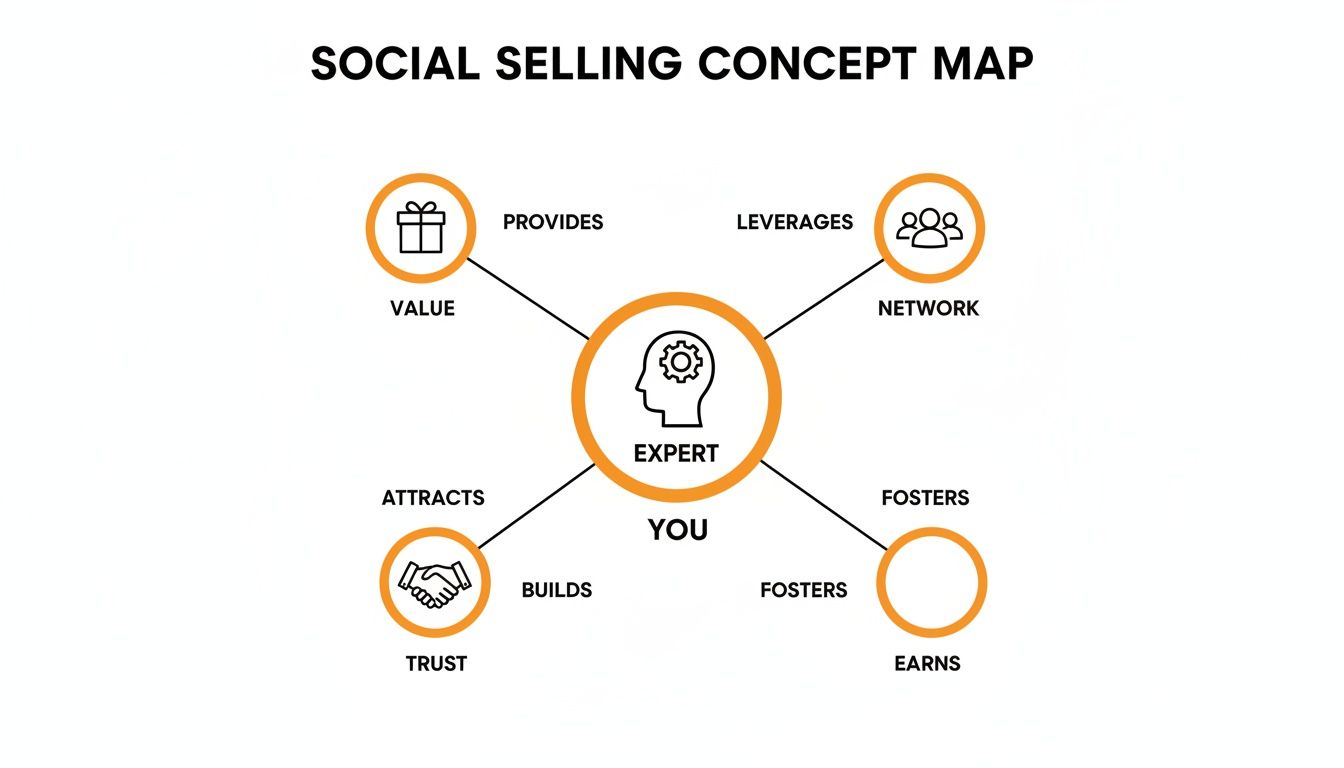
As you can see, it's a cycle. You use your network to provide value, and that value is what builds the trust you need to even start a sales conversation.
Comparing the Two Approaches
When you look at the results, the difference is stark. Cold outreach often feels like you're searching for a needle in a haystack. With social selling, you make it easy for the needle to find you.
Here’s a quick breakdown of how they stack up:
- Lead Quality: Traditional methods are notorious for generating cold, unqualified leads. Social selling, however, brings in warm, pre-qualified prospects who’ve already shown interest by engaging with you.
- Timeline: Cold outreach is all about getting instant results, which usually means very low success rates. Social selling is about building a sustainable pipeline over time through consistent, patient nurturing.
- Cost & ROI: While social selling definitely takes time, the ROI is often much higher because you're not wasting energy on prospects who were never a good fit to begin with.
The proof is in the numbers. The global social commerce market is already valued at a staggering $1.63 trillion and growing fast. This boom shows that social platforms aren't just for scrolling anymore—they're where people make buying decisions. You can dig into more stats about the rise of social commerce over at inbeat.agency.
Actionable LinkedIn Social Selling Tactics

Okay, theory is great, but let's get down to brass tacks. Knowing what social selling is doesn't mean much until you put it into practice. For anyone in B2B, LinkedIn is the main event, and with the right moves, you can turn your profile from a static resume into a lead-generating machine.
We're going to walk through strategies you can start using today. These aren't about spammy pitches or aggressive tactics. It's all about building your personal brand, having real conversations, and creating opportunities naturally.
Optimize Your Profile to Build Instant Credibility
Think of your LinkedIn profile as your digital storefront. Before you do anything else, it needs to be ready for visitors. Your profile is the foundation of your entire social selling effort, and it has to scream "trusted expert," not "salesperson."
Here’s what you absolutely must nail down:
- A Professional Headshot: This is non-negotiable. Get a clear, high-quality photo where you look like someone people would want to talk to. No logos, no vacation pics, just you.
- A Value-Driven Headline: Don't just list your job title. Your headline should immediately answer the question, "How do you help people?" Instead of "Sales Manager at Company X," try something like, "Helping SaaS Founders Scale Revenue with Proven Go-to-Market Strategies." See the difference?
- A Compelling "About" Section: This is your chance to tell a story. Write in the first person and talk about who you help, the problems you solve, and why you care. Make it personal. People connect with people.
Your profile should do the heavy lifting for you. When a prospect lands on your page, they should instantly get a sense of your expertise and see you as a credible resource. This makes every future interaction feel warmer.
Create Content That Actually Starts Conversations
Consistent, valuable content is the fuel for your social selling engine. And let's be clear: the goal isn't to go viral. The goal is to consistently spark conversations with the right people.
Your posts should be helpful, relevant, and easy to engage with. A solid LinkedIn content strategy isn't about posting the same thing over and over; it's about mixing it up to keep your audience engaged.
For example, you could try:
- Asking Thought-Provoking Questions: Throw out a question about a common pain point in your industry. This invites comments and shows you're actually listening.
- Sharing Quick Wins or Tips: Break down a complex idea into a simple, actionable tip. People love content they can use right away.
- Telling a Story: Share a personal experience or a client success story that makes a point. Stories are what people remember, and they build a real human connection.
If you hit a creative wall, a tool like RedactAI can be a lifesaver. It can analyze what you know and generate personalized post ideas that sound like you, so you never run out of things to say. Consistency is what keeps you top-of-mind.
Engage Smartly to Build Relationships
What you do off your own feed is just as important as what you post. This is how you get on the radar of key people and show off your expertise in real-time. Don’t just be a broadcaster; get into the conversation.
Stop just "liking" posts. Leave a thoughtful comment that adds to the discussion. A single great comment can be more powerful than your own post because it puts you directly in front of a new, highly relevant audience.
Also, find LinkedIn Groups where your ideal customers are actually hanging out. Jump in, answer questions, and be genuinely helpful. This is how you become a go-to expert and build trust long before you ever think about making a pitch. This is the heart of social selling—building relationships through real interaction.
How to Measure Your Social Selling Success
So, you're putting in the work. You're commenting, posting, and connecting. But is any of it actually working? Without a way to measure your efforts, you're basically just posting into the void and hoping for the best.
Success in social selling isn't about vanity metrics like piling up likes and followers. It’s about tracking the numbers that directly feed your pipeline and, ultimately, your bottom line. The whole point is to connect your online activity to real business results, figuring out how to measure marketing ROI in a way that proves the value of your time. We need to draw a straight line from that insightful comment you left to a newly booked meeting.
Start with LinkedIn's Social Selling Index
A great place to kick things off is with a tool LinkedIn gives you for free: the Social Selling Index (SSI). It grades you on a scale of 1 to 100, breaking down how effective you are across four key pillars of social selling. Think of it as a quick health check for your LinkedIn presence, showing you exactly where you're crushing it and where you could use a little work.
Here’s a peek at what the SSI dashboard looks like:
The score gives you a data-backed look at how well you’re building your brand, connecting with the right people, sharing valuable insights, and nurturing relationships. If you want to really get into the weeds, we've got a complete guide on understanding your social selling index score.
Beyond SSI: The Metrics That Really Matter
While the SSI is a fantastic starting point, it doesn't paint the full picture. To truly understand your impact, you need to look at the metrics that connect directly to business outcomes.
The most important metrics aren't just about activity; they're about outcomes. You need to track how many of your online interactions are turning into legitimate sales conversations.
To get a clearer view of your performance, focus on tracking these key performance indicators (KPIs).
Here's a breakdown of the essential metrics, what they actually mean, and some realistic targets to aim for.
Key Social Selling Metrics to Track
| Metric | Description | Target Benchmark |
|---|---|---|
| Engagement Rate | The percentage of your audience that comments, likes, or shares your posts. This shows if your content is hitting the mark. | 2-5% on posts |
| New Relevant Connections | The number of connection requests accepted by people who fit your ideal customer profile (ICP). | 20-30% acceptance rate |
| Conversations Started | The number of DMs or comment threads that move into a meaningful, one-on-one conversation. | 5-10 new conversations per week |
| Social-Sourced Leads | The number of leads that originated directly from your social selling activities. Always ask, "How did you hear about us?" | 2-4 qualified leads per month |
| Meetings Booked | The ultimate goal: how many conversations led to a booked demo, discovery call, or meeting? | 1-2 meetings per week |
Tracking these numbers gives you undeniable proof of what's working. Instead of guessing, you can confidently say, "My activity on LinkedIn last month led to X new conversations and Y booked meetings."
When you're ready to get serious about tracking, tools like RedactAI can help you monitor which posts are driving real engagement, allowing you to double down on what resonates and ditch what doesn't.
Real-World Social Selling Examples

It's one thing to talk about social selling theory, but seeing it in the wild is what really makes it click. These aren’t just made-up scenarios; they’re quick stories of real pros turning their LinkedIn habits into actual business.
Let's dive into a couple of examples.
The SaaS Account Executive
Picture a software AE who was getting nowhere trying to book meetings with VPs of Engineering at big companies. Her cold emails were being deleted on sight, and her calls went straight to voicemail. Frustrating, right? Instead of just hammering away, she switched gears to social selling.
She started posting simple, text-only updates on LinkedIn three times a week. The theme was straightforward: “Common headaches for engineering leaders and how to fix them.” She never once pitched her product. The goal was pure, unadulterated value.
- Tactic: She identified 10 dream accounts and started following the key people there.
- Action: She made a point to drop thoughtful comments on their posts a couple of times a week, just adding her two cents to the conversation.
- Result: About a month in, a VP from one of those target companies actually replied to her comment. That tiny interaction was all she needed to slide into his DMs with a warm message, which led directly to a discovery call.
She went from being just another salesperson to a familiar, helpful expert in his feed. The secret sauce? Patience and a genuine focus on helping first.
The best social selling doesn't feel like selling at all. It feels like smart networking. You show up, you're helpful, and you're consistent. When the time is right, you're the first person they think of.
The Marketing Agency Founder
The founder of a small marketing agency needed to generate leads but didn't have a massive ad budget to play with. He decided to go all-in on LinkedIn to position himself as the go-to expert in his niche.
His game plan was to publish one solid, original post each week—maybe a mini-case study, a hot take on a new trend, or a detailed breakdown of a winning campaign. To keep the momentum going, he used RedactAI to help brainstorm shorter, daily post ideas that aligned with his main topics. This way, he was always on his audience's radar without burning himself out.
The AI helped him stay consistent with his brand voice and cover relevant ground, which freed up his time to actually engage with people. That consistency paid off big time. A prospect reached out cold, saying, "I've been following your posts for weeks and love your approach." That one inbound message turned into a $50,000 project.
Got Questions About Social Selling? Let's Clear Them Up.
So you’re getting the hang of this whole social selling thing, but a few nagging questions keep popping up. Don't worry, that's completely normal. Moving from just understanding social selling to actually doing it is where the real learning happens.
Let's tackle the big one first: consistency. How often do you actually need to be posting on LinkedIn to get noticed? While there’s no single magic number, a solid rule of thumb for most professionals is three to five times a week. The goal is to stay on your network's radar without flooding their feeds. It’s always better to share one great piece of content than five mediocre ones.
Then there's the awkward part: starting a conversation without sounding like a sleazy salesperson.
The secret is to stop selling and start connecting. Lead with genuine curiosity. Your best opening line will always be about them—a post they shared, a recent company milestone, or a shared connection. Make them the hero of the conversation, not your product.
How Do I Keep This Up Without Burning Out?
Ah, the million-dollar question. It's one thing to be fired up for a week, but it's another to create valuable content day in and day out when you have a million other things to do. This is where you need a good system and the right tools.
This is exactly why so many smart professionals are turning to AI assistants.
Think of a tool like RedactAI as your personal content strategist. Instead of that dreaded feeling of staring at a blank cursor, you can use it to:
- Get personalized post ideas based on what’s happening in your industry and what you’re an expert in.
- Whip up multiple drafts from a single thought, letting you pick the one that sounds most like you.
- Schedule your posts ahead of time, so you can get a whole week's worth of content done in one sitting.
An AI assistant takes the grunt work out of content creation. It frees you up to spend your time on the parts that truly matter—engaging in conversations and building relationships that actually lead somewhere. It’s what makes your social selling efforts sustainable for the long haul.
Ready to stop staring at a blank page and start creating LinkedIn content that actually gets results? RedactAI learns your voice to generate post ideas, drafts, and a content schedule that makes consistency effortless. Start your free trial today and see how simple building your brand can be.