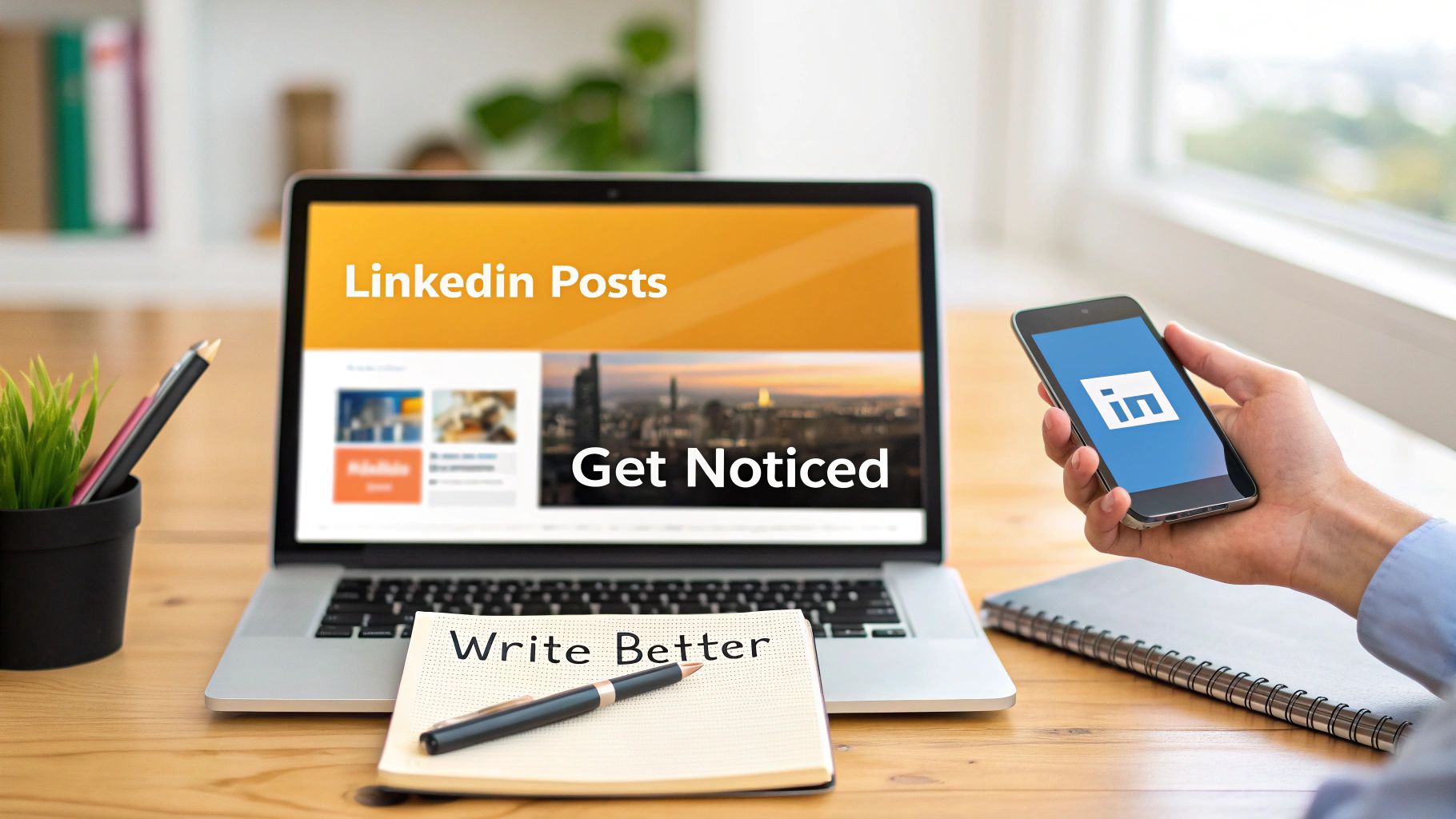
So, you want to know how to bold text in your LinkedIn posts? The easiest way is to use a Unicode text generator. You just pop your text in, it spits out a bolded version using special characters, and you can copy and paste it right into your post. It's a quick trick that makes your key points pop in a busy feed.
Why Bolding Text on LinkedIn Is a Game Changer
Ever scroll through your LinkedIn feed and notice how some posts just grab your attention while others are... well, invisible? A lot of the time, it's not just what they're saying, but how they're saying it.
Bolding text on LinkedIn isn't just a stylistic flourish; it's a strategic way to guide your reader's eye and make sure your most important messages actually get noticed.
In a world of endless scrolling, visual cues are king. Bolding is like a little signpost that tells your audience, "Hey, pay attention here!" It breaks up those dreaded walls of text and makes your content far easier to scan for busy professionals who don't have time to read every single word.
A little bit of bold can do a lot:
- Highlight the important stuff: Make a critical stat, a powerful quote, or your call-to-action impossible to miss.
- Make it easy to read: Guide your reader through your post so they can follow along without getting lost.
- Get more engagement: Posts that look good are just more inviting. Better formatting often leads to more interaction.
Here's the iconic LinkedIn logo, a great example of the clean, professional vibe that works so well on the platform.
This polished look is exactly what you should aim for in your own content.
The Impact on Your Post Performance
Formatting your posts isn't just about looking good—it gets real results. In fact, some LinkedIn engagement benchmarks on contentin.io suggest that posts using formatting like bold text can see up to 30% higher interaction rates than plain text updates.
Think about it. Data from millions of posts shows that accounts posting often with visually interesting content earned 25% more impressions per post. It's a clear signal that both people and the algorithm respond well to it.
A well-formatted post tells everyone—your readers and the LinkedIn algorithm—that you've structured your content for clarity. This can have a direct impact on its reach and help you better understand what LinkedIn impressions mean for your content strategy.
At the end of the day, learning how to bold text in LinkedIn posts is a small skill that delivers a big payoff. It's a simple step toward building a more memorable and effective professional brand on the platform.
Want to know the quickest, no-fuss way to make your LinkedIn text pop? It’s all about using a Unicode text generator. While that might sound a bit techy, it's really just a simple copy-and-paste job.
These free online tools don't actually apply a "bold" format like you would in Microsoft Word. Instead, they swap your normal text characters for special Unicode characters that just look bold. Your browser and the LinkedIn app see them as different characters entirely, but to your readers, they provide that visual punch you're after.
Sometimes, a little bit of bold formatting is all you need to make your point land. This quick decision guide can help you figure out when to use it for maximum impact.

The takeaway here is pretty clear: using bold isn't just about making things look good. It's a strategic move to guide your reader's eye and make your message stick.
How to Do It: Your 60-Second Workflow
Getting this done is incredibly fast. You don't need any special software or tech skills—just your web browser and a minute to spare.
Here’s the basic rundown:
- Find a Generator: First, pop open your browser and search for something like "bold text generator." You'll find tons of free options.
- Enter Your Text: Type the word or phrase you want to emphasize into the tool's input box.
- Copy the Result: The generator will spit out your text in various bold styles. Just click to copy the one you like best.
- Paste it into LinkedIn: Jump back over to your LinkedIn post draft and paste the bolded text right where you want it.
And that's it! The bolded text appears instantly in the LinkedIn editor. After a few times, this little trick becomes muscle memory. It's always a good idea to preview your LinkedIn post before hitting publish, just to make sure everything looks right on both desktop and mobile.
A Quick Look at Popular Bold Text Generators
Here's a simple comparison of free online tools to help you pick the right one for creating bolded text for your LinkedIn posts.
| Tool Name | Ease of Use | Ad Intrusiveness | Style Options |
|---|---|---|---|
| YayText | Very High | Low | Excellent (Bold, Italic, Cursive, etc.) |
| Fancy Text Generator (lingojam) | High | Moderate | Good (Many decorative styles) |
| Bold Text Generator (coolsymbol) | High | Moderate | Good (Focus on bold/italic styles) |
| Unicode Text Converter (qaz.ws) | High | Very Low | Decent (Simple, no-frills interface) |
Most of these tools work the same way, so it really comes down to personal preference. Find one with a clean interface that you like and stick with it.
My Go-To Tip: Bookmark your favorite Unicode generator. Seriously. Having it saved in your browser's toolbar saves you from having to search for it every time you want to add a little flair to your posts. It’s a tiny time-saver that adds up.
This technique is especially powerful for your post's hook. I've seen well-formatted posts—especially those with a bolded first line—pull in 50-100 high-quality comments from senior-level professionals, easily outperforming plain text. That's a huge deal when you consider that 80% of a post's interactions happen in the first 24 hours. You've got to grab their attention immediately.
How to Use Bold Text Without Overdoing It
So, you've figured out how to make text bold on LinkedIn. Awesome. But before you go full-on bold with every other word, let's talk strategy. It’s incredibly easy to go overboard, and that can make your post look spammy or, worse, a little desperate for attention.
The best approach? Think like a designer. Less is always more.

Smart bolding is all about guiding your reader's eye, not shouting at them. Instead of bolding entire sentences (please don't do that), zero in on a few specific words or a short phrase that carries the most weight. This creates a clean, professional look and makes sure your main points are impossible to miss as people scroll.
Pinpoint What to Bold for Maximum Impact
Think of bold text as your digital highlighter. You wouldn't highlight an entire page in a book, right? The same logic applies here. You're just trying to create a few visual signposts that make your post easy to scan and digest.
I've found that bolding these specific elements works best:
- The Hook: A bolded opening can be a powerful scroll-stopper. Something like, "Here's a mistake most founders make..." immediately grabs attention.
- Key Data Points: When you share a compelling number or statistic, make it pop. For example: "Our new approach boosted leads by over 250% in Q1."
- Important Keywords: If your post is about a specific niche, bolding it once can anchor the reader. For instance, "Lately, I've been diving deep into ethical AI development..."
- The Call to Action (CTA): Gently nudge your audience on what to do next. A simple "Drop a comment below" or "Grab the free template" is all you need.
The real magic happens when bolding supports your message, not overpowers it. It should feel like a natural emphasis, helping people quickly grasp the core value of your post without feeling like they're reading a wall of heavy text.
The Hidden Downside: Accessibility Concerns
Here's something a lot of people miss when they start using bold text generators: accessibility. Because Unicode bold isn't actually formatted text—it's a set of unique symbols—screen readers used by visually impaired individuals can get tripped up.
Sometimes, a screen reader will spell out the bolded word letter by letter or just pronounce it as gibberish. That’s not the experience we want to create for our audience.
This doesn't mean you can never use it. It just means you need to be mindful.
A good rule of thumb is to keep your bolding to just a few key words or a single statistic. Avoid bolding entire sentences or long phrases. This approach minimizes any potential accessibility issues while still giving you that visual punch you're after.
By using this technique thoughtfully, you create content that’s engaging for a broad audience and considerate of everyone. For more tips on crafting great content, check out these best practices for posting on LinkedIn.
Beyond Bold: Creative Ways to Emphasize Your Points
While a good Unicode bold can make a word pop, it's not the only trick up your sleeve. Sometimes, a more nuanced approach is what you really need to make your post stand out without being over the top. Thinking about different ways to create emphasis helps you pick the right tool for the right message.
This is where LinkedIn’s own formatting options really shine. They give you a cleaner, more integrated way to guide the reader’s eye.

Use Native Italics for a Softer Touch
Here’s a simple trick that most people miss: LinkedIn has its own built-in italics. All you have to do is wrap your text in single asterisks, like *this*, and LinkedIn will automatically convert it to italics when you publish the post.
It’s a much more subtle way to add emphasis compared to bold text. I find it works great for a few specific things:
- Highlighting a key term: It's perfect for drawing attention to a concept without interrupting the natural flow of your sentence.
- Adding a bit of personality: Italics can signal a specific tone, like a quick personal thought or a reflective comment.
- Citing titles: It’s the standard, professional way to reference things like book titles, articles, or podcasts.
Best of all, since this is a native feature, it’s completely accessible to screen readers. That makes it a reliable and professional choice when you just need a little something extra.
Go Big: When to Use a LinkedIn Article
Ever feel like a regular post just isn't cutting it? If you're itching to bold entire sections, add proper headers, and drop in images, that's a huge clue that you should be writing a LinkedIn Article.
Think of LinkedIn Articles as your personal blog, built right into the platform. They give you a full set of formatting tools—real bold, headings (H1, H2), blockquotes, and lists—all inside the LinkedIn environment.
This is the perfect format for your heavy-hitting, long-form content. We're talking about the kind of in-depth thought leadership you want people discovering and coming back to for months. A post is for a quick hit; an article is for building real authority. Knowing when to make that jump is a core part of a savvy content strategy.
Ready to Really Stand Out on LinkedIn?
Look, making your text bold is a great trick to have up your sleeve. But let's be honest—it's just one small piece of a much larger puzzle. If you're serious about growing your influence, you need to think beyond formatting hacks.
This is where a solid content strategy, often powered by smart tools, comes into play. Think of something like RedactAI not just as a formatting aid, but as your co-pilot for creating content that actually gets noticed. It can help you figure out what to post, fine-tune your writing to get more engagement, and even schedule everything to go live at the best possible times.
We've seen thousands of professionals use tools like this to build a truly consistent and powerful brand. It's the difference between occasionally posting and strategically building your presence.
To really connect the dots between great-looking posts and actual business results, it helps to see how formatting fits into a bigger plan. You can explore these proven LinkedIn lead generation strategies to see how it all works together.
At the end of the day, bold text is just a tactic. A winning LinkedIn presence is built on a foundation of consistent, high-value content. That’s where the real growth happens. We’ve seen creators go from staring at a blank screen to publishing compelling posts every single day. That's how you build a powerful network and truly win on the platform.
A Few Common Questions About Bolding on LinkedIn
So you've learned the "how," but a few questions always seem to come up when people start playing around with bold text in their LinkedIn posts. Let's get these cleared up so you can format your content confidently.
Will Using Bold Text Kill My Post's Reach?
This is the big one, and the short answer is no. There's absolutely zero evidence to suggest that using bold Unicode characters will get your post penalized by the LinkedIn algorithm.
In fact, the opposite is often true. When you use bolding to make your content more scannable and engaging, you encourage people to stick around and actually read it. That increased "dwell time" is a great signal to LinkedIn that your post is valuable. The only real rule here is not to go overboard—a post screaming in bold is just hard to look at, and that can hurt engagement.
Can I Use This Trick in Comments or DMs?
Yep, you sure can! The copy-and-paste method with a Unicode generator works almost everywhere on LinkedIn. It's a fantastic way to add a bit of polish and emphasis beyond just the main feed.
You can use it in:
- Comments: Make your reply stand out in a busy thread.
- Direct Messages: Drive home a key point in a private chat.
- Your Profile: Highlight specific skills or accomplishments in your "About" section.
It’s a simple way to add a professional touch to all your conversations and profile elements.
I get it—the biggest worry is often, "Will this look broken for some people?" It's a fair question, but honestly, the risk is incredibly low these days.
The vast majority of modern browsers, phones, and computers handle these special Unicode characters without a problem. Someone on a very old, outdated system might see a blank box, but that's becoming super rare. For almost everyone in your audience, your bolded text will show up exactly as you planned.
Ready to move beyond basic formatting and create truly impactful LinkedIn content? RedactAI helps you generate on-brand post ideas, optimize your writing for engagement, and schedule everything in minutes. Stop guessing and start growing at https://redactai.io.