Alright, let's clear up the confusion between impressions and views for good. Think of it this way: an impression is like your content showing up in someone's peripheral vision—it was on their screen, but they might have just scrolled right past. A view, on the other hand, means someone actually stopped and decided to watch.
This one distinction changes everything when it comes to measuring what's actually working.
Unpacking the Core Differences
Getting a handle on this is the first real step toward a smarter content strategy. An impression is all about potential—the opportunity for your content to be seen. A view confirms that you captured at least a moment of someone's genuine attention. One is about potential reach, the other is about active consumption.
This might sound like a small detail, but the ripple effects are huge. It's easy to get caught up chasing big impression numbers, making you feel like your content is reaching a massive audience. But if those impressions don't lead to actual views, clicks, or comments, you might just be shouting into the void.
Flipping that around, a high number of views tells a much different story. Especially on platforms like YouTube where a "view" requires a meaningful amount of watch time, it’s a powerful signal that your content is genuinely connecting with people. It proves you've earned your audience's time, not just a split-second of their screen space.
Quick Comparison Impressions vs Views
To put it simply, here’s a quick breakdown of what sets these two metrics apart. This table gives you a clear, side-by-side look at the fundamental differences to guide your initial understanding.
| Metric | What It Measures | User Intent Signal | Best For Measuring |
|---|---|---|---|
| Impression | The total number of times your content is displayed on a screen. | Passive. The user may have just scrolled past without noticing. | Brand awareness, reach, and content visibility. |
| View | An intentional action where a user chooses to watch a video for a set duration. | Active. The user has shown a clear interest in consuming your content. | Audience engagement, content quality, and educational impact. |
As you can see, one is about broadcasting a message, while the other is about starting a conversation. Having this foundation is key to figuring out why prioritizing one metric over the other can completely change your results.
Why Not All Impressions Are Created Equal

It’s tempting to think an impression is an impression, no matter where you see it. But that’s a huge mistake. The truth is, what counts as an impression on LinkedIn is a world away from what counts on Instagram or Google Ads. Think of it less like a universal standard and more like a local dialect.
If you don't get a handle on these subtle differences, you’re basically flying blind. You might see a huge impression count on one platform and pop the champagne, thinking you’ve gone viral. Meanwhile, the same number on another platform could be a sign that something’s seriously wrong. It all comes down to the rules of the game for each specific platform.
How Different Platforms Define an Impression
The whole "impression vs. view" debate really boils down to how each channel measures visibility. Every platform has its own technical fine print for what it considers a "served" impression, which is why your dashboards never quite line up.
Here’s a quick look at how the definition changes from place to place:
- Social Media Feeds (Instagram, Facebook): An impression is usually counted the second a post flickers onto a user's screen. It doesn't matter if they stop to read it or just keep on scrolling. If it appeared, it counts.
- Google Display Ads: The bar is a bit higher here. At least 50% of the ad has to be visible on the screen for a minimum of one second. It’s a step up from a simple scroll-by.
- LinkedIn Feed: The professional network is incredibly specific. An impression is logged when 50% of a creative is visible for at least 300 milliseconds. That’s a literal blink of an eye, which really shows how low the threshold can be.
This is exactly why comparing raw impression numbers across platforms is like comparing apples and oranges. An impression on one channel might be a real shot at getting noticed, while on another, it's just a pixel that flashed on a screen for a moment.
The Nuance of LinkedIn Impressions
On LinkedIn, impressions are a big deal, especially for anyone trying to build a personal brand. The platform’s super-specific definition means that every single time your content shows up for a logged-in member—whether on their feed or from a share—it racks up another impression. For creators, this means your total impressions can easily shoot past your number of unique viewers.
As a general benchmark, newcomers often aim for about 1,000 impressions per post. But if you’re really hitting your stride, you’ll start seeing numbers in the 5,000 to 20,000 range. That's a clear sign your content is connecting and getting picked up by the algorithm. If you want to dive deeper, you can read more about how to track LinkedIn performance.
An impression doesn't guarantee attention—it only confirms an opportunity. Your job is to create content so compelling that it converts that fleeting opportunity into a meaningful interaction.
At the end of the day, context is everything. The format of your content and where it’s placed also muddy the waters. An impression on an Instagram Story is totally different from one on a feed post. Same goes for a Google search ad versus a display ad on a partner site. Once you get these distinctions, you can start making sense of your analytics and put your energy where you’re getting true visibility.
What "View" Actually Means on Different Platforms
You’d think a "view" would be a simple thing, right? Someone watches your video. But it’s not that straightforward. What counts as a view on one platform might just be a passing glance on another. Getting this difference is key to knowing if your content is actually hitting the mark.
Why the variation? It all comes down to what each platform wants you to do. Some are built for endless scrolling, while others want to capture your undivided attention. That core goal shapes how they measure a view.
The Wildly Different Definitions of a Video View
The biggest difference-maker is the time threshold—how long someone has to watch before it’s officially counted as a view. A longer watch time usually means someone is genuinely interested, which makes that view far more valuable. This is where the whole impressions vs. views debate really heats up.
Let's look at how the big players define it:
- YouTube: This is the gold standard for engaged viewing. A view only counts after someone watches for a solid 30 seconds. If the video is shorter than that, they have to watch the whole thing. It’s a high bar, but it means a YouTube view is a strong signal of real interest.
- Facebook & Instagram: Here, a view is logged after just 3 seconds. Since videos autoplay in the feed, this metric often includes people who were just scrolling past. It’s great for measuring how many eyeballs you reached, but not so much for deep engagement.
- TikTok: A view is counted the second the video starts playing. That sounds low, but don't be fooled. TikTok's algorithm is all about completion rates and re-watches, which are much better indicators of whether your content is a hit.
- LinkedIn: The professional network strikes a middle ground. A view is counted after 2 continuous seconds of playback, but only if at least 50% of the video is visible on the screen. It requires a little more intent than a quick scroll-by.
Why Quality Beats Quantity
The platform's definition of a view changes the entire story your analytics tell. Bagging a million views on a platform that counts them after 3 seconds is great for brand awareness, but it’s not nearly as powerful as a million high-intent views on YouTube.
When you're digging into performance on a giant like Facebook, specialized Facebook Insights analytics tools can give you the context behind the numbers, showing you things like audience retention that a simple view count never will.
A view isn’t just a number; it’s a measurement of attention. The more time someone gives you, the more valuable that interaction becomes.
At the end of the day, what you're trying to achieve dictates which kind of view matters most. If your goal is to educate an audience or build real trust, you’ll want to focus on platforms that reward longer watch times. To get the full picture, checking out the best social media analytics tools can help you pull all these different metrics into one place. That way, you know your video content isn't just being seen—it's actually being watched.
Choosing the Right Metric for Your Marketing Goals
So, should you be chasing impressions or views? It's a classic marketing question, but there's no single "winner." The right answer always comes back to your specific goal for that piece of content.
Trying to max out both metrics without a clear strategy is a surefire way to burn through your budget and end up with a mess of confusing data. You have to pick a lane.
The trick is to match your main Key Performance Indicator (KPI) to what you're actually trying to achieve. Are you just trying to get your brand name in front of as many eyeballs as possible? Or are you trying to teach your audience something meaningful? The answer changes everything.
Aligning Metrics With Campaign Objectives
Let's say you're launching a new product or have a big company announcement. Your goal is simple: mass awareness. You need to get the word out to the biggest audience you can, as fast as you can.
In this case, impressions are your North Star. A massive impression count is your confirmation that the platform's algorithm is doing its job and pushing your content far and wide.
But what if you're putting out a detailed how-to video, a deep-dive customer story, or a thought leadership article? Now your goal is all about education and engagement. You need to know people are actually sticking around and absorbing what you've created.
For this kind of content, views are the only metric that really counts—especially quality views with a long watch time.
This decision tree breaks down how the value of a view changes depending on where someone sees it and how they interact with it.
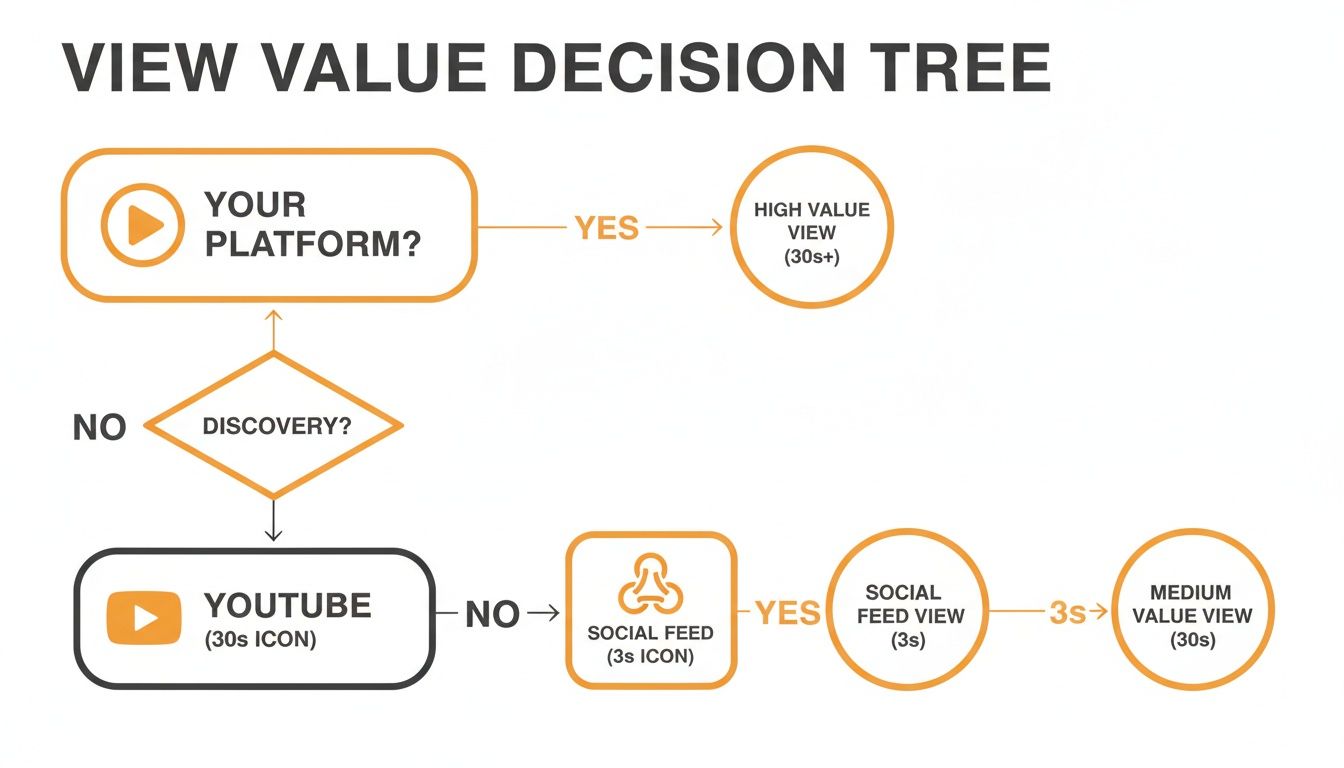
As you can see, a 30-second view on YouTube is a whole different beast than a 3-second auto-play view someone scrolled past on a social feed. One signals real intent; the other is just a fleeting glance.
A Practical Framework for Your Goals
To make this crystal clear, I've put together a simple table that maps common marketing goals directly to the metric you should be focusing on. Use this to make smarter strategic choices and, just as importantly, to explain the "why" behind your focus to your team or clients.
Matching Goals to Metrics: A Practical Guide
Use this table to decide whether impressions or views should be your primary KPI based on your specific campaign objectives.
| Your Marketing Goal | Primary Metric to Focus On | Strategic Rationale | Real-World Scenario |
|---|---|---|---|
| Brand Awareness & Reach | Impressions | The goal is maximum visibility. You want your content served to the largest possible audience to build name recognition. | You just launched a new company and need to get your logo and tagline in front of everyone in your industry. |
| Audience Education | Views (and Watch Time) | You need proof that your audience is consuming and understanding your content, which signals genuine interest. | You created a 10-minute video tutorial explaining a complex feature of your software. |
| Lead Generation | Views (leading to a Click) | A view is the first step, but the ultimate prize is a click. High views with a low click-through rate means something is off. | Your post promotes a downloadable e-book. You need people to not only see it but click the link to get it. |
| Community Building | Views (and Comments) | Views show people are watching, but comments confirm they feel connected enough to join the conversation. | You've posted a video asking for your audience's opinion on a new trend to spark a discussion. |
The metric you choose doesn't just measure your success—it actually defines it. Focusing on impressions when you really need deep engagement is like judging a book by how many people saw its cover in the bookstore.
Picking the right metric is foundational to any good campaign. It helps you read your analytics correctly and make better decisions down the road. You can always explore further insights into marketing goals to get a broader perspective, but it all starts here.
Knowing your true objective is the first and most important step in figuring out how to measure content performance the right way.
Using RedactAI to Get More LinkedIn Impressions

If you're serious about building a real presence on LinkedIn, impressions are the first domino you need to topple. They're the initial spark of visibility—the thing that leads to profile clicks, new connections, and actual business opportunities. While views matter, you can't get views if nobody sees your content in the first place.
This is where a solid strategy comes in, especially one supercharged by a tool like RedactAI. Instead of throwing spaghetti at the wall to see what sticks, you can use AI to consistently create content that the LinkedIn algorithm actually wants to show people.
Tap Into Trending Conversations with AI
One of the quickest ways to get a bump in impressions is to jump into conversations already buzzing with activity. RedactAI has a content inspiration feature that’s perfect for this. It looks at viral posts and what's currently trending in your niche, then hands you a list of topics people are already fired up about.
Getting started is as simple as giving it a prompt.
- Prompt Example: "Generate five post ideas about the future of remote work for a B2B SaaS audience. Focus on controversial or forward-thinking angles."
This approach makes sure your content is timely and relevant. When you do that, you're signaling to the algorithm that your post is a valuable addition to a hot topic, making it more likely to get pushed out.
The real magic here is getting several distinct drafts from one simple idea. It completely cuts out the "blank page" problem and lets you pick the angle that feels most authentic to you.
Craft Scroll-Stopping Hooks and Structures
Great impressions are won or lost in the first 300 milliseconds. That’s all the time you have to stop someone from scrolling past your post. Your opening line is everything. RedactAI has been trained on thousands of high-performing LinkedIn posts, so it knows how to help you write hooks that actually grab attention.
Your LinkedIn hook has one job: earn you three more seconds of attention. If it fails, the rest of your post doesn't matter. The algorithm sees when people slow down, and it rewards that behavior with more impressions.
It’s not just about the hook, though. The structure of your post is just as critical. The LinkedIn algorithm loves content that’s easy on the eyes.
- Short Sentences: Break down your big ideas.
- White Space: Use single-line paragraphs to give readers room to breathe.
- Bulleted or Numbered Lists: Make your key points easy to scan and remember.
RedactAI automatically formats its suggestions this way, which means your content is optimized for both the algorithm and your human audience right from the start. For a deeper dive, check out our guide on what impressions on LinkedIn really mean for your growth.
Build Consistency with Scheduling and Repurposing
If there's one thing the LinkedIn algorithm rewards above all else, it's consistency. Posting on a regular schedule shows that you're an active, reliable voice on the platform. With RedactAI's scheduling feature, you can keep that rhythm going without having to live on LinkedIn 24/7.
And remember, not every post has to be a brand-new masterpiece. Use the content repurposing feature to find your old winners—the posts that got a ton of impressions. From there, you can ask RedactAI to give it a fresh spin, turn it into a question, or update it with new stats. This simple move can give great content a second life and capture a whole new wave of impressions from people who missed it the first time around.
Your Top Questions About Impressions and Views, Answered
Once you start paying attention to your content analytics, a few key questions always seem to surface. The whole impression versus view thing can feel a bit murky at first, but getting it straight is crucial if you want to actually understand what your metrics are telling you.
Let’s clear up some of the most common hangups.
Are Impressions the Same as Reach?
Nope, not at all. They’re two totally different measurements that tell separate parts of your content's story.
Reach is the count of unique people who saw your content. Think of it as a headcount of individual eyeballs.
Impressions, on the other hand, count the total number of times your content was displayed on a screen. This is a big difference, because one person can easily see the same post several times, and each time counts as a new impression.
So, if one person sees your post twice, your reach is 1, but your impressions are 2. This is why your impression count will pretty much always be higher than your reach.
Why Are My Impressions High but Engagement Is Low?
Ah, the classic (and super frustrating) dilemma. When you see this, it’s a big, flashing sign that you have a content problem.
On the bright side, high impressions mean the platform’s algorithm is doing its job and pushing your content out there. You're winning the visibility game, which is the first step.
But the low engagement—the lack of likes, comments, shares, or clicks—tells you that once people see it, they just keep on scrolling. Your content isn't grabbing them. It's a signal that your hook, your visual, or your core message just isn't hitting the mark. You earned the screen time, but you lost the attention battle. Time to go back to the drawing board with your content.
High impressions get your foot in the door. High engagement proves you belong in the room. If one is missing, your message isn't landing.
Can I Get Views Without Impressions?
This one’s an easy one: absolutely not. It's just not possible.
An impression has to happen first. It's the prerequisite for any other action, including a view. Your content has to be displayed on someone's screen (that's the impression) before they can even make the choice to watch it (that's the view).
Think of an impression as the opportunity. A view is the action someone takes because of that opportunity. Without the opportunity, the action can't happen. Every single view, click, like, and comment started its journey as a humble impression.
Which Metric Is More Important for SEO?
Honestly, the "right" answer here totally depends on where you're trying to rank. The whole impressions vs. views debate changes a lot based on the platform and what you’re trying to achieve.
For old-school web SEO, the kind you do for Google, impressions are a huge deal. In Google Search Console, your impression count shows you how often your pages are popping up in search results. It’s a direct measure of your visibility for the keywords you’re targeting.
But flip over to video SEO on a platform like YouTube, and the game changes. Here, views—and more importantly, watch time—are king. These metrics tell YouTube’s algorithm that people are genuinely interested in your video, which is a massive signal for ranking and getting recommended. A high view count with great watch time tells YouTube your content is what people are looking for, and they'll reward you for it.
Ready to stop guessing and start creating LinkedIn content that consistently earns impressions? RedactAI provides the inspiration, structure, and scheduling tools you need to build your personal brand with confidence. Try it for free and see how thousands of professionals are creating high-impact posts in minutes at https://redactai.io.