Let's get one thing straight right from the start: the difference between an impression and a view is huge. An impression is counted the moment your content shows up on someone's screen, but a view requires a person to actually watch it for a certain amount of time. Deciding whether to chase visibility (impressions) or genuine engagement (views) is a fundamental choice that will steer your entire content strategy.
Untangling Your Two Most Common Metrics
So, let's settle the whole impressions vs. views debate once and for all. They might sound like they're in the same ballpark, but they measure two completely different aspects of your content's journey.
An impression is just a tally mark for your content being displayed—it's all about visibility. A view, on the other hand, demands more. It means someone actually stopped and engaged by watching your content for a specific length of time. This distinction isn't just semantics; it's a critical piece of the puzzle. Impressions tell you about your potential audience size, while views signal that you've genuinely captured someone's interest.
For instance, if one person scrolls past your post three separate times, that's logged as three impressions. For a deeper dive into how these metrics vary on different platforms, you can find some great insights on SocialPilot.co. Think of this as your quick-start guide before we dig into the strategy behind it all.
Core Differences Between Impressions and Views
To kick things off, let's cut through the jargon with a simple side-by-side look.
This little table breaks down exactly what separates these two metrics, making it easy to see what each one is really telling you about your audience's behavior.
| Metric | What It Measures | Primary Signal | Example |
|---|---|---|---|
| Impressions | How many times content is displayed on a screen. | Reach and Visibility | A LinkedIn post appearing in someone's feed as they scroll. |
| Views | How many times video content is watched for a minimum duration. | Engagement and Interest | Someone watching the first 3 seconds of your LinkedIn video. |
In short, one is about being seen, and the other is about being watched. Both are important, but for very different reasons.
So, How Exactly Are Impressions Counted?
Ever seen a post rack up 10,000 impressions on LinkedIn and wondered what that really means? The way it's counted is surprisingly straightforward. An impression is registered the moment your content loads and shows up on someone's screen.
That's it. They don't have to pause their scroll, click anything, or even fully register what they've seen. If your post flashes by in their feed, even for a split second, that's one impression. This makes it a fantastic, if broad, measure of your content's potential visibility right at the top of the funnel.

Ultimately, impressions are a raw measure of how well you're playing the algorithm's game. A high impression count is a great sign that LinkedIn is actively pushing your content out to a wide audience.
Don't Mix Up Impressions with Reach
It's super common for people to get impressions and reach mixed up, but they tell you two very different stories. Let's clear that up.
- Reach is the number of unique people who saw your content. If 100 different people saw your post, your reach is 100. Simple.
- Impressions are the total number of times your content was shown. If those same 100 people each saw your post twice, you'd have 200 impressions, but your reach would still be 100.
Think of it like this: an impression tells you about visibility and frequency, while reach tells you about the size of your unique audience. Impressions are about how often your message is getting out there.
Because one person can be responsible for several impressions, it's the go-to metric for gauging brand awareness and how frequently your message is hitting home. If you want to dive deeper into this, our guide on impressions on LinkedIn has a ton more detail. That kind of repetition is what helps you stay top-of-mind.
So, What Actually Counts As a View?
Think of a view as the next step up from an impression. It’s not just about your content appearing on a screen; a view means someone actually stopped scrolling and decided to watch. It's a much more concrete sign that you've captured someone's attention.
But here’s where it gets messy. What qualifies as a "view" is all over the place, depending on the platform. This is a huge deal because you can't compare your performance apples-to-apples without knowing the rules of the game.
Every Platform Plays by Its Own Rules
A view on LinkedIn isn't the same as a view on YouTube, and that's a critical detail when you're looking at your analytics. Let's break down how different platforms count a view:
- LinkedIn: They count a view once someone watches for at least 2 seconds with 50% of the video on their screen. It's a pretty low bar, but it confirms a brief pause.
- YouTube: This is the gold standard. YouTube doesn't count a view until someone has watched for a solid 30 seconds (or the whole video if it's shorter). This signals real intent.
- Instagram & Facebook (Meta): Over here, it only takes 3 seconds of watch time to get a view. It's quick, which means view counts can inflate easily, but it doesn't mean the viewer was deeply engaged.
- TikTok: The most lenient of all. A view is counted the second your video starts playing. No minimum watch time required.
Simply put, a view is proof your content was good enough to stop the scroll. It’s a conscious decision from a user to engage, making it a way more telling metric about your content's quality than an impression ever could be.
This is why so many marketers are moving away from chasing impressions and focusing on views instead. It's a much better gauge of real engagement. Interestingly, you'll sometimes see your view count climb higher than your impression count—by over 25% in some cases. Why? Because views track every single playback, including when people re-watch your content.
If you want to dig deeper into that, Talkwalker has a great analysis on this. It really highlights why views are the metric to watch if you want to know if your message is actually landing.
Aligning Your Metrics With Your Marketing Goals
https://www.youtube.com/embed/G6X1RDdkt1Y
It’s one thing to know the textbook definitions of impressions and views, but it’s another thing entirely to use them to get real results. The secret is to stop chasing vanity metrics and start tying your KPIs directly to what you're trying to achieve in your business.
To make this work, you have to start by defining your value proposition. Once you're crystal clear on your core message, you can pick the right metric to see if that message is actually landing.
So, when do you focus on impressions? Think about a new product launch or breaking into a fresh market. In those cases, impressions are your best friend. The main goal is just getting your name out there—pure visibility. You want as many eyeballs on your content as often as possible to build that crucial brand recognition.
When Views Steal the Show
On the flip side, if your campaign is all about educating your audience, building trust, or actually generating leads, then views become the star player. A view is proof that someone didn't just scroll past your content; they stopped and actually engaged with it. That’s a far stronger signal of real interest and a critical step before someone will ever consider taking action.
Take an in-depth tutorial video, for example. Its success isn't measured by how many feeds it appeared in, but by its views and total watch time.
This simple flowchart shows how platforms decide if an interaction actually counts as a "view."
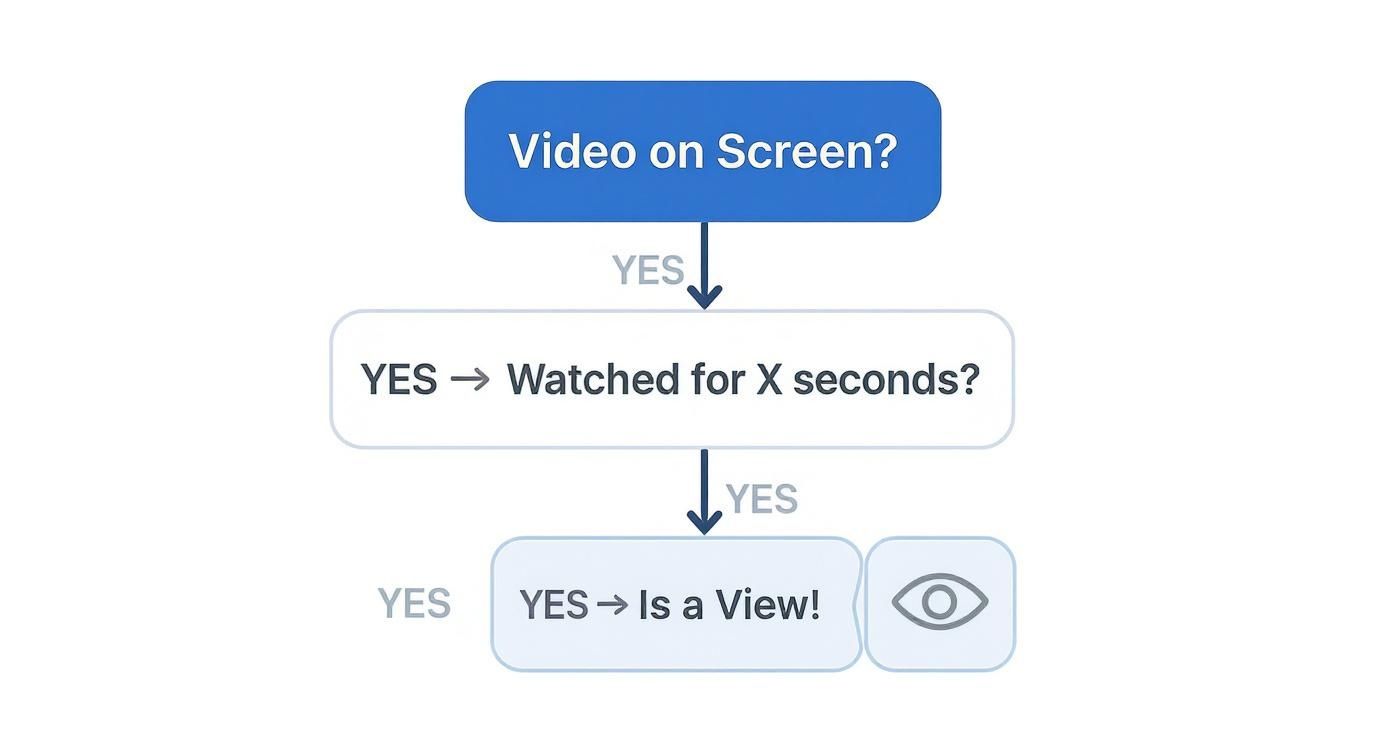
As you can see, a view isn't just a fleeting glance. It requires someone to pause and watch for at least a few seconds, which is a world of difference from a passive impression.
Deciding between impressions and views really comes down to your campaign's specific objective. The table below breaks down which metric you should be tracking based on common marketing goals.
Choosing Your Metric Based on Campaign Goals
| Campaign Goal | Primary Metric to Track | Why It's the Right Metric |
|---|---|---|
| Brand Awareness | Impressions | Your goal is maximum visibility. You want your brand in front of as many people as possible, as often as possible, to build recognition. |
| Product Education | Views | A view indicates someone stopped to learn. It shows genuine interest in understanding your product's features and benefits. |
| Lead Generation | Views | Leads come from engaged prospects. A view is a strong early indicator that a person is invested enough to potentially share their info. |
| Audience Engagement | Views | Views (especially with high watch time) are a direct measure of how compelling your content is and how well it resonates with your audience. |
| New Market Entry | Impressions | When entering a new space, you need to make a splash. High impression volume helps establish your initial presence and familiarity. |
Ultimately, choosing the right metric sets the entire tone for your strategy. Focusing on impressions pushes you toward broad, awareness-focused campaigns. Prioritizing views, however, forces you to create truly valuable and engaging content that can actually hold someone's attention.
Knowing how to measure content performance is all about connecting the dots between your analytics and your overarching goals.
How to Optimize Content for Better Performance
Alright, so you know the difference between impressions and views. Now what? Putting that knowledge to work means you need a two-part game plan. You need tactics that get the LinkedIn algorithm to notice you (for impressions) and content that actually keeps a real person interested (for views).
Getting more impressions is all about playing the discoverability game. You have to send the right signals to the algorithm so it shows your post to a wider audience. Think of it as making your content as appealing to the platform as possible.

Driving More Impressions
To get your content in front of more eyeballs, focus on these algorithm-friendly moves:
- Smart Hashtags: Don't just throw random hashtags out there. Use a solid mix of broad, niche-specific, and even your own branded hashtags. This helps you reach people way beyond your current followers.
- Perfect Timing: Post when your audience is actually online and scrolling. Dive into your analytics to pinpoint when your specific followers are most active.
- Thumb-Stopping Visuals: The image or video thumbnail is your first—and maybe only—shot to grab someone's attention. Make it bold, clear, and compelling enough to make them stop scrolling.
Converting Impressions to Meaningful Views
Once you've snagged that impression, the real challenge starts. You have to convince someone to actually stick around and watch your content. This is where the quality of your post and its ability to hold attention become critical.
A view is a commitment, even if it's just for a handful of seconds. For video, those first few moments are absolutely everything. Our guide on how to post a video on LinkedIn has some great technical tips that can really help here.
The real difference between optimizing for impressions versus views is this: one is about getting your content distributed, and the other is about getting it consumed. You need a strategy that nails both to see any real growth.
To boost your view count and, more importantly, your watch time, focus on what happens after someone stops scrolling. You have to hook them within the first 3 seconds. After that initial grab, use good old-fashioned storytelling to keep them engaged, and always wrap up with a clear call-to-action asking them to like, comment, or share.
For more ideas on optimizing different types of content, you might want to check out tools like ShortGenius. By focusing on both getting seen and being worth seeing, you create a powerful cycle for long-term success.
Common Questions About Impressions and Views
Let's clear up some of the usual suspects when it comes to confusion around impressions vs. views. Nailing these definitions is the first step to actually using them to make better content decisions. Here are the questions I hear most often from marketers.
Is One Metric Better Than the Other?
It's a classic question, but honestly, it’s not about which one is "better." It's about which one matters for what you're trying to do.
Think of impressions as your go-to for brand awareness. If you're just trying to get your name, your product, or your company in front of as many eyeballs as possible, as often as possible, then impressions are your north star. A high number here means you're making your mark.
On the flip side, views are the clear winner for engagement and consideration. When you're trying to teach something, build real trust, or get someone to take the next step, a view is proof that they actually paused their scroll to listen. It signals a much deeper level of interest.
The best metric is the one that lines up with your goal. Chasing views when you just need brand awareness is a waste of energy, just like focusing only on impressions for a video designed to get leads.
How Is Reach Different from Impressions?
This is a big one, and it's easy to get them mixed up. They both measure visibility at the top of the funnel, but they're telling you two completely different things.
- Reach is about unique people. If 100 different people see your post, your reach is 100. It's the total size of the audience you managed to connect with.
- Impressions are about the total number of times your content showed up on a screen. If those same 100 people saw your post three times each, you'd have 300 impressions.
Basically, reach tells you how many individuals you hit, while impressions tell you how often you hit them.
How Do These Metrics Affect Engagement Rate?
Your engagement rate calculation can change depending on what you divide by. You usually take your total interactions (likes, comments, shares) and divide them by either your reach, impressions, or even your follower count.
Using impressions as the denominator will almost always give you a lower, more conservative engagement rate. Why? Because you're counting every single time the post was served, even repeat views to the same person.
Using reach gives you a more people-focused perspective, showing you what percentage of unique viewers actually interacted. And when it comes to video, a high view count often leads to a higher engagement rate because a viewer is, by definition, already paying attention. They're primed and more likely to leave that like or comment.
Ready to stop guessing and start creating LinkedIn content that gets both impressions and views? RedactAI uses your unique voice and expertise to generate high-impact posts in minutes, complete with analytics to track what's working. Join over 21,000 creators and try it for free at https://redactai.io.