LinkedIn newsletters have become a powerhouse for professionals looking to build authority, connect with their audience on a deeper level, and drive real business outcomes. But in a sea of content, simply hitting "publish" isn't enough. The difference between a newsletter that gets archived and one that becomes a must-read lies in a deliberate, repeatable strategy.
This guide cuts through the noise to deliver 10 proven LinkedIn newsletter best practices you can implement immediately. We’re moving beyond the obvious advice and diving into the specific, actionable tactics that top creators use to build loyal audiences, spark meaningful conversations, and turn subscribers into genuine advocates for their brand.
Forget generic tips. Instead, you'll get a clear framework for everything from crafting irresistible subject lines and structuring your content for maximum readability to promoting your newsletter for sustainable growth. Whether you're just launching your first issue or looking to breathe new life into an existing publication, these insights will help you create a valuable asset that consistently delivers results. Let's get into the strategies that will make your newsletter stand out in a crowded inbox and become a highlight for your professional network.
1. Establish a Clear Publishing Schedule
Think of your favorite TV show. You know exactly when it airs, right? Applying that same principle to your LinkedIn newsletter is a game-changer. Maintaining a consistent publishing frequency, whether it's weekly, bi-weekly, or monthly, is a foundational best practice that builds anticipation and trains your subscribers to look for your content.
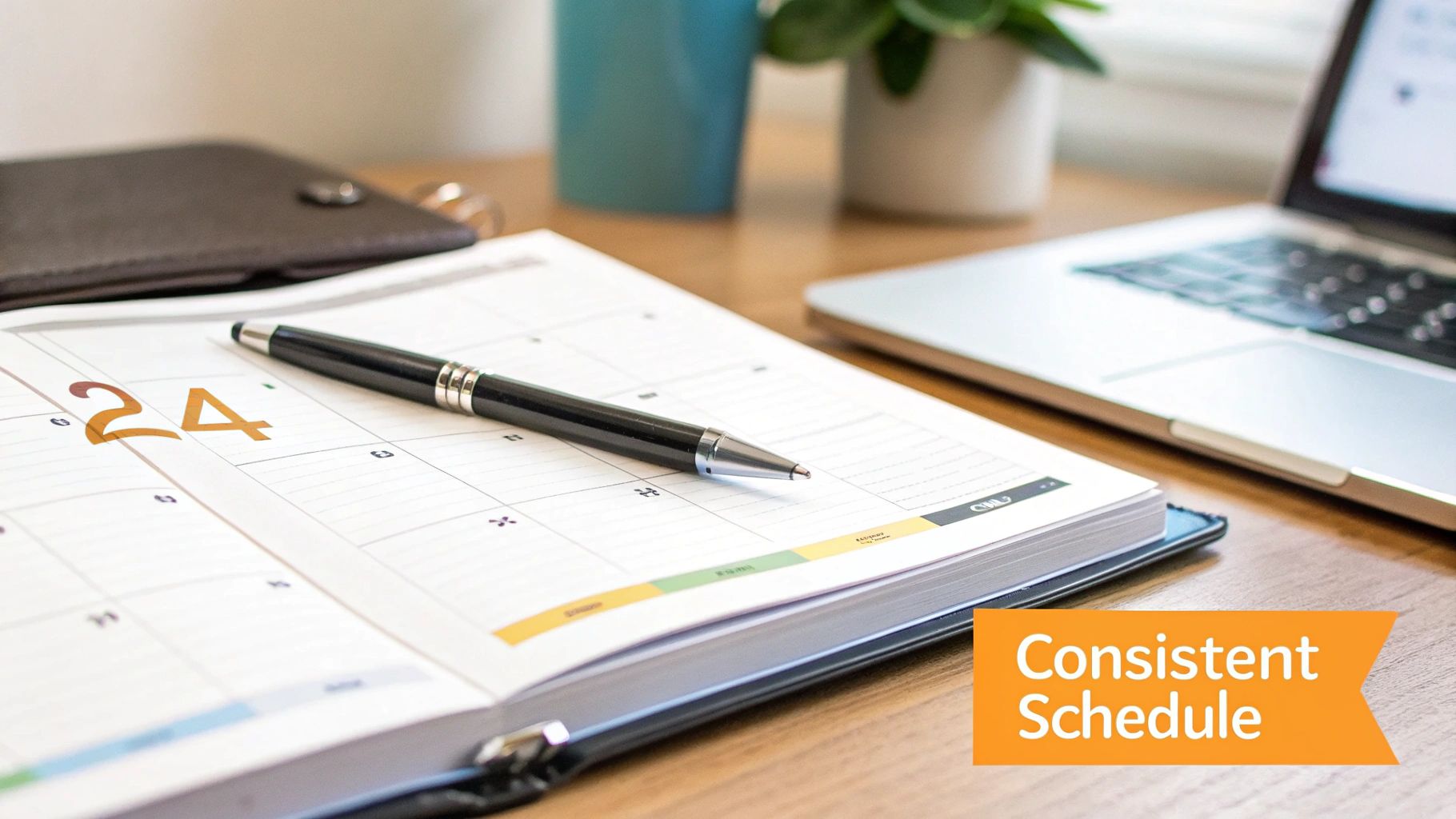
This predictability doesn't just benefit your readers; it also signals to LinkedIn's algorithm that your newsletter is a reliable and active source of content, which can improve its distribution and visibility. Just look at successful examples like Ali Abdaal's weekly 'Deep Dive' or Ann Handley's bi-weekly 'Total Annarchy'. Their audiences know precisely when to expect value, which keeps them engaged and coming back for more.
How to Implement a Consistent Schedule
Putting this into practice requires a bit of planning but pays off immensely in the long run. The key is to remove the last-minute scramble and work ahead.
- Plan Ahead with a Calendar: Use a content calendar to map out your topics at least 4-8 weeks in advance. This gives you a clear roadmap and prevents writer's block. For a deep dive into this, check out our guide on how to create an editorial calendar.
- Set a Specific Time: Don't just pick a day; pick a time. "Every Tuesday at 9 AM ET" is much more effective than just "sometime on Tuesday."
- Batch Your Content: Dedicate a block of time to write several newsletter editions at once. This is a huge productivity hack that ensures you're never without content, even during busy weeks.
- Use LinkedIn's Scheduler: Take advantage of LinkedIn’s built-in scheduling feature to automate the publishing process. Write it, schedule it, and forget it.
2. Craft Compelling Subject Lines and Previews
Your subject line and preview text are your newsletter's first impression. They are the digital handshake that happens in a crowded inbox, determining whether your audience clicks 'open' or 'archive'. Crafting a compelling subject line is one of the most crucial LinkedIn newsletter best practices because it directly impacts your open rates and initial engagement.
Think of subject lines like 'The One Skill That Changed My Career' or '3 Mistakes I Made Before Landing My Dream Job'. They don't give everything away; instead, they spark curiosity and promise tangible value, making the click irresistible. While LinkedIn newsletters have unique characteristics, many principles from general email management best practices can be applied, especially when it comes to grabbing attention in a professional context.
How to Write Attention-Grabbing Subject Lines
The goal is to be intriguing without resorting to clickbait. Your subject line should be an honest, exciting preview of the value inside.
- Focus on Value or Curiosity: Lead with a clear benefit ('Proven Ways to...') or a question that sparks interest ('Are You Making This Leadership Mistake?').
- Keep it Short and Sweet: Aim for under 50 characters to ensure your full subject line is visible on mobile devices, where most users check notifications.
- Use Numbers and Data: Specificity builds credibility. '7 Essential Tools for...' is often more compelling than 'Tools for...'.
- Leverage 'Power Words': Incorporate words like 'Discover', 'Essential', 'Proven', or 'Secrets' to create a sense of importance. For more ideas, explore our guide on how to write a great headline for LinkedIn.
- Avoid Spam Triggers: Steer clear of all caps and overly promotional words like 'Free' or 'Act Now', which can hurt deliverability and look unprofessional.
3. Focus on Authentic, Original Insights
In a sea of recycled content, your original perspective is your most valuable asset. Readers subscribe to newsletters for unique insights they can't find elsewhere, not for a summary of the week's top articles. This is one of the most crucial LinkedIn newsletter best practices: sharing authentic experiences and fresh analysis builds unparalleled trust and authority.
Think about newsletters that truly stand out, like Lenny Rachitsky's deep dives into product strategy, which are packed with proprietary case studies. He isn't just commenting on trends; he's creating the source material. By focusing on your own lessons, data, and experiences, you transform your newsletter from a simple content roundup into a must-read destination for genuine expertise.
How to Cultivate Original Insights
Developing original content means looking inward at your own expertise and outward for unique connections, rather than just echoing what's already popular.
- Share Your Lived Experiences: Discuss a specific project, challenge, or failure. What did you learn? People connect with stories and vulnerability far more than with generic advice.
- Focus on a Single, Deep Insight: Instead of covering five shallow topics, dedicate each newsletter to unpacking one powerful idea. This allows you to explore the nuances and provide real depth.
- Present Your Own Data: Did you run an experiment or survey? Share the results. Even small-scale, proprietary data is infinitely more valuable than re-sharing a widely-cited statistic.
- Add Your Unique Angle: If you must discuss a trending topic, make sure you bring a contrarian or novel perspective to the conversation. Ask, "What is everyone else missing?"
4. Optimize for Readability and Scannability
Let's be honest: your audience is busy and likely skimming your newsletter on their phone while waiting for a coffee. This is why making your content easy to scan isn't just a good idea; it's essential for engagement. Formatting for scannability with short paragraphs, clear headers, and bullet points ensures your key messages land, even with the most time-pressed readers.
This approach respects your reader's time and drastically improves their experience. A well-formatted newsletter prevents overwhelm and encourages readers to absorb the entire piece. Look at how The Hustle uses minimalist formatting or how the former Levo League newsletter used clean section breaks. Their success proves that presentation is just as important as the content itself, making it one of the most critical LinkedIn newsletter best practices to master.
How to Improve Readability
Implementing this is all about creating visual breathing room and guiding the reader's eye to the most important information. It’s a design-thinking approach to writing.
- Lead with the Punchline: Use the "inverted pyramid" style. Put your most crucial information at the very beginning, followed by supporting details.
- Keep Paragraphs Tiny: Limit paragraphs to a maximum of 2-3 short sentences. This is especially important for mobile viewing.
- Use Descriptive Headers: Your subheadings should act as a mini-summary, telling the reader exactly what each section is about.
- Embrace Lists: Use bullet points for non-sequential items and numbered lists when order matters. They are magnets for the skimming eye.
- Bold Strategically: Emphasize 2-3 critical phrases per section to highlight key takeaways. Don't overdo it.
- Always Test on Mobile: Before you hit publish, preview your newsletter on a mobile device to ensure the formatting holds up on a small screen.
5. Include a Strong Call-to-Action (CTA)
Your newsletter shouldn't be a dead end. Each issue is an opportunity to guide your reader toward a specific next step. Including a clear Call-to-Action (CTA) transforms your newsletter from a passive piece of content into an active tool for engagement, traffic generation, or lead conversion. It gives your content a purpose beyond just being read.
Think about it: what do you want your audience to do after they finish reading? Without a CTA, you leave that decision to chance. Effective CTAs, like asking readers to 'Reply with your thoughts' or 'Read the full analysis on my blog', provide clear direction. This is a crucial part of the best practices for a LinkedIn newsletter because it makes your content's impact measurable.
How to Implement a Strong CTA
Integrating effective CTAs is about being intentional and clear. Guide your readers without being overly aggressive.
- Be Singular and Specific: Focus on one primary CTA per newsletter to avoid decision fatigue. Instead of a generic "Click here," use action-oriented language like "Download the free template" or "Join the workshop."
- Place it Logically: Position your CTA where it makes the most sense. If you've just discussed a case study, that's the perfect spot to link to the full report. A CTA at the end is standard, but a mid-content CTA can also be highly effective.
- Make it Visually Distinct: Use bold text, a button-like hyperlink, or even just a separate line with an emoji to make your CTA stand out from the rest of the text.
- Track Your Clicks: Use UTM parameters on your links to see exactly how much traffic your newsletter is driving. This data is invaluable for refining your strategy and proving your newsletter's ROI.
6. Build Community Through Engagement and Feedback
Don't just broadcast; start a conversation. One of the most powerful LinkedIn newsletter best practices is transforming your one-way content stream into a dynamic two-way dialogue. When you actively solicit and respond to reader feedback, you create a loyal community, not just a subscriber list. This sense of belonging is what turns passive readers into active brand advocates.
When subscribers feel heard and valued, their loyalty deepens. For instance, many top marketing newsletters feature a 'reader spotlight' section, showcasing insightful comments or success stories from their audience. This not only rewards engagement but also provides social proof, encouraging others to participate. This community-centric approach makes your newsletter a destination rather than just a notification.
How to Build Community and Encourage Feedback
Fostering this interactive environment requires a consistent and genuine effort to connect with your audience. It's about making your readers feel like they are part of the creative process.
- Ask Specific Questions: End each newsletter with a direct question related to the topic. Instead of "What do you think?", ask "What's one tactic you've used to overcome this specific challenge?"
- Acknowledge and Feature Subscribers: Dedicate time each week to reply to comments. Go a step further by featuring the most insightful replies, with permission, in your next issue to show you're listening.
- Run Polls and Surveys: Use simple polls within your newsletter or link to a short survey to gather direct feedback on content topics, format preferences, or challenges they're facing.
- Host Live Q&A Sessions: Periodically host a LinkedIn Live or audio event exclusively for your newsletter subscribers to discuss recent topics and answer their questions in real time.
7. Provide Immediate, Actionable Value
In a world of endless content, the newsletters that stand out are the ones that deliver immediate utility. Your subscribers are busy; they're looking for solutions, not just stories. A crucial LinkedIn newsletter best practice is to ensure every issue gives your reader something concrete they can apply within the next 24-48 hours.
This approach transforms your newsletter from a passive read into an active resource. When subscribers know they'll walk away with a ready-to-use framework, a customizable template, or a specific tactic, they're far more likely to open, read, and share your content. Think of marketing newsletters that provide email templates or career guides that offer specific salary negotiation scripts; their value is instant and tangible.
How to Implement Immediate Value
The goal is to shift from "food for thought" to "tools for action." Make it easy for your readers to see a direct return on the time they spend with your newsletter.
- Lead with the Actionable Insight: Don't bury the lede. Start with the framework, the script, or the checklist. You can provide the context and story afterward.
- Use Specific Frameworks: Instead of general advice, offer a numbered or step-by-step process. For example, "A 3-Step Framework for Effective Delegation" is more powerful than "Tips for Delegating."
- Include Tangible Assets: Whenever possible, add templates, checklists, or links to useful tools. This gives your readers a physical or digital takeaway.
- Time-Box the Task: Reassure your busy readers by framing the action within a specific timeframe. For instance, "Here’s a 15-minute technique to improve your next sales call."
8. Maintain Authentic Voice and Personality
In a sea of corporate jargon and polished posts, your unique voice is your greatest asset. Readers subscribe to newsletters to hear from a specific person, not a faceless brand. Letting your personality shine through, whether it's with humor, storytelling, or a particular perspective, is what builds a genuine connection and a loyal following. It transforms your content from just another update into a must-read conversation.
This principle is one of the most crucial LinkedIn newsletter best practices because it fosters trust and makes your content memorable. Think of Jason Lemkin’s irreverent SaaS commentary or Sahil Lavingia’s philosophical, personal takes. Their audiences aren't just there for the information; they're there for the unique lens through which it's delivered. Authenticity is the secret ingredient that keeps subscribers engaged and eager for more.
How to Cultivate Your Authentic Voice
Injecting your personality doesn't mean being unprofessional; it means being human. The goal is to create a consistent, recognizable voice that your readers can connect with.
- Write Like You Talk: Read your draft out loud. Does it sound like you? If not, rewrite it. Use contractions and conversational language to make your writing feel more natural and approachable.
- Share Personal Stories: Weave in relevant personal anecdotes, struggles, or lessons learned. Vulnerability builds trust and makes your professional insights far more relatable and impactful.
- Develop Signature Elements: Create a unique sign-off, a recurring segment, or a specific formatting style that becomes your trademark. This adds a layer of predictability and personality.
- Don't Shy Away from Opinions: Share your genuine, well-reasoned perspectives, even if they're controversial. A strong, authentic viewpoint is more engaging than a neutral, safe one.
9. Grow Your List Through Strategic Promotion and Lead Magnets
Hoping your newsletter will grow organically is like planting a seed and never watering it. While amazing content is the foundation, strategic promotion is the catalyst that accelerates subscriber growth. Actively promoting your newsletter and using lead magnets helps you break through the noise and build momentum much faster than waiting for readers to find you on their own.
This approach transforms your newsletter from a passive content piece into an active growth engine. Think of creators who offer a free template library or a career guide in exchange for a signup. They aren't just sharing expertise; they are creating an irresistible value exchange. This is one of the most effective linkedin newsletter best practices for turning passive profile visitors into dedicated subscribers.
How to Implement Strategic Promotion
Building a deliberate promotion plan ensures your great content gets the audience it deserves. It’s about creating multiple pathways for people to discover and subscribe to your work.
- Create a Compelling Lead Magnet: Offer something of high value that solves a specific problem for your target audience. This could be an ebook, a checklist, a webinar recording, or a template pack.
- Optimize Your LinkedIn Profile: Add a call-to-action to your headline or featured section. A simple "Subscribe to my weekly newsletter for X tips" can work wonders.
- Promote in Your Content: End your relevant LinkedIn posts with a direct link and a compelling reason for people to subscribe to your newsletter for more in-depth insights.
- Cross-Promote on Other Platforms: Share your newsletter signup link on your personal blog, Twitter profile, or even in your professional email signature.
- Collaborate with Other Creators: Partner with creators in complementary niches for a newsletter swap or shout-out. This introduces your work to a new, relevant audience.
10. Analyze Metrics and Continuously Optimize Based on Data
Launching a newsletter without tracking its performance is like driving with your eyes closed. One of the most critical LinkedIn newsletter best practices is to dive into the data, see what's working, and relentlessly optimize. LinkedIn provides detailed analytics on subscriber growth, open rates, and click rates that offer a direct window into your audience's behavior.

This data-driven approach is what separates good newsletters from great ones. For instance, you might discover that your personal stories generate a 40% higher click-through rate than simple tips, or that sending your newsletter at 8 AM on a Wednesday morning yields the highest open rate. These insights are pure gold, allowing you to tailor your content and timing to maximize engagement and growth.
How to Use Analytics for Optimization
Turning raw numbers into actionable improvements is the goal. It's a continuous cycle of testing, learning, and refining your strategy.
- Establish a Review Cadence: Set aside time weekly to glance at your metrics and monthly for a deeper analysis of trends. This keeps you in tune with performance without getting overwhelmed.
- Test One Variable at a Time: To get clear results, isolate your tests. If you want to see which subject line works best, change only the subject line, not the send time or content format.
- Benchmark Against Yourself: While it's tempting to compare your numbers to industry averages, your most important benchmark is your own historical performance. Focus on consistent, incremental improvement.
- Track Content Themes: Pay close attention to which topics or formats drive the most clicks and shares. If short lists consistently outperform long-form narratives, lean into what your audience loves. For more ideas, explore our complete guide on how to measure content performance.
10-Point Comparison: LinkedIn Newsletter Best Practices
| Item | Complexity 🔄 | Resources ⚡ | Expected Outcomes 📊 | Ideal Use Cases 💡 | Key Advantages ⭐ |
|---|---|---|---|---|---|
| Establish a Clear Publishing Schedule | Medium — ongoing planning & discipline | Low–Medium — time, calendar tools | Steady subscriber growth, better algorithm distribution | New or scaling newsletters that need predictability | Builds habit and reliability; improves visibility |
| Craft Compelling Subject Lines and Previews | Medium — copywriting + testing | Low — time, A/B tools | Higher open rates and initial engagement | Improving open rates or launching campaigns | Immediate lift in opens and CTR; easy to iterate |
| Focus on Authentic, Original Insights | High — research and unique perspective needed | High — expertise, time, data/interviews | Deeper trust, retention, thought leadership | Positioning as an expert or monetizing a niche | Differentiates content; builds authority and loyalty |
| Optimize for Readability and Scannability | Low–Medium — editing and format discipline | Low — editing time, mobile checks | Higher completion rates and comprehension | Mobile-first audiences; dense or instructional topics | Improves retention and engagement; reduces cognitive load |
| Include a Strong Call-to-Action (CTA) | Low — clear placement and messaging | Low — tracking links, simple design | Measurable clicks/conversions and clearer ROI | Driving traffic, signups, or sales from issues | Directly drives actions and measurable outcomes |
| Build Community Through Engagement and Feedback | High — ongoing interaction and moderation | Medium–High — time, community tools | Increased retention, advocacy, user-generated content | Niche communities or long-term subscriber strategies | Strengthens loyalty and transforms readers into advocates |
| Provide Immediate, Actionable Value | Medium–High — craftable, evidence-based items | Medium — templates, examples, testing | Fast perceived ROI, higher shareability & retention | Practical skill-building or tactical newsletters | Readers can apply advice quickly; boosts trust |
| Maintain Authentic Voice and Personality | Medium — consistent voice and vulnerability | Low — personal time and content choices | Stronger brand recall and closer subscriber bonds | Personal brands and creator-led newsletters | Distinctive, memorable voice that increases loyalty |
| Grow Your List Through Strategic Promotion and Lead Magnets | Medium — outreach strategy and partnerships | Medium — lead magnets, cross-promo effort | Faster subscriber acquisition; variable quality | New newsletters or rapid scaling phases | Accelerates list growth and attracts targeted subscribers |
| Analyze Metrics and Continuously Optimize Based on Data | Medium — regular review and testing discipline | Medium — analytics tools, time for tests | Incremental performance gains and ROI clarity | Mature newsletters seeking steady improvement | Data-driven decisions reduce guesswork and improve results |
Turn Your Newsletter Into Your Greatest Asset
And there you have it: a complete roadmap to transforming your LinkedIn newsletter from a simple broadcast into a powerful strategic asset. We’ve covered a lot of ground, from establishing a rock-solid publishing schedule and crafting irresistible subject lines to fostering a genuine community and diving deep into your analytics. It's easy to look at a list this comprehensive and feel a little overwhelmed, but the core message is simple: consistency, value, and authenticity. These three pillars are the foundation of every successful newsletter.
Think of it less as a set of rigid rules and more as a flexible framework. The real magic happens when you weave your unique personality and expertise through these proven strategies. Your authentic voice is what makes readers choose your newsletter over the countless others vying for their attention. Providing immediate, actionable value is what keeps them subscribed and eagerly awaiting your next issue. And consistency is what builds the trust and habit that turns casual readers into loyal advocates. Mastering these linkedin newsletter best practices isn't about chasing vanity metrics; it’s about building a direct line to your audience, nurturing relationships at scale, and creating a platform that showcases your authority.
Key Takeaways and Your Next Steps
Let's distill this down to the essentials. If you remember nothing else, remember this:
- Your Reader Comes First: Every decision, from your topic to your formatting, should be made with the reader's experience in mind. Are you solving their problems? Are you making it easy for them to consume your content?
- Data is Your Co-pilot: Don't just publish and pray. Your analytics are a treasure trove of insights. Pay attention to what resonates (and what doesn't) and let that data guide your content strategy.
- Authenticity is Non-Negotiable: People connect with people, not faceless brands. Let your personality shine through. Share your unique perspective, tell your stories, and don't be afraid to be yourself.
- Action is the Goal: A great newsletter doesn't just inform; it inspires action. Your CTAs are crucial for guiding subscribers toward deeper engagement, whether that's commenting, visiting your website, or booking a call.
To see these principles in action, look at what the pros are doing. Drawing inspiration from successful models, like those recognized among the best investing newsletters, can help you identify common threads for building a truly impactful publication. Notice how they combine deep expertise with a clear, consistent voice.
Your immediate next step? Don’t try to implement all ten practices at once. Choose just one or two that you can apply to your very next issue. Maybe it's rewriting your CTA to be more specific or adding a section that actively asks for reader feedback. Small, consistent improvements are what lead to massive long-term growth. Your newsletter is a marathon, not a sprint, and you've just been given the ultimate training plan. Now, go put it to work.
Struggling to maintain that authentic voice and consistent flow of ideas? RedactAI can help you generate on-brand content and draft posts in your unique style, ensuring you never run out of high-quality material. Focus on your expertise and let RedactAI handle the heavy lifting of content creation.