We’ve all been there. That sinking feeling right after you hit ‘Post’ on LinkedIn and immediately spot a typo or a wonky-looking link. The good news? It's completely avoidable.
When you're drafting your content in the "Start a post" window, LinkedIn gives you an automatic preview of any links or images you add. This is your final checkpoint, your last line of defense against those face-palm moments. Don't skip it.
Why You Absolutely Cannot Skip the Preview on Your LinkedIn Posts
Taking that extra five seconds for a final once-over isn't just about catching spelling errors; it’s a crucial step in managing your professional brand. A post with a horribly cropped image, a broken link, or weird line breaks doesn't just look sloppy—it can chip away at your credibility. It subtly tells your network you don't sweat the small stuff, and that's not a message you want to send to potential clients or employers.
Think about it from an engagement perspective. Clean, professional-looking posts just perform better. It's a fact. Adding a sharp headline and a compelling thumbnail to a link post can juice your engagement by 15–40%. That's a huge difference, turning a simple share into something that genuinely grabs attention.
Your Professional Image Is on the Line
Every single thing you post on LinkedIn is a brick in the foundation of your digital reputation. Consistently sharing polished, well-presented content cements you as an expert who values quality. If you're serious about how to build a personal brand on LinkedIn, you already know that every detail counts. The preview is one of those details.
A preview isn’t just about dodging mistakes. It’s about making sure the first impression your content makes is exactly the one you want. It’s your chance to own the narrative and present your ideas with the polish they deserve.
Here’s a quick rundown of the key things I always double-check in a preview and why they're so important for getting the results you want.
Elements to Check in Your Preview and Why They Matter
| Preview Element | What to Check For | Why It Boosts Performance |
|---|---|---|
| Link Thumbnail | Is the image clear, relevant, and not awkwardly cropped? Does it grab attention? | A strong visual stops the scroll. A bad one makes your post look amateurish and untrustworthy. |
| Link Headline | Does it accurately reflect the content? Is it compelling enough to make someone click? | This is your hook. A weak headline means no clicks, no matter how great the content is. |
| Text Formatting | Are your line breaks and spacing correct? Is the "See more..." cut-off happening where you want it to? | Good formatting makes your post easy to read. Bad formatting makes it a wall of text that people will skip. |
| @Mentions & #Hashtags | Are the right accounts and companies tagged? Do the hashtags look right and are they clickable? | Incorrect tags mean missed opportunities for visibility and networking. They need to work perfectly. |
At the end of the day, taking a moment to check that preview is one of the simplest, yet most effective, habits you can build. It ensures your message lands exactly as intended, protecting your brand and helping you stand out in a very crowded feed.
Nailing the Post Preview on Your Desktop
Let’s be honest, the desktop version of LinkedIn is where the real work happens. It’s where most of us build our thoughtful, detailed posts, and thankfully, it gives you the clearest, most accurate preview of what your network will see.
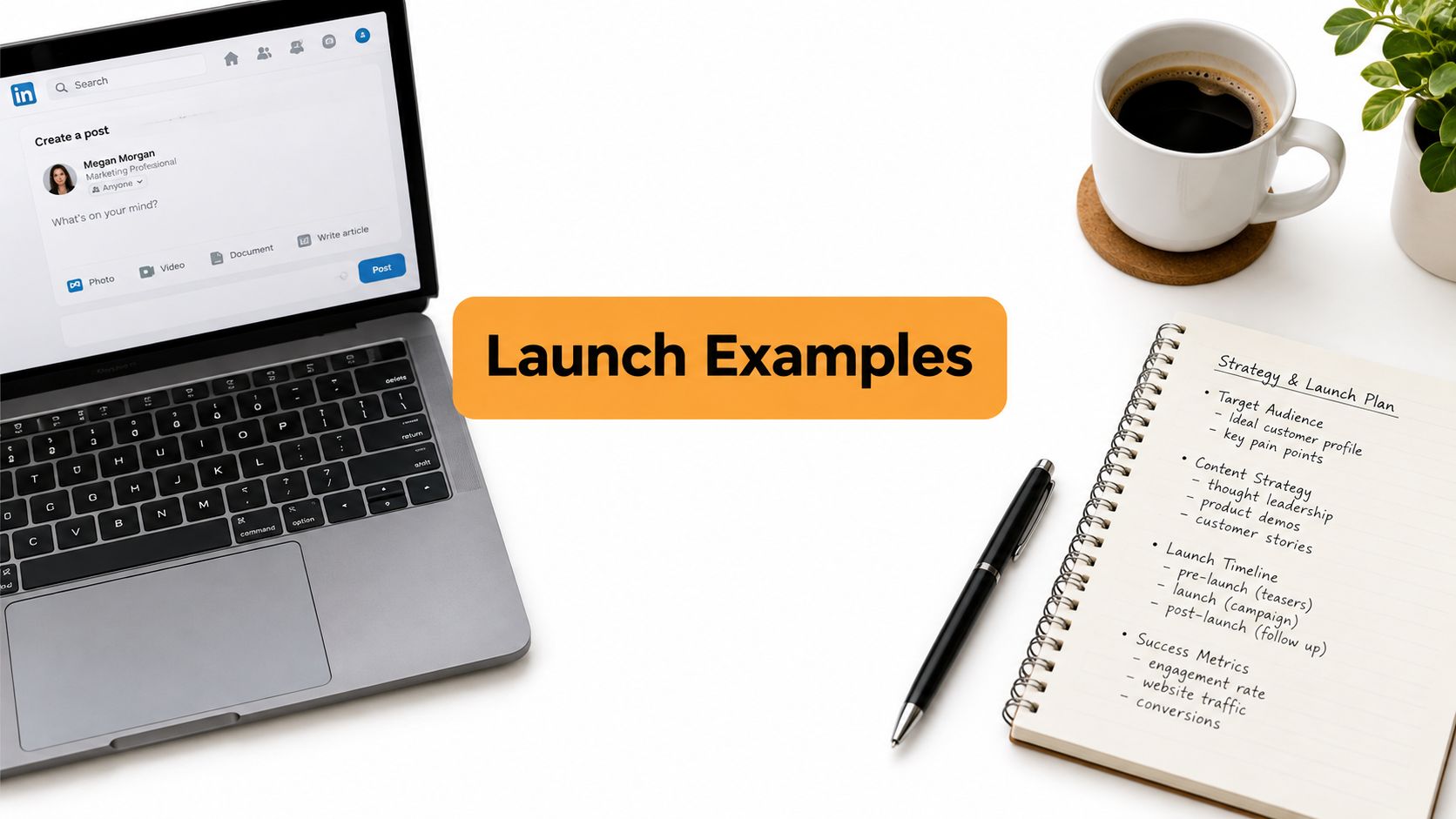
The process itself is built right into the "Start a post" box. It's not a separate step you have to take; it's a live look at your post as it comes together. As you type your text, add an image, or drop in a link, the preview pane below your text updates instantly.
Composing and Previewing in Real-Time
As you're writing, you need to be strategic. The most important thing to watch is where LinkedIn will slap that pesky "…see more" link on your text. This is your make-or-break moment.
Your first few lines are an audition for your audience's attention. You absolutely have to put your most compelling hook right before that cutoff to get them to click and read the rest.
What about links? When you paste a URL into the composer, give it a second. LinkedIn will go fetch the article’s info and create a preview card, pulling in the headline and a thumbnail image. This is your first look at how that shared link will appear in the feed.
This is exactly what it looks like in the standard post composer when the preview card pops up.
See how it clearly lays out the thumbnail, headline, and the website? You get the full picture before you hit "Post."
If that thumbnail looks wonky or the headline gets cut off awkwardly, this is your chance to fix it. A weird-looking preview usually isn't a LinkedIn glitch; it's an issue with the source website's metadata. While you can't edit the preview card directly on LinkedIn, you can go back to your own website and tweak the "Open Graph" settings that tell LinkedIn what to grab.
Pro Tip: After LinkedIn has generated that nice preview card, you can actually delete the messy URL from your post text. The preview card sticks around, making your post look way cleaner.
It's a similar deal for posts with images or documents. Upload your file, and the preview will show you precisely how it's going to be cropped and displayed. This is super important for any custom graphics you've created.
To make sure your visuals are always on point, I'd recommend bookmarking these updated LinkedIn post specs. Getting the dimensions right from the start saves a ton of headaches later. Trust me, catching these little things on desktop will save you from that sinking feeling of post-publication regret.
Getting Your LinkedIn Preview Right on Mobile
Let's be real—most of us are posting to LinkedIn from our phones while waiting for coffee or between meetings. The mobile app is where the action is, but previewing your post on that smaller screen comes with its own set of quirks.
The process is straightforward enough on both iOS and Android. You tap the "Post" button, start typing, and add your media. The app does give you a live preview right there in the composer, which is helpful, but it's a condensed version of what your followers will see.
Working Around the Mobile Preview's Quirks
Here's the thing about the mobile preview: it's not always a perfect 1:1 match with the final post. The compact view can be a bit deceptive, especially with images and link cards.
When you drop a link into your post, for example, the preview card that pops up is your only shot at seeing it before it goes live. You can't edit it. If it pulls in a weird, pixelated image from the article, your only real option is to delete the link and fix it later on a desktop.
My go-to trick for this is to write the text on my phone, save it as a draft, and then open it on my computer to add the final link or image. You get the convenience of drafting on the fly with the full preview power of the desktop.
And don't even get me started on videos! They have their own unique preview behaviors. If you want to get those looking perfect, we've got a whole guide on how to post a video on LinkedIn that breaks it all down.
Ultimately, the key to a great mobile post is knowing what the app can't show you perfectly and planning for it.
Third-Party Tools Can Be Your Secret Weapon
Let's be real: sometimes, LinkedIn's native preview just doesn't play nice. You drop a link in, and it pulls an old headline or the wrong image. It's frustrating, and it happens to all of us. This is where a good social media management tool becomes your best friend for getting that perfect preview linkedin post.
Platforms like Buffer, Hootsuite, or Sprout Social are built for this. They plug directly into LinkedIn's system but often have much more reliable preview generators. Drafting a post in one of these dashboards gives you a crystal-clear look at how your content—the text, the link card, the image—will actually appear in the feed.
Why Schedulers Give You a Better Preview
The big win with these tools is control. You're working in a stable, predictable environment, away from the random glitches that can pop up on LinkedIn's live interface. This is a game-changer if you're managing multiple accounts or scheduling a whole batch of content at once.
Think of it this way: a dedicated tool turns previewing from a "cross your fingers and hope" moment into a deliberate, strategic part of your process. You get to fine-tune the presentation before it even hits LinkedIn, so there are no last-minute surprises.
With LinkedIn's user base rocketing from 644 million in 2019 to a projected 1.2 billion by early 2025, every little detail matters. Getting your preview right can mean the difference between getting scrolled past and earning thousands of extra impressions. For more on this, check out the stats on LinkedIn's massive growth on columncontent.com.
Taking Back Control of Your Content
These platforms do more than just preview; they simplify your entire workflow. Instead of living in the LinkedIn composer, you can create, check, and schedule everything from a single, organized dashboard.
Here’s what that looks like in practice:
- No More Link Roulette: Schedulers are usually better at grabbing the latest thumbnail and headline from your links, so you're not stuck with outdated info.
- Visuals You Can Trust: See exactly how your images will be cropped and where your text will wrap. This keeps your branding looking sharp and intentional.
- Easier Teamwork: If you have a team, everyone can sign off on a post based on a reliable preview before it ever goes public.
Ultimately, using a scheduler takes the guesswork out of the equation. When you pair a solid tool with a great LinkedIn post template, you'll see a huge jump in both the quality and efficiency of your posts.
It's incredibly frustrating. You spend hours crafting the perfect article, hit publish, and share it on LinkedIn... only to see the wrong thumbnail or a bizarre headline pop up. Nothing torpedoes your post's momentum faster than a busted link preview.
This happens all the time, and it almost always comes down to something called Open Graph tags. Think of them as little instructions on your website that tell platforms like LinkedIn, "Hey, when someone shares this link, use this specific image, this headline, and this description." When those tags are missing or out of date, LinkedIn's crawler just has to guess, and it often guesses wrong.
Luckily, you don't have to just cross your fingers and hope.
Your Go-To Tool: The Post Inspector
LinkedIn gives us a fantastic, free tool to solve this exact problem: the Post Inspector. I use this thing constantly. Before I share any important link, I paste the URL into the inspector first.
It gives you a perfect sneak peek of what LinkedIn is seeing and pulling from your page. More importantly, it forces LinkedIn to clear its cache and grab the freshest version of your content.
I tell everyone to think of the Post Inspector as a "hard refresh" for your link preview. Just updated your blog post's featured image? Run it through the inspector to make sure LinkedIn sees the new one immediately.
This simple step can save you so much grief. If you see an error message like "Too many requests," for example, it's a good sign that your web host might be temporarily blocking LinkedIn's crawler. Usually, just waiting a few minutes and trying again does the trick.
Quick Fixes for Common Preview Headaches
When your preview looks off, run through this mental checklist. It's almost always one of these things.
- The Wrong Image or Title Shows Up: This is a classic Open Graph tag issue. Head back to your website's backend (if you're on WordPress, a plugin like Yoast or Rank Math handles this) and make sure the right info is set. Then, pop the URL back into the Post Inspector to refresh it.
- You Get No Preview at All: Sometimes, especially with new websites, a firewall might be blocking LinkedIn from accessing the page. The inspector will help you figure out if LinkedIn can even "see" your site.
- The Preview is Old and Outdated: Here's the key thing to remember: LinkedIn caches link information for about seven days. If you've updated your content, the only way to force an immediate update is to use the Post Inspector.
Making the Post Inspector part of your regular publishing routine is a game-changer. It takes ten seconds and helps you preview your LinkedIn post to guarantee your content always looks sharp and professional, every single time.
Making Previews That People Actually Want to Click

Getting the preview to show up correctly is just step one. The real goal? Making it so irresistible people have no choice but to click. Think of your preview as the sales pitch for your content. It’s the one thing that can stop someone mid-scroll and get them to pay attention.
The secret is to stop thinking like a content creator and start thinking like a marketer. Every single piece of that preview, from the headline down to the image, has a job to do: spark curiosity and push someone to act.
Nailing the Headline
Let's be real, your headline is the hook. It has to be sharp, clear, and punchy enough to earn that click. Bland, descriptive titles are the enemy here. Instead, try asking a provocative question or promising a tangible, valuable takeaway.
For instance, "An Article About Marketing Trends" is a guaranteed scroll-past. But what about, "Are These 3 Marketing Trends Killing Your ROI?" See the difference? The second one creates a sense of urgency and hints that you have the solution, making it way more compelling.
This is critical when you consider the scale of LinkedIn. The U.S. and India alone have massive user bases, with roughly 230–250 million and 130–150 million members. A headline that truly resonates with these professionals can make a huge difference. You can discover more insights about these LinkedIn demographics on Statista.com.
Choosing a Standout Thumbnail
Your thumbnail image is your post's visual handshake, and you don’t want it to be a limp one. It has to be high-quality, on-brand, and actually related to what you're talking about. Please, no more generic stock photos.
Here are a few things I always keep in mind for thumbnails:
- Go for bold colors and high contrast. You need your image to pop out of a very crowded, very blue-and-white feed.
- Put text on the image. Slapping your headline right onto the thumbnail reinforces your message and grabs attention instantly.
- Use a human face. Our brains are wired to notice faces. It’s a simple trick that builds an immediate connection.
Getting your preview linkedin post right is a proactive step in managing how your audience perceives your expertise. It’s about controlling the narrative from the very first glance.
Speaking of controlling the narrative, this is a core part of building a strong online presence. For a deeper dive into this, you might find some useful tips in this comprehensive guide to online reputation management. It all circles back to presenting yourself and your content in the most polished and engaging way possible.
Stop staring at a blank page and start creating high-impact LinkedIn posts in minutes. RedactAI analyzes your unique style to generate content that sounds like you, helping you build your brand and engage your network effortlessly. Start for free at RedactAI.