A business writing style guide is basically your company's rulebook for all things written. It lays out the ground rules for everything—your brand's voice, the tone you should take, nitty-gritty grammar points, and how to format things. The whole point is to make sure everyone, from the marketing crew to the customer support team, sounds like they're on the same page.
Think of it as the one document that keeps all your company's writing aligned and consistent.
Why You Need a Business Writing Style Guide Today
Ever had an experience like this? You see a sharp, witty ad on Instagram and click through to the company’s website. But when you get there, the blog posts read like a college textbook—dense and stuffy. Still curious, you shoot a question over to their support team and get a reply that’s so casual, full of slang and emojis, that it feels unprofessional.
That jarring shift in tone is what I call "communication whiplash," and it quietly chips away at a brand's credibility. Every single piece of writing, whether it's a quick tweet or a hefty instruction manual, is a chance to connect with your customers. When those moments feel disjointed, it paints a picture of a brand that's disorganized and untrustworthy.
End the Internal Chaos
Without a clear guide, your team is flying blind. Your marketing folks might be all about using exclamation points, while the product team insists on a more buttoned-up, formal style. This leads to those soul-crushing editing cycles where documents bounce back and forth, not to fix actual mistakes, but to bicker over personal preferences.
A business writing style guide puts an end to the guesswork. It gives every employee a solid framework to work from, so they can write with confidence and consistency. No more wasting an hour debating the Oxford comma or how to capitalize job titles—your team can finally focus on what they're actually trying to say.
A style guide is a massive efficiency booster. By setting clear standards, it cuts out the confusion, slashes review times, and helps your team create better content, faster.
Build a Recognizable Brand Identity
The way your brand "sounds" in writing is just as critical as your logo or color palette. It’s the personality that shines through your words. A style guide is where you nail down that personality. Are you trying to be helpful and friendly? Or are you the go-to expert who's serious and authoritative? Maybe you're witty and a little bit playful.
Writing these things down ensures your brand has a consistent voice, no matter where people encounter it. That consistency is what builds a sense of familiarity and trust. Over time, customers start to recognize your voice, which deepens their connection to your brand and makes you stand out from everyone else.
At the end of the day, a style guide isn't just a document of rules—it's a strategic asset for building a stronger, more cohesive brand from the inside out.
Defining Your Core Style Principles
Before you can start cranking out consistent content, you have to figure out what your brand actually sounds like. This is where you lay the groundwork, establishing the communication DNA that will shape every single word you write. Think of it like deciding on the architectural style for a house before you start picking out paint colors.
The whole thing rests on three key pillars: Voice, Tone, and Persona. If you can nail these, you're well on your way to creating a business writing style guide that people will actually use.
Unpacking Voice, Tone, and Persona
It's super common to get these three mixed up, but they each have a distinct job to do. Let me break it down.
Imagine your brand is a person. Your Voice is their personality—it’s who they are at their core, and it doesn't change. Are they a witty expert, a friendly guide, or a buttoned-up professional? That core personality stays the same whether you’re writing a celebratory blog post or a serious security update.
Tone, on the other hand, is the emotional inflection you layer on top. Just like you wouldn't talk the same way at a party as you would at a funeral, your brand's tone has to adapt. It might be empathetic when replying to a customer complaint or super enthusiastic when announcing a new feature.
Finally, your Persona is all about who you're talking to. I find it helpful to create simple "persona cards" that detail your ideal customer's goals, challenges, and how they like to be spoken to. This keeps your team focused on writing for a real person, not just a faceless crowd.
Practical Exercises to Find Your Voice
"Finding your voice" can feel a bit abstract, I get it. So, let's make it concrete with a simple exercise that always works.
- Brainstorm Adjectives: Get your team in a room (or on a call) and just list out 20-30 adjectives that could describe a personality. Think playful, authoritative, formal, quirky, sophisticated—get it all out there.
- This, Not That: Now, draw two columns. In the "We Are" column, pick the words that feel right for your brand. In the "We Are Not" column, put the ones that are definitely a bad fit. For example, you might decide you're "Confident" but not "Arrogant," or maybe "Approachable" but not "Silly."
- Distill and Define: Look at your "We Are" list and circle the top 3-5 adjectives that really capture your essence. For each one, write a short, practical sentence explaining what it means for your writing.
For example:
- Expert: We provide clear, data-driven insights without using confusing jargon.
- Witty: We use clever wordplay and humor when appropriate but never at the expense of clarity.
A business writing style guide is a huge piece of your overall brand identity. If you want to see how these writing rules fit into the bigger picture with your logo, colors, and messaging, this guide on how to create brand guidelines is a great resource.
When your brand voice is all over the place, it doesn't just feel messy—it causes real problems.
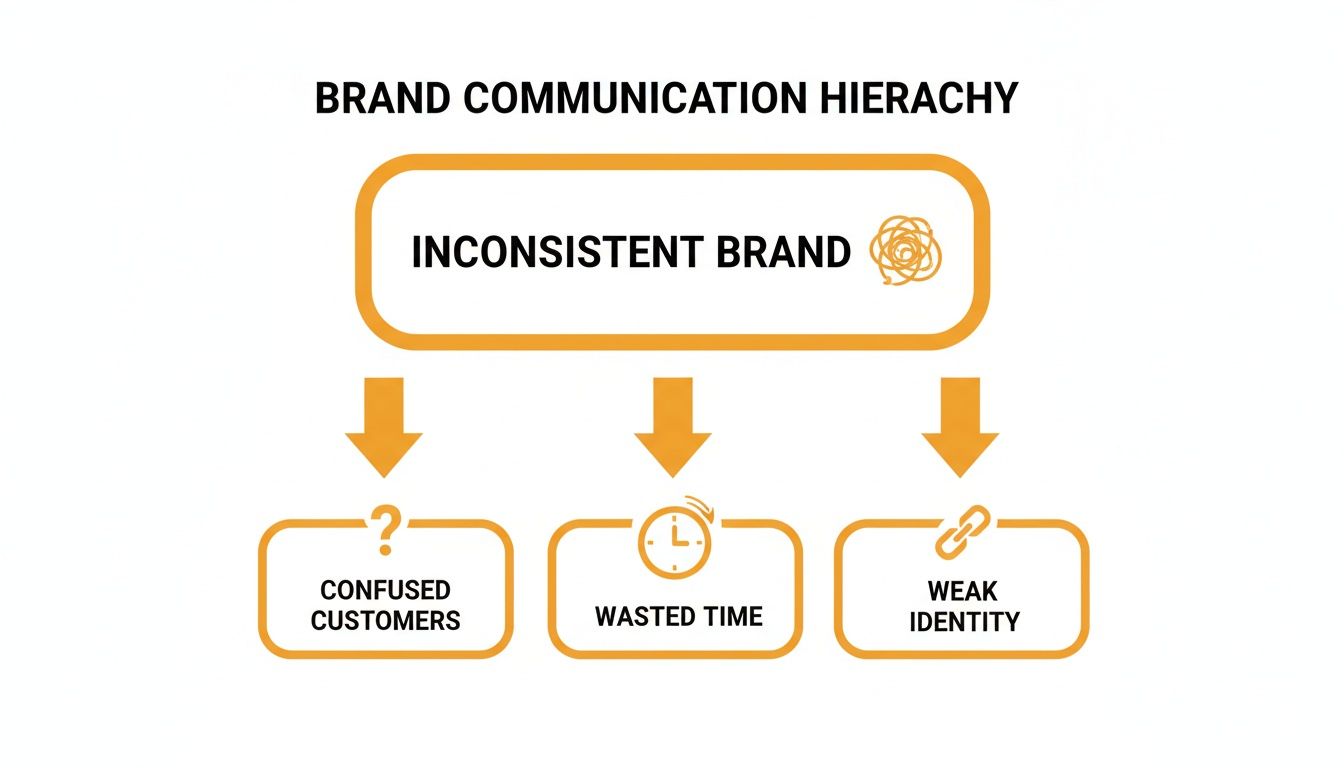
As you can see, a lack of consistency confuses customers, wastes your team's time, and ultimately weakens your brand's identity.
Setting Practical Grammar and Formatting Rules
Okay, beyond the personality stuff, your style guide needs to settle those small but constant arguments that slow your team down. These are the practical, everyday rules that keep everything looking and feeling consistent.
You don't need to rewrite a grammar textbook here. Just focus on the decisions your team has to make over and over again.
- Numbers and Dates: Do you write out numbers one through nine, or always use numerals? Decide on a standard date format (e.g., October 26, 2024, or 26/10/2024).
- Capitalization: How do you handle job titles? Is she "our Chief Executive Officer" or "our chief executive officer"?
- Acronyms and Jargon: When are industry acronyms okay to use? Do you need to define them on first use, like Search Engine Optimization (SEO)?
- Punctuation: This is where you settle the classic debate—do you use the Oxford comma or not? Make a call and stick to it.
This focus on clarity isn't just a modern trend. Back in the 1980s, Toyota’s continuous improvement philosophy, Kaizen, pushed for clear, data-driven reporting over vague descriptions—a practice that changed business writing forever. You can still see that legacy today; one survey found that 78% of executives report faster decision-making when they get reports with hard data, cutting down review times by an average of 35%.
Structuring Content for Maximum Readability
Let's be honest. Even the most groundbreaking idea will get lost if it’s buried in a giant wall of text. In the business world, people don't have time to read every single word you write—they scan. They hunt for the good stuff.
Structuring your content isn’t just about making it look pretty. It's about respecting your reader's time and making absolutely sure your message lands. A well-organized document guides the reader’s eye, turning a dense report into something that’s actually easy to understand.
Why You Need to Write for Scanners
Think about how you read online. You don't start at the top and read every word like a novel, right? You look for headlines, keywords, and bullet points that tell you, "Hey, this is what you're looking for!"
Research backs this up. Studies consistently show that most people scan web pages in an "F" pattern—they read the first couple of lines and then their eyes drift down the left side of the page, looking for something to grab onto.

This means if your most important points are hidden deep inside a chunky paragraph, they’re probably going to be missed entirely. Your style guide has to be built around this reality.
The Building Blocks of Easy-to-Read Content
So, how do you fight back against the dreaded "wall of text"? You need clear, simple rules that everyone can follow. These are your best friends for keeping readers engaged.
Start with these fundamentals:
- Super Short Paragraphs: Seriously, keep them to 1-3 sentences max. This creates white space, which is like a breath of fresh air for your reader's eyes. It makes everything feel less intimidating.
- Headings That Tell a Story: Use clear headings (H2s) and subheadings (H3s) as signposts. They should tell the reader exactly what they're about to learn in that section.
- Lists, Lists, and More Lists: Got a few related points? Use bullet points. Have a step-by-step process? Use a numbered list. Lists are a scanner's best friend.
Think of good formatting as a courtesy. You're doing the hard work of organizing the information so your reader doesn't have to. That simple act builds trust and keeps them hooked.
By following these rules, you make your writing instantly more inviting. And if you want to make sure your content is easy to find in the first place, weaving in some actionable SEO content writing tips is a great next step.
A Quick Readability Makeover
Let's look at a real-world example. Imagine getting a project update that looks like one giant, messy paragraph. It's a nightmare to figure out what's important.
Before: The Wall of Text
Our Q3 marketing initiative, Project Phoenix, has concluded its initial analysis phase, revealing several key insights. The data shows that our target demographic engagement increased by 15% on social media platforms, primarily driven by video content, while email open rates remained flat at 22%. A major blocker we identified was the delay in creative asset delivery from the design team, which pushed our campaign launch back by one week. The next steps will involve a full team debrief on Monday to review these findings, after which we will refine our Q4 strategy to double down on video and address the internal workflow bottlenecks to prevent future delays.
Yikes. Now, let's clean that up using our readability rules.
After: Structured for Clarity
Project Phoenix: Q3 Update & Key Findings
- Social Media Engagement: Shot up by 15%, mostly thanks to video.
- Email Performance: Stalled out with open rates holding at 22%.
- Key Roadblock: A one-week launch delay caused by late creative assets.
What's Next
- Team Debrief: We'll review all these findings together on Monday.
- Q4 Strategy Shift: We’re going to focus more heavily on video content.
- Fixing Workflows: We’ll work with the design team to solve the asset bottleneck.
The difference is night and day, isn't it? The second version gets straight to the point. It's scannable, clear, and anyone can grasp the critical info in seconds. This is the gold standard for all business communication.
Crafting a Compelling Brand Narrative
Every business has a story. The problem? Most of them are a total snooze. They just slap a few dates and milestones on their "About Us" page and expect people to care.
But a real story isn’t a timeline. It’s the emotional thread that weaves your company's past, present, and future together into a narrative people actually want to follow. Your business writing style guide is where you map this out, creating the plotline that guides everything from website copy to investor updates.
Think about it—you’re not just selling a product. You're selling the story behind it. A compelling narrative transforms a dry company history into a tale of challenges, breakthroughs, and purpose. It gives people a reason to believe in you.
Unearthing Your Brand Story
So, where do you find this story? It's not about making something up. It’s about digging into your company's real history to find the human moments—the struggles, the turning points, and the flashes of inspiration that made you who you are today.
A simple framework can help you get started. Just ask three basic questions:
- What was the founding spark? Go all the way back to the beginning. What problem was the founder trying to solve? What frustration was the final straw that led to creating the business? This is your origin.
- What were the biggest hurdles? Every good story needs a little conflict. What were the toughest challenges you faced along the way? Maybe it was a market crash, a competitor’s sudden move, or an internal crisis. These moments don't show weakness; they show character.
- Why does your company still exist today? This is your purpose, your "why." Beyond turning a profit, what impact are you trying to have on the world? This is the core message that holds the entire narrative together.
Answering these questions helps you move beyond a boring list of facts. You start to build a real story with a beginning, a middle, and a clear sense of direction.
Your brand story isn't just marketing fluff. It's the strategic foundation that aligns your internal culture and external messaging, creating a consistent and authentic brand experience for everyone.
This approach gives your audience a reason to care. Instead of just knowing what you do, they finally understand why you do it—and that’s a much more powerful way to build lasting loyalty.
Turning Timelines into Tales
If you want to see a masterclass in this, look at Starbucks. Their company history page isn't just a list of store openings. It’s the story of how a single Seattle shop in 1971 grew into over 38,000 locations worldwide, all while driving a 15% annual increase in brand loyalty. They don't just give you dates; they tell a story about a shared passion for coffee and community.
And this isn't just a hunch; the data backs it up. A report analyzing 500 global brands found that companies using story-driven formats on their 'About Us' pages see 22% higher customer engagement. It just works. If you're looking for more tips, you can explore these insights on writing a company history.
To get your team on the same page, your business writing style guide should define the key components of your narrative. Here’s a quick breakdown of what to include.
Storytelling Elements for Your Business Narrative
This table outlines the essential building blocks for crafting a story that resonates. Think of these as the key characters and plot points in your company's ongoing tale.
| Element | Description | Example |
|---|---|---|
| The Hero | The person or group facing a challenge. It could be your founder, your company, or even your ideal customer. | "Our founder, Jane, was a frustrated architect tired of clunky design software." |
| The Conflict | The problem the hero is trying to solve. This is the "why" behind your business's existence. | "The industry's tools were slow, expensive, and stifled creativity." |
| The Turning Point | The key milestones or "aha!" moments that changed the trajectory of the story. | "After months of late nights, she finally coded a prototype that worked." |
| The Resolution | How your product or service solves the initial conflict, creating a better future for the hero. | "Today, our software helps over 100,000 architects design beautiful buildings, faster." |
By defining these elements clearly, you ensure everyone on your team is telling the same story. This consistency is what turns passive customers into true believers and passionate advocates for your brand.
How to Apply Your Style Guide Across Different Formats
So, you’ve built a fantastic style guide. Now what? It can't just sit in a folder collecting digital dust. Its real value comes to life when your team actually uses it—and adapts it for all the different ways you talk to people every day.
Think of your style guide as a core recipe. You wouldn't use the exact same instructions for a cupcake and a rustic loaf of bread, right? But the base ingredients—flour, sugar, salt—are pretty consistent. In the same way, your brand voice and core principles are your foundation, but the execution has to change depending on whether you're writing a formal report or a quick email.

This is where we turn abstract rules into practical, real-world checklists for every channel your team uses.
Getting Emails Right
Email is the lifeblood of most businesses, but it's also where consistency goes to die. One person signs off with "Cheers," another with "Best regards," and suddenly your brand voice feels fragmented. Your guide should offer simple, clear rules to keep everyone on the same page.
Here’s a quick checklist to build into your guide:
- Standard Greetings: Decide on your defaults. Is it a formal "Dear [Name]," a friendly "Hi [Name]," or a super casual "Hey [Name]"? More importantly, clarify when to use each one.
- Emoji and Exclamation Point Policy: Set some friendly boundaries. Maybe one exclamation point shows enthusiasm, but three looks unprofessional. Are emojis okay for internal Slack messages but a no-go for client emails? Spell it out.
- Consistent Signatures: This one’s a must. Provide a mandatory email signature template so everyone includes their name, title, company, and any key links. It’s a small detail that makes you look like a unified, professional team.
Adapting for Formal Reports and Documents
When you’re writing the heavy hitters—annual reports, white papers, investor updates—the game changes. The playful tone you might use on Twitter needs to be dialed back for a voice that's authoritative and precise.
A great report doesn't just present data; it tells a story with that data. Your style guide should give writers a framework to shape complex information into a clear and compelling narrative.
Storytelling structures are surprisingly powerful here. For example, Microsoft famously chronicled its history by breaking 20 years of market dominance into four distinct eras. This approach helped frame their journey, and it certainly didn't hurt their market cap, which surged from $12 billion in 1990 to over $500 billion by 1999. You can learn more about how businesses leverage their history by exploring these best practices for creating a company history book.
Your guide should include:
- Executive Summary Templates: Give your team a fill-in-the-blank template. This helps make sure every summary is concise, impactful, and hits all the key points.
- Data Visualization Rules: Set standards for charts and graphs. Define your brand colors, font sizes, and how to label things so every visual looks like it came from the same company.
- Citation and Sourcing: Decide on a standard for citing sources. It keeps your work credible and professional.
Finding Your Voice on Social Media and Blogs
Social media and blogs are where your brand’s personality gets to have some fun. But these channels are all about conversation and scannability, so the writing style has to match. Long, dense paragraphs just won't fly.
Your style guide should offer specific tips for these formats:
- Headline Formulas: Give writers examples of catchy, SEO-friendly headlines that still sound like your brand.
- Paragraph and Sentence Length: This is a big one for online content. Make it a rule: keep paragraphs to 1-3 sentences, max.
- Smart Formatting: Mandate the use of bullet points, bold text, and subheadings. These tools break up the text and make your content way easier to read.
- Hashtag and Mention Strategy: Create some basic guidelines for using hashtags and tagging other accounts to boost your reach and engagement.
By creating these format-specific mini-guides, you’re not just giving your team a list of rules. You’re handing them a practical toolkit to communicate with confidence, no matter where they’re writing. That’s how a style guide becomes a living, breathing asset for your business.
Making It Stick: How to Roll Out Your New Guide
So, you’ve built a fantastic business writing style guide. Pat yourself on the back—that’s a huge win. But here’s the thing: a style guide gathering dust in a forgotten folder isn’t helping anyone. The real challenge, and where the magic happens, is getting your team to actually use it.
Think of this next phase less like enforcing a new set of rules and more like introducing a brilliant new tool that makes everyone's job easier. The aim is to weave it so smoothly into your team’s daily routine that checking it becomes second nature.
The Right Tech Makes It Easy
Let's be honest, manually checking every comma and turn of phrase is a drag. This is where a little bit of tech can be a massive help, turning your guide from a static document into an active assistant.
Here are a few ways to bring your guide to life:
Create a Central Home: First things first, the guide needs a single, easy-to-find spot. A shared Google Doc, a dedicated page in Notion, or a space in Confluence works perfectly. The key is that there’s only one source of truth, so everyone is always on the same page—literally.
Use an AI Writing Assistant: This is where things get really powerful. Tools like Grammarly Business or Writer.com are designed for this. You can actually build your unique style rules right into the software. Hate the Oxford comma? Love a particular brand phrase? The tool will flag anything that goes against the grain as your team writes, offering live feedback and gentle nudges in the right direction.
Don’t overcomplicate it. The best tool is simply the one your team will use without groaning. Start with a shared doc and see how it goes. The goal is to make looking up a rule easier than guessing.
Getting Your Team on Board
Technology is only half the battle. If you want people to truly adopt the guide, they need to believe in it. You have to sell the "why"—not just the "what."
When people understand that the guide is there to save them time on endless edits and make their own writing sharper, they're far more likely to get on board. Kick things off with a fun, practical training session that focuses on the benefits.
A great move is to anoint a few "style champions" on different teams. These are people who are already enthusiastic about clear writing and can be the friendly, go-to person for questions. They can offer gentle reminders and champion the guide from within, which is always more effective than a top-down mandate.
And finally, remember this guide isn't set in stone. It's a living, breathing document. Plan a quick check-in every quarter to see what’s working, what isn’t, and what needs updating. A guide that grows with your company is a guide that will keep delivering value for a long, long time.
Got Questions? We've Got Answers
Even the best-laid plans come with a few questions. When you're putting together a business writing style guide, some common queries always seem to surface. Let's tackle them head-on.
So, How Long Does This Thing Need to Be?
Honestly, there's no magic number. A lean startup might get by just fine with a 2-3 page document that nails down the voice, tone, and a few grammar basics. On the flip side, a massive corporation with multiple departments might need a 50-page bible to keep everyone aligned.
The goal is to create something useful, not a doorstop. Start with the non-negotiables: your voice, your tone, and the most critical formatting rules. You can always let the guide grow and change as your company does.
If I Only Focus on One Thing, What Should It Be?
Hands down, make it your Voice and Tone. This is the absolute core of your company's personality. It's the foundation for every single word you publish.
Think of it this way: you can easily go back and fix a typo or a wonky headline. But an inconsistent voice? That actively confuses people about who you are. Getting your voice right is what builds a strong, recognizable brand over time. Everything else is built on top of that.
How Do I Actually Get My Team to Use This?
Great question, because a style guide nobody reads is just a pretty PDF. Getting your team on board is everything. Here’s how to make it happen:
- Make it impossible to miss. Stick it in a place so obvious they can't ignore it—a shared Google Drive, the company wiki, or even a pinned message in your main Slack channel.
- Sell them on the "why." Don't just dump a rulebook on them. Hold a quick launch meeting and frame it as a tool that makes their jobs easier and their writing more impactful.
- Build it into the workflow. Use tools that can check for style consistency. Make a "style guide check" a mandatory step in your editing process before anything goes live.
- Find your champions. Pick a few enthusiastic people from different teams to be the go-to experts. They can be the friendly faces people turn to with a quick question, which feels a lot better than asking a manager.
Ready to make your professional writing shine on LinkedIn? RedactAI helps you create high-impact posts that reflect your unique voice and expertise in just minutes. Start for free today and see why over 21,000 creators trust us to build their brand.