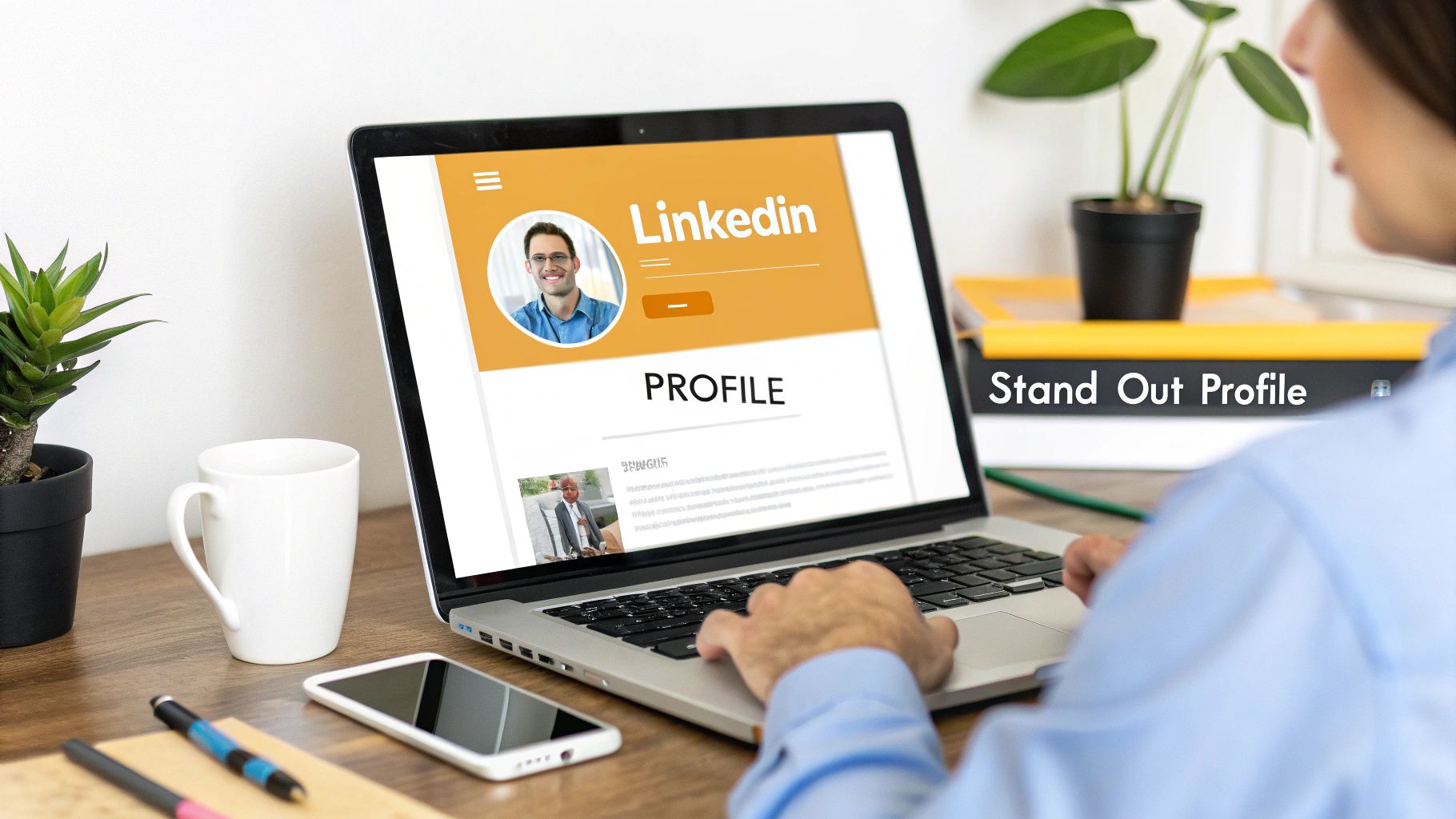
Before you even think about sending a single connection request, let's talk about your LinkedIn profile. It's your digital handshake, your personal brand headquarters, and the first thing anyone sees. People absolutely judge a book by its cover online, and a sloppy or generic profile is an instant turn-off.
A great profile doesn't just get your requests accepted; it brings people to you.
Make Your Profile Your Best Sales Pitch
Think of your profile as the foundation for everything you do on LinkedIn. If it's weak, your entire networking strategy will crumble. A killer profile, on the other hand, makes people genuinely curious and eager to connect. It’s the difference between being ignored and getting an enthusiastic “yes!”
Nail Your Headline
Your headline is the most valuable piece of real estate on your profile. Please, stop using the default "Job Title at Company." It tells people nothing. Instead, use that space to instantly communicate your value. Who do you help, and how do you do it?
Here are a couple of examples that work way better:
- "Helping SaaS Startups Scale with Data-Driven Content Marketing"
- "Agile Project Manager | Certified ScrumMaster | Delivering Tech Projects On Time & Under Budget"
See the difference? It transforms you from a simple title into a problem-solver, which is far more compelling. For more ideas on how to spruce up your entire profile, check out our guide on how to optimize your LinkedIn profile: https://redactai.io/blog/how-to-optimize-your-linkedin-profile.
Tell a Story, Don't Just List Facts
Your 'About' section is where you get to show some personality. This isn't the place to just dump a list of skills. Instead, weave them into a story. Talk about why you love what you do, what problems you get excited about solving, and what your professional journey has looked like.
Think of it this way: your profile is the handshake before the handshake. A great 'About' section should feel like the beginning of an interesting conversation, making someone want to hear the rest of the story.
This is your shot to build a human connection before you ever send a message. If you're stuck, there are some great resources out there on optimizing your LinkedIn 'About' section.
Show Results, Not Just Responsibilities
Go through your 'Experience' section right now. Does it read like a job description? If so, it’s time for an upgrade. Ditch the passive phrases like "Responsible for..." and replace them with punchy, quantifiable achievements.
Here’s a quick before-and-after:
- Before: Managed social media campaigns.
- After: Grew organic social media engagement by 45% in six months by launching a data-backed content strategy.
Numbers are powerful. They provide concrete proof that you don't just do the work—you get real, tangible results. That makes you someone people want in their network.
Profile Optimization Checklist Before You Connect
Before you start your outreach, run through this quick checklist. Think of it as your pre-flight inspection to make sure your profile is ready for takeoff.
| Profile Element | Key Action | Why It Matters |
|---|---|---|
| Profile Photo | Use a professional, high-quality headshot. | People connect with faces, not logos. A good photo builds trust instantly. |
| Headline | Craft a value-driven headline, not just a job title. | This is your one-line pitch. It should grab attention and explain your value. |
| About Section | Write a compelling story that shows your passion and expertise. | This is where you build rapport and turn a visitor into a potential connection. |
| Experience | Focus on achievements with numbers and specific outcomes. | It provides tangible proof of your skills and makes you stand out from the crowd. |
| Banner Image | Create a custom banner that reflects your brand or value. | It’s a huge visual space that most people waste. Use it to reinforce your message. |
Getting these five elements right will dramatically increase the chances of your connection requests being accepted. It sets the stage perfectly for every other strategy we’re about to cover.
Finding the Right People to Connect With
Alright, so your profile is looking sharp. That's your launchpad. But now comes the real work: deciding who to actually invite into your network.
Let's be honest, blasting out connection requests to random people is like shouting into the wind. It's just noise, it's not effective, and it’s a huge waste of your time. The goal isn't just to rack up a high connection count; it’s to build a network with the right people.
Think of it like building a personal board of directors. You want a mix of mentors, peers you can learn from, leaders in your industry, and maybe even potential clients or collaborators. Quality absolutely crushes quantity here. A tight-knit, engaged network of 500 relevant professionals is way more powerful than 5,000 random contacts you'll never talk to.
Using Search Filters Like a Pro
That little search bar at the top of LinkedIn is your best friend. But don't just type in a job title and call it a day. The real magic happens when you click on "All filters." This is where you can get super specific.
You can start to zero in on people based on things like:
- Current Company: Want to work at a specific place? Start by connecting with people there.
- Past Company: Find alumni from your old jobs who have moved on to cool new things.
- Industry: Cut through the noise by focusing only on "Marketing & Advertising" or "Information Technology," for example.
- Keywords: This is a big one. Search for terms you’d find in someone's profile, like "SaaS sales" or "product marketing manager."
Getting this precise means you can build a hand-picked list of people who actually align with your goals. This kind of strategic approach is something we dive deep into in our guide on how to network effectively.
Your network is your net worth, but only if it’s built with intention. Every connection should be a potential conversation, not just another number.
Mining Your Existing Network for Gold
Here’s a trick people don't use nearly enough: go look at who your current connections are connected to. If their privacy settings allow it, you can literally browse their network. It's a goldmine for finding "warm" introductions.
For instance, you might discover that a colleague you trust is connected to a hiring manager at that company you've been eyeing. Instead of a cold, out-of-the-blue message, you can now ask your colleague for a quick intro. That little bit of social proof instantly makes you more credible and seriously boosts your odds of getting a reply.
The sheer scale of the platform is staggering. LinkedIn's professional community has swelled to over 1.15 billion members across more than 200 countries. And get this: 77% of these users have at least a bachelor's degree. You're not just connecting with people; you're tapping into a massive pool of educated professionals and decision-makers. You can discover more insights about the power of LinkedIn's user base.
When you focus your energy this way, every single connection request you send has a purpose. It's professional, it's targeted, and it's far more likely to be accepted. This is how you stop just having a network and start building one that actually works for you.
Crafting Connection Requests That Actually Get Accepted
Sending the default “I'd like to add you to my professional network on LinkedIn” is a massive missed opportunity. Let's be honest, it's lazy. It’s the digital equivalent of a limp handshake—forgettable and totally impersonal. If you want to build a network that matters, you have to do better than the default.
The good news? A great connection request doesn't need to be a novel. A single, genuine sentence explaining why you want to connect is often all it takes to see your acceptance rate shoot up.
I like to think about it as a simple three-part flow: Target, Search, and Curate. It’s all about being intentional, not just playing a numbers game.
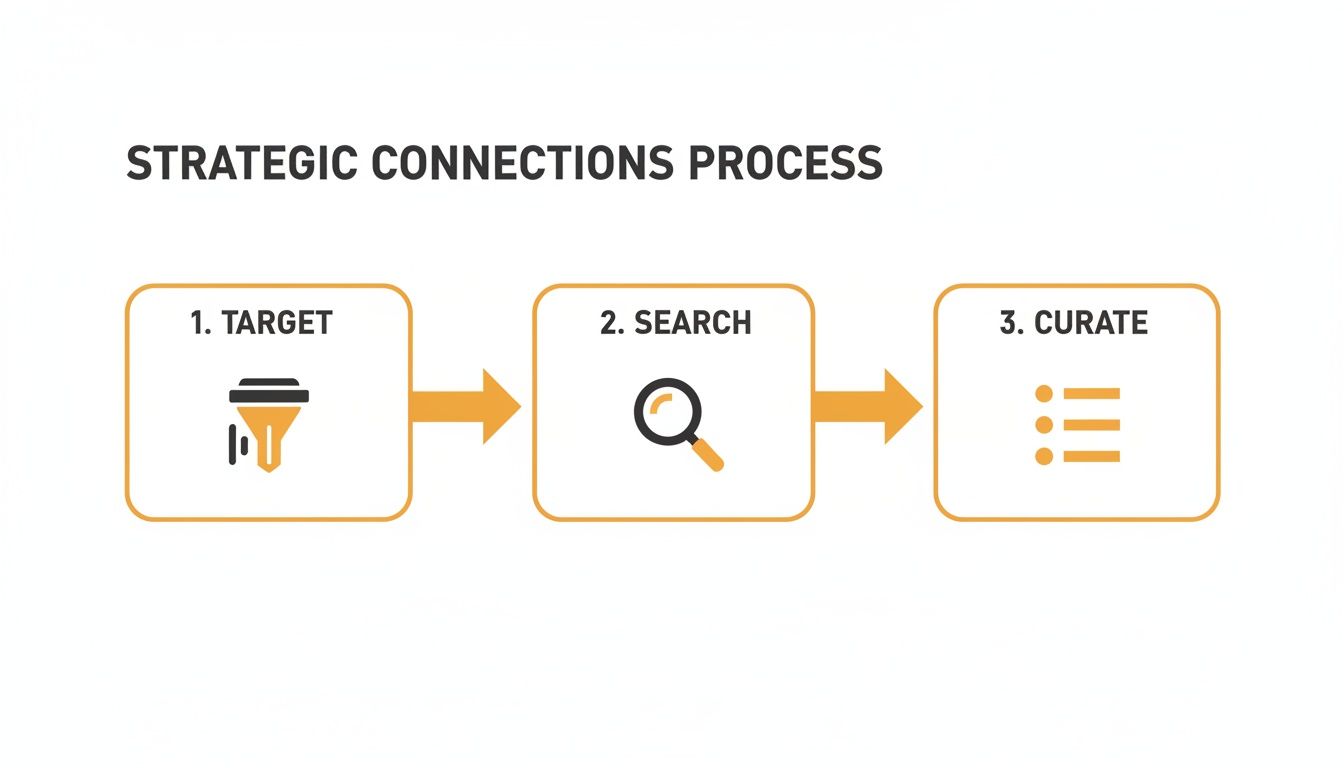
This keeps your outreach focused and effective.
Personalize Every Single Time
Personalization is everything. Before you hit that "Connect" button, give yourself 30 seconds. That's all it takes to scan their profile and find one small, genuine point of common ground.
You're not looking to flatter them; you're just looking for an authentic conversation starter.
- Did they just post something interesting?
- Do you have a mutual connection you both respect?
- Were they recently on a podcast or featured in an article?
- Did you go to the same university or work at the same company years ago?
Even the smallest reference shows you see them as a person, not just another notch on your connections belt.
A personalized request shifts the dynamic from "What can I get from you?" to "I see what you're doing, and I value it." That small change in perception is huge.
Connection Request Templates For Different Scenarios
Forget the one-size-fits-all approach. Your message needs to match the context. Here’s a quick comparison to show you what works and what doesn't.
| Scenario | Ineffective Message (Generic) | Effective Message (Personalized) |
|---|---|---|
| You Admire Their Work | "Hi Jane, I'd like to connect." | "Hi Jane, I really enjoyed your article on project management frameworks. The point about agile ceremonies resonated with me. Would love to connect and follow your work." |
| You Met at an Event | "It was great meeting you." | "Hi Tom, it was great hearing you speak at the SaaS Growth Summit yesterday. Your insights on customer retention were spot on. Would be great to connect here." |
| Shared Mutual Connection | "I see we both know Mark." | "Hi Sarah, I see we're both connected with Mark Smith. He's spoken highly of your work in UX design, and I'm hoping to connect with more experts in the field." |
See the difference? Each effective example is brief, specific, and gives a clear reason for the request. This approach respects their time and dramatically increases your chances of starting a real conversation.
And if you need to take the conversation off-platform for a more direct approach, you can even explore how to find emails on LinkedIn to personalize your outreach even further.
Let Connections Come to You Through Content
Outbound connection requests are great, but the real magic happens when people start coming to you. You want to flip the script from chasing connections to attracting them. The single best way to do this? Share valuable content, consistently.
You don't need to be a LinkedIn celebrity or aim for viral fame. Seriously. Just share what you already know.

Put Your Expertise on Display (Authentically)
Your unique take on industry news, the lessons you've learned from a project, or even personal career stories—that’s all fantastic content. This isn't about bragging; it's about building authority and showing people you're a voice worth listening to. The goal is to build a reputation that makes people want to be in your network.
This approach works incredibly well when you consider who’s on the platform. The biggest slice of LinkedIn users is in the 25-34 age range. This is a group that responds to genuine expertise, not old-school, superficial networking. When you share what you know, you're speaking their language. You can see more on how LinkedIn's audience shapes professional interactions to understand this better.
Content Formats That Actually Work
You don’t need a fancy video setup or a design team to make an impact. Some of the most effective content on LinkedIn is surprisingly simple.
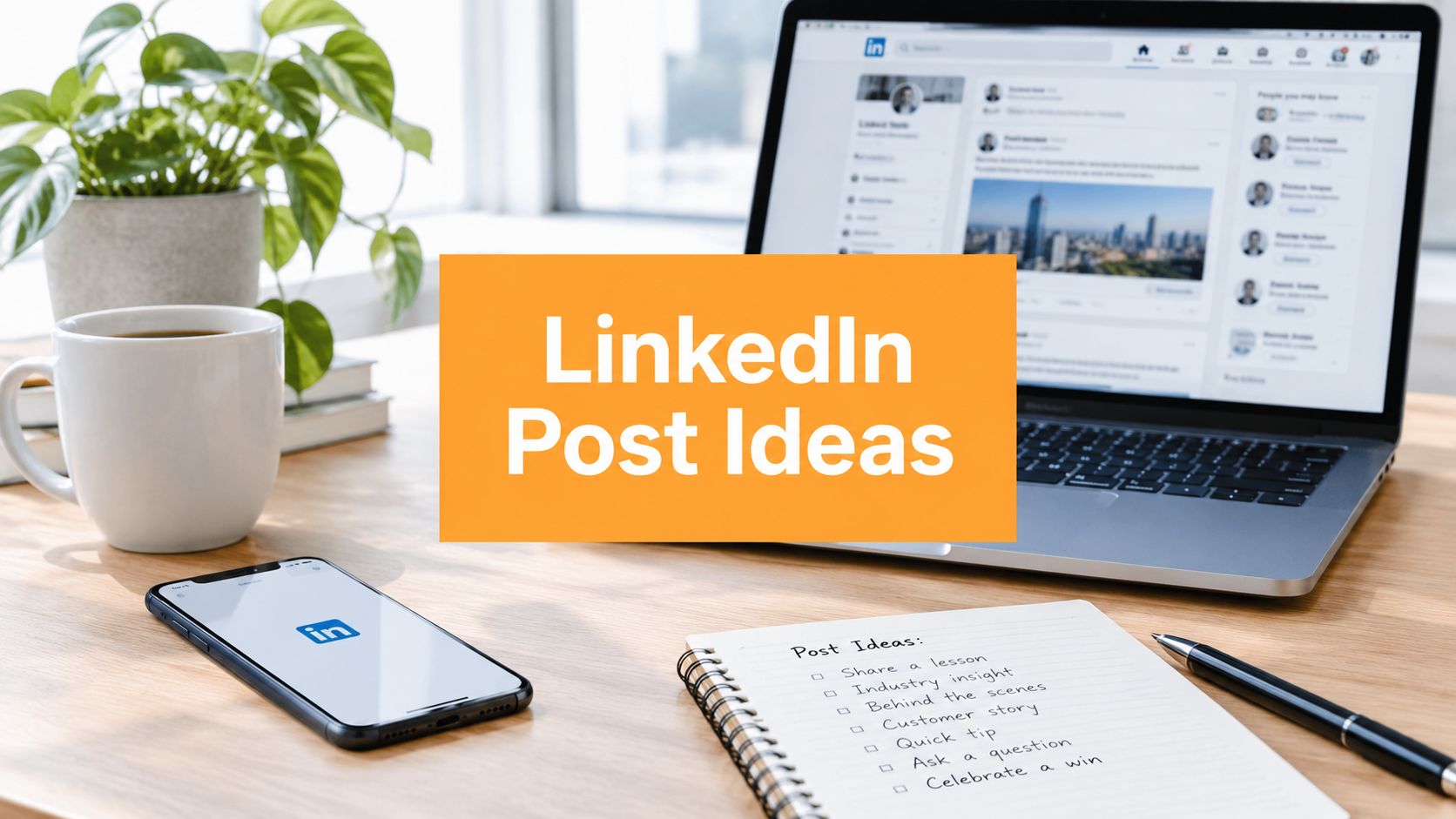
- Text-Only Posts: Just share a quick tip, a lesson you learned the hard way, or ask your network a thought-provoking question. They’re super easy to create and often get the best conversations going.
- Simple Polls: Ask for opinions on a hot topic in your field. Polls are a low-friction way for people to engage and can give you a ton of insight into what your audience is thinking.
- Document Posts (Carousels): Have a simple idea? Turn it into a multi-page PDF and upload it. These are incredibly shareable and instantly position you as an expert who is willing to teach.
Remember, consistency beats intensity every time. One thoughtful post a week is infinitely better than five generic updates in one day. Quality over quantity, always.
Your Content Is a Magnet
Think of every post as a beacon, signaling to the right kind of people. It shows off what you know, reveals a bit of your personality, and gives them a really good reason to want to connect. This inbound strategy builds a network of people who are already bought into what you have to say.
And the best part? It compounds. Every post boosts your visibility, and every new connection you make exposes your content to their network. For a more detailed breakdown, you might want to check out our guide on building a solid LinkedIn content strategy. This is how you stop hunting for connections and start building a community.
Go Where Your Audience Is Already Talking
Relying only on your own feed or sending cold connection requests is a tough way to network. The real breakthroughs happen when you join the conversations your ideal connections are already having. It’s about tapping into existing communities where they're sharing ideas, asking for help, and building relationships.
This whole strategy is about creating context. When you eventually send a request to someone you’ve already chatted with in a group, it feels familiar and welcome, not like a random shot in the dark. That shared context is your golden ticket to getting that request accepted and starting a real conversation.
Find Your Digital Hangouts
LinkedIn Groups are one of the most powerful, yet overlooked, networking tools on the platform. Think of them as 24/7 industry conferences, filled with niche experts and decision-makers. The trick is finding the ones that are actually active and well-run.
Start by searching for keywords tied to your industry, your role, or your specific interests. But hold off on clicking that "Join" button right away. Do a little reconnaissance first to see what's actually happening inside.
- Are the discussions recent and relevant? You want to see people asking real questions and getting thoughtful answers, not just crickets.
- What's the quality of the content? If it’s just a wall of self-promo links, run away. Look for people sharing genuinely useful resources.
- Compare member count to engagement. A group with 50,000 members but zero comments on any post is a ghost town. You’re much better off in a smaller group where people are actually talking to each other.
Honestly, it’s better to be an active participant in two or three great groups than a silent member in ten dead ones. Focus your energy where it counts.
The goal isn't just to be in the group; it's to participate. Being a silent member is like going to a great party and standing in the corner all night. You're not going to meet anyone that way.
Give Value Before You Ask for Anything
Once you're in, your mission is simple: be helpful. This isn't the time for a hard pitch or to just drop links to your latest article. It's about building up social capital by genuinely contributing to the conversation. That's how you get noticed by the right people for all the right reasons.
Here’s a simple game plan:
- Answer questions. Jump in where you have real expertise. Offering a helpful tip or a different way of looking at a problem is the quickest way to establish your credibility.
- Ask insightful questions. A thoughtful question can spark an incredible discussion. It shows you’re engaged in your field and positions you as a curious, forward-thinking pro.
- Share great third-party content. Found an amazing article, a game-changing tool, or a fascinating industry report (that isn't yours)? Post it! But don't just drop the link—add your own key takeaway and ask the group what they think.
When you consistently show up and add value, you become a familiar, trusted name. The next time you see someone from the group you want to connect with, your request writes itself:
"Hi [Name], I've really enjoyed your insights in the [Group Name] community. Would love to connect."
This approach turns networking from a cold numbers game into a genuine relationship-building activity. And those are the connections that actually stick.
Answering Your Top LinkedIn Networking Questions
As you start putting these strategies into action, you're bound to have some questions. It's totally normal. Let's walk through a few of the most common ones I hear, so you can move forward with confidence and build your network the right way.
How Many Connections Should I Aim For?
This is the big one, right? The magic number everyone wonders about. My advice is to set your first goal at 500+ connections.
Why that number specifically? Once you hit 501 connections, LinkedIn stops showing the exact count on your profile and just displays "500+." This little detail is a huge piece of social proof. It signals to anyone who lands on your profile—be it a recruiter, a potential client, or a peer—that you're an established and active professional in your space. It’s like a baseline of credibility.
Think of it as the difference between an empty restaurant and one with a lively buzz. People are naturally more drawn to the one that looks popular and established.
Should I Accept Every Single Connection Request?
Please don't. I can't stress this enough: your network is a reflection of your professional brand. Treat it like a curated guest list for an important event, not just a numbers game.
When a request comes in, give their profile a quick 10-second scan. I always ask myself a few simple questions:
- Are they in my industry or a field I'm interested in?
- Do we share some high-quality mutual connections?
- Does their profile look real and professional? (No egg profile pics, please!)
If you can't find a good reason to connect, it's perfectly okay—and smart—to hit "Ignore." A focused, high-quality network of 500 relevant contacts is infinitely more valuable than a noisy, random network of 5,000.
Is It Really Okay to Connect with People I Don't Know?
Absolutely! That's how you grow. But there's a golden rule here: you must personalize your invitation.
Sending a generic, default "I'd like to connect" message to a stranger is the fastest way to get your request ignored or deleted. You have to give them a reason to click "Accept."
Your note should immediately answer the "Why me?" question from their perspective. Did you love an article they shared? Are you both in the same LinkedIn Group? Do you admire their work on a specific project? A little context goes a long way.
This simple act of personalization shows you've put in a tiny bit of effort and aren't just spamming for numbers. It turns a cold outreach into a warm introduction and makes it so much more likely that they'll not only accept but also be open to a real conversation down the road.
We've covered some of the most pressing questions, but you might have more. Here are a few quick answers to other common queries that pop up.
| Question | Answer |
|---|---|
| How often should I send connection requests? | Start with 5-10 personalized requests per day. Consistency is more important than volume. This avoids triggering LinkedIn's spam filters and helps you build genuine relationships. |
| What if someone doesn't accept my request? | Don't take it personally. They might be busy, inactive on the platform, or simply curating their own network. Just move on and focus on connecting with others. |
| Should I withdraw old pending requests? | Yes, it's good practice. Periodically check your pending invitations and withdraw any that are more than a few weeks old. This keeps your account in good standing with LinkedIn. |
Hopefully, these quick tips clear things up and help you network more effectively.
Ready to stop guessing what to post and start attracting connections effortlessly? RedactAI crafts high-impact LinkedIn posts for you in minutes, using AI to match your unique tone and expertise. Join over 21,000 creators and build your personal brand with content that gets noticed. Start for free on RedactAI.