Most freelancers have the same LinkedIn problem. The profile looks fine, the experience is real, the headshot is decent, and still nothing happens. No useful inbound messages. No steady stream of warm prospects. Just the occasional recruiter, a few likes from peers, and long stretches of silence.
That usually happens because the account is set up like a résumé, not a client funnel.
The version of LinkedIn that works for freelancers is simpler than people make it sound. You need a profile that makes a buyer stay, content that gives people a reason to notice you, a lead process that turns browsing into conversations, and outreach that doesn't read like spam. Done right, LinkedIn stops being a place where you "have a presence" and starts becoming a place where you generate deals.
Craft a Client-Attracting LinkedIn Profile
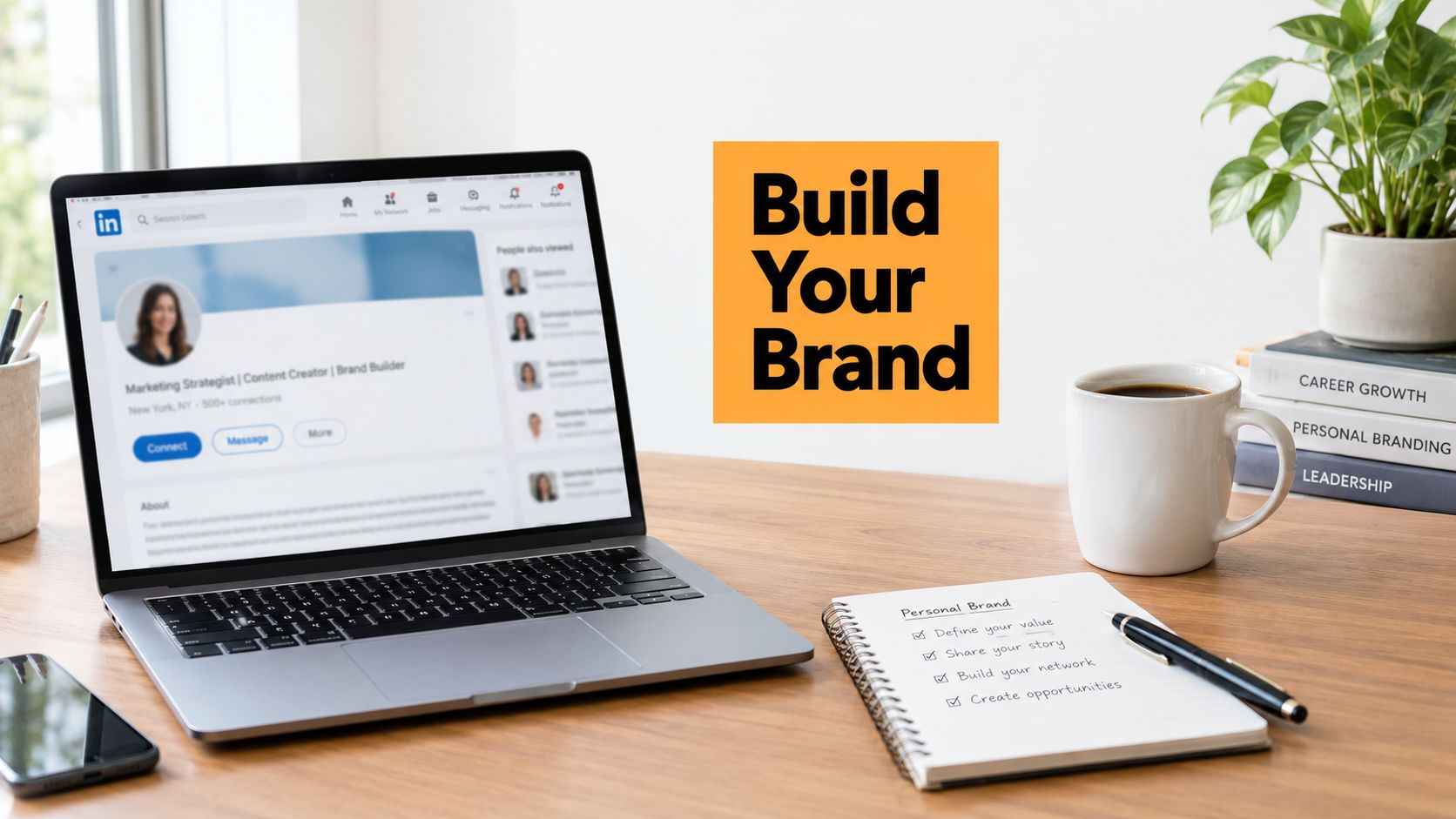
A freelance LinkedIn profile should answer one question fast: why should a client hire you instead of the next person they see?
If your headline says something like "Freelance Copywriter | Self-Employed," you're wasting the most important line on the page. Clients don't care that you're freelance. They care what you help them achieve.
A practical positioning approach is to use a client-outcome headline, then back it up with proof in your Featured and Experience sections. One independent playbook recommends a simple problem, solution, proof structure, and uses the example of a freelance UX designer who cited an average 35% conversion-rate lift across 20+ brands to strengthen credibility in their positioning in this freelancer LinkedIn positioning guide.

Fix the top third of your profile first
Most freelancers start with the About section. I don't. I start with the parts people scan before they ever click "see more."
Use this order:
Banner
Put your niche and core offer in plain language. Not a motivational quote. Not abstract branding.Profile photo
Clear, current, and professional. Not stiff. Not cropped from a wedding photo.Headline
Write it for buyers, not colleagues.
A strong headline usually includes three things:
- Who you help
- What outcome you help create
- What kind of work you do
Examples:
- SaaS copywriter helping B2B teams turn product complexity into pipeline
- Freelance email strategist for ecommerce brands that want stronger retention
- UX designer helping product teams reduce friction across key conversion paths
If you want inspiration before rewriting yours, review a few LinkedIn profile examples for client-facing positioning.
Practical rule: If a stranger reads your headline and still can't tell what you do for clients, rewrite it.
Turn the About section into a sales page
The About section shouldn't read like a career summary. It should read like the opening of a proposal.
A simple structure works well:
| Part | What to say |
|---|---|
| Problem | What your clients are usually struggling with |
| Solution | How you help fix it |
| Proof | What evidence supports your claim |
| Call to action | What they should do next |
That means less "I'm passionate about storytelling" and more "I help B2B teams turn technical expertise into content buyers can understand."
Then make the CTA easy. Tell people whether to message you, email you, or book a call through your site.
Use Featured like a proof shelf
Featured is where weak profiles become convincing profiles. Most freelancers either ignore it or dump random links there. Don't.
Add assets that reduce buyer doubt:
- Case studies that show the business problem and the result
- Testimonials that speak to working style and outcomes
- Work samples that match the kind of client you want more of
- Short PDFs or screenshots that make your process visible
Your Experience section should follow the same logic. Don't list duties. Show what changed because you were involved.
One more thing matters here. Your network quality affects who sees you and who takes you seriously. If you're trying to grow that network deliberately, these LinkedIn connection tactics for sales are useful because they focus on relevance and context instead of random volume.
Develop Your Content and Posting Plan
A strong profile helps once a prospect arrives. Content is what puts you in front of them before they start searching for help.
I used to post whenever I had a spare hour. That produced a few spikes in reach and long quiet gaps in between. Clients do not read that as expertise. They read it as inconsistency. The fix was building a simple system I could repeat every week.

The goal is not to post more. The goal is to create a path from visibility to profile visit to conversation. That means each post needs a job. Some posts build trust. Some posts show how you solve problems. A smaller share can point people toward your offer.
Pick a few content pillars and stay inside them
Freelancers get into trouble when they treat LinkedIn like a general diary. Post about the problems you want to get paid to solve.
I recommend three to four pillars tied directly to your service:
Process
Show how you approach the work, make decisions, and avoid common failures.Problems
Call out the mistakes, bottlenecks, and bad assumptions your clients run into.Breakdowns
Review a landing page, email sequence, workflow, proposal, or campaign and explain what you would change.Perspective
Share field-tested opinions that help buyers make better decisions.
The shape of your funnel is revealed. If your profile says you help SaaS teams improve onboarding copy, your posts should keep reinforcing onboarding, activation, conversion friction, and messaging clarity. Random posts about productivity or broad marketing trends may get polite engagement, but they do little to attract the right buyer.
Build a posting rhythm you can keep
Consistency beats intensity on LinkedIn. Two or three useful posts a week is enough for many freelancers if the topics are relevant and the quality is steady.
A simple schedule works well:
| Day | Post type |
|---|---|
| Tuesday | A lesson from recent client work |
| Thursday | A teardown, opinion, or practical framework |
| Saturday | A lighter story, observation, or soft promotional post |
That rhythm keeps you visible without turning content into a second business.
If you want to batch ideas instead of scrambling each week, this LinkedIn content calendar template for creators and freelancers is a useful starting point. Some freelancers also use drafting and scheduling tools to speed up production. The Direct AI blog on social media AI is useful if you are comparing options for ideation, repurposing, and scheduling. RedactAI is one option in that category. It helps generate LinkedIn post drafts, organize ideas, and schedule posts based on your existing profile and writing style.
Use a simple content mix
A healthy posting plan usually leans toward useful, problem-focused content with occasional promotion. If every post sells, people stop paying attention. If every post teaches but never points to your service, you get attention without inquiries.
A practical mix looks like this:
- Posts that teach something your buyer can use
- Posts that show how you think through real work
- Posts that prove results or share client lessons
- Occasional posts that invite a call, a message, or a look at your offer
Useful content earns profile visits. Promotional content converts the right visits.
What to post when you do not have a big idea
You do not need grand thought leadership. You need sharp observations from real work.
Start with prompts like these:
- A client question that keeps coming up
- A mistake you see in your niche every week
- A before-and-after explanation of a deliverable
- A trade-off clients misunderstand
- A small process change that improved results
Good LinkedIn content helps a buyer recognize their problem and trust your approach. That is why this section matters in the larger system. Your profile sets the promise. Your content repeats and proves it. Then your outreach has context, because the prospect has already seen how you think.
Generate and Qualify High-Value Leads
Inbound interest is great. Relying on it alone is risky.
The freelancers who use LinkedIn well usually do something very unglamorous in the background. They look for specific companies, specific people, and specific moments when outreach makes sense.
This is what that looks like in practice.
I start broad. Let's say the target is B2B SaaS companies with a product marketing problem. I search by industry, company size, and a few likely functions. Then I ignore a lot of the first page, because the first page is often full of people with the right titles but no real buying power.

Find the real decision-maker
The obvious contact isn't always the right one.
A founder might care about positioning but hand execution to a content lead. A marketing manager may own the project but need approval from a director. So instead of asking "Who matches my service?" ask "Who can move this forward without a long internal relay?"
A quick qualification check helps:
Recent activity
Are they posting about the exact problem you solve?Role fit
Can they approve a contractor, or are they purely operational?Company context
Does the business look active, growing, or focused on the area you support?Timing
Did they just announce a launch, hiring push, rebrand, or product shift?
Those details matter more than sending a high volume of connection requests.
Warm up before you reach out
The coldest message on LinkedIn is the one that arrives with no context. The sender hasn't engaged, hasn't read the profile, and immediately asks for a meeting.
A better move is to get on their radar first. Comment on a post. Respond to an idea they shared. Save the profile and watch for a buying signal.
Buyers rarely respond well to messages that feel automated. They respond to relevance.
This short video gives a solid visual walkthrough of lead generation mechanics on LinkedIn:
Separate leads from prospects
Not every lead is worth your time.
A lead matches your market. A qualified prospect has a visible need, some likely budget authority, and a believable reason to talk now. That distinction saves a lot of energy.
I usually pass on profiles that fit my niche on paper but show no signs of active projects, no recent activity, and no reason to believe timing is right. That's not missed opportunity. That's filtering.
The point of LinkedIn for freelancers isn't to build the biggest list. It's to build the shortest path to the right conversation.
Master Your Outreach and Proposals
The fastest way to kill a LinkedIn opportunity is to pitch too early.
Most freelancers know this in theory, then ruin it in practice. They send a connection request, get accepted, and immediately drop a paragraph about services, availability, and rates. That message is written for the sender's urgency, not the buyer's attention.
The better approach is slower for a few days and faster over the full sales cycle.
Stop sending pitch-slaps
Bad connection request:
Hi, I'm a freelance copywriter who helps brands grow with high-converting content. I'd love to connect and explore how I can support your business.
Nothing in that message proves you chose them on purpose.
Better connection request:
Hi Sam, I liked your post about simplifying onboarding copy for enterprise users. I work in adjacent territory and appreciated how clearly you framed the tradeoff between clarity and compliance. Thought it made sense to connect.
That works because it sounds like a person, not a sequence.
If you want more examples before rewriting your outreach, this guide on LinkedIn connection messages that feel natural is a helpful reference.
Keep the first DM about them
Once they accept, don't rush into the offer. Continue the thread you already opened.
A simple follow-up might look like this:
Acknowledge the connection
"Thanks for connecting."Reference something specific
Mention the post, launch, hiring update, or comment that caught your attention.Add one useful thought
Not a teardown. Not a mini-consulting session. Just one smart observation.
That gives the conversation room to breathe.
Here's the logic. LinkedIn DMs are not proposals. They're door-openers. Your first goal is not "close the deal." Your first goal is "earn the next reply."
Use a mini-proposal instead of a giant pitch
Once there's back-and-forth and a real need surfaces, then you can suggest a next step. I prefer a compact message over a long formal proposal inside LinkedIn.
A useful mini-proposal has four parts:
| Part | Example |
|---|---|
| Context | From what you shared, it sounds like the main issue is low response from outbound sequences |
| Observation | My guess is the messaging is trying to cover too much at once |
| Possible approach | I'd start by tightening the offer language, then rebuilding the first-touch sequence around one buying trigger |
| Next step | If useful, I'm happy to sketch this out on a short call and show how I'd approach it |
That format feels consultative, not needy.
If the conversation should move off LinkedIn, do it cleanly. Ask whether they'd prefer email. If you need help with that step, this guide on how to find someone's email from LinkedIn is a practical resource for moving a promising conversation into a more workable channel.
Measure Your Results and Refine Your Strategy
A freelancer can spend a month posting, commenting, and sending messages on LinkedIn, then conclude it "isn't working" because the posts did fine but no client conversations followed. I've made that mistake myself. I used to track attention. Now I track movement through the funnel.
That shift matters because LinkedIn only becomes a reliable client channel when each step connects to the next. Profile views should lead to profile clicks. Profile clicks should lead to messages. Messages should lead to calls or qualified project discussions. If one step is weak, the whole system slows down.
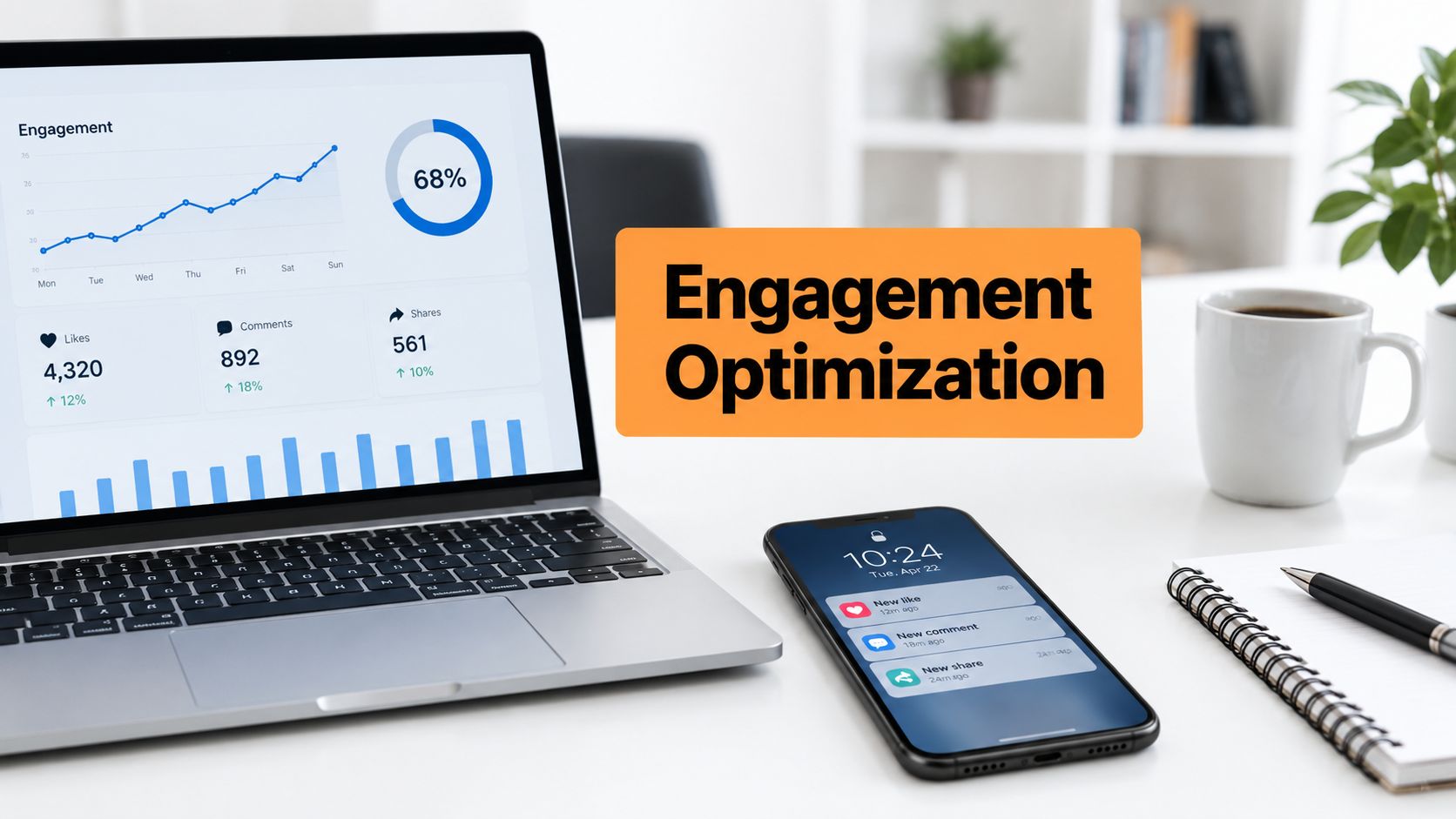
Track the numbers tied to buyer intent
A simple spreadsheet reviewed once a week is enough.
Watch these four numbers first:
Profile views
More views usually mean your content, comments, or outreach are creating curiosity. If views rise and inquiries do not, the profile is not converting attention into trust.Search appearances
This shows whether LinkedIn understands what you do. If this stays flat, your headline, About section, and service language probably need sharper keywords.Inbound messages
These matter more than likes because they show a person was interested enough to start a conversation.Sales conversations started
This is the metric I care about most. If that number is growing, LinkedIn is doing its job.
Some posts will attract peers. Some will attract buyers. Those are not the same audience, and the difference shows up in your inbox, not your engagement rate.
Use SSI as a secondary check
LinkedIn's Social Selling Index can help you spot whether your fundamentals are improving across profile strength, network building, and engagement. Treat it as a directional signal, not a scoreboard.
If SSI rises while search appearances, profile views, and conversations also improve, you're probably on the right track. If SSI rises but the quality of leads stays poor, don't celebrate yet. A tidy LinkedIn presence is useful. A client pipeline is better.
Measurement lens: Track what creates qualified conversations.
Change one variable at a time
Freelancers lose the plot. They rewrite the headline, switch content topics, change the call to action, update the banner, and alter their outreach message in the same week. Then they have no clean read on what worked.
I used to do this. Now I make one change, give it enough time, and look for a clear response.
| If you notice | Adjust this |
|---|---|
| High views, low inquiries | Strengthen your proof, call to action, or Featured section |
| Low search appearances | Rewrite headline and service keywords |
| Good engagement, poor-fit audience | Narrow your topics, examples, and positioning |
| Connections accepted, no replies | Improve your opening message and send timing |
Small tests beat big overhauls.
If profile views jump after you sharpen your headline, keep the headline. If search appearances improve after you clarify your niche, keep that language across the profile. If your posts get praise from other freelancers but no buyer interest, stop writing for other freelancers and start writing for the client you want.
Review the numbers weekly. Refine monthly. Stay patient long enough to see a pattern. That is how LinkedIn turns from a pile of activity into a repeatable client acquisition system.
Common LinkedIn Mistakes Freelancers Make
A freelancer spends an hour polishing a post, gets a few likes from peers, adds two new connections, and assumes LinkedIn is working. Then the month ends and no qualified leads came from any of it.
That pattern is common. The problem usually is not effort. It is using LinkedIn as a collection of disconnected tasks instead of a client acquisition system. A profile that does not build trust, content that attracts the wrong audience, and outreach that starts too early will break the funnel long before a proposal is on the table.

Mistakes that cost you work
These mistakes look small on their own. Together, they make you harder to hire.
Generic headline
"Freelancer," "Consultant," and "Self-Employed" waste the most valuable line on your profile. Buyers want to know who you help, what you do, and what result you are known for.Weak proof layer
A profile that makes claims without samples, testimonials, or clear examples creates friction. If a client has to guess whether you can do the work, many will leave instead of digging deeper.Half-finished profile
Missing banner text, an empty Featured section, vague service descriptions, or restrictive visibility settings all reduce trust. I used to treat these as cosmetic details. They affect whether someone moves from curiosity to inquiry.Networking only with familiar contacts
That keeps your network comfortable, not useful. Freelancers get better results when they connect on purpose with buyers, partners, and people close to the work they want more of.
Habits that feel productive but stall the funnel
Some LinkedIn habits create activity without creating buying intent.
| Don't do this | Do this instead |
|---|---|
| Post only when work is slow | Post on a consistent schedule so prospects see you before they need help |
| Talk only about yourself | Publish ideas, examples, and lessons that help the client understand their problem |
| Pitch in the first message | Start with relevance, context, and a reason for the conversation |
| Chase broad visibility | Build recognition in the niche that hires and pays well |
One of the biggest traps is treating every LinkedIn action as separate. It is one system. Your profile gets the click. Your content builds familiarity. Your outreach starts the conversation. Your proposal closes the gap between interest and budget. When one part is weak, the rest has to work harder.
I used to focus too much on visibility. Now I focus on fit. A smaller number of profile views from the right buyers is worth far more than broad engagement from other freelancers.
Another common mistake is copying creator tactics that are built for audience growth, sponsorships, or course sales. Freelancers need a different setup. Reach helps, but relevance, proof, and timing usually win the client.
If you fix only three things this week, fix the parts that affect the whole funnel: rewrite your headline so buyers understand your offer, add proof to Featured, and stop sending a pitch the moment someone accepts your connection request.
If you want help keeping the content side of this system consistent, RedactAI is built for that workflow. It helps you turn ideas into LinkedIn posts, match your natural voice, schedule content ahead of time, and keep your posting cadence steady without staring at a blank draft every week.