Your LinkedIn plan looked solid on Sunday. By Thursday, the queue is empty, the hook you liked feels flat, and you're staring at a blank draft wondering whether to post something useful or just stay quiet. That's usually the moment people realize a content calendar for LinkedIn isn't really a spreadsheet problem, it's a production problem.
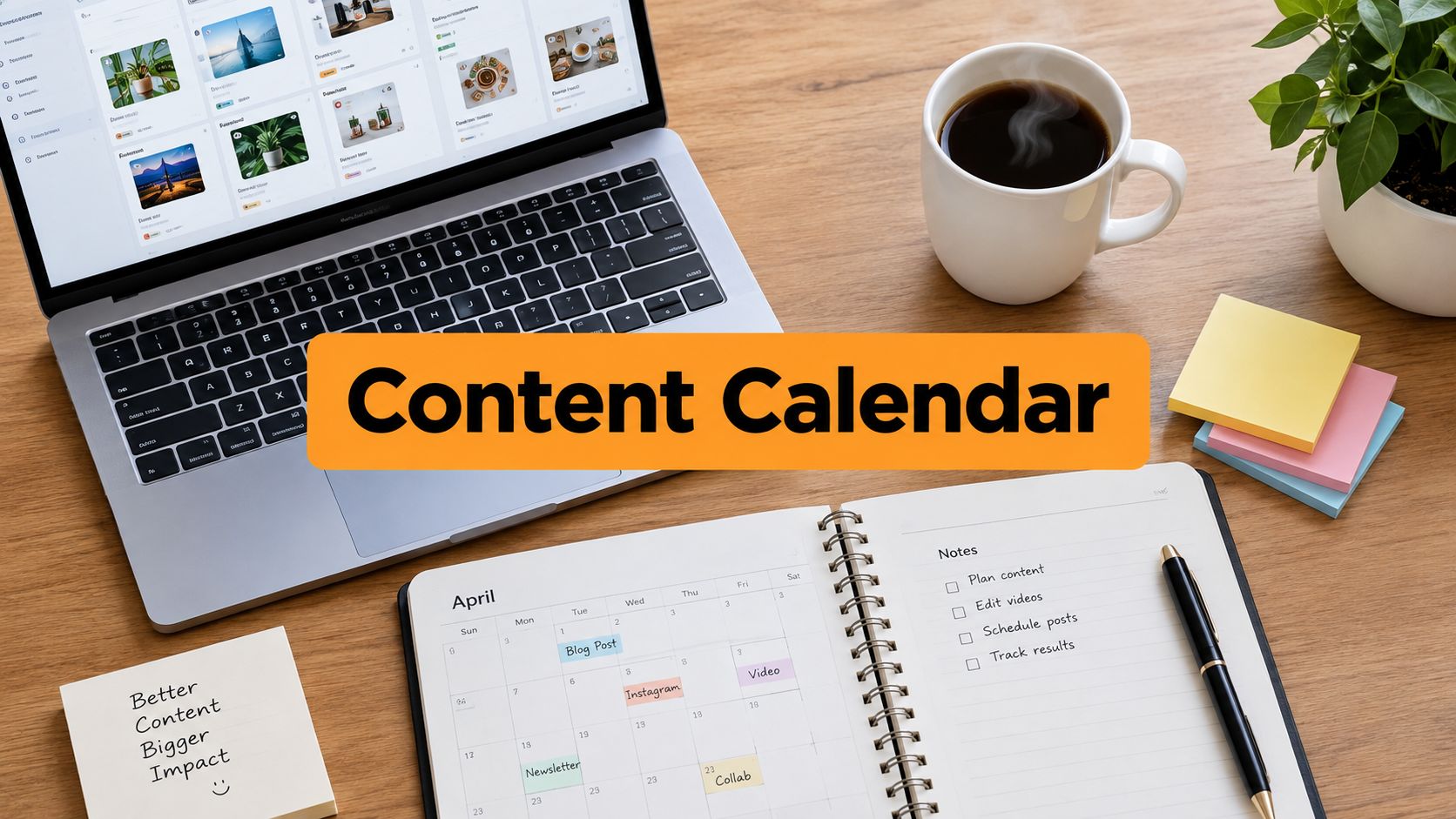
The calendars that survive real workdays don't rely on motivation. They rely on a repeatable system that decides what you'll post, in what format, and how you'll keep ideas moving when meetings, client work, and low-energy days show up. LinkedIn's own guidance frames that approach as an always-on calendar, with planning done in advance so teams stay consistent instead of posting ad hoc, and its sample template organizes posts by date, topic, format, and status (LinkedIn marketing blog).
Why Most LinkedIn Calendars Fall Apart by Week Three
Most calendars do not fail because the creator lacks ideas. They fail because the calendar is built like a list of dates, not like a system that can absorb a normal week.
A good Monday looks easy. A client call runs long, a post idea needs another angle, and suddenly the calendar turns into a guilt document instead of a workflow. LinkedIn planning works better when you treat it as a repeatable operating process, with the calendar tracking impressions, comments, and clicks so the next round is easier to refine than the last.
The hidden issue is decision fatigue
The biggest drain is not writing. It is deciding, again and again, what the post should be, what format it should take, and whether it is worth shipping today. Once those decisions are open every morning, the calendar gets fragile.
Practical rule: if a post still needs three big decisions on the day it is due, it is not scheduled, it is parked.
The calendars that hold up treat each post as part of a queue. The theme is already chosen, the format is already assigned, and the hook only needs to be sharpened. That is a very different experience from opening a blank doc and trying to invent relevance from scratch.
That is also why planning by topic alone is too loose. LinkedIn's own template uses fields like date, topic, format, and status, which sounds basic until you realize those fields are what make a calendar usable during a busy week. The StoryCV guide to LinkedIn summaries is useful for this same reason, because the better your positioning is, the easier it is to decide what deserves a slot on the calendar.
If your calendar keeps breaking, the problem usually is not discipline. It is that the calendar does not separate idea capture, drafting, and publishing into distinct steps.
Set the Goals, Audience, and Pillars That Drive Every Post

Before a calendar earns a slot in your week, it needs a clear job. If you try to make it serve reach, engagement, leads, and hiring all at once, every post gets watered down.
Start with one primary goal
Pick one main outcome first. Reach asks for shareable, high-clarity posts. Engagement asks for conversation starters. Leads asks for trust-building and conversion paths. Hiring signal asks for posts that make your team, standards, and culture visible.
That choice changes what “good” looks like. A post that earns thoughtful comments may still be the wrong post if the goal was profile visits from prospects. A hiring post that gets nice reactions may still miss the mark if it never tells candidates what kind of environment they'd join.
Define the reader in one plain sentence
The audience sentence should sound like something you'd say to a colleague, not a brand workshop. “First-time founders trying to build visibility without sounding generic” works better than a blurry label like “professionals.” The sharper the sentence, the easier it is to choose examples, tone, and format.
Many people get stuck writing summaries that sound polished but don't anchor the content. A practical reference is the StoryCV guide to LinkedIn summaries, because the same rule applies here, one clear audience picture beats three vague personas.
Lock in three or four content pillars
Pillars are the recurring lanes your audience can recognize. Think founder lessons, industry teardowns, behind the scenes, and practical how-to posts. LinkedIn's own planning guidance still centers on core themes and batch creation, but the calendar works best when those themes are narrow enough that a hook can be formed quickly.
A simple way to pressure-test pillars is this:
- Does this pillar help the goal? If not, it's decoration.
- Can I make three to five posts from it without stretching? If not, it's too thin.
- Would my target reader expect this from me? If not, it won't build recognition.
The payoff is alignment. Once the goal, audience, and pillars match, the calendar stops feeling like a random stream of tasks and starts behaving like a content system.
Choose the Right Format Mix for a Month of Posts
A calendar that only changes the topic is still a repetitive calendar. The feed can look active and still do very little if every post relies on the same structure. Format allocation fixes that by assigning each post type a clear job.
A month works better when the mix is planned up front, not filled in after the topic is chosen. Text can carry speed and consistency, carousels and documents can carry depth, video can carry trust, and polls or images can keep the feed from feeling flat.
| Format | Share of Month | What It Tends to Deliver |
|---|---|---|
| Text | Roughly 40% | Speed, clarity, and low-friction publishing |
| Carousel or document | Roughly 30% | Deeper teaching and stronger visual stopping power |
| Video | Roughly 20% | Presence, personality, and trust cues |
| Polls or images | Roughly 10% | Lightweight interaction and variety |
That split is a starting point, not a rule. It leaves room for the formats that are easiest to sustain while still giving you enough variety to teach, show up as a person, and invite interaction without turning the calendar into a content dump.
Use the format before you write the hook
Start with the format, then shape the angle around it. A founder lesson might work as text if the point is sharp and compact. The same lesson can work as a carousel if it needs sequence, examples, or a more visual explanation. A product post may be stronger in video if tone and delivery matter more than dense detail.
A poll makes sense when you want quick interaction and a low-lift post, but it can waste a slot if the question is vague or too broad. That trade-off matters. Polls can surface reactions fast, yet they often reveal less about your expertise than a strong text post or a tightly built carousel.
LinkedIn's own content calendar guidance still leaves room for different post types and spontaneous publishing, but it does not give you a clean allocation formula. That gap is exactly why a format rule helps. If you decide the mix before writing, you avoid falling back on text every time because it is the quickest option.
Leave one slot open for reactive publishing
A calendar filled wall to wall looks tidy until a useful industry moment shows up. One open slot gives you room to respond to a news item, a client insight, or a comment thread while it still has energy.
That slot should stay flexible on purpose. A planned calendar keeps the month moving, and a reserved slot keeps it relevant.
A good batching process also gets easier when the format mix is already decided. Content batching works best when you are choosing from a defined set of post types instead of inventing the structure from scratch each week.
Build the 5-Column Grid and Your Weekly Batching Session

The most workable calendars stay simple on purpose. A 5-column grid keeps the system light enough to use every week and structured enough to stop random posting.
Set up the grid once
Use these columns:
- Date, the day the post is scheduled.
- Pillar, the theme it belongs to.
- Format, such as text, carousel, video, or poll.
- Hook, the opening angle or attention line.
- Status, which shows where it sits in the workflow.
That last column matters more than people think. A calendar without status becomes a graveyard of good intentions. Typical status values are idea, drafted, scheduled, posted, and reviewed. Those labels make progress visible, which keeps work moving when the week gets busy.
Keep a running idea bank next to the calendar, not inside it. Store 15–30 raw ideas in a separate list so you are not forced to invent new concepts during batching. A separate bank gives each weekly planning session something to pull from instead of starting at zero.
Batch once, then edit lightly
A 60–90 minute weekly batching session is enough for many solo creators and small teams to draft the next 3–5 posts in one sitting. The point is not perfect copy. The point is getting the week out of your head and onto the page.
A useful rhythm looks like this:
- Pull ideas from the bank.
- Assign them to pillars and formats.
- Draft the hooks first.
- Write the body copy or slide structure.
- Schedule or save them for review.
The next-day edit is where most weak posts get rescued. Fresh eyes catch hooks that are too broad, too soft, or too clever for their own good.
That follow-up pass matters because the first draft usually carries the energy of the brainstorm, not the clarity of the final post. Once the review habit is in place, the calendar produces cleaner work with less hesitation.
If you want a closer look at how that weekly production cadence works, the guide on what content batching looks like in practice maps well to LinkedIn workflows.
Repurpose Winners and Run One-Variable A/B Tests
A calendar that only pushes new ideas is leaving value on the table. The posts that already proved themselves should come back into rotation with a fresh hook, a new opening, or a different format.
That doesn't mean reposting the same content unchanged. It means treating the calendar like an asset library, not a one-time publishing queue.
Reuse the right posts on purpose
Every 6–8 weeks, pull the top two performers from the last cycle and rework them. A strong text post can become a carousel. A good carousel can become a tighter text post. A useful video can become a written breakdown with a sharper angle.
If you need inspiration for how repurposing can be adapted across short-form assets, the find anime short repurposing tips resource is a useful reminder that the core idea is format translation, not simple duplication. The same logic applies on LinkedIn, even though the formats and audience expectations are different.
A repurposed post should answer a slightly different question than the original. That small shift keeps the feed from feeling recycled while still using proven material.
Test one thing at a time
The cleanest LinkedIn tests are simple. Keep the pillar the same, keep the format the same, then change one variable. Test one hook on Tuesday and a different hook on Friday. Test one carousel cover against another. Test a direct opening against a story-led opening.
That approach matters because messy tests produce messy conclusions. If you change the topic, format, and CTA all at once, you won't know what moved the result. A calendar should record the variable you changed, the result, and the takeaway so the next cycle is better informed.
If you want a workflow that supports that logging habit, the content repurposing strategies guide pairs well with a monthly review sheet.
One-variable tests only. If everything changes, nothing gets learned.
That discipline is what turns the calendar into a learning loop. Instead of guessing what works, you start seeing which hooks, formats, and themes deserve more room.
Pick the Tools That Fill the Calendar Without Adding Friction
A LinkedIn calendar breaks down fast when the tooling adds more decisions than it removes. The best setup keeps publishing, planning, and drafting in separate lanes so the workflow stays clear.

Match the tool to the job
Native LinkedIn scheduling fits a solo creator who already knows what gets published and only needs posts lined up in advance. It keeps everything close to the platform, which means fewer handoffs and less risk of overbuilding a process that does not need it.
Third-party schedulers make more sense when the calendar needs planning views, queues, collaboration, or cross-platform publishing. Buffer and Hootsuite are a better fit when multiple people touch the calendar and the team needs visibility into what is drafted, approved, or ready to go.
AI-assisted creation tools help when the main bottleneck is drafting, not scheduling. RedactAI, for example, generates post drafts in a user's voice, suggests hooks, and feeds an idea bank into the calendar workflow. A content calendar generator for LinkedIn is useful when the structure is already there and the blank page keeps slowing execution.
A simple tool comparison looks like this:
- Native scheduling: good for direct publishing and basic consistency.
- Calendar tools: good for batching, reviewing, and team coordination.
- AI drafting tools: good for accelerating first drafts and preserving voice.
Don't buy complexity you won't use
The common mistake is choosing software because it can do everything, then using only a small part of it. Most LinkedIn workflows do not need a large system. They need fewer handoffs, clearer status tracking, and a way to move from idea to scheduled post without extra friction.
The calendar should drive the tooling choice, not the other way around. If weekly batching is already working, a simple scheduler may be enough. If the weak point is ideation or drafting, add a tool that solves that specific problem instead of filling the process with extra tabs and settings.
The cleanest setups are usually the ones people can explain in one minute.
Track KPIs and Run a 30-60-90 Day Rollout

A calendar only gets sharper if the review loop is honest. The KPI set should match the goal you chose at the start, not whatever number happens to look flattering that week.
Tie the metric to the job
If the goal is reach, watch impressions and follower growth. If the goal is engagement, focus on comments and saves. If the goal is leads, pay attention to profile views and DMs. If the goal is hiring signal, look at application starts and the quality of candidate response.
The review cadence matters too. Daily numbers lie, weekly numbers react, and monthly numbers teach. That rhythm keeps you from changing direction too early or waiting too long to adjust.
Use a simple 30-60-90 rollout
Days 1–30 are for consistency. Ship the planned cadence, log what was published, and avoid changing too many variables. Early on, the goal is to prove the calendar can be maintained without turning every week into a scramble.
Days 31–60 are for trimming. Cut formats or pillars that clearly underperformed, then give more room to the posts that earned attention or responses. This is the point where format allocation starts to matter more than raw volume, because a calendar that overfeeds weak post types will look busy and still underdeliver.
Days 61–90 are for stabilization. Lock in the format mix, the pillar weights, and the batching rhythm that felt sustainable, then carry that operating system into the next quarter. By then, you should know which slots belong to text, which ones deserve carousels, and where video or polls earn their place.
That sequence works because it respects the reality of content work. The first month tells you what you can sustain. The second month shows what deserves more space. The third month turns that pattern into a repeatable system.
If you want a calendar that helps you move from rough ideas to scheduled posts without losing your voice, RedactAI can generate LinkedIn drafts, suggest hooks, and support a repeatable posting workflow. It fits best when the goal is to keep the calendar full without turning every week into a fresh writing sprint.