Most advice on personal brand vs business brand is lazy. It tells you to pick a lane, stay consistent forever, and build either your name or your company like it's a lifelong identity decision.
That's the wrong frame.
This isn't a personality test. It's a conversion problem. The right question is simpler and more useful: which brand gets this specific offer in front of this specific buyer with the least friction and the most trust? If you sell expertise, your face may close faster. If you sell a product that needs procurement, security review, onboarding, and team buy-in, your company brand usually has to carry the load.
A personal brand can punch far above its weight now because LinkedIn has become a serious distribution system for individual expertise. The platform passed 1.3 billion members in 2026 across 200+ countries, and 4 out of 5 members are reported to drive business decisions at their organizations, according to personal branding statistics collected here. That changes the old debate. An individual isn't whispering into a niche network anymore. They can reach buyers directly.
But reach isn't the same as resilience. Plenty of founders build audience under their own name, then realize the company has weak independent credibility, weak portability, and weak buyer trust once the sale moves beyond founder-led conversations.
If you want the blunt version, here it is:
Your brand choice should follow the offer, the audience, and the risk tolerance. Not your ego.
Why the Personal Brand vs Business Brand Question Is Misframed
Most people ask, “Which is better, personal brand or business brand?” That question sounds strategic, but it's too broad to help anyone make money.
The decision sits lower. It lives at the offer level.
A consultant selling a small advisory package doesn't need the same trust architecture as a founder selling enterprise software. A coach, ghostwriter, recruiter, lawyer, and SaaS CEO are not making the same branding decision, even if they all post on LinkedIn. They're choosing different conversion paths.
Think in offers, not identity
A personal brand works best when the buyer is buying judgment, perspective, taste, or direct access to you. That includes consulting, executive coaching, fractional work, keynote speaking, niche advisory, and creator-led education. In those categories, your name is often the product wrapper.
A business brand works better when the buyer needs durability. They want process, team capacity, support, legal structure, repeatability, and something that still exists if one person goes quiet. That includes agencies trying to grow beyond founder delivery, software companies, service firms with multiple operators, and any company that wants enterprise trust.
That's why the usual “pick one” advice falls apart. You don't need one answer for your whole career. You need the right answer for each revenue stream.
The wrong question creates bad brand architecture
People also confuse consistency with permanence. Brand consistency matters. But consistency doesn't mean chaining every offer to one identity structure forever. It means making each brand asset coherent, recognizable, and trustworthy in its own lane. If you need a useful primer on that, this guide on brand consistency is worth reading.
Here's the practical rule. If one offer closes because buyers trust the operator, build around the person. If another closes because buyers trust the system, build around the company.
- Sell expertise: Let the personal brand lead.
- Sell capacity: Let the business brand lead.
- Sell both: Split them on purpose.
Practical rule: Stop asking which brand is better in general. Ask which brand converts better for the exact thing you sell.
That framing removes a lot of confusion fast.
What Each Brand Type Actually Means in 2026
A lot of people use these terms loosely, then wonder why their LinkedIn presence feels muddy. Let's make it plain.
A personal brand is the reputation, voice, and visibility attached to a specific human being. Your face, your name, your opinions, your history, and your communication style carry the credibility. If people buy because they trust you, that's a personal brand.
A business brand is the reputation and identity of an organization. It has its own positioning, standards, message, and trust signals that aren't supposed to depend on one employee or founder. If buyers trust the company as a stable entity, that's a business brand.
If you need a clean baseline definition, this piece on what personal branding means is a useful companion.
Personal Brand vs Business Brand Structural Definitions
| Dimension | Personal Brand | Business Brand |
|---|---|---|
| Core identity | One named person | An organization |
| Main trust source | Personality, expertise, track record | Company reputation, systems, proof, customer experience |
| Ownership | The individual owns it | The company owns it |
| Portability | Can move with the person | Stays with the business |
| Risk concentration | High, because one person carries visibility | Lower, because visibility can spread across roles |
| Equity accrual | Attention compounds around the individual | Brand equity compounds around the company |
| Voice style | First person, direct, opinion-led | Collective, structured, less personality-dependent |
| Exit scenario | Hard to separate business from person | Easier to transfer, scale, or sell |
The part most people ignore
These are not just marketing labels. They determine where the value piles up.
If you post under your own name for years, win attention, and generate demand, the attention usually sticks to you. That's great until you want the company to stand on its own. If you build a business brand from day one, the company gets the equity, but growth often feels slower because people trust humans before logos.
Neither structure is “right” by default. One is just more efficient for certain buying motions.
Side-by-Side Comparison Across Five Real Criteria
The personal brand vs business brand debate gets clearer when you compare the mechanics instead of the aesthetics.
Ownership and portability
A personal brand has the edge in portability. You can change employers, launch a new offer, or pivot categories, and your audience may come with you.
The catch is that portability cuts both ways. If the business depends on your visibility, the company may be left hollow.
A business brand wins on institutional ownership. The audience, assets, and reputation belong to the company. That's cleaner for hiring, handoffs, and long-term equity.
Voice consistency under scale
Personal brands usually publish with more clarity because one person sets the tone. The voice feels sharper, and audiences can recognize it quickly.
Business brands struggle here. The more contributors involved, the easier it is to drift into bland committee writing.
Counterpoint. A business brand can document tone, review posts centrally, and train multiple operators to publish consistently. It's harder, not impossible.
What each brand actually measures well
The metric stack is different, and that matters.
For personal brands, outcome tracking is tighter around individual opportunity. Good measurement focuses on inbound leads, connection-to-client conversion rate, search demand for the person's name, media or speaking invitations, and peer or press mentions, as outlined in this guide to tracking personal branding metrics.
For business brands, the measurement framework is broader. Teams often track revenue, profit margin, market share, customer lifetime value, awareness, associations, preference, and purchase intent, as summarized in this business brand metrics overview.
Five-Criteria Comparison Personal Brand vs Business Brand
| Criterion | Personal Brand Edge | Business Brand Edge | Verdict |
|---|---|---|---|
| Ownership and portability | Audience can travel with the individual | Equity stays with the company | Personal for flexibility, business for permanence |
| Voice consistency | Stronger, clearer, more recognizable voice | Can outlast one communicator | Personal wins early, business wins later |
| Metrics | Tighter link to leads and opportunities | Better for market-level performance tracking | Depends on what you need to measure |
| Scalability | Fast attention when the person is active | Better for team-based growth beyond one person | Business wins once delivery expands |
| Trust signals | Human credibility lands faster | Institutional credibility supports larger buying processes | Split by sale complexity |
Trust favors humans, but not always the whole deal
Trust data explains why personal brands work so well. In the 2026 Edelman Brand Growth in an Insular World report, 88% of people say trusting the brand is an important or critical purchase criterion, alongside quality at 89% and value at 88%. The same report says 80% of people trust the brands they personally use more than traditional institutions such as government, media, or NGOs, according to the Edelman report.
That doesn't mean personal brands beat business brands outright. It means companies increasingly need human trust layers. A founder, operator, or subject-matter expert can make a business feel credible faster than a logo can.
Buyers don't trust logos first. They trust people, then decide whether the company behind them feels solid enough to buy from.
How Personal and Business Brands Actually Look on LinkedIn
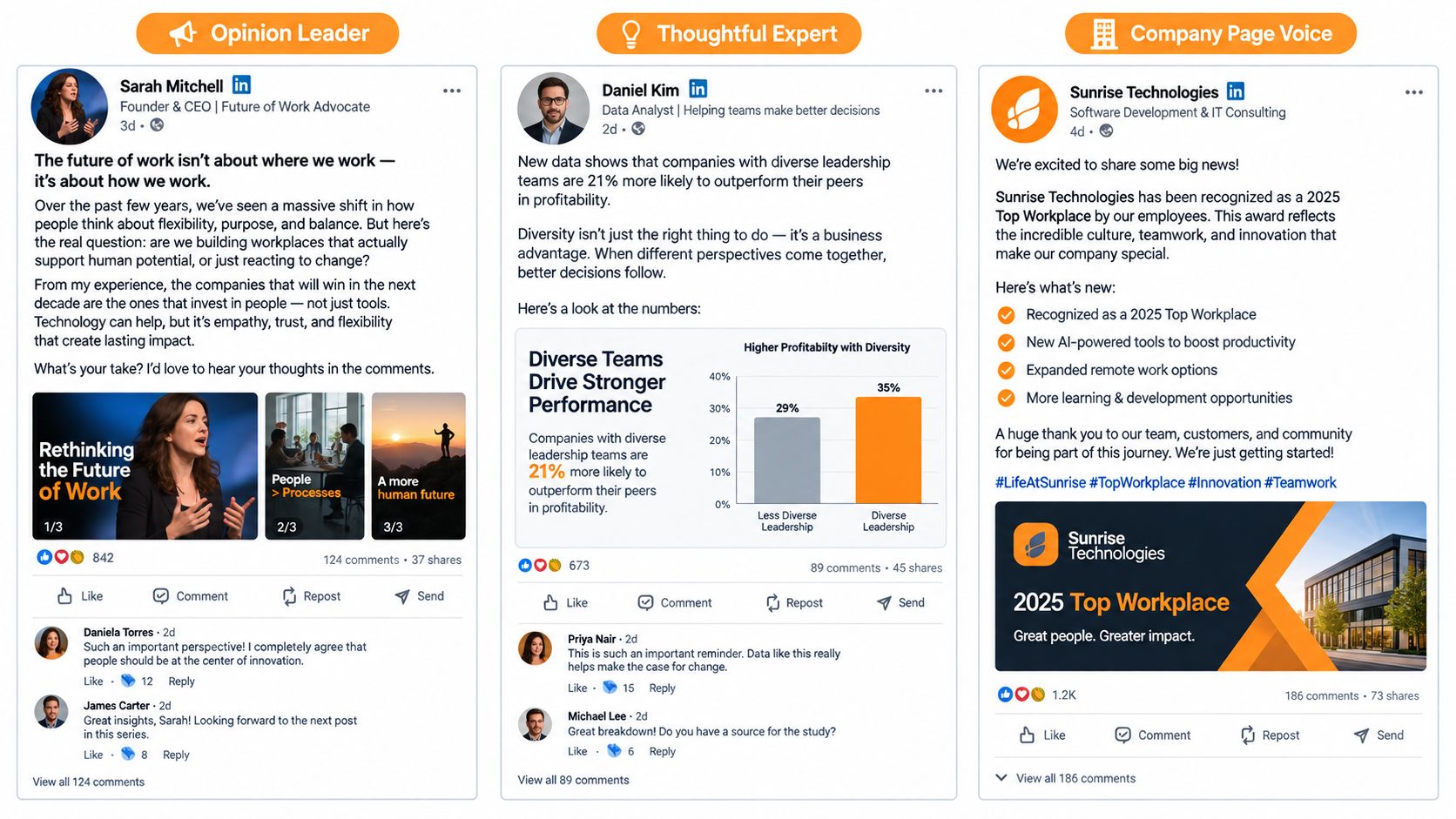
You can usually tell which route someone picked before reading a single full sentence. The brand shows up in the photo, banner, headline, and post rhythm immediately.
The solo consultant
This profile is face-forward from the first glance. Clean headshot. Strong point of view in the headline. Posts written in first person. Plenty of “here's what I'm seeing with clients” energy. Comments are part of the strategy, not an afterthought.
The content usually has:
- Direct hooks: Strong opening line, often opinionated
- Narrative proof: Short story, lesson, mistake, or insight from lived work
- Visible operator cues: Speaking clips, screenshots, carousels with their face on the cover
This style fits LinkedIn well because the platform rewards recognizable human voices. If this person also turns one idea into multiple formats, a practical resource like Nim's short-form AI video workflow can help extend the same message across video without flattening it into generic repurposing.
The mid-size agency
The agency page looks different. The profile picture is a logo. The banner pushes positioning. The posts are more structured, often using category education, team wins, company updates, and customer proof. Leadership may repost from personal accounts, but the company page avoids turning into a founder fan page.
The visible cues are obvious:
- Brand-led graphics: Typesetting, templates, polished visual system
- Collective language: “We helped,” “our team,” “our approach”
- Distributed credibility: Team members tagged, client context highlighted, founder not always centered
If you're building this kind of presence, how to make a LinkedIn business page is the tactical starting point many teams skip.
The B2B founder running both
This is the smartest setup for a lot of early-stage companies. The founder account carries the conversation. The company page carries the institution. The founder posts market opinions, product beliefs, build-in-public updates, and customer context. The company page publishes launches, product education, hiring, event presence, and broader proof.
The key is that the copy should not be identical. Parallel message, different voice.
The strongest LinkedIn operators don't make the founder and company accounts compete. They make them play different jobs.
Posting Cadence, Voice, and Content Mix for Each Path
Don't fail because you chose the wrong brand type. Fail because you run the right type with the wrong publishing behavior.
If you're building a personal brand
Post often enough to stay familiar, but not so often that your thinking gets diluted. A strong weekly rhythm is 4 to 5 posts per week.
Use this mix:
- Narrative or lesson posts: About 60 percent. Tell stories from work, decisions you made, mistakes you fixed, or patterns you're noticing.
- Contrarian takes: About 20 percent. Push against lazy industry assumptions.
- Proof posts: About 20 percent. Share results, testimonials, screenshots, press mentions, or process snapshots without turning every post into chest-thumping.
Write in first person. Keep paragraphs short. Make one point per post. Reply to substantive comments quickly, ideally inside a day, because comments are where trust deepens.
If you're building a business brand
The business page needs steadier structure and less personality dependence. A practical rhythm is 3 to 4 posts per week.
Use this mix instead:
- Customer story or case-study style content: About 50 percent
- Product or category education: About 30 percent
- Behind-the-scenes content: About 20 percent
The voice can use third person or a collective “we.” Hooks should be cleaner and more informative than hot-take heavy. Tag employees and partners when it's natural. Invite user-generated content and employee amplification, because company pages rarely win by acting like lone creators.
If you're doing both
Don't cross-post identical copy.
That's the mistake I see constantly. Founders write one post, paste it on their personal account and company page, then wonder why one version feels dead. Of course it does. Those audiences are not expecting the same thing from both accounts.
Run separate calendars:
- Founder account: insight, opinion, narrative, conversation
- Company account: proof, product, people, positioning
- Employee amplification: selective reposting with added context
If you want help producing that kind of rhythm without losing your own voice, tools like RedactAI can support drafting and scheduling based on your LinkedIn profile, posting history, and tone. That's useful when a founder has to maintain consistency without sounding templated.
The burnout warning
Daily posting looks disciplined for a few weeks. Then quality drops, your opinions get repetitive, and you start publishing because the calendar says so.
Cadence should serve conversion, not vanity. If fewer posts produce better conversations with the right buyers, keep the lower cadence and protect quality.
A Decision Framework for Founders, Consultants, and Teams
Use three filters, not another philosophical debate.
Start with the offer type
If the thing you sell depends on your judgment, taste, or direct involvement, lean personal. That includes consulting, advising, coaching, ghostwriting, speaking, recruiting, and many creator-led products.
If the thing you sell depends on systems, onboarding, product reliability, support, or multi-person delivery, lean business. That includes software, agencies trying to grow past founder delivery, marketplaces, and category products.
Then look at the audience
Some buyers want a person they can trust. Others want an entity they can defend internally.
A senior executive hiring a strategist often buys conviction first. Procurement teams, buying committees, and category buyers usually need company-level trust signals, documentation, and continuity. LinkedIn trend coverage has also pushed the idea that personal brands are increasingly treated as a business model and that niche depth beats general influence, as noted in this LinkedIn trend piece on personal branding in 2025.
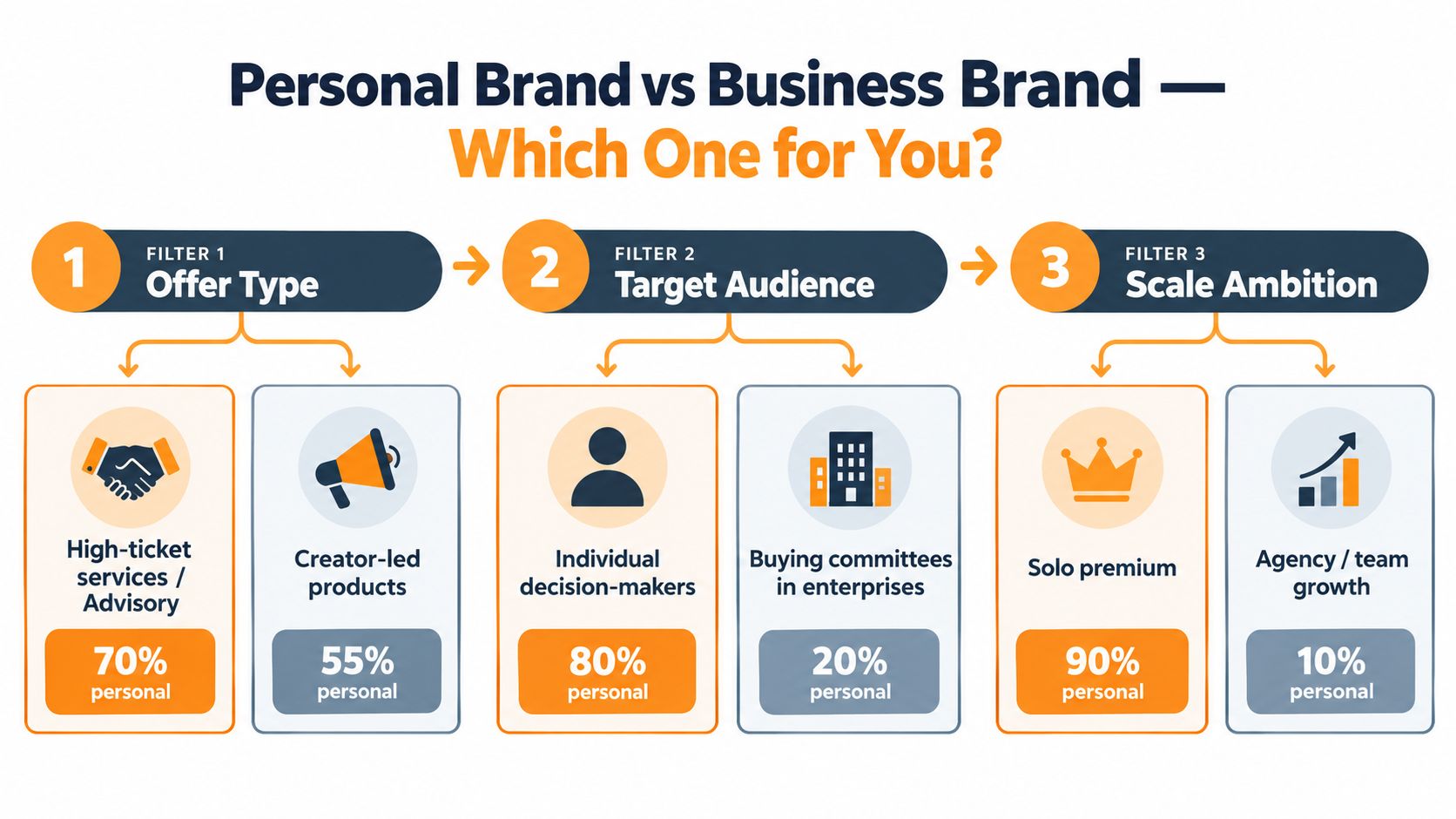
Then check founder dependency
If most of your pipeline only exists because one founder shows up online, the personal brand is no longer just a growth asset. It's an operational dependency.
Simple mapping works well here:
- Solo consultants: default to personal
- Agencies: default to business, with founder support
- Product companies: default to business
- Venture-backed founders: run both, but keep them distinct
If your team is trying to scale content across both founder and company channels, a process-oriented guide like the Veo3 AI scaling framework 2026 is useful because the challenge becomes operational quickly.
Build a Founder Plus Company split. Let the founder account create traction early. Let the company account absorb that attention into an asset the team can keep building.
That split is usually the cleanest answer for companies with serious growth plans.
When a Personal Brand Becomes a Liability
The internet sells personal branding like it's upside with no invoice attached. That's nonsense.
A personal brand is powerful, but it creates concentration risk. You should treat it like any other asset. Useful in the right context, dangerous when overexposed.
Portability is overrated
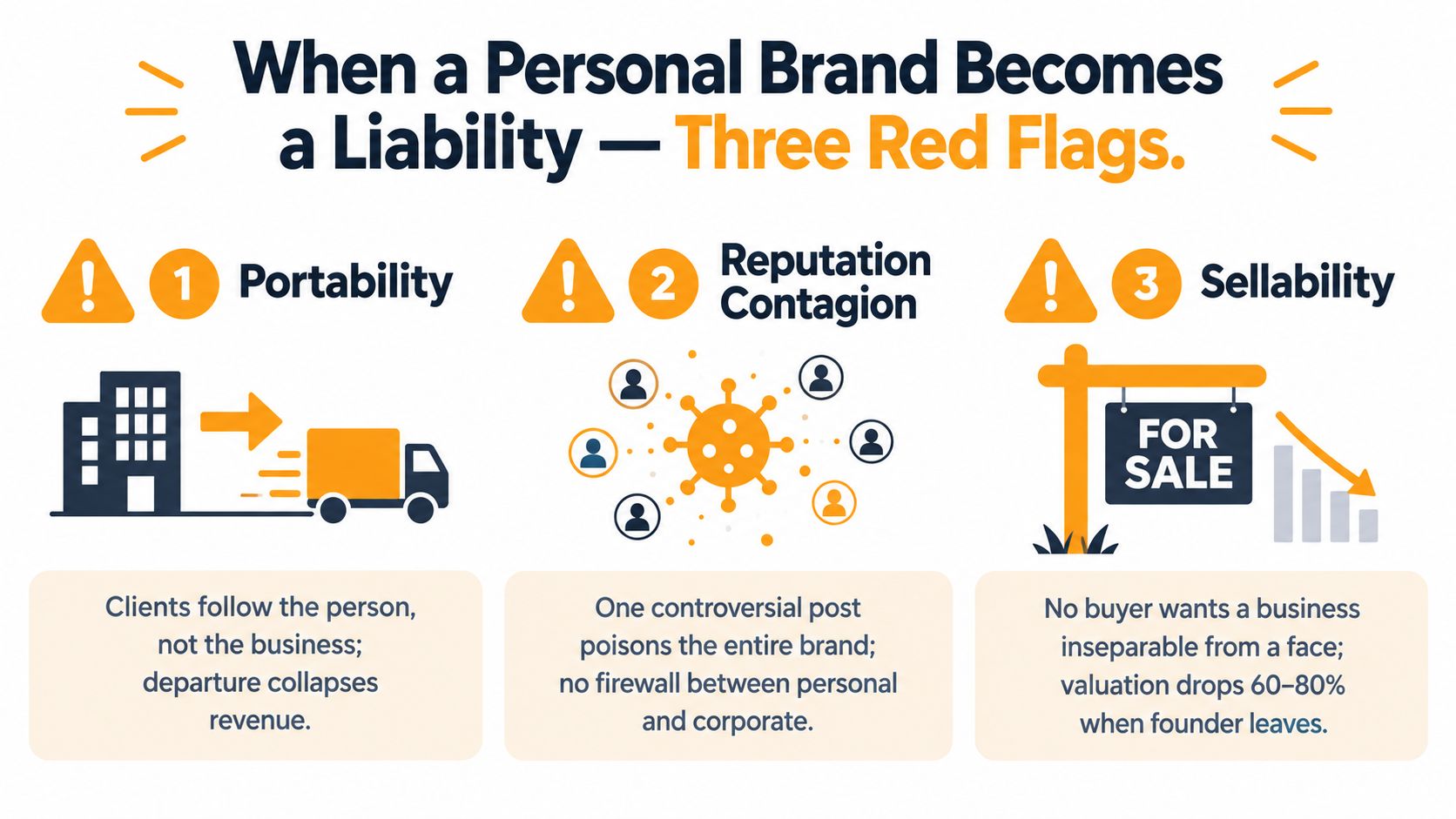
Yes, a personal audience can move with you. That sounds great until you're the company owner and your audience leaves the company with the founder. The same issue shows up when someone relies too heavily on one platform. If reach drops or the account changes direction, the business feels it immediately.
Named reputation also doesn't always transfer cleanly after a repositioning. A person known for one thing can struggle to carry that trust into another category.
Key-person risk is real
If revenue is tightly tied to one face, one voice, or one person's stamina, then the business has a single point of failure.
Investors notice that. Buyers notice it. Senior hires notice it too. They can all tell when the “brand” is really one person holding the whole structure together with content and charisma.
AI voice makes lazy personal branding weaker
Another problem is erosion. As AI tools make tone imitation cheap, the moat of “I have a distinctive voice” gets thinner unless the underlying thinking is strong. Audiences are also getting more sensitive to forced self-promotion and more interested in narrower, more credible expertise. That lines up with recent coverage on sustainability, trust, work-life harmony, and the downside of overreliance on one visible person in this B2B guide on personal brand vs business brand.
Here's when I'd hedge early:
- Regulated industries: You need institutional trust and compliance boundaries.
- Pre-exit founders: Buyers want transferable value.
- Larger teams: Once the company grows, the brand can't stay trapped inside one personality.
The big takeaway is simple. A personal brand is not the safe default. It's a bet. Sometimes it's the highest-converting bet available. Sometimes it builds a fragile company with great engagement.
Choose per offer. Then choose with your eyes open.
If you're trying to separate founder voice from company voice without making both sound generic, RedactAI helps you draft LinkedIn content based on your real profile, tone, and posting history. It's useful when you need a repeatable publishing system for a personal brand, a business brand, or both, without turning your feed into copy-paste sludge.