You're publishing on LinkedIn, sending connection requests, and having conversations. Yet the retainers still aren't closing. Your team's posts go live when someone finds time, outreach activity creeps toward account limits, and prospects leave the first call with a polite “we're good for now.”
That pattern usually isn't a content problem. It's an operating-model problem. Selling, servicing, and scaling are three different jobs, but many agencies run all three through the same profile, the same content calendar, and the same vague offer.
LinkedIn is structurally important for B2B agencies because its member base grew from 500 million in 2017 to 900 million by 2023, with sources reporting more than 1 billion members from over 200 countries in the 2024 to 2026 period. Its revenue reached $10 billion in 2021 and $17.812 billion in 2025, showing that it's a commercial channel, not merely a recruiting network. (LinkedIn's platform timeline)
The agencies that get value from LinkedIn don't “post more.” They choose a defensible service wedge, build a dual-layer content engine, run disciplined outbound, and connect activity to pipeline without pretending every touch is a closed deal.
Why Most Agencies Struggle on LinkedIn
The familiar failure begins with a promising signal. A founder notices that LinkedIn is producing profile views, comments, and direct messages, but the sales pipeline remains thin. The team responds by increasing activity, publishing more generic advice, sending more invitations, and adding another tool. Within weeks, LinkedIn has become the agency's biggest time sink without becoming a reliable source of signed work.
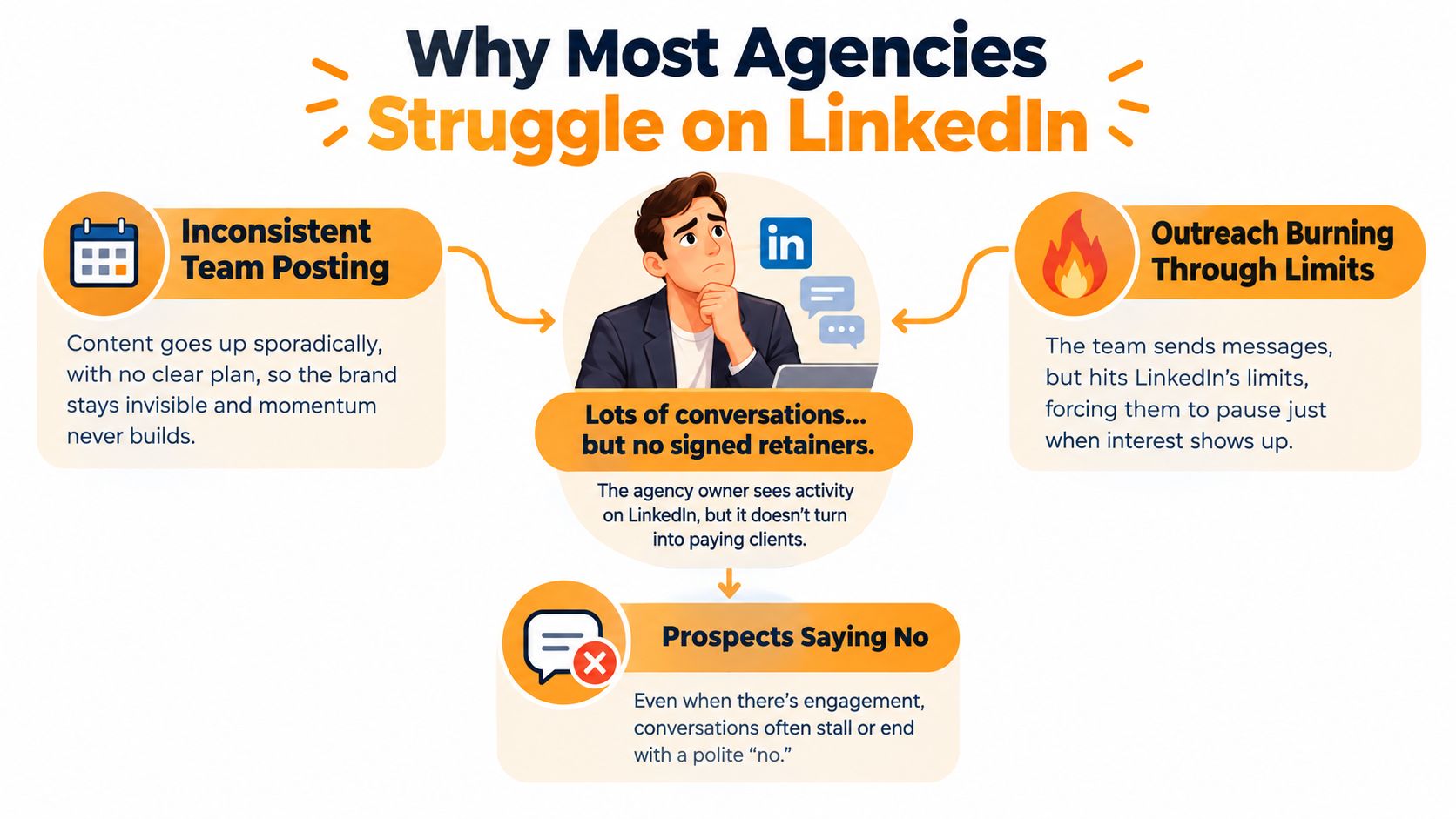
The root cause is usually conflation. Selling needs sharp positioning and targeted conversations. Servicing needs repeatable delivery, approvals, and quality control. Scaling needs delegation, documentation, and margin protection. A single LinkedIn playbook rarely handles those requirements well.
Three jobs, three operating systems
For selling, the agency needs a profile and offer that make the right buyer think, “This is specifically for us.” Broad claims such as “we help brands grow online” create no useful reason to accept a connection or book a call.
Servicing requires a different system. The agency must turn expertise into a content library, an editorial workflow, approved examples, and clear client deliverables. Without that layer, every post becomes a custom creative exercise.
Scaling adds another constraint. The team needs ownership, limits, templates, reporting definitions, and a process that can survive when the founder isn't personally reviewing every sentence.
Practical rule: If your team can't explain who owns the profile, who approves the post, what action counts as a qualified response, and where the lead goes next, you don't have a LinkedIn system yet.
LinkedIn also makes vague positioning especially expensive. Personal profiles, company pages, content formats, and outreach activity all perform better when they give the platform and the audience a clear subject to associate with the account. A generalist agency may be capable of many things, but a prospect has to understand one relevant thing quickly.
The rest of the playbook separates the lanes. You'll choose one service wedge, use personal profiles and the company page for different purposes, create outbound rules that protect account quality, package delivery around a defined outcome, and report what LinkedIn influenced. The result should be practical: a prospect can describe your offer back to you, your team can ship content consistently, outbound can book qualified conversations, and your reporting can prove progress without overclaiming.
Pick the LinkedIn Service You Actually Sell
“LinkedIn marketing” is too broad to be a sellable service. In practice, agencies tend to operate across six distinct motions:
- Done-for-you content, including editorial planning, writing, editing, design, and publishing.
- Done-with-you coaching, where the agency supplies strategy, prompts, feedback, and account reviews.
- Outbound lead generation, built around targeting, connection workflows, messaging, qualification, and handoff.
- Profile optimization, focused on positioning a founder, executive, sales leader, or team.
- Employee advocacy, which gives employees approved themes, assets, and participation guidance.
- LinkedIn Ads management, covering campaign structure, creative, audiences, testing, and reporting.
These motions require different skills and create different buying conversations. A founder may buy executive content to build authority, while a sales director may care about qualified meetings and handoff quality. An HR leader may want employee advocacy, not another publishing retainer.
Use three filters before choosing
Start with proof. Which motion has your strongest examples, internal expertise, and delivery confidence? If your team has repeatedly produced strong executive content but has no mature paid media capability, advertising shouldn't be the wedge because the category sounds attractive.
Next, assess willingness to pay in your chosen market. A niche B2B consultancy may value executive positioning and authority content, while a software company with an established sales team may value outbound infrastructure. The buyer's commercial problem should shape the offer.
Finally, ask whether the service is difficult to deliver alone. A narrow offer that combines strategy, writing, stakeholder interviews, design, distribution, and reporting is harder to replace than a list of isolated tasks. That's where operational capability can create defensibility.
Market fragmentation reinforces the point. Neutral benchmark content places LinkedIn among the go-to channels for 38% of agencies, while public agency listings often provide unclear positioning, pricing, and deliverables. (Agency category and positioning analysis) Buyers aren't only comparing performance promises. They're trying to understand what they are buying.
| Service Motion | Typical Monthly Price | Skill Intensity | Defensibility |
|---|---|---|---|
| Done-for-you content | Varies by scope | Editorial, subject-matter, design | Strong when specialized |
| Done-with-you coaching | Varies by access and depth | Strategy, coaching, editing | Moderate |
| Outbound lead generation | Varies by targeting and handoff | Research, sales operations, messaging | Strong with a proven system |
| Profile optimization | Usually project-based | Positioning, copy, stakeholder interviews | Limited unless paired with strategy |
| Employee advocacy | Varies by team size and governance | Change management, content operations | Strong in regulated or complex teams |
| LinkedIn Ads management | Varies by spend and complexity | Paid media, creative, analytics | Strong with sector expertise |
For a practical view of how prospecting can be structured as its own motion, Eludic's guide to LinkedIn prospecting is a useful reference point. The important distinction is that prospecting isn't interchangeable with content production.
Write your decision down this week:
- Proof: Which motion can you demonstrate without stretching the evidence?
- Buyer: Which client type has an urgent, expensive problem in that motion?
- Delivery: Which work can your team repeat without founder-only knowledge?
- Positioning: Can a prospect explain the offer after one conversation?
If the answer is “we do all of it,” you haven't selected a wedge. The wedge should be specific enough that a buyer can repeat it without prompting.
Build the Dual-Layer Content Engine
An agency that publishes the same message from its company page and personal profiles is using one channel twice, not building distribution. Each layer has a separate job, audience expectation, and approval process.
Layer one is the company page. Use it for credibility assets, client wins, hiring signals, service explanations, useful announcements, and evidence that the agency can deliver. Keep posts easy to scan, give ownership to a content lead, and publish on a dependable cadence. A page that appears only during a sales push looks reactive.
Layer two is personal profiles. Founders, sales leads, strategists, and subject-matter experts should publish from direct experience. Their posts can explain decisions, challenge common advice, share delivery lessons, or examine a client problem without becoming another company announcement.
The performance gap supports this division. Metricool reports that personal profiles generate 63% higher average engagement than company pages, while only 7% of company pages moved into a higher follower tier in its study. (Metricool's LinkedIn study) Keep the company page active, but stop asking it to perform the personal profile's job.
Assign people, not just channels
A workable weekly system gives each task a named owner:
- Content lead: Maintains the pillar library, assigns drafts, manages the calendar, and checks consistency.
- Subject-matter expert: Supplies raw ideas, examples, voice notes, and technical review.
- Editor: Tightens structure, removes generic claims, and checks the call to action.
- Founder or executive: Approves personal posts and adds the lived experience that makes them credible.
- Company-page owner: Publishes proof, announcements, and selected amplification assets.
Choose pillars according to the client's buying context. For B2B SaaS, cover onboarding friction, product marketing alignment, category education, and sales enablement. For professional services, use buyer misconceptions, delivery lessons, diagnostic frameworks, and evidence-led commentary. For e-commerce brands, examine merchandising decisions, retention problems, creative testing, and the operational trade-offs behind growth.
Personal profiles should carry the sharper point of view. The company page should carry polished evidence. Maintain a shared swipe file, set an approval flow that takes less than two working days, and reject personal drafts that sound like corporate broadcasts.
Before publishing, check:
- Audience: Is this for a defined buyer rather than “everyone in business”?
- Point: Does it make one useful argument?
- Evidence: Are examples, claims, and links accurate?
- Voice: Does a real person sound like the author?
- Action: Does the next step match the reader's intent?
- Conversation: Can the author respond meaningfully to comments?
Native format affects distribution and reader behavior. Socialinsider's 2026 benchmark reports 7.00% average engagement for native documents, compared with 5.20% overall, while link posts recorded 3.25%. (Socialinsider's LinkedIn benchmarks) Use documents and carousels for frameworks, proof, and educational sequences. Reserve text for concise opinions, and avoid turning every post into a disguised link campaign.
Agencies managing multiple voices also need a documented multi-account management workflow that separates access, approvals, and publishing responsibilities. The software matters less than clear governance, ownership, and a review process people follow.
Run Safe Outbound That Books Calls
Outbound becomes manageable when it runs as a controlled pipeline rather than a contest to send more messages. Define the buyer, the reason to contact them now, the sequence, and the handoff sales will own after a reply.
Start with targeting. Build Sales Navigator lists using buyer title, company characteristics, and relevant changes such as a new role, a new product, or a visible shift in priorities. Review each list manually, add email details where appropriate, and remove poor fits before any paid outreach tool enters the workflow. A smaller list with a clear buying reason usually gives the team better conversations than broad prospecting.
Account safety needs its own operating rules. Expandi's guidance for lead-generation agencies recommends a practical weekly ceiling of around 100 connection requests per account and describes a healthier 2026 agency acceptance benchmark of 30% to 45%. Treat those figures as guardrails, not targets. Reduce activity when acceptance or reply quality declines, and review the account before increasing volume.
Build a sequence with an exit
A useful sequence can include:
- A connection request without a pitch.
- A value-led message after acceptance, tied to the prospect's situation.
- A soft follow-up after several days.
- A respectful close when there is no response.
Make the next step easy to decline. “Would a short comparison of your current process be useful?” invites a response more effectively than a long explanation of the agency's capabilities.
| Metric | Daily Cap | Target Benchmark |
|---|---|---|
| Connection requests | Controlled per account | 30% to 45% acceptance |
| Profile views | Keep activity moderate | Monitor for relevance, not volume |
| Messages | Send only to qualified contacts | Track replies and intent |
| Qualified calls | No artificial quota | Measure against fit and pipeline |
Avoid residential-IP logins, large-scale scraping, and automatic messages that fire immediately after acceptance. These shortcuts increase account risk and create a poor buyer experience. Route replies such as “Interested,” “Not the right time,” and “How much?” into different human-reviewed paths instead of sending one follow-up to every contact.
Review acceptance, replies, qualified calls, and opportunities created each week. Reactions provide useful context, but they do not show whether outbound is producing pipeline. Engagement patterns can shift even when the visible reaction mix weakens, so judge the system by conversation quality and commercial outcomes.
Use this LinkedIn outreach strategy guide to refine targeting, sequencing, and follow-up alongside your account-safety rules. The operating goal is controlled pipeline creation, not a full inbox.
Package and Price the Offer
A typical agency loses margin before delivery starts because the proposal says “LinkedIn strategy and support” instead of defining the work. The client hears flexibility. The delivery team hears an unlimited revision queue.
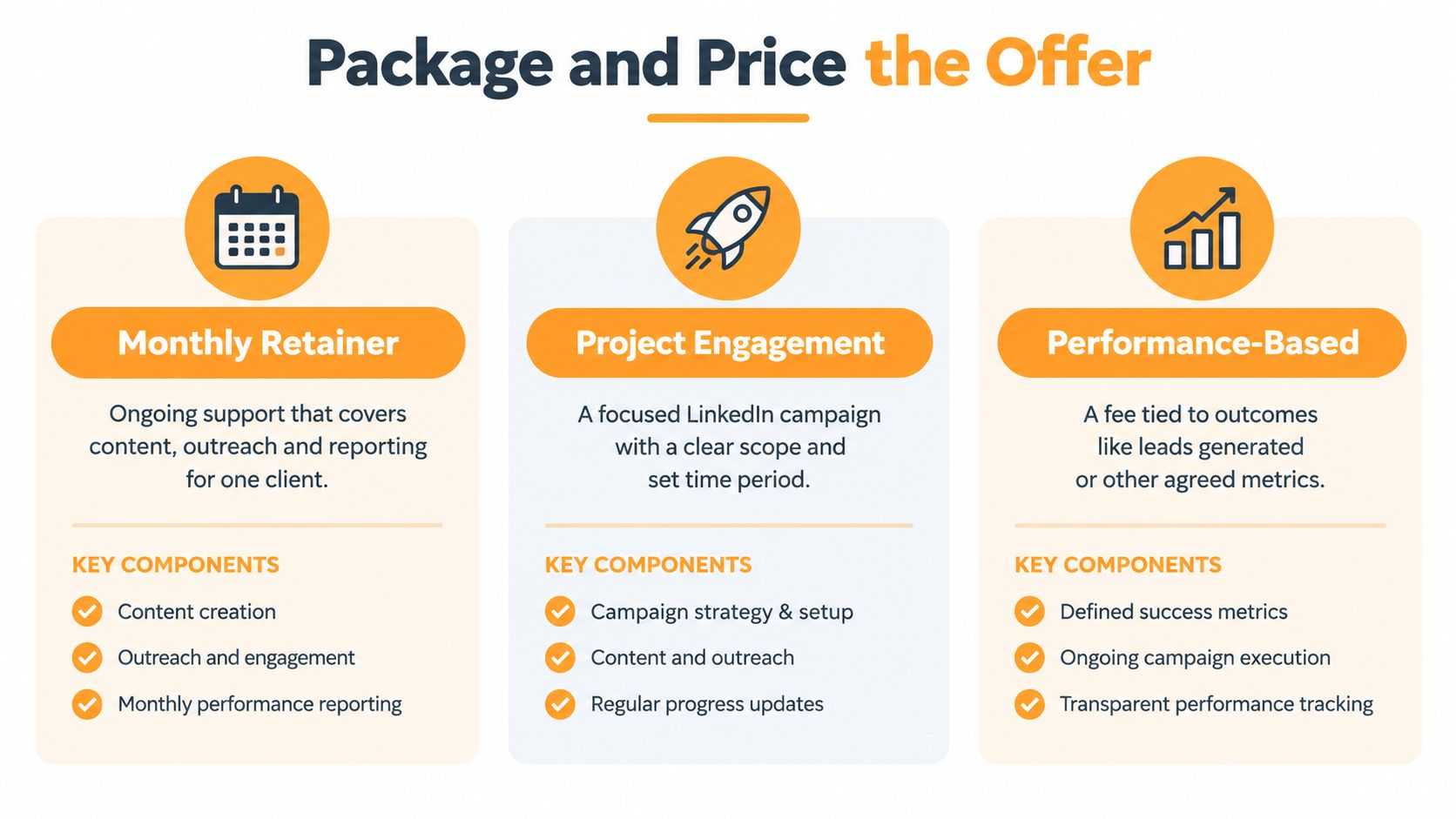
Package the service around a commercial outcome and a fixed operating system. Three shapes usually hold up:
- Monthly retainer: Ongoing content, outbound, reporting, and account management for one client.
- Project engagement: A defined launch, fundraise, campaign, or positioning sprint with a start and finish.
- Hybrid: A setup phase for research and infrastructure, followed by a smaller recurring engagement.
The right shape depends on the buyer's maturity. A company preparing a launch may need a concentrated project. An executive building long-term authority needs recurring content and feedback. A sales team with an existing list may need outbound setup first, then ongoing optimization.
Put the scope in the proposal
A useful proposal states the cadence and boundaries in plain language:
- Number of posts and profiles covered.
- Number of target accounts researched.
- Outreach activity and review process.
- Reporting frequency and meeting schedule.
- Included design, editing, and revisions.
- Client responsibilities and approval deadlines.
- Costs excluded, such as ad spend, paid data, custom research, and additional creative.
Avoid “unlimited” revisions, messages, or strategy calls. Those words make the offer sound accommodating while transferring the risk to your team.
A strong contract also includes a review point, a clear exit clause, and an intellectual-property provision. Define when the client owns final approved assets, what happens to drafts and working files, and how access is handled after termination.
Performance-based pricing can sound attractive, but it creates attribution disputes when the agency controls only part of the buying journey. If you use it, define the outcome precisely, including qualification, acceptance criteria, and the time window in which a result counts.
Scope test: A new team member should be able to read the proposal and know exactly what gets delivered, by whom, and at what point an extra request becomes a new line item.
The strongest LinkedIn offers aren't collections of tasks. They're packaged systems with a defined audience, a visible process, and enough constraints to protect quality.
Measure, Report, and Prove ROI
Clients don't renew because a dashboard contains many charts. They renew when the report answers three questions: what happened, what did it change, and what should we do next?
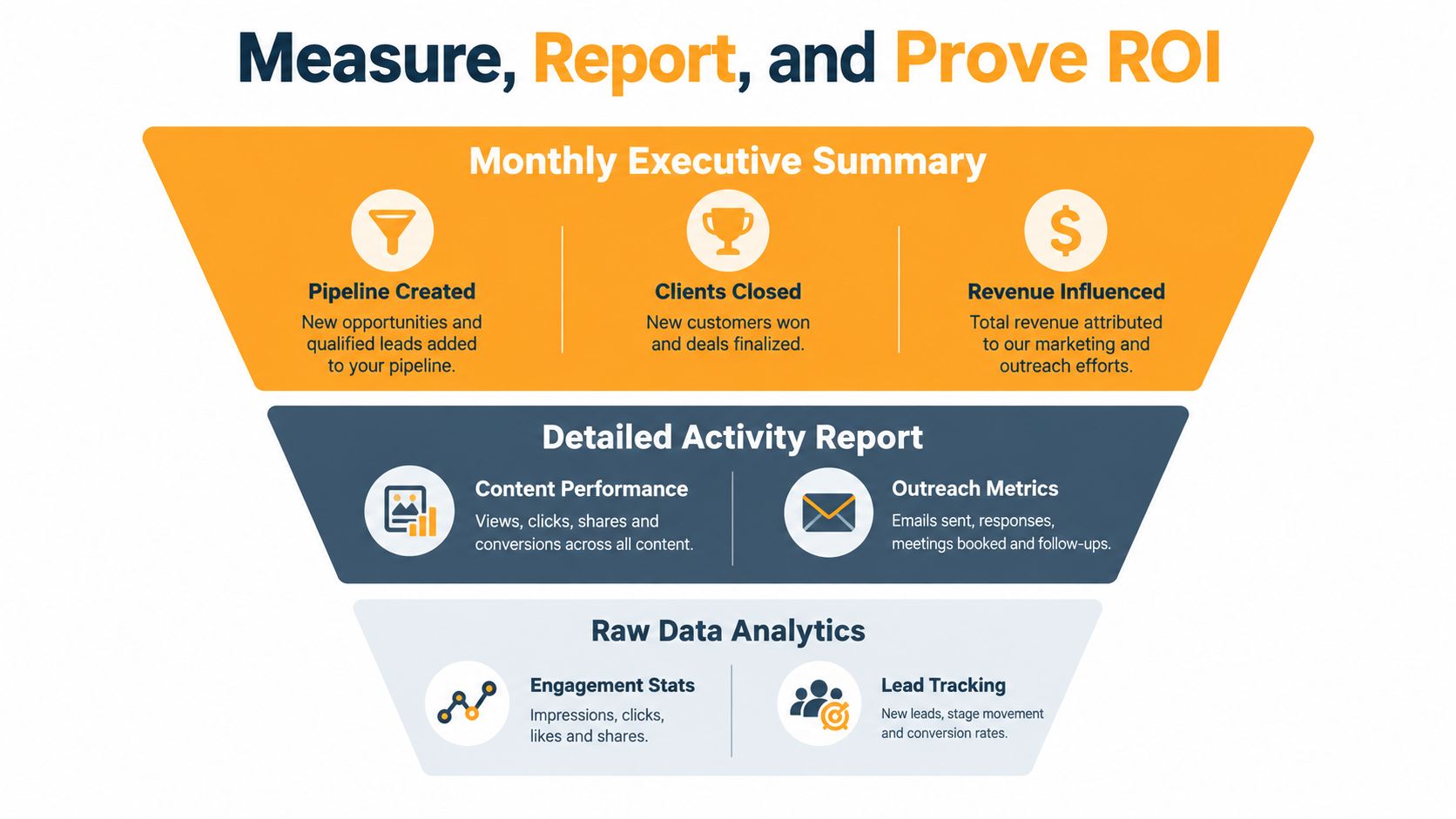
Build reporting in layers. The weekly operations log records sends, replies, qualified leads, content published, approvals delayed, and sales handoffs. It is where the delivery team finds problems early.
The monthly performance scorecard shows channel movement. Include impressions, follower growth, post engagement, connection acceptance, reply rate, calls booked, and opportunities advanced. Keep definitions stable so a change in the report doesn't create a false improvement.
The executive summary translates activity into commercial language. Show pipeline created, clients closed, and revenue influenced where the CRM supports those claims. Separate sourced opportunities from influenced opportunities, and show engagement cost beside the business outcome.
Make attribution auditable
Use UTM-tagged links on posts and campaigns. Add opportunity-source fields to the CRM, record the first meaningful LinkedIn touch, and note whether the contact arrived through content, outbound, a referral, or another channel. Profile-view changes can provide useful context after an outbound campaign, but they shouldn't be presented as revenue.
LinkedIn often assists a buying journey without receiving the final click. A prospect may read an executive post, visit the company page, reply to an email, and book a call later. If the report only credits the last interaction, it hides the channel's role. If it credits every later deal to LinkedIn, it overstates performance.
Use a one-page narrative memo beside the dashboard:
- What changed: Identify the strongest audience, format, or message.
- Why it matters: Connect the movement to conversations or opportunities.
- What stalled: Explain weak acceptance, delayed approvals, or poor-fit leads.
- What happens next: State the specific experiment or operating change.
For a practical framework on connecting social activity to business outcomes, see this guide to measuring social media ROI. Reporting should make uncertainty visible instead of hiding it behind a single attribution number.
The report's real job is decision support. If content earns attention but no qualified conversations, refine the offer or audience. If outbound produces replies but no calls, inspect the message and qualification step. If meetings happen but deals don't advance, the issue may sit in sales, not LinkedIn.
Your 90-Day LinkedIn Rollout Plan
Don't launch every motion at once. Use the first quarter to create evidence, remove operational friction, and decide whether the service deserves productization.
Week one creates the foundation
Start with the agency page and the profiles that will carry distribution. Rewrite each headline and About section around a specific buyer, problem, and offer. Define the ideal customer profile, document exclusion criteria, choose the publishing and CRM tools, and assign owners.
The artifacts for the first week are simple:
- Profile copy document.
- Agency page update.
- ICP and exclusion sheet.
- Tool and access register.
- Initial service-wedge decision.
Don't begin outbound until those assets agree with one another. A prospect who sees a precise founder profile and a generic company page receives mixed signals.
Month one tests the system
Create a 30-day editorial calendar from a shared pillar library. Assign personal posts to the founder, sales lead, and subject-matter experts, while the company page publishes proof and useful agency assets. Build the outreach list, write the sequence, define response branches, and start below the account's permitted activity ceiling.
By the end of the first month, you should have a content calendar, an outreach SOP, a reporting template, and a record of qualified conversations. At the day-30 gate, decide whether to kill the wedge, narrow it, or double down. Don't judge the offer from impressions alone. Review buyer fit, response quality, calls, and the objections prospects repeat.
Quarter one turns evidence into an offer
During the second month, improve the weakest stage. If content is inconsistent, appoint a content lead. If the founder is generating the only useful ideas, document the interview and editing process. If outbound replies are positive but calls don't book, tighten qualification and the next-step message.
At day 60, choose whether to hire or remain founder-led based on the actual bottleneck, not on the desire to appear bigger. Produce a first case study from documented activity and outcomes, without claiming results the tracking system can't support.
By day 90, the agency should have a KPI dashboard, a proposal template, a case study, an outreach SOP, and a named offer with fixed scope and price. That's the productization gate. If delivery still depends on improvisation, keep refining the system before adding more clients.
Day-90 standard: You should be able to explain the offer, deliver it through documented steps, report its contribution, and hand part of the work to another person without losing the client's voice.
LinkedIn becomes a growth channel when the agency stops treating it as one endless activity stream. Separate selling from servicing, separate both from scaling, and make every promise traceable to a process your team can run.
RedactAI helps agencies and consultants develop LinkedIn posts from profile context, posting history, and personal experience, with drafting, scheduling, content ideas, and performance analytics for managing consistent publishing. Visit RedactAI to explore how it can support your multi-profile content workflow.