73% of B2B decision-makers trust founder thought leadership more than marketing materials. That makes personal branding for founders a commercial asset, not a vanity project. The practical question isn't whether you should post more. It's whether your public expertise is creating qualified demand, shortening trust-building, and giving buyers a reason to remember your company.
Founders often hide behind the company page because corporate communication feels safer. It also tends to sound interchangeable. A founder who explains hard decisions, shares useful evidence, and takes a clear position gives buyers something a polished brochure can't provide, a credible person to evaluate before a sales conversation begins.
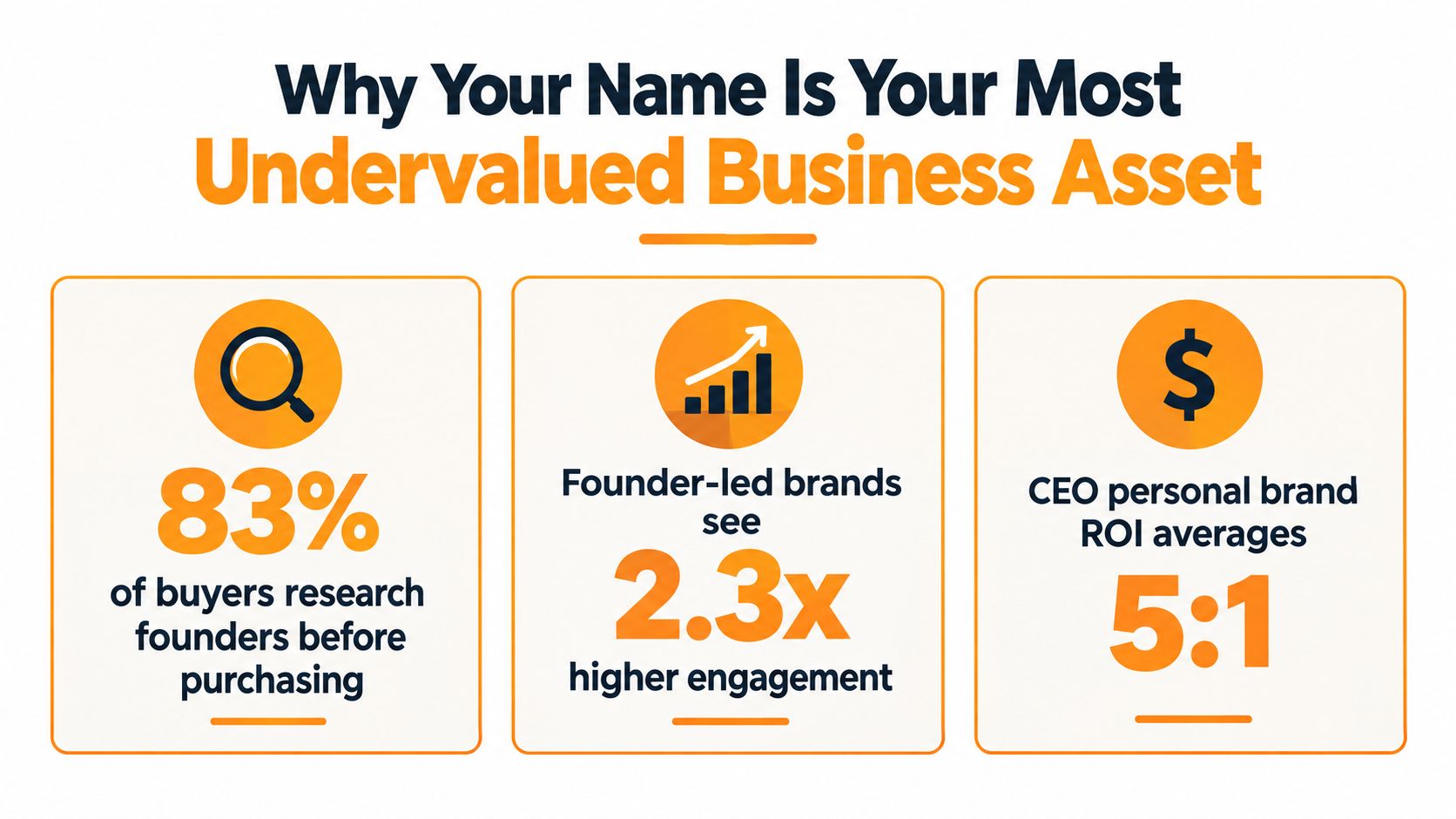
Why Your Name Is Your Most Undervalued Business Asset
A company brand tells buyers what the business offers. A founder brand shows them how the business thinks.
That distinction matters in B2B markets where products can look similar, websites use the same vocabulary, and every competitor claims to understand the customer. Your name becomes valuable when it carries a recognizable point of view. Buyers remember the founder who explains why a common solution fails, what changed after working with customers, or which trade-off the company refuses to hide.
The 2024 Edelman–LinkedIn B2B Thought Leadership Impact Report surveyed 3,484 global business executives and found that 73% of B2B decision-makers considered thought leadership more trustworthy than marketing materials and product sheets when assessing an organization's capabilities. That isn't a case for posting opinions without substance. It's evidence that useful expertise can carry more weight than company-controlled messaging.
Demand starts before procurement
The same report found that 75% of decision-makers and C-suite executives had researched a product or service they weren't previously considering after encountering a particular piece of thought leadership. Among those respondents, 60% said the content made them realize their organization was missing a significant business opportunity. Those findings change the role of founder content. It isn't only awareness at the top of a funnel. It can create the category problem that makes a buyer search for a solution.
This is why founder-led content can outperform another product announcement. Product announcements speak to people already paying attention. A strong founder perspective can reach someone who hasn't named the problem yet.
Practical rule: Publish the thinking that helps a buyer recognize an expensive problem, not just the features that explain your solution.
Executive visibility also affects how people interpret the organization behind it. A longitudinal study of Chinese publicly listed firms covering 2009–2020 found that companies with socially active CEOs demonstrated higher corporate social performance, with CEO status and reputation amplifying that relationship. The study doesn't prove that social activity alone causes better business results, and it measures social performance rather than revenue. It does show that stakeholders can connect a leader's public behavior with their evaluation of the organization, as reported in the study on CEO sociability and corporate social performance.
Visibility has a cost
Founder branding isn't free. It takes attention away from selling, hiring, product work, and recovery. It also exposes judgment in public, which means a careless claim can travel further than a careful one.
The answer isn't to stay invisible. It's to treat your name like an owned distribution channel with editorial standards. Choose a narrow authority position, collect evidence from your operating work, and publish insights that your company can defend. Your name becomes an asset when buyers associate it with useful judgment, not constant activity.
Building a Profile That Converts Visitors Into Buyers
A LinkedIn profile shouldn't read like a compressed résumé. It should function like a landing page for people who are already curious about your company.
Start with the headline. Don't lead with a vague title such as “Founder and CEO” unless the title carries unusual recognition. State the problem you solve, the audience you serve, and the distinctive approach you bring. A useful structure is:
I help [specific buyer] achieve [valuable outcome] without [painful trade-off].
That structure gives visitors a reason to keep reading. You can add the company category afterward, but the buyer's problem belongs first.
Build proof into every visible layer
Your banner should reinforce the same position as your headline. Use a short phrase, a clear category, or a specific promise. Avoid filling the space with small text, competing logos, or decorative slogans that disappear on mobile screens.
Use the Featured section as a proof shelf. Add a strong explanation of your point of view, a customer lesson you can share responsibly, a useful resource, and a relevant interview or event. Don't make every item a product page. A visitor is trying to assess your judgment before they're ready to assess your offer.
The About section should read like a compact case study:
- Name the buyer's difficult situation.
- Explain what you learned from working close to that problem.
- Describe your method in plain language.
- Show the kinds of decisions or evidence that support your view.
- Give the reader one clear next step.
Write in the first person, but don't turn the section into a personal memoir. The founder is the narrator, not the subject of every sentence.
Remove friction from the next action
Your profile needs one obvious path for a qualified visitor. That might be a relevant guide, an assessment request, a newsletter, or a direct conversation. Don't offer five competing calls to action. Match the action to the level of trust your content has earned.
Your experience entries should also support the narrative. Replace task lists with decisions, customer problems, operating lessons, and the type of work your company now handles. Founders who sell expertise can borrow useful positioning ideas from this outcome-based fractional executive playbook, especially the shift from listing responsibilities to describing business outcomes.
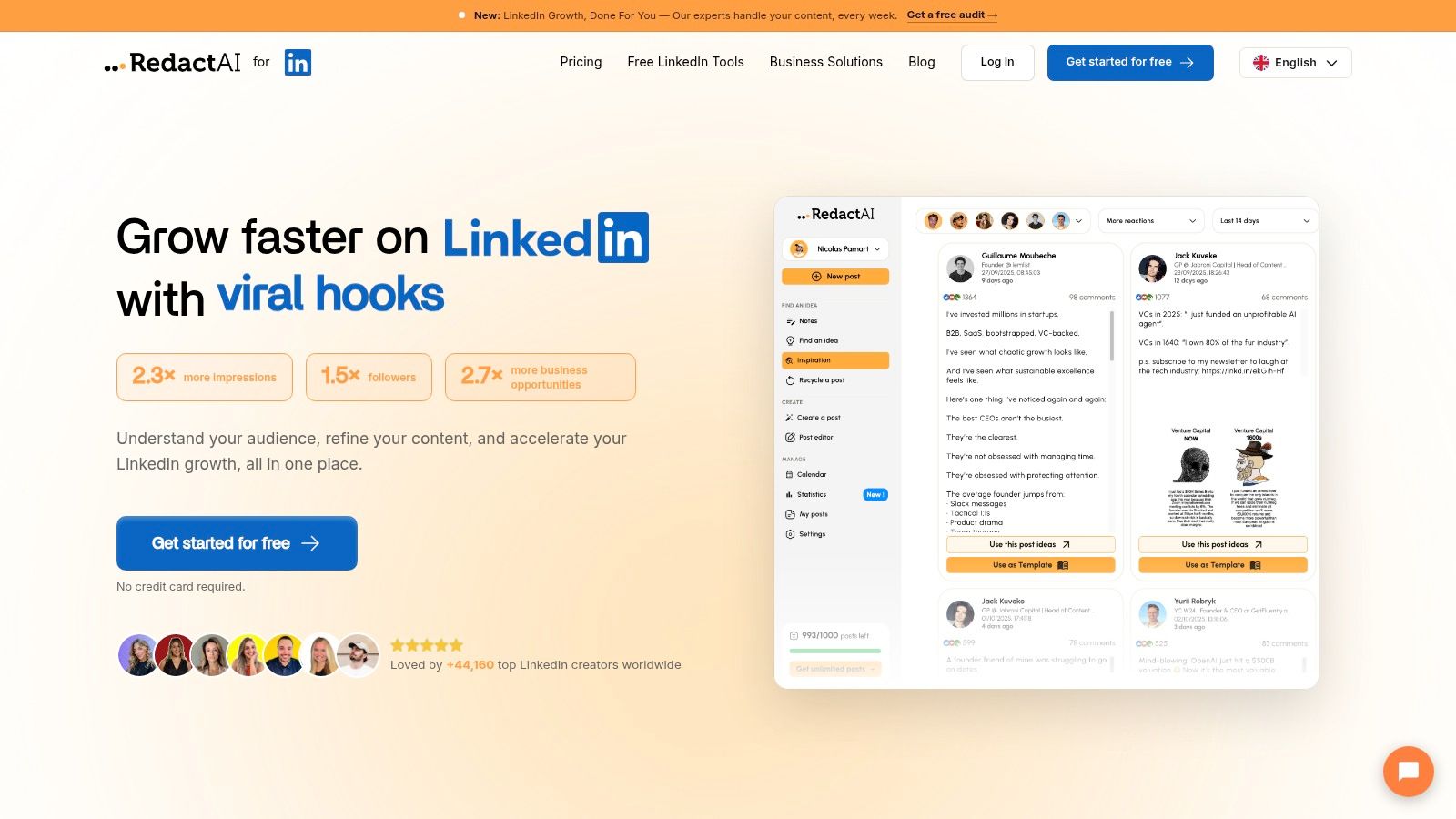
A profile audit can reveal gaps you don't notice because you read your own page through the lens of your history. Use this LinkedIn profile optimization guide to review the headline, banner, About section, Featured section, and experience descriptions as one connected conversion path.
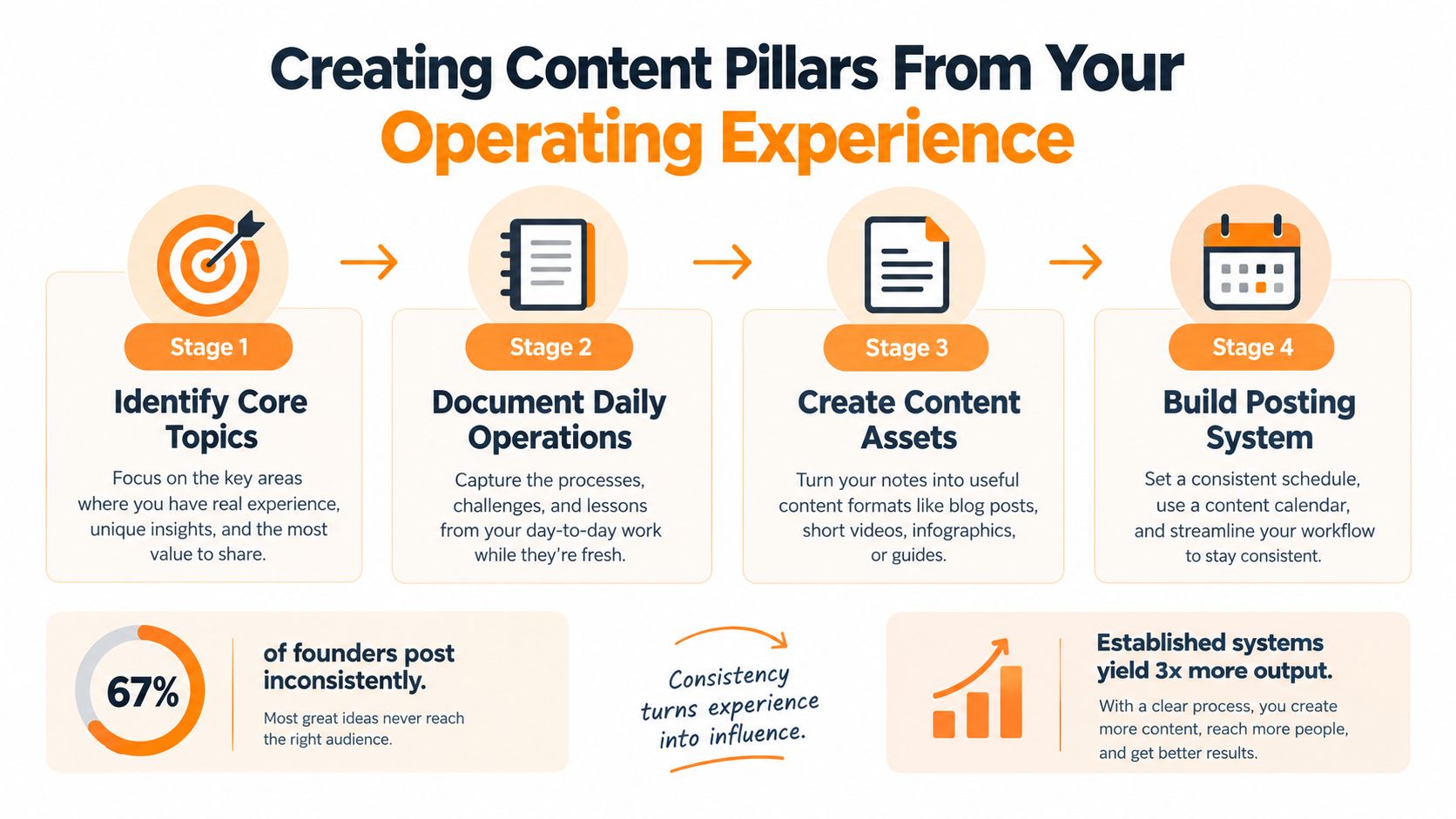
Creating Content Pillars From Your Operating Experience
The best founder content usually starts as an internal conversation.
A customer asks a difficult question. A hiring decision exposes a cultural tension. A product choice forces a trade-off. A sales call reveals that buyers describe the problem differently from your marketing team. Each moment contains material because it reflects judgment under real conditions.
Turn those moments into three to five repeatable evidence types, such as customer lessons, original analysis, operating decisions, contrarian opinions, and quantified results when you can disclose them responsibly. The point isn't to document everything. It's to identify the experiences that demonstrate why your view deserves attention.
Use one reliable post structure
A practical post can follow this sequence:
- Problem signal: Name the situation your audience recognizes, using the language buyers use.
- Founder-specific observation: Explain what you noticed from your position, including the assumption that proved wrong.
- Evidence or example: Share an anonymized customer lesson, operating decision, comparison, or result you can substantiate.
- Practical implication: Tell the reader what they should change, test, or question.
- Low-friction prompt: Invite a specific response, such as asking how others handle the same trade-off.
The four-part structure prevents two common failures. The first is generic advice with no connection to lived experience. The second is an unedited diary entry that may be interesting but doesn't help a buyer make a decision.
A post about hiring, for example, shouldn't stop at “we hired carefully.” Explain which signal you prioritized, what you rejected, and how that choice affected the role. A post about product strategy shouldn't announce a feature. Explain the customer behavior that changed your roadmap and the constraint that shaped the final decision.
Create a system from recurring questions
Keep a simple operating log. After customer calls, leadership meetings, product reviews, and difficult decisions, record:
- the question someone asked,
- the assumption behind it,
- what evidence changed your view,
- the decision you made,
- what another founder could apply.
Group recurring entries into pillars. A services founder might use buyer education, delivery decisions, and category criticism. A technical founder might use architecture trade-offs, security lessons, and implementation reality. The specific labels matter less than the connection between the pillar and your authority position.
Use the LinkedIn content strategy guide for personal branding to turn those pillars into a practical publishing workflow. Keep the workflow light enough to survive a busy week. If creating content requires a fresh burst of inspiration every time, it isn't a system.
A useful editorial filter is simple: Could a buyer make a better decision after reading this? If the answer is no, the post may still entertain people, but it probably won't strengthen demand.
Selecting the Right Authority Angle for Your Industry
Authority isn't one personality type. A founder selling enterprise infrastructure needs a different public role from a founder building a design-led consumer company, even when both have strong opinions.
Choose the angle that matches your buyer's uncertainty. If customers need to understand where the market is moving, lead with strategic interpretation. If they fear implementation failure, lead with technical pragmatism. If the category is crowded, a well-supported contrarian position can give your expertise a sharper edge.
Founder Authority Archetypes
| Archetype | Best For | Content Style | Risk Level |
|---|---|---|---|
| Strategic Visionary | Emerging categories and complex market shifts | Category analysis, future scenarios, business-model interpretation | Medium |
| Technical Pragmatist | Products with implementation, security, or operational complexity | Trade-offs, teardown posts, architecture lessons, practical constraints | Low to medium |
| Customer Advocate | Markets where trust and service quality drive selection | Buyer stories, objection handling, service standards, expectation setting | Low |
| Contrarian Operator | Crowded categories with established assumptions | Counter-arguments, failed experiments, unpopular operating lessons | Medium to high |
| Educator and Translator | Technical products sold to non-specialist buyers | Plain-language explanations, decision guides, examples | Low |
Don't choose the most dramatic archetype. Choose the one you can sustain without pretending. A technical pragmatist who suddenly posts grand predictions will sound less credible than a founder who explains one implementation constraint clearly.
Make disagreement useful
Contrarian content works when it challenges an assumption and replaces it with a better decision rule. “Everyone is wrong about remote work” is a provocation. “A distributed team should measure written decision quality before adding more meetings” is a position that invites examination.
Before publishing a counter-argument, answer three questions:
- Which assumption am I challenging?
- What have I observed that supports the challenge?
- When would my position be wrong?
That last question protects your credibility. Buyers don't need a founder who sounds certain about everything. They need someone who understands boundaries, evidence, and consequences.
For a deeper treatment of trust signals, communication choices, and executive positioning, these leader credibility strategies provide useful context. Apply them selectively. Credibility doesn't come from adopting a performance style. It comes from making your public behavior consistent with the way you operate privately.
Measuring True Influence Beyond the Vanity Metrics
A founder can get attention and still generate no pipeline. Reach tells you how far a post traveled. It does not tell you whether the right buyers noticed, remembered it, discussed it internally, or changed how they evaluate your company.
That distinction matters because founder branding in B2B is not a publishing hobby. It is a demand-generation system where the founder is often the strongest distribution and trust asset in the company. The 2024 Edelman–LinkedIn B2B Thought Leadership Impact Report noted that 70% of C-suite executives had reconsidered an existing vendor relationship after consuming thought leadership, and 60% said high-quality thought leadership could make them willing to pay a premium. The commercial effect can show up before a demo request, and long before a deal is attributed cleanly in CRM.
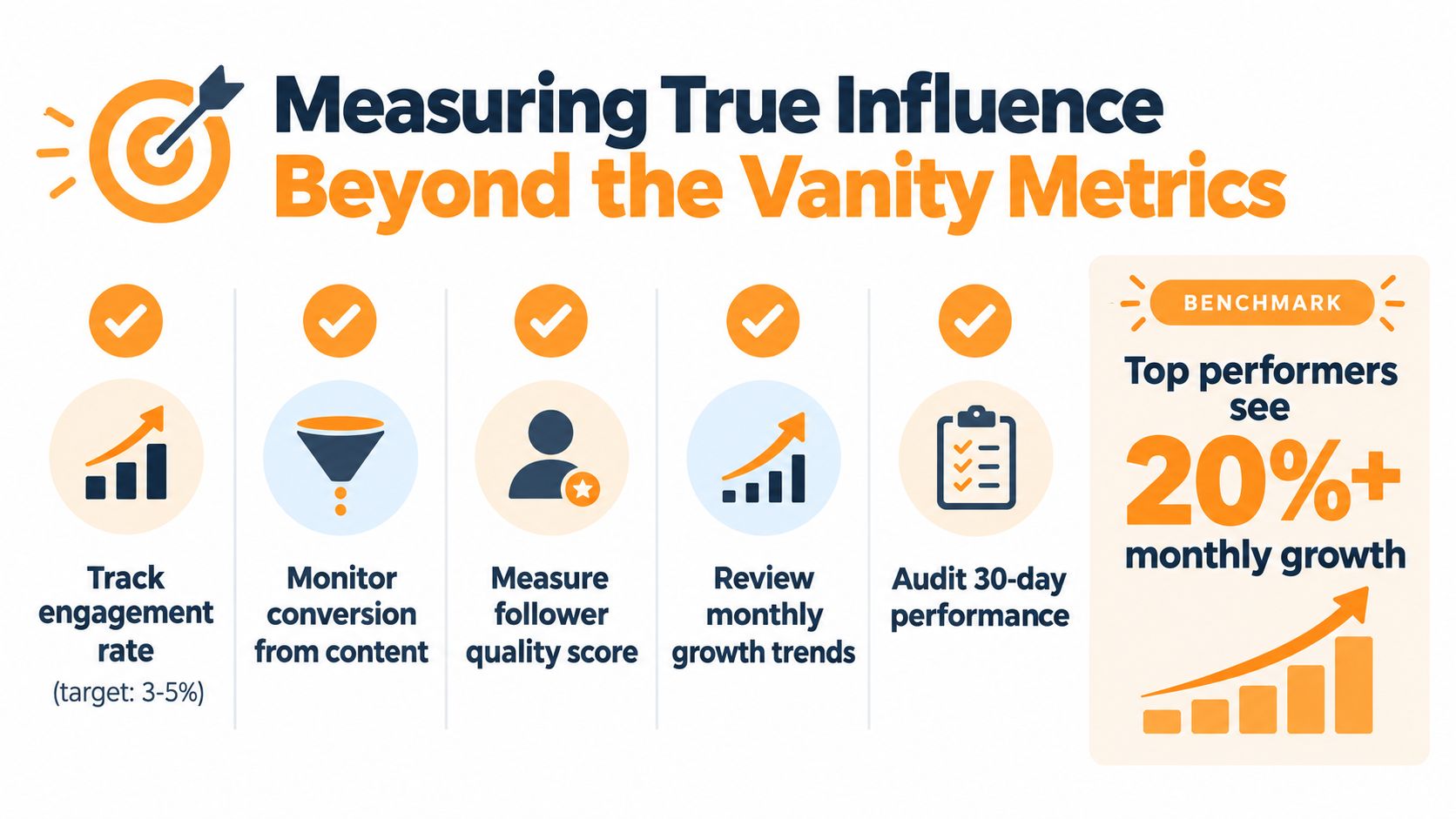
A measurement system should start with three things: the audience you want, the problem you want to be known for, and the business action you want content to influence. Then track by pillar. A post that brings ten thoughtful responses from target accounts can matter more than one that collects broad, low-intent engagement from people who will never buy.
Run a 30-day learning audit
Use the first month as a learning cycle. Personal brand performance is noisy in the short term, especially when you are still clarifying which operating experience actually resonates with buyers.
- Tag every post by pillar. Label the problem addressed, the authority angle, the format, and the intended audience.
- Separate reach from relevance. Track qualified profile views, target-account engagement, inbound conversations, assisted pipeline, and conversion by pillar.
- Review the audience manually. Sort engagement into prospects, customers, partners, candidates, peers, and low-relevance accounts.
- Compare stronger and weaker posts. Examine problem specificity, proof, opening, structure, and call to action.
- Make one decision per pillar. Keep what attracts qualified attention, revise what shows promise, and stop publishing what only creates empty activity.
This prevents a common mistake. Founders often judge each post as if it should produce a direct commercial result on its own. That is rarely how B2B buying works. A buyer may see two posts, visit your profile a week later, mention your company in an internal conversation, and only then respond to outbound or request a meeting. If your system can capture assisted influence, use it. Do not force every outcome into last-click attribution.
For broader terminology, measuring brand awareness helps separate visibility signals from stronger indicators of market attention. For platform-specific reporting, LinkedIn analytics explained is useful for understanding what LinkedIn can measure reliably, and what it cannot.
Watch for reputation concentration
Founder visibility creates influence, but it can also create dependence. Research discussed in this founder-brand risk analysis estimates that 45% of a company's overall reputation is linked to the CEO's reputation, while 44% of market value is attributed to CEO reputation. That is a strong argument for building institutional credibility before growth, hiring, regulation, or investor expectations make the gap obvious.
Use these questions in your audit:
- Can the company explain its expertise without the founder present?
- Do employees and subject-matter experts have permission to publish?
- Would a controversial personal post create confusion for customers?
- Does the founder's content dominate acquisition to the point of concentration risk?
- Are company values visible in processes, customer experience, and institutional channels?
The goal is not founder invisibility. The goal is founder visibility without founder indispensability. The strongest founder brands make the company easier to trust, then gradually transfer that trust into team voices, proof assets, customer evidence, and repeatable systems.
A founder brand should support demand, not become a single point of failure. Track commercial signals. Keep a record of the evidence behind your public positions. Then build enough shared authority inside the company that growth does not depend on one person staying permanently visible.