You post a thoughtful LinkedIn update, check the analytics the next day, and find a result that seems impossible to interpret: 12,000 impressions and only 340 views. Is that a strong post that reached a wide audience, or a weak post that many people ignored?
The answer depends on what each metric measures. LinkedIn impressions and views aren't interchangeable success scores. One reflects exposure, while the other signals a stronger act of attention. Once you separate those behaviors, the numbers become much more useful for deciding what to publish next.
Why Your LinkedIn Analytics Feel Confusing
A marketing professional might see the result above and immediately start rewriting the wrong part of the strategy. They may celebrate the reach, worry about the views, or compare the two numbers as though they were supposed to match. None of those reactions works without knowing whether the post was text, video, an article, or another format.
LinkedIn analytics uses familiar words for different kinds of activity. An impression records that content appeared on a member's screen. A view generally represents a more deliberate step, such as opening content, expanding a post, watching a native video, or visiting a profile. The platform therefore gives you signals about distribution and attention, not one universal score.
The useful question isn't “Which number is bigger?” It's “What decision should this number help me make?”
This distinction matters for every professional who publishes regularly. A real estate agent trying to build local recognition needs to understand how broadly posts travel, while someone selling consulting services needs stronger evidence that the right people stopped to consume the content. If you're developing a broader presence, resources on how to master LinkedIn as a realtor can complement your analytics work by connecting profile positioning with content distribution.
The dashboard becomes easier to use when you give each metric a job. Impressions can help you assess whether LinkedIn is distributing a post. Views can help you judge whether the format and opening created enough interest to prompt action. Engagement, profile activity, comments, and business outcomes add further context.

Before changing your posting schedule or content themes, review the fundamentals of how to measure content performance. The goal isn't to make every metric rise at once. It's to understand which signal matches the result you want.
How LinkedIn Measures Impressions and Views
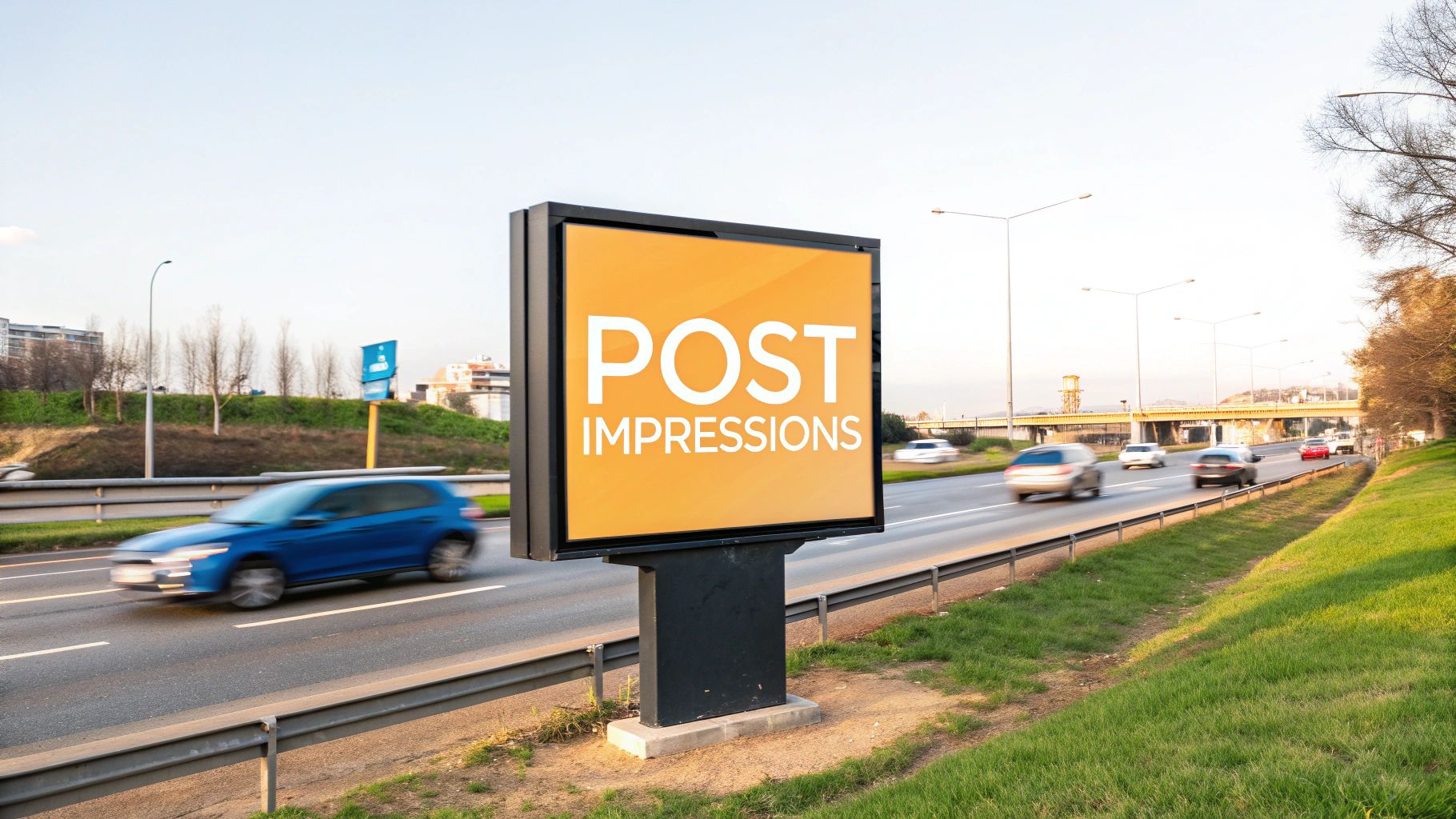
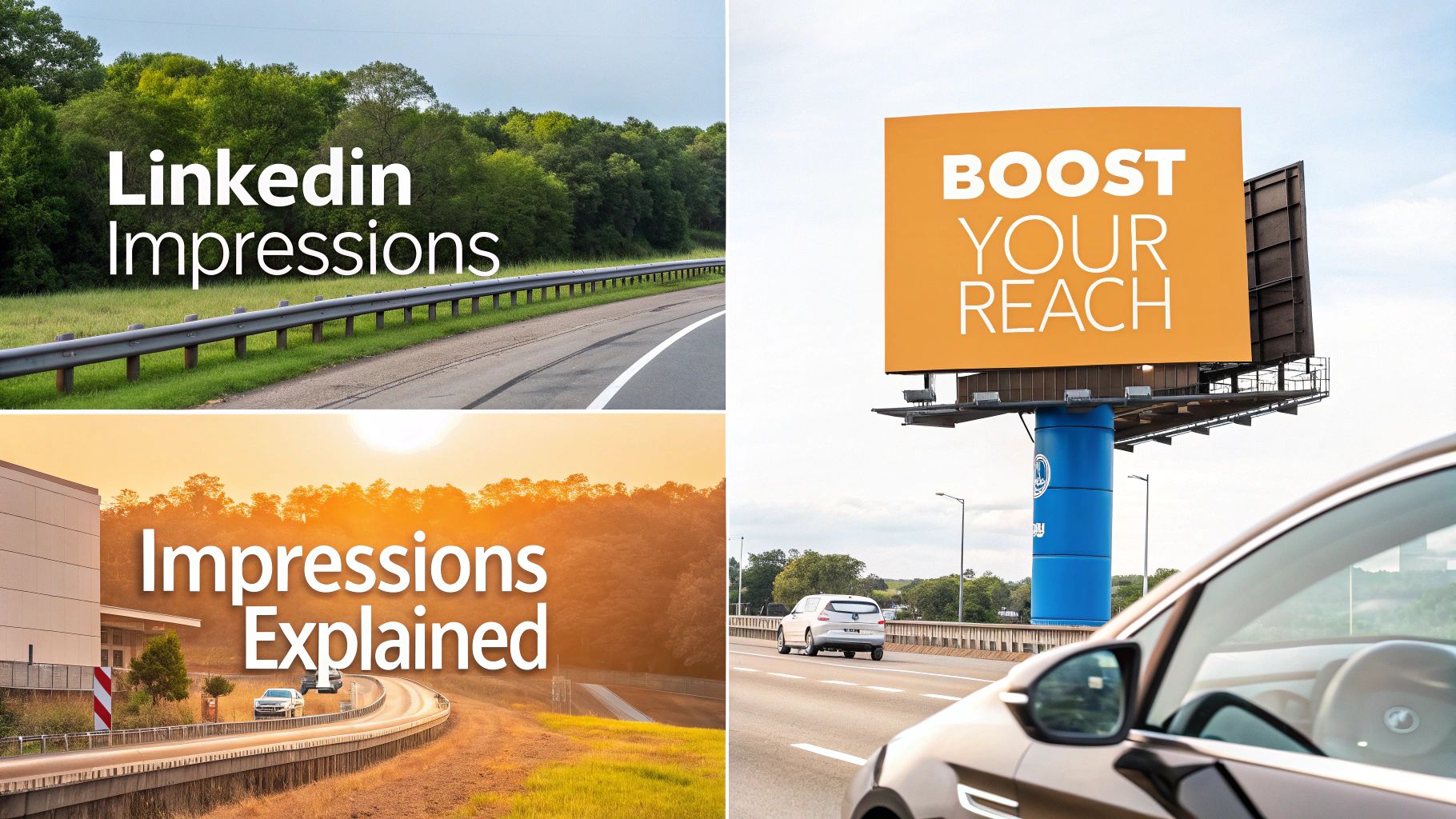
Start with a simple analogy. An impression is like placing a billboard beside a busy road. A driver passes it, and the billboard was available to be seen, but you don't know whether the driver read the message or remembered the brand.
LinkedIn counts an impression when content is displayed on a signed-in member's screen with at least 50% visibility for at least 300 milliseconds, as summarized by LinkedIn impressions and views analysis. That technical threshold explains why impressions can increase quickly in a feed. A post can qualify for exposure even when a member continues scrolling without processing the full message.
A view is closer to a driver pulling over to examine the billboard. It requires a stronger action, depending on the content and analytics surface. LinkedIn may count a view when someone clicks into a post, expands an article, or watches a native video for at least 3 seconds, according to the same industry summary. Other independent guidance describes video thresholds as commonly falling between 2 and 3 seconds, so the precise behavior depends on the format and LinkedIn's metric definition.
The difference between delivery and attention
Impressions answer:
- Distribution: How often did LinkedIn display the content?
- Visibility: Did the post enter members' feed experiences?
- Exposure: Did the content travel beyond the people who regularly see your updates?
Views answer a narrower question:
- Attention: Did someone take an active step toward consuming the content?
- Consumption: Did a person open, expand, watch, or visit the relevant content?
- Interest: Did the post create enough pull to interrupt passive scrolling?
The same person can generate multiple impressions if LinkedIn displays the post repeatedly. That means impressions measure delivery volume, not the number of unique people who saw the content. Treating impressions as audience size can make a post appear to have wider reach than it did.

Views are usually lower because they require a more demanding behavior. That difference isn't automatically a problem. A low view count can be normal for a post whose purpose is broad awareness, while the same result may concern you for a video designed to educate prospects.
For a practical explanation of the exposure metric itself, see what LinkedIn impressions mean. The important habit is to interpret impressions and views as related but separate signals.
Impressions vs Views Across Content Types
The meaning of a view changes with the content format. A feed display may create an impression across many formats, but the action that creates a view differs between a text update, a video, a document, and an article.
| Content Type | What Triggers an Impression | What Triggers a View | Typical Impression:View Ratio |
|---|---|---|---|
| Text post | The post appears on a member's screen | An active expansion or stronger content interaction, where LinkedIn reports it | Varies by post length and presentation |
| Image post | The image post appears in the feed | A deliberate interaction or content opening, where the metric is available | Varies by visual appeal and context |
| Video content | The video appears in-feed | Active playback that reaches LinkedIn's watch-time rule, commonly described as at least 2 to 3 seconds in independent guidance from Socialinsider's comparison | Often wider exposure than qualified views |
| Carousel document | The document preview appears in the feed | A member opens the document or interacts with its pages | Depends on the strength of the cover and first page |
| Article | The article preview or link appears in a feed context | A member clicks through to read the article | Depends on headline, topic, and audience fit |
The table isn't a performance benchmark. There isn't one universal ratio that proves a post succeeded. A short text update may not create the same view event as a video, and comparing those totals directly can lead you to reject a format that is working for its intended purpose.
Why video often creates a wider gap
Video is the clearest example. LinkedIn can display a video to someone who never presses play or watches long enough to satisfy the view rule. The impression reflects delivery, while the view reflects qualified watch activity. A video with strong impressions and modest views may have reached many feeds but failed to create enough stopping power.
For video creators, the opening frame, captions, sound-off clarity, and first moments all matter. For articles, the headline and preview must earn the click. For documents, the cover page must make the next swipe feel worthwhile.
If you're building a video workflow, this guide to posting video on LinkedIn can help you connect format choices with the attention signal you're trying to improve.
What High Impressions and Low Views Really Mean
High impressions with low views usually tell you that LinkedIn distributed the post more successfully than the post captured attention. The content appeared in many feeds, but relatively few members took the stronger action represented by a view.
That isn't a complete diagnosis. The cause may be a weak opening, an audience mismatch, an unclear promise, or a format that doesn't make the desired action obvious. Impressions show that the content had opportunities to perform. Views help reveal whether those opportunities became active consumption.
Read the pattern by format
A text post with a large impression count and limited views may have a preview that doesn't earn the expansion click. The first lines might introduce background instead of presenting the problem, tension, or useful insight immediately.
A video with the same pattern points you toward a different inspection. Check the thumbnail, opening frame, captions, and initial delivery. If viewers scroll before the video reaches LinkedIn's active-watch threshold, the distribution signal will look healthier than the attention signal.
A document can lose people at the cover or first page. An article can attract feed exposure but fail to earn the click because the headline doesn't make the benefit clear.

A practical diagnostic checklist
Review the post in this order:
- Opening lines: Can a reader identify the problem or payoff before expanding the post?
- Audience fit: Does the topic speak to the people you want to attract, or merely to a large general audience?
- Format promise: Does the first frame, cover, or headline accurately show why the content deserves attention?
- Reading experience: Can someone scan the post quickly, or does dense formatting make the next action feel costly?
- Call to action: Is the requested response clear and proportionate to the value offered?
The right response isn't to chase views blindly. Fix the earliest point where attention drops, then compare that post with future content built around the same goal.
How to Optimize for the Right Metric
Not every post needs the same target. Start with the business outcome, then choose the metric that reflects the behavior required to reach it.
If your goal is awareness, impressions can be a useful top-line signal. You want the content to enter more relevant feeds and create familiarity. That calls for clear positioning, topics your audience recognizes, and openings that make the post easy to understand quickly. Distribution tactics can help, but broad exposure only matters when the audience is relevant.
For thought leadership, views deserve more attention because they indicate that someone moved beyond passive exposure. Use a specific point of view, a strong question, or a useful tension in the opening. Long-form posts need clear spacing and logical progression. Documents should make the first page valuable enough to invite further interaction.
For lead generation, don't stop at either number. Connect content attention to profile activity, meaningful comments, direct conversations, and the next business action. A post can earn modest visibility and still attract the right prospect if its message is specific.
| Business Goal | Primary Metric | Key Tactics |
|---|---|---|
| Hiring and employer branding | Impressions for broad awareness, views for attention-heavy formats | Show real work, explain the role clearly, and make the opening relevant to the candidates you want |
| Selling a service | Views and downstream profile activity | Lead with a recognizable buyer problem, demonstrate a practical solution, and make your expertise easy to investigate |
| Building authority | Views, comments, and meaningful discussion | Share a defensible opinion, explain the reasoning, and invite informed disagreement |
| Driving newsletter signups | Views and link or profile actions | Preview a useful insight, make the benefit of subscribing specific, and keep the next step simple |
Match the tactic to the signal
To improve impressions, make the content easy for the right audience to recognize and share. To improve views, make the first interaction feel worth the effort. These goals overlap, but they aren't identical.
Optimizing for attention can also support distribution because useful content gives people a reason to interact. The reverse isn't guaranteed. More exposure doesn't automatically create deeper consumption, so a rising impression count shouldn't distract you from a flat attention signal.
Use native LinkedIn analytics for the basic picture, then add a content workflow that helps you compare hooks, formats, and outcomes. RedactAI, for example, analyzes a user's profile, posting history, and experiences to create personalized LinkedIn drafts and provides analytics for reviewing performance. It's one option for turning repeated metric reviews into a more consistent testing process.
Common Misconceptions About LinkedIn Metrics
The first misconception is that more impressions always mean better performance. Impressions can show that LinkedIn delivered your content widely, but they don't prove that the audience understood it, trusted it, or took a business action. A post can be valuable for awareness and still be a poor lead-generation asset.
The second mistake is treating impressions and views as synonyms. An impression is tied to display, and a view requires a stronger behavior that depends on the content type. Comparing the totals without considering the format is like comparing storefront foot traffic with the number of people who entered the shop.
Reach tells you who had an opportunity to notice you. Attention tells you who chose to stay.
A third misconception says that LinkedIn punishes every post with a low view count. Raw views don't work as a universal ranking score. Distribution depends on context, relevance, audience behavior, and the type of content being measured. A specialized post may attract fewer total actions while creating better conversations with the audience that matters.
The fourth assumption is that creators control impressions completely. They control the topic, positioning, writing, creative treatment, timing choices, and consistency. They don't control every feed appearance, because LinkedIn decides how content is distributed across a member's network and discovery surfaces.

The most reliable mental model is simple:
- Impressions measure exposure.
- Views measure a stronger attention action.
- Business outcomes measure whether the content mattered commercially.
That model keeps you from calling a post a failure just because its views are lower than its impressions, or calling it a success just because distribution was broad.
Building a Metrics-Driven LinkedIn Strategy
Use a three-step process for every important post.
Start with the objective
Choose the result before choosing the format. Brand awareness prioritizes visibility. Lead generation requires attention and a path toward conversation. Thought leadership depends on whether the audience spends enough time with your reasoning to understand and remember it.
Select the matching metric
For an awareness-led campaign, impressions can indicate whether the message is reaching relevant feeds. For engagement-driven content, views provide a stronger indication that people took an active step. Neither metric is superior. The correct metric depends on the job assigned to the post.
Choose a format that supports the goal
A recruiter building employer awareness might prioritize video impressions, then inspect views to see whether the opening holds attention. A B2B founder nurturing potential buyers might prioritize document or article views, then look for profile visits and meaningful conversations. A consultant sharing a concise insight may focus on discussion quality rather than trying to maximize exposure.
LinkedIn's newer analytics guidance also adds value by separating in-network and out-of-network impressions, helping creators see whether distribution comes from existing connections and followers or from broader discovery through algorithms, reshares, and search, as described by AuthoredUp's LinkedIn metrics guide. That source-quality view is more useful than treating every impression as equally valuable.
If you want a broader framework for using content to drive leads with LinkedIn strategy, connect these metrics to profile positioning, offers, and follow-up. Review your analytics regularly, compare each post with its intended objective, and adjust your content mix based on the signals that lead to real professional outcomes.
RedactAI helps professionals create personalized LinkedIn posts, generate ideas from their expertise, refine drafts, and review performance without losing their own voice. Visit RedactAI to turn your impressions and views into a more deliberate publishing workflow.