Most executive thought leadership advice starts with the wrong prescription: post more on LinkedIn. That approach treats visibility as a volume problem, when the harder commercial problem is turning executive judgment into useful, credible insight that a buying committee can trust and forward internally.
A strong executive thought leadership strategy works differently. It captures what leaders already learn from customers, deals, hiring decisions, and operational challenges, then turns that material into a repeatable system with clear business signals. The objective isn't to become an internet personality. It's to influence consideration before a sales conversation, give hidden buyers language for an internal problem, and transfer trust from the executive to the company.
The Business Case for Executive Thought Leadership
Executive thought leadership earns budget when it changes how buyers assess risk, not when it produces a large impression count. Vague commentary, company announcements, and recycled predictions create visibility without giving a buying committee a reason to trust the company's judgment.
The commercial evidence is stronger than that. In the 2024 Edelman-LinkedIn B2B Thought Leadership Impact Report, 75% of global B2B buyers and C-suite leaders said thought leadership had led them to research a product or service they had not previously considered, while 60% said it helped them recognize that their organization was missing a significant business opportunity. Edelman's report on thought leadership and B2B buyers shows how an executive narrative can influence demand before a salesperson enters the account.
Buying committees do not make decisions through one contact. A commercial leader may discover a vendor, an operations executive may assess delivery risk, finance may challenge the investment, and a technical stakeholder may shape the decision without attending the first call. Useful executive content gives each person a way to judge how the company thinks, what it understands, and where its recommendations may carry risk.
That trust transfer matters commercially. 73% of decision-makers viewed thought leadership as a more trustworthy basis for assessing a company's capabilities than marketing materials or product sheets, according to the same 2024 report. A widely cited 2024 summary also reported that 86% of decision-makers would likely invite a company to bid because it consistently shared high-quality insights. These findings do not make every post a pipeline source. They indicate that credible expertise can put a company into consideration before formal procurement starts.
Quality creates leverage
Strong content shortens the distance between a buyer's problem and the company's perceived competence. An effective executive post names a difficult decision, explains the trade-off, and provides evidence or a practical way to assess the issue. A promotional post asks readers to accept authority without showing the reasoning behind it.
Measure the commercial value through trust and buyer behavior, not engagement alone. 60% of decision-makers said strong thought leadership made them willing to pay a premium, while 73% considered it more trustworthy than marketing collateral. The 2024 Edelman-LinkedIn B2B Thought Leadership Impact Report frames the operating question: does the executive narrative increase confidence in the company's capabilities?
Practical rule: Treat every executive idea as a potential sales asset, but do not turn it into a sales pitch.
The executive should explain the belief, the evidence behind it, and the conditions under which it could fail. Sales teams can use that reasoning to start better conversations. Buyers can assess the thinking without feeling targeted by a campaign. The content becomes part of a repeatable insight engine, with sales conversations and account movement providing feedback for future ideas.
A media appearance can extend that authority when the format allows substantive discussion. Leaders exploring that channel can find HBR guest opportunities, but the appearance should reinforce a defined point of view rather than create another disconnected visibility exercise.
Carving Out a Defensible Topic Territory
Posting on every popular subject can make a CEO visible while making the company forgettable. A Monday opinion on artificial intelligence, a Wednesday hiring post, and a Friday view on geopolitics leave buyers without a clear answer to a basic question: what does this executive understand better than others?
LinkedIn's executive guide recommends defining 3–5 thought-leadership lanes, publishing 1–2 posts per month, and building visibility through its “Profile, Publishing, Participation” framework. LinkedIn's executive thought leadership guide offers a useful operating boundary. The lanes establish a recognizable point of view. The framework connects that point of view to participation, rather than treating LinkedIn as a broadcast channel.
Start with the intersection
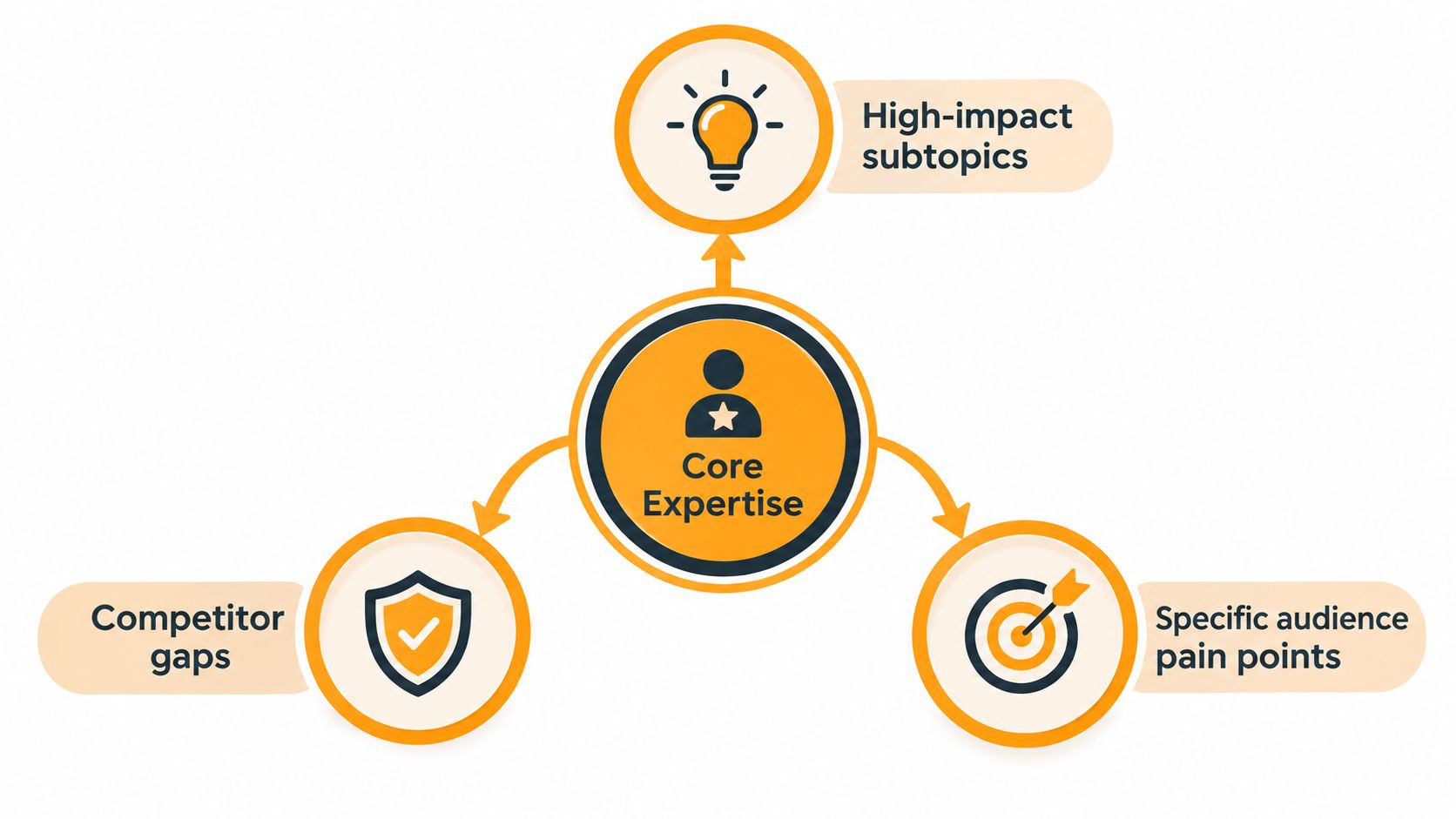
A defensible topic territory combines three inputs:
- Core expertise: Choose subjects the executive knows through direct decisions and experience, not topics selected only because they attract attention.
- Buyer friction: Identify recurring problems affecting active projects, internal alignment, risk, cost, or implementation.
- Competitive whitespace: Find questions competitors answer with generic claims, then offer a sharper interpretation grounded in real work.
“Customer experience” is too broad to guide an executive program. “Why enterprise customer experience initiatives fail at the handoff between sales and implementation” defines a usable arena. It can draw on onboarding, delivery, product design, and account management, while giving sales a relevant idea to discuss with buyers.
The strongest lanes support company strategy without repeating company messaging. A cybersecurity founder could write about security operations. A more distinctive territory might examine how security leaders balance incident response with board-level risk communication. That subject remains commercially relevant, yet gives the executive room to explain judgment a product page cannot provide.
Audit before you publish
Review existing posts, sales calls, customer interviews, board discussions, and conference remarks. Mark ideas that meet at least two tests:
- A buyer has raised the issue more than once.
- The executive made a decision or changed an operating practice because of it.
- The company can provide evidence, an example, or a clearly explained mechanism.
- The idea creates a useful disagreement with standard industry advice.
Cut topics built on borrowed authority or empty prediction. The goal is not a new opinion every day. It is a recognizable set of positions that becomes more useful as buyers encounter the same reasoning across content, conversations, and evaluation cycles. That consistency helps transfer trust from the executive to the company and gives the publishing program a basis for commercial measurement.
Building a Repeatable Insight Engine
Executives shouldn't have to invent ideas at a keyboard. The raw material already exists in the conversations they have every day, including the customer objection that changed a proposal, the implementation problem that exposed a product weakness, or the internal debate that revealed a market assumption.
A 2026 analysis argues that many executive programs lack a system connecting what leaders discuss daily with what appears on LinkedIn, and recommends capturing material from meetings, client calls, and internal strategy sessions instead of chasing topical trends. This analysis of the 2026 thought leadership landscape points toward a more durable model: extract judgment from normal executive work, then edit it for public use.
Separate capture from production
The executive's role is to notice and explain. The operator's role is to preserve, organize, verify, and shape those observations. A shared document, voice-note workflow, meeting transcript, or dedicated message channel can collect raw ideas without demanding polished prose.
Use a simple capture prompt after important conversations:
- What decision did the buyer struggle to make?
- What assumption did the team challenge?
- What advice sounded reasonable but failed in practice?
- What evidence changed the executive's view?
- What would another leader need to know before making the same decision?
The answer may be rough. That's useful. A phrase such as “buyers don't need another dashboard, they need a way to decide which signal deserves attention” contains a point of view. The writer can then ask for context, evidence, and a practical implication.
Turn one insight into an evidence chain
A publishable idea needs more than a strong hook. Build it through four layers:
- Observation: State what the executive has seen.
- Interpretation: Explain why it happens.
- Decision: Describe what leaders should do differently.
- Boundary: Clarify when the advice doesn't apply.
That structure prevents generic inspiration. It also makes content easier for a sales representative, analyst, or buyer to forward because the argument gives them language and a decision framework.
An internal content system can support this without erasing the executive's voice. A useful reference point is this guide to thought leadership content strategy, particularly for designing a workflow that moves from raw expertise to structured publishing.
The goal isn't to manufacture opinions. It's to make the executive's existing judgment legible to the market.
Before publication, verify every factual claim, remove confidential details, and ask whether the post says something the executive would defend in a customer meeting. If the answer is no, the draft needs more substance or a narrower point.
Executing a Sustainable Publishing Cadence
A sustainable cadence is an operating decision, not a race for visibility. The executive needs a publishing rhythm that survives a difficult quarter, a major deal, or a crisis that changes priorities. If the process collapses under pressure, the company has built a calendar, not an insight engine.
LinkedIn's executive guidance recommends 1–2 posts per month, a practical baseline for leaders establishing a disciplined program. The appropriate frequency depends on the executive's available material, audience expectations, and editorial capacity. A smaller set of well-supported arguments usually serves buying committees better than a crowded feed of thin commentary.
Use a low-friction workflow
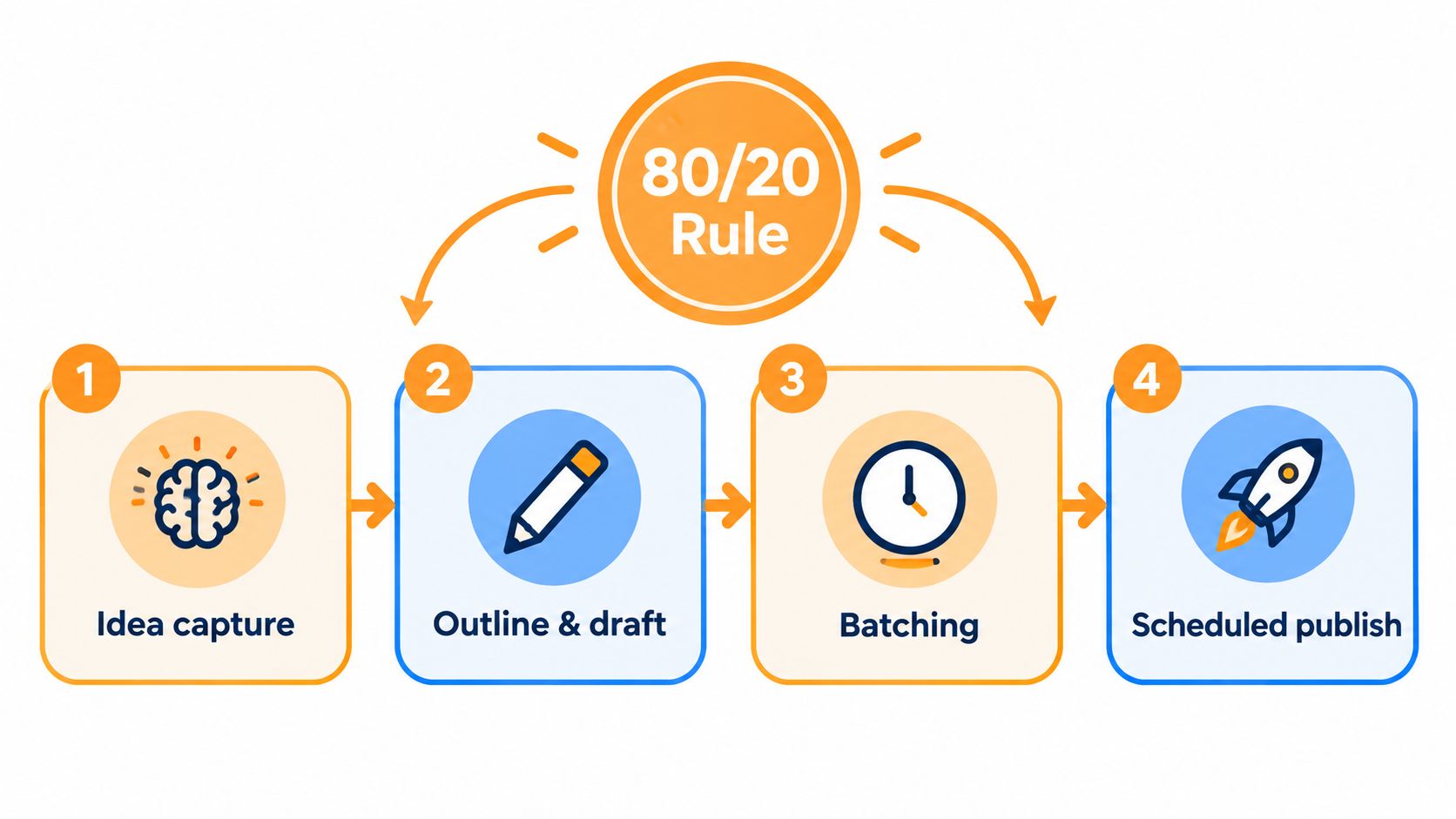
Build the workflow around four stages:
- Capture: Record observations from customer calls, internal meetings, feedback, and executive notes.
- Outline: Tie each idea to a topic lane, buyer problem, and intended action.
- Draft: Express the argument in the executive's natural language, then add proof and remove corporate phrasing.
- Batch and schedule: Approve several finished pieces together, so publishing does not depend on a new decision every week.
This process also creates useful operating data. Teams can see which topics generate qualified questions, which formats sales representatives reuse, and where the executive's judgment helps buyers interpret a difficult decision.
Decision-makers tend to value concise, evidence-rich material. The 2017 Edelman-LinkedIn study found that 71% of decision-makers and 67% of C-suite executives preferred short-form content, while 66% and 63% valued facts, data points, charts, infographics, and figures. Those findings support a LinkedIn-first approach built around clear arguments and proof-rich formats, without requiring the team to publish constantly.
One source idea can become a text post, document carousel, newsletter section, podcast talking point, and sales enablement note. Repurposing does not mean copying one paragraph across every channel. Keep the central judgment, then adapt the structure, evidence, and call to action to the audience.
Participation is part of publishing
An executive profile gains credibility when the leader contributes to relevant conversations. A thoughtful comment on a customer's question, an analyst's observation, or a peer's argument can show expertise without requiring another full post. The comment should add an example, challenge an assumption, or clarify a commercial implication.
A practical guide to best practices for thought leadership can help teams set expectations for credibility, consistency, and reputation management.
Assign an owner to monitor responses, route meaningful questions to the executive, and record ideas generated by discussion. That feedback connects publishing to pipeline: recurring buyer questions become future topics, while useful arguments can support sales conversations and trust transfer.
Measuring Trust Transfer and Commercial Impact
Likes and impressions can tell you whether a post traveled. They can't tell you whether a buying committee trusted the company more, invited a sales conversation, or used the executive's argument to make an internal case.
Measurement remains a weak point across many programs. One source cites 19% of organizations with no measurement process, 42% relying on traffic as the main metric, and only 29% able to link thought leadership to sales outcomes. The analysis of why executive thought leadership programs fail highlights the operational gap: teams create content, but they don't define the business signal it should move.
Use three measurement layers
Start with a baseline and assign an owner for each layer. The executive can own the strategic outcome, while marketing, sales, or communications teams maintain the evidence.
| Measurement Layer | Vanity Metrics (Avoid) | Business Signals (Track) |
|---|---|---|
| Brand lift | Raw impressions, follower totals | Direct mentions in buyer conversations, analyst interest, invitations to relevant discussions |
| Engagement quality | Likes without context, superficial comments | Saves, thoughtful replies, qualified profile visits, forwarding behavior, questions from target accounts |
| Commercial response | Click volume alone | New opportunities influenced, sales cycle conversations, deal progression, executive introductions |
Brand lift asks whether the market associates the executive with the intended territory. Engagement quality asks whether the right people are thinking with the content, not merely seeing it. Commercial response asks whether trust transfers into activity that sales can recognize.
Use qualitative evidence as well as dashboard data. Ask sales representatives whether prospects mention a post, whether a buyer arrives with a more informed question, and whether an executive introduction happens earlier than it normally would. Add a simple content influence field to opportunity notes, but don't claim causation every time someone saw a post. Long B2B buying cycles require disciplined attribution.
Build governance into the workflow
A monthly review should examine which topic lanes generated useful conversations, which claims lacked evidence, and which pieces sales teams used. Keep a record of the executive's intended audience, business objective, publication date, and observed response.
For teams trying to connect content activity with revenue more rigorously, this practical guide to measuring content marketing ROI offers a useful companion to the executive measurement model.
Trust also depends on internal consistency. Sales, customer success, and leadership should recognize the same principles in public content and private interactions. Resources on team rituals that build trust are relevant here because an executive narrative becomes more credible when the organization behaves consistently with it.
Scaling Influence and Strategic Growth Tactics
Influence scales through trusted paths, not publication volume. An executive post may reach only part of a buying group on the executive's profile. A peer who forwards the same idea can place it inside a private discussion with context, credibility, and a clear reason to pay attention.
The 2017 Edelman-LinkedIn study found that 63% of decision-makers and 63% of C-suite executives wanted content relevant to a specific project. Forwarding by someone known and respected increased credibility for 84% of decision-makers and 86% of C-suite executives. The Edelman-LinkedIn thought leadership research explains why trusted distribution matters more than abstract reach.
Design for forwarding
Write for the person who will share the idea with a colleague. Name the problem, state the executive's position early, and give the reader a sentence that connects the issue to the recipient's work. This makes distribution part of the insight engine rather than a final promotion task.
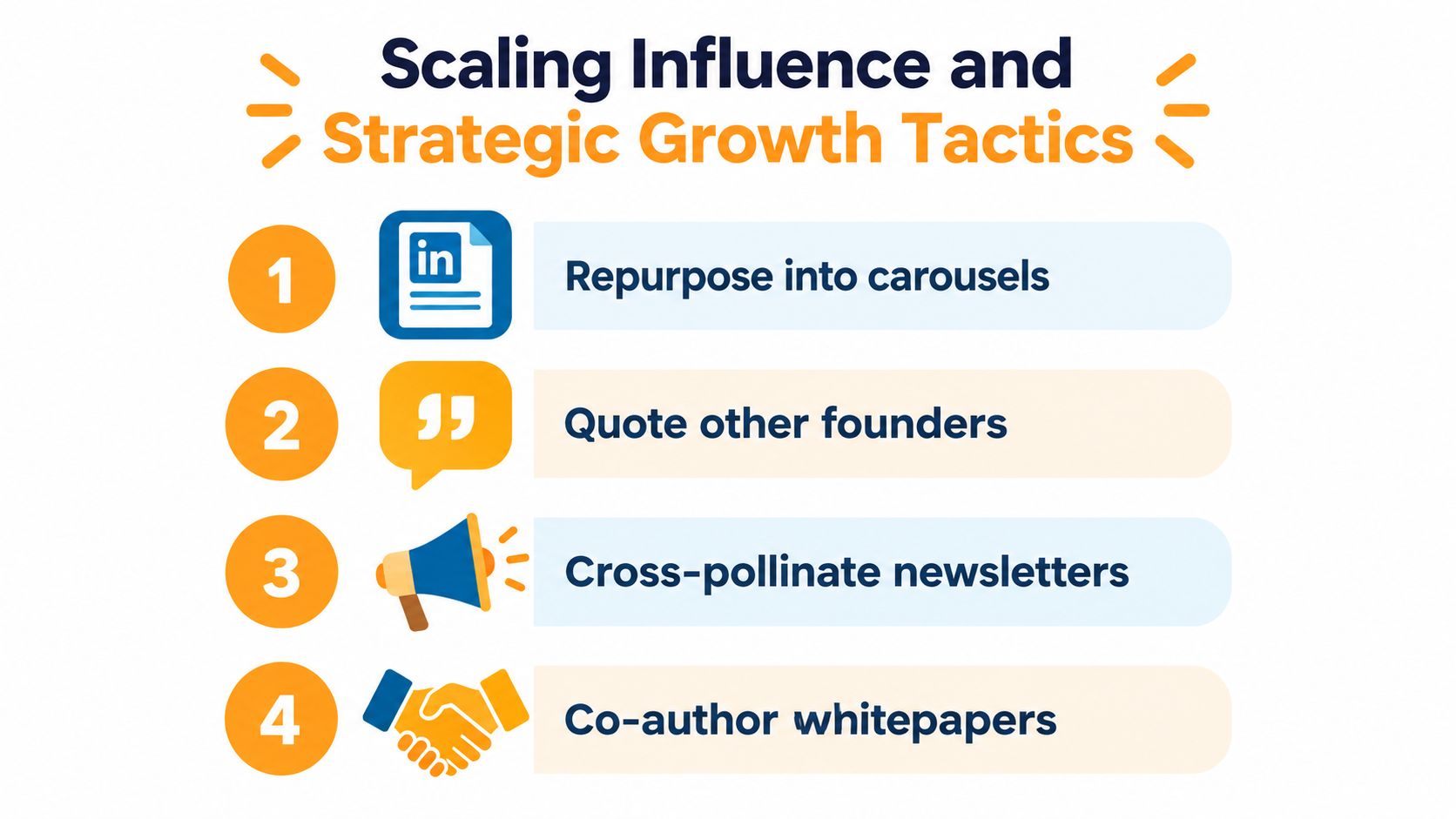
Four growth moves support that system:
- Repurpose the core argument: Turn a substantial insight into a carousel, short post, interview answer, and sales conversation prompt. Keep the argument consistent while changing the format.
- Quote other founders and operators: Respond to specific ideas and add a useful point. Tag people only when the connection is genuine, not as a reach tactic.
- Cross-pollinate newsletters and podcasts: Adapt the same argument for adjacent audiences without reducing it to generic commentary.
- Co-author evidence-rich assets: Work with customers, analysts, or peers on research, whitepapers, or structured discussions. Each contributor should bring evidence or experience that improves the asset.
Distribution also requires audience-specific framing. A board audience may need the risk and decision implication first. A practitioner may need the workflow and technical detail. A procurement stakeholder may need assumptions, boundaries, and implementation consequences. The underlying point can remain stable while the proof and next action change.
Avoid scale without substance
Overproduction creates a predictable failure pattern. The executive publishes frequently, expands into broader topics, makes less defensible claims, and becomes harder to associate with useful expertise. More distribution cannot repair weak judgment or an unclear point of view.
Use a quality check before increasing output:
- Does the piece address a real buyer problem?
- Is the executive's position unmistakable?
- Can the team support every factual claim?
- Is the format easy to consume and forward?
- Can sales, recruiting, or analysts use it in a real conversation?
- Will the executive defend the argument publicly?
Leaders refining the relationship between authority and visibility can use this guide to personal branding for executives, provided profile visibility remains subordinate to commercial trust and useful expertise.
RedactAI can support the workflow by using past posts, interviews, notes, and recurring phrases to generate draft directions. Teams can then edit for a specific executive voice, schedule approved content, and review audience behavior. The tool should strengthen the insight engine, not replace executive judgment.
A sustainable strategy builds a repeatable path from evidence to judgment, judgment to useful content, and content to measurable trust transfer. Start with one defensible territory, assign an owner, capture material from real work, and review business signals before expanding.
If executive content still depends on last-minute inspiration, use RedactAI to turn existing notes, interviews, and expertise into structured LinkedIn drafts while keeping final decisions with the executive. Build capture, approval, scheduling, and measurement into the workflow before the next publishing push.