A feature isn't a differentiator until customers can recognize it, experience it, and explain why it matters. A faster workflow, smarter algorithm, or polished brand story may look distinctive inside a product demo, yet disappear when buyers compare familiar promises from five competitors.
That's why the strongest differentiation strategies connect two systems. The first system changes what the product or service does. The second makes that advantage visible through proof, language, repetition, and customer experience. LinkedIn is especially useful for this work because professionals can show how an advantage operates, not just announce that it exists. LinkedIn has over 1 billion members across 200 countries, with about 310 million monthly active users, creating a large distribution environment for a clear point of view and consistent expertise (LinkedIn content benchmarks).
The list below treats each strategy as an operating decision. For every approach, you'll find the move to make, the evidence to track, the risk to manage, and a practical LinkedIn angle. The aim isn't to admire uniqueness. It's to turn a competitive idea into a signal buyers can remember, test, and repeat through your author platform building strategies.
1. Personalization Through AI-Powered Profile Analysis
Generic personalization usually means adding a name to a template. Useful personalization goes deeper. It studies a person's profile, posting history, professional experiences, and recurring language patterns, then uses that context to shape recommendations and drafts.
Spotify's listening history informs personalized playlists. Netflix uses viewing behavior to shape recommendations. Amazon uses browsing and purchase signals to suggest products. The lesson for professional content is similar: the system needs meaningful inputs before it can produce relevant outputs.
For a LinkedIn writing tool, those inputs might include a user's headline, role, industry, expertise, opinions, and previous posts. A detailed onboarding process can ask whether the user prefers analytical posts, personal stories, tactical breakdowns, or contrarian observations. It can then improve through feedback, such as accepting, editing, rejecting, or rewriting a draft.
What to implement and measure
Start with a clear profile-analysis workflow rather than promising instant “personalization.” Let users review the information being used and correct assumptions. Segment recommendations by role, industry, and experience level, but keep the user in control of the final voice.
Measure draft acceptance, edit distance, publishing frequency, and qualitative feedback about relevance. A draft that gets generated quickly but requires a complete rewrite hasn't created much differentiation.
Practical rule: Personalization should reduce the distance between a blank page and a publishable draft, not remove the professional judgment that makes the post credible.
LinkedIn communication should show the reasoning behind the work. A sales leader might share how customer conversations shape their writing prompts. A founder could compare a generic industry opinion with a version grounded in their own operating experience. Professionals looking to improve the raw material can also use RedactAI's LinkedIn summary builder to clarify the profile context that personalization tools rely on.
2. Content Inspiration at Scale
A B2B marketer reviewing a high-performing LinkedIn post should leave with a usable hypothesis, not a copied template. A curated library can reveal which topics, hooks, structures, and arguments attract attention within a professional community, then turn those observations into new content directions.
BuzzSumo's trending content database, Later's inspiration resources, and Hootsuite's trend reporting reflect the same practical principle: relevant examples reduce the distance between an observation and a draft. An enterprise guide to AI content creation can help teams build that process without treating volume as the outcome.
The library needs annotations. Record whether a post worked because its argument was specific, its author challenged an assumption, or it connected a technical issue to a business consequence. Without that explanation, users copy surface patterns and publish interchangeable opinions.
Make inspiration useful, not imitative
Organize examples by industry, role, topic, and format. Let users save posts, add notes, and create personal collections. Update the library frequently, while keeping trend reports as prompts rather than instructions for everyone to repeat the same view.
Measure saves, return visits, inspiration-to-draft conversion, and the share of ideas adapted into original posts. The operational test is whether browsing produces a distinctive point of view, not whether users consume a large library.
Manage the main risk, imitation, by requiring a new audience, claim, example, or implication in each draft. LinkedIn communication should show that reasoning. Break down a strong post's structure, then explain how its underlying principle changes for another audience. A practical guide to creating viral content should emphasize adaptation, evidence, and relevance rather than formulaic imitation.
3. One-Click Multi-Draft Generation
Speed creates an advantage when it preserves meaningful choice. A user can enter a keyword, customer problem, or rough idea and receive several complete directions before committing to a single opening. The operational move is to generate deliberate variations, not minor rewrites.
Jasper's long-form generation, Copy.ai's variant workflows, and Writesonic's bulk content features show why this capability appeals to professionals. Generate different hooks, levels of directness, narrative structures, and calls to action, then select the version that fits the audience and author. The same workflow can support AI video personalization for TikTok when each draft needs a distinct message or audience angle.
Build a selection system
A multi-draft feature needs comparison controls. Rank or filter outputs by clarity, specificity, originality, length, and alignment with the chosen tone. Editing controls should remain visible, because hiding revision encourages passive acceptance.
Track time from idea to selected draft, selection rate, editing behavior, and published-draft performance. Generation volume is a weak primary KPI. Ten weak options increase review time, while one useful draft can move directly into testing.
Choice depends on meaningful contrast. If every version uses the same hook and argument, the interface creates repetition rather than options.
For LinkedIn, assign each draft a distinct job. One can lead with a personal lesson, another with a customer objection, and another with a direct framework. Users should be able to explain the selection and connect it to a measurable goal, such as qualified comments, profile visits, or conversations. A focused LinkedIn post generator supports that process when the user supplies enough experience and context to guide the drafts. Manage the main risk, superficial variation, by requiring a different claim, example, audience, or implication in each version.
4. Integrated Analytics and Performance Tracking
A content platform becomes strategically useful when it connects publishing activity with learning. Reach, impressions, reactions, comments, profile visits, and engagement rates can reveal patterns, but raw numbers rarely tell a professional what to do next.
Hootsuite Analytics, Buffer's social insights, and Later's reporting tools all point toward a more useful model. The dashboard should summarize what changed, identify repeatable patterns, and suggest a test. For example, it might show that practical operating lessons consistently attract more qualified comments than broad predictions, or that a particular topic earns profile visits without producing meaningful conversations.
Turn reporting into decisions
Use plain-language summaries alongside raw metrics. Let users compare dates, content types, themes, and formats. Scheduled reports can help agencies and consultants share progress, but the report should explain uncertainty. A single strong post doesn't prove a permanent content strategy.
Measure engagement rate, reach, impressions, profile activity, qualified replies, and downstream conversations where those signals are available. The right KPI depends on the business goal. An executive building authority may prioritize relevant comments and profile visits. A recruiter may care more about conversations with candidates.
The visual below reinforces an important operational comparison. Multi-draft generation can shorten the path from idea to test, but analytics determines which test deserves another iteration.

A reporting walkthrough can help teams decide which metrics belong in their weekly review.
5. Content Recycling and Asset Repurposing
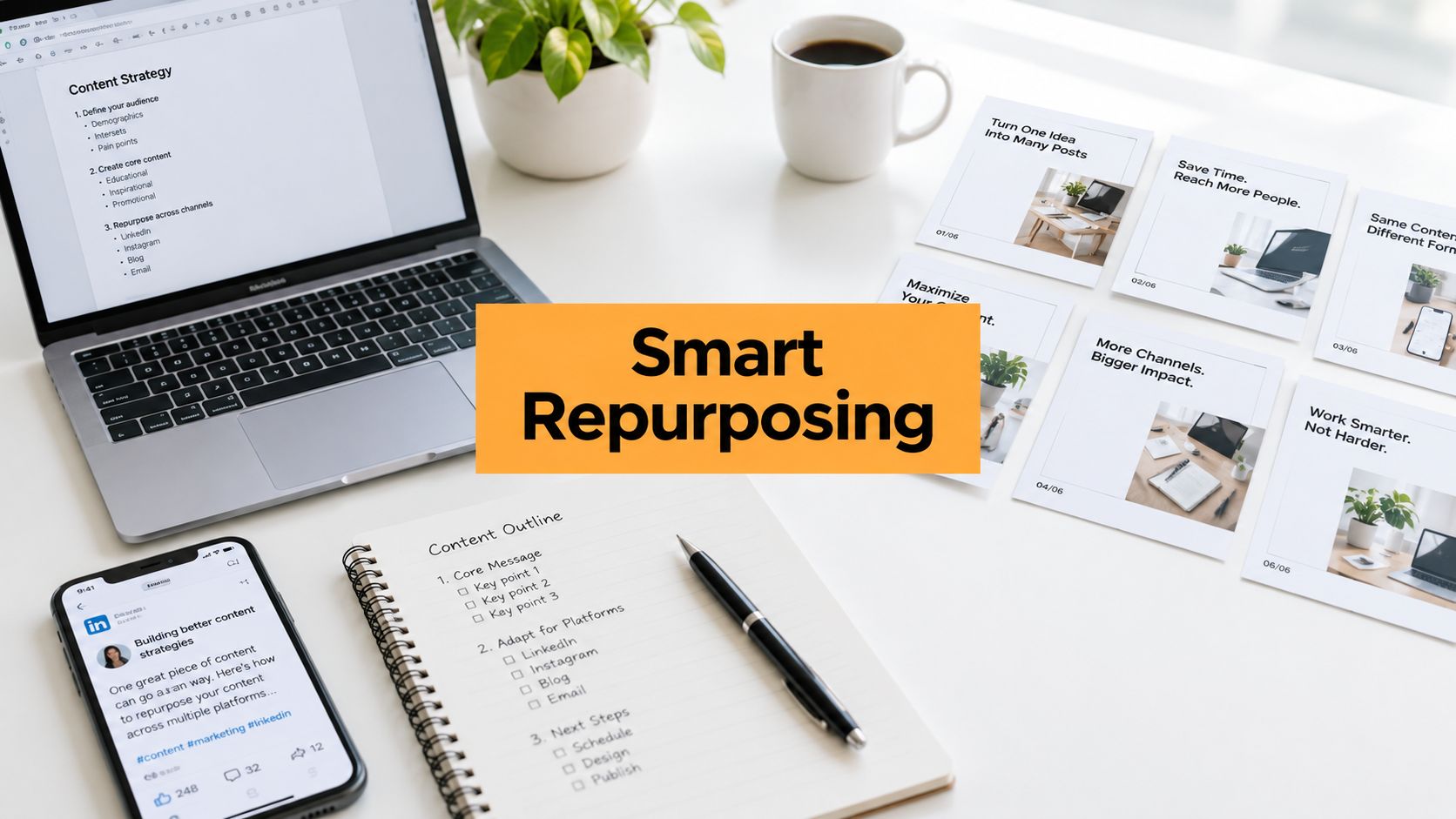
High-performing content shouldn't become disposable the moment it leaves the feed. A strong post can become a different argument, a short story, a checklist, a client discussion prompt, or a deeper explanation for another audience.
Content studios routinely turn long articles into social posts. Podcasters convert episodes into articles, clips, and quotations. The operational advantage comes from treating the original idea as an asset with multiple possible expressions, not as a one-time performance.
Preserve the insight, change the context
Start by identifying posts that earned meaningful responses or led to useful conversations. Then create variations with a different audience, example, objection, or conclusion. Repeating the same wording too soon damages trust and teaches followers to ignore your updates.
A repurposing workflow should include:
- Change the angle: Move from “what happened” to “what we learned” or “what others should do.”
- Change the format: Convert a narrative into a framework, a framework into a short story, or a lesson into a question.
- Require approval: Let the author review every recycled draft before scheduling.
- Track the derivative: Compare the adapted post with the original by topic, format, and audience response.
The main risk is content fatigue. A publishing calendar should create enough space for the audience to encounter a fresh interpretation rather than a recognizable duplicate. Measure recycled-content saves, comment quality, profile activity, and whether repurposed posts introduce the idea to a new audience.
LinkedIn storytelling works best when the author adds new evidence. A follow-up post can explain what changed after the original lesson, which makes the series more credible than repeating a winning hook.
6. Industry-Specific and Niche Content Expertise
Broad advice is easy to produce and difficult to remember. Niche expertise creates a sharper reason to follow, especially when the content reflects the language, constraints, buying process, and unresolved problems of a particular professional group.
HubSpot publishes industry-oriented marketing guidance. SalesLoft focuses heavily on sales workflows. ConvertKit built a recognizable position around creators. Their common lesson is not that every company needs a narrow audience forever. It's that specificity gives content a working context.
Start narrow enough to learn
Choose a small group of industries or roles where you can validate terminology and pain points. Partner with practitioners who can challenge generic assumptions. Build templates around real decisions, such as procurement reviews, hiring handoffs, compliance concerns, or implementation trade-offs.
Measure qualified engagement, return readership, content saves, inbound conversations, and whether prospects use your language when describing their problem. Avoid vanity signals from a broad audience if the business serves a specialized market.
The risk is overfitting. A niche system can become so narrow that it misses adjacent buyers or treats every professional as a stereotype. Let users adjust the level of specialization and keep examples grounded in actual experience.
On LinkedIn, niche expertise becomes visible through useful specificity. A cybersecurity professional could explain how a security team evaluates a vendor claim. An HR leader could unpack the operational cost of a hiring policy. The post should sound like it came from someone inside the work, not someone summarizing an industry page.
7. Authentic Voice Preservation Technology
AI can produce fluent language while erasing the author. The sentences may be polished, but the argument becomes generic, the humor disappears, and the professional's distinctive way of explaining a problem gets replaced by familiar platform language.
Voice preservation technology addresses that failure by studying linguistic patterns, communication habits, expertise, and personal principles. OpenAI's fine-tuning concept and custom brand-voice chatbots illustrate the broader approach. A professional content system can use prior posts and structured interviews to identify how someone opens an argument, uses examples, handles disagreement, and closes a point.
Define authenticity operationally
Voice isn't a single slider called “professional.” Let users adjust characteristics such as directness, warmth, technical depth, skepticism, and storytelling. Provide draft feedback that flags phrases which don't resemble their normal language, but avoid pretending that an authenticity score can replace human review.
Track accepted drafts, manual edits, voice-related feedback, repeat usage, and whether the author can recognize the reasoning behind the output. Interview users during onboarding and ask for examples of writing they consider unmistakably their own.
The best AI draft sounds like an accelerated version of the author, not a replacement for the author.
LinkedIn offers a clear test. Publish a post that makes a real claim, includes a specific experience, and uses the author's normal vocabulary. Ask trusted colleagues whether it sounds like the person they know. If the answer is no, more automation won't solve the differentiation problem.
8. Advanced Scheduling and Cadence Optimization
Scheduling is more than placing posts on a calendar. A useful system connects audience behavior, content type, time zones, publishing frequency, and the author's capacity to maintain quality.
Buffer's optimal posting-time feature, Later's calendar interface, and Hootsuite's recommendations show how scheduling tools can move beyond manual date selection. The practical advantage comes from testing a sustainable rhythm and learning which conditions support useful engagement.
Optimize without manufacturing noise
Analyze the audience's time-zone distribution and separate schedules for educational posts, personal stories, announcements, and conversation starters. Offer preset cadences for users who need a starting point, but allow them to override recommendations. A schedule that maximizes activity while exhausting the author isn't a durable advantage.
Measure consistency, engagement by content type, qualified comments, profile activity, and the relationship between publishing volume and content quality. Don't assume the most convenient time is the best time, and don't confuse more posts with a stronger position.
The risk is automation without judgment. LinkedIn audiences notice when a professional publishes polished but context-free updates at a mechanical rhythm. Keep a human approval step, especially for posts tied to current events, clients, hiring decisions, or sensitive industry issues.
A strong LinkedIn cadence gives the audience a reason to return. It might be a weekly teardown, a recurring lesson from customer calls, or a regular explanation of a technical decision. The schedule reinforces the promise, while the author's insight makes the promise worth following.
9. Real-Time Trend Detection and Opportunity Alerts
Trend participation can create visibility, but chasing every popular topic weakens positioning. Real-time detection becomes a differentiation strategy only when it filters emerging subjects through the user's expertise and suggests a credible angle.
Twitter's Trends section, Google Trends, Brandwatch, and Muck Rack's monitoring tools represent different versions of the same workflow. They help users notice what is gaining attention. A professional content system should add judgment by filtering trends by industry, role, relevance, and potential audience value.

Alert users to a useful point of entry
An alert should answer more than “this topic is popular.” It should suggest why the user has permission to comment, what question their audience may have, and which evidence would make the post valuable. Let users subscribe to categories and mute topics that don't fit their position.
Measure alert-to-draft conversion, time from alert to publication, relevant engagement, and subscriber retention. Historical performance can help users understand which types of trends produce meaningful conversations rather than temporary reactions.
The main risk is speed without accuracy. Before publishing, verify the source, date, context, and implications. A fast but uninformed LinkedIn opinion can damage authority more quickly than silence.
The strongest trend post adds a professional lens. A finance leader might explain how a market story changes planning assumptions. A product manager might connect a technology announcement to implementation constraints. The trend supplies attention, but expertise supplies differentiation.
10. Community-Driven Content Inspiration and Peer Learning
Professionals often learn faster from people facing similar decisions than from polished brand content. A community can surface practical examples, compare approaches, and show which ideas resonate within a role or industry.
Product Hunt uses community feedback around products. Reddit organizes discussion through topic-focused communities. Indie Hackers gives founders a place to share experiences, and AppSumo users contribute reviews and comparisons. A professional content platform can apply the same principle by showing anonymized patterns from peers with similar goals.
Design for trust and contribution
Privacy comes first. Anonymize performance data and obtain clear permission before using examples. Role-specific and industry-specific groups can make discussion more relevant, while recognition programs can reward useful analysis instead of shallow activity.
Useful community features may include:
- Peer libraries: Let members save strong examples and explain why they worked.
- Mentorship paths: Connect professionals with compatible experience and goals.
- Learning sessions: Host webinars where members dissect a post, experiment, or publishing decision.
- Recognition signals: Reward thoughtful contributions, not only high-volume posting.
Measure contribution quality, repeat participation, peer responses, content adaptations, and whether members apply lessons in their own LinkedIn publishing. A leaderboard can motivate participation, but it can also encourage gaming if the rules reward quantity over usefulness.
LinkedIn communication should reflect the community's learning. Share an anonymized pattern, explain the decision behind it, and invite practitioners to challenge or extend the idea. The author becomes a guide and participant, not a broadcaster pretending to have every answer.
10-Point Differentiation Strategy Comparison
| Strategy | 🔄 Implementation Complexity | ⚡ Resource Requirements | ⭐ Expected Outcomes | 📊 Ideal Use Cases | 💡 Key Advantages & Tips |
|---|---|---|---|---|---|
| Personalization Through AI-Powered Profile Analysis | High, complex ML pipelines & continuous training | High, historical user data, compute, privacy controls | Very high authenticity & stronger audience trust | Professional creators with rich histories; platforms needing per-user voice | Creates authentic content; onboard to capture voice prefs; implement feedback loops |
| Content Inspiration at Scale (Viral Post Database) | Medium, real-time tracking + curation workflows | Moderate, data ingestion, curation team, metrics feeds | Faster ideation; reduces writer's block (risk of formulaic output) | New creators, content teams seeking examples and trends | Removes creative barriers; update frequently; explain why posts performed well |
| One-Click Multi-Draft Generation | Medium, generation models and variant UI | Moderate, text-generation models, editing & ranking tools | High throughput; enables quick A/B testing (quality varies) | High-volume publishers, non-writers, social teams | Speeds production; include quality filters, editing tools & ranking |
| Integrated Analytics and Performance Tracking | High, API integrations, dashboards, real-time processing | High, analytics stack, data engineering, LinkedIn access | Data-driven optimization; clearer ROI and content refinement | Marketing teams, enterprises, ROI-focused stakeholders | Provide actionable insights + scheduled reports; simple dashboards for non-analysts |
| Content Recycling and Asset Repurposing | Medium, content scoring + variant generation + scheduling | Moderate, repurposing tools, calendar integration, oversight | Maximizes ROI; extends lifespan of top content (avoid overuse) | Teams with evergreen assets; resource-constrained creators | Space repurposed posts (3–6 months); vary angle and obtain user approval |
| Industry-Specific and Niche Content Expertise | High, domain research, specialized models & validation | High, industry data, expert partnerships, ongoing updates | Higher relevance and credibility within niches | Niche professionals, vertical B2B strategies, role-specific audiences | Start with 3–5 industries; partner experts; build niche templates and benchmarks |
| Authentic Voice Preservation Technology | Very high, voice fingerprinting, scoring & calibration | High, advanced NLP R&D, onboarding and calibration time | Preserves personal brand voice; increases trust and consistency | Executives, thought leaders, creators prioritizing authenticity | Offer manual adjustments and authenticity scores; run onboarding voice interviews |
| Advanced Scheduling and Cadence Optimization | Medium, timing algorithms + scheduling UX | Moderate, historical engagement data, calendar integrations | Optimizes reach and prevents audience fatigue | Multi-timezone teams, busy creators needing consistent cadence | Provide presets, timezone-aware recommendations; allow schedule A/B tests |
| Real-Time Trend Detection and Opportunity Alerts | Very high, streaming monitoring, signal filtering & alerts | High, streaming data, NLP models, alerting infrastructure | First-mover advantage on trends; increased timeliness (not guaranteed virality) | PR teams, newsjacking, trend-driven creators & strategists | Filter by relevance/industry; send timely alerts with suggested angles |
| Community-Driven Content Inspiration and Peer Learning | Medium, community features, moderation & benchmarking | Moderate, critical mass of users, moderators, incentive programs | Collective intelligence and faster learning; network effects | Creators who learn from peers; platforms building community moats | Anonymize peer data; incentivize sharing; host mentorships and case studies |
Turn Your Advantage Into a Repeatable Signal
The best differentiation strategies don't begin with a large feature list. Choose one customer problem where your product, service, or expertise can behave differently, then define what a buyer should notice. If the difference can't be experienced or explained without a long presentation, it probably isn't ready to lead your positioning.
Start with a baseline KPI that matches the intended outcome. For LinkedIn, that could be qualified comments, profile activity, saves, direct conversations, or draft-to-publish time. Record the current pattern before changing the workflow. Without a baseline, teams tend to credit every improvement to the newest tool and learn very little about what caused it.
Then turn the operational advantage into a communication system. If your product personalizes content, show how the inputs change the output. If your expertise is niche, publish examples that generalists can't produce without lived experience. If your scheduling system improves consistency, make the recurring format recognizable enough that followers know what they'll get from you.
Thought leadership deserves particular discipline because buyers spend real attention on it. In research cited by independent statistics coverage, 54% of decision-makers spent more than an hour per week reviewing thought leadership in 2021, while 63% of hidden buyers did so by 2025, according to the cited coverage (thought leadership and market differentiation). That attention creates an opportunity, but only for content that offers original insight, useful evidence, or specialized judgment.
A serious validation process also asks whether customers perceive the difference. One 2025 industry research summary says brand differentiation accounts for 57% of future retail growth, while a separate 2025 LinkedIn industry post citing Bain research says only 8% of customers agree that brands are meaningfully differentiated (research summary on brand differentiation). These figures point to a practical gap. Internal teams may understand a distinction that buyers never recognize.
Pair authentic voice preservation with analytics and a sustainable publishing workflow. Voice keeps the message credible. Analytics shows which ideas earn attention from the right people. Scheduling protects consistency, while recycling and niche inspiration help the system compound without forcing the author to sound like a generic content machine.
RedactAI can support that workflow by generating personalized LinkedIn drafts, surfacing niche inspiration, scheduling posts, recycling strong content, and reviewing performance while preserving the user's established voice. Treat it as part of a testing system, not as a substitute for customer knowledge or editorial judgment.
The strategic question is simple: can your audience recognize the difference, experience its value, and repeat the reason it matters? If you can answer yes with customer evidence and LinkedIn consistency, your differentiation has moved beyond a claim. It has become a market-facing signal.
RedactAI helps professionals turn profile context, past posts, niche inspiration, multi-draft generation, scheduling, recycling, and analytics into a more consistent LinkedIn workflow. Visit RedactAI to test a personalized approach and make your competitive advantage easier for the right audience to recognize.