It's the second week of December, and your feed has already started its slide into highlight reels. A founder you follow "closed the best quarter of her life." A sales director posts a photo of a whiteboard with twelve circles on it. Somewhere in your drafts folder sits a half-written post of your own, three bullet points about wins, and no clear sense of whether it's worth publishing.
The hesitation has data behind it. Pew Research Center found that fewer than one month into the year, 87% of people who made resolutions said they'd kept at least some of them, but only 59% had kept all of them, and 28% had kept only some (Pew Research Center). People start strong and drift. Your readers have lived that drift inside their own year, which is why a wrap-up that lists only wins reads like a press release from a company nobody quite trusts.
The version that earns replies is harder to write and simpler to read: every win carries its baseline, every metric its denominator, and one real miss keeps the whole post honest.
The Wrap-Up Post Template, Part by Part
Six parts, in this order: hook, context, three wins, one lesson, two or three priorities, and one closing question. That's the skeleton. It lands at roughly 180 to 260 words, which is about what people will finish on a phone before they scroll on.
| Part | What goes in it | Length |
|---|---|---|
| Hook | One specific moment or number from your year | 1-2 lines |
| Context | What your year was about, in one sentence | 1 line |
| Wins | Three outcomes with numbers and baselines | 3 short bullets |
| Lesson | One thing you would change next time | 2-3 lines |
| Priorities | Two or three goals for next year with dates | 3 short bullets |
| Closing question | One question that invites replies | 1 line |
Two filled-in versions
A consultant's post might read like this:
We shipped 14 client projects this year and lost 3 at the proposal stage. 2025 was the year I stopped selling retainers and started selling audits. Audits went from 2 to 9 a quarter. Proposal-to-close moved from 31% to 44% across 27 proposals. Average project value went from $8k to $11k. What I'd change: I priced the first five audits at cost, and the next ten clients held me to that number. Next year: one teardown published by the 15th of each month, six audits per quarter maximum, a VA hired by April. What's the smallest number you'd need to see before calling a year a good one?
A marketing lead's version runs shorter and blunter: "Our webinar program drove 4,900 of the 5,600 subscribers we added this year, and I treated it as a side project for two quarters. We're running six next year, one per quarter, with a landing page built before the first invite goes out." Notes it as a win, names the mistake, dates the fix.
Why the order matters
The hook sits first because only about two lines show above the "see more" tap on mobile, and a line like "We shipped 14 projects, and 3 failed" gets tapped while "Reflecting on an incredible year" gets scrolled. The wins come next because they buy you the right to be believed before you ask for anything. The closing question last, because comments are the clearest signal a post is worth showing to more people.
Every slot needs something true in it. If the lesson line is empty, you don't have a wrap-up yet. Paste the draft into the LinkedIn post formatter to see where the mobile cut lands and whether your line breaks survive the trip.
The Metrics Worth Sharing and the Ones to Skip
One post that catches the algorithm can out-reach eleven months of steady work. That's exactly why leading with impressions is a trap: the number is real, but it describes one Tuesday in April, not your year. Reach works as context. It stops working as your only headline, because it says nothing about whether the right people noticed.
| Metric | What it tells readers | Watch out for |
|---|---|---|
| Impressions | Total reach across the year | Inflated by one viral post; pair with another metric |
| Profile visits | Who wants to learn more about you | Spikes easily; hard to tie to revenue |
| Saves | Content people want to revisit | Small base, so report as a rate |
| Qualified replies | Conversations with your target audience | Count only replies from the right people |
| Click-throughs | Traffic to your site or booking page | Needs a tracked link to mean anything |
| Follower growth | Audience change over twelve months | Report net growth, not gross additions |
Profile visits sit one step up from impressions, because someone chose to look. They still spike for reasons that have nothing to do with your work, usually a comment you left on somebody else's viral post. Saves are more useful, and a much smaller base, so quote them as a rate against your own median rather than a raw total.
Qualified replies are the metric I'd defend hardest. A reply from a hiring manager in your target industry is worth more than two hundred likes from people who will never buy anything. Click-throughs only count if a tracked link sits behind them, and follower growth only means something as a net figure across twelve months, which means you have to subtract the drop-offs.
Rules that keep the numbers honest
- Show the denominator. "Replies from 320 people in my target audience" is a claim. "Lots of great conversations" is a mood.
- Compare the same window. Twelve months against twelve months, or Q4 against Q4. A strong December against a weak January tells you nothing.
- Never crown an outlier. One post that outperformed doesn't prove a strategy. Say "one post did this, and here's my guess why" if you want to mention it at all.
Practical rule: if you can't name the denominator, leave the number out of the post.
The one-sentence test settles most of this. Share a metric only if you can say what it means and how you measured it in a single sentence. If the sentence needs a second clause to explain the caveat, the caveat belongs in the post. Pick three for the year: one reach metric, one engagement metric, one business action. Impressions, saves, and booked calls is a defensible set. Twelve metrics is a spreadsheet nobody reads.
Drafting the Honest Wrap-Up in Five Steps
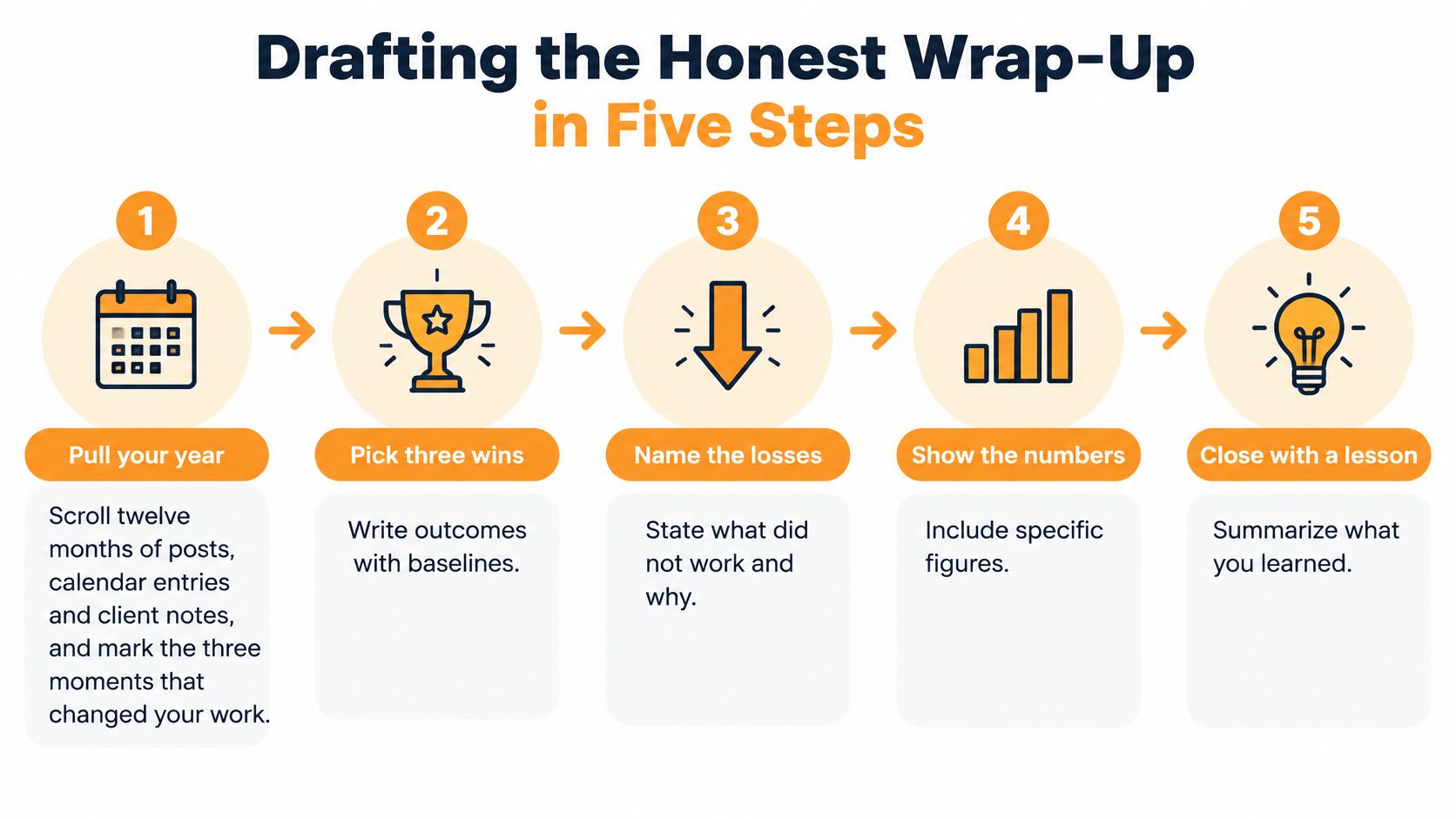
1. Pull your year before you write a word. Scroll twelve months of posts, calendar entries, and client notes, and mark the three moments that changed how you work. The common slip here is trusting memory, which reconstructs the last six weeks and confidently calls it a year.
2. Pick three wins and write them as outcomes with baselines. "Qualified replies rose from 40 to 65 a month" is a win. "Posted 200 times" is a chore list. The slip is describing effort instead of result, which is the single fastest way to make a year-end post forgettable.
3. Write one miss, and only one. Name a stalled project or a wrong assumption, then state three things: what didn't work, the belief that turned out to be false, and what you'll stop doing. For example: "A launch I pushed for six months reached 40% of target because I assumed my email list would carry it. I'm not running another launch without a paid channel attached from week one." This is the line that fills the lesson slot in the template, and it's the line readers remember. Two misses reads like an apology. One miss reads like judgment.
4. Draft two or three priorities, each with a target and a date. Not "be more consistent." Instead: "Ship a case study by the 20th of each month, starting January." A priority without a date is a wish, and readers can tell.
5. Write the hook last. Find the most specific sentence in the draft and move it to line one. "We shipped 14 client projects, and 3 of them failed" beats "What a year!" every time, because the second one could belong to anyone.
What to check before you publish
Two things get people in trouble. First, employer rules: if your post touches team performance, a layoff, or a reorg, check what you're allowed to say before you say it. Second, names: get written permission before you mention a client, a colleague, or a candidate, even if the story flatters them.
Then answer three questions for yourself. Which goal became irrelevant this year? Which decision would you reverse? What are you stopping next year? Any answer you can't bear to write down is usually the most useful one.
Read the finished draft aloud and time it. If you run out of breath before the end, cut the middle third. Most wrap-ups lose a full paragraph of throat-clearing before the first real number.
Setting Next-Year Goals That Survive February
More than half of U.S. adults said they planned to make at least one New Year's resolution for 2025, according to an AP-NORC poll conducted in December 2024 (AP News). Most of those plans are dead within weeks, and the reason is usually grammar rather than willpower.

Write goals as behaviors you can observe. "Publish one case study a month" survives contact with a busy quarter. "Stop posting fluff" and "publish more" don't, because neither one tells you what to do on a Tuesday morning.
Then attach a trigger to each goal, in if-then form: "If a post format drops below my average engagement for three posts in a row, then I test a new opening on the fourth." This isn't a productivity ritual, it's the part that does the work. A meta-analysis of 94 independent studies found if-then plans produced a medium-to-large improvement in goal attainment (d = 0.65), beyond the effect of having a goal (NYU Scholars). Intentions alone are weaker still: goal intention explains only about 28% of the variance in behavior across 422 studies (National Cancer Institute).
Build each goal from the review you just finished. Classify every result from last year as achieved, partially achieved, missed, or abandoned, then take the biggest constraint behind each miss and turn it into one if-then plan. The failure modes are well catalogued in this rundown of common mistakes in goal setting, and nearly all of them come down to a goal with no trigger and no review date.
The four fields every published goal needs
- Owner. Even when it's you. Write your own name, because it makes the next deadline harder to move.
- Deadline. A specific date, not a month, not a quarter.
- Metric. The number that tells you whether it happened.
- Check-in date. The first week of March, June, and September works for most annual plans.
The working rule: publish only the goals you can check in December. Anything you can't audit stays in a private notes file, where it can be revised without becoming a public retreat.
If you run LinkedIn consulting for clients, build those four fields into their plans before you hand the document over. A client who receives three dated, checkable goals will use them. A client who receives a slide titled "Content pillars 2026" will not open it twice.
Using AI Without Losing Your Own Voice

A model is good at four things here: outlining the six parts, tightening sentences that ran long, offering five alternate hooks so you can pick, and spotting the paragraph where your structure collapses. Let it do all of that. None of it requires your judgment.
What it cannot supply is the material that makes the post yours. The specific numbers from your own dashboard. The names, once you have permission. The moment you were wrong and what it cost. Your read on what the year meant, which is the one thing no model has access to.
The stakes are measurable. Baringa found that 81% of respondents valued human-created content more than technology-created content, citing authenticity and personal connection, and 42% worried AI-generated content could be passed off as real (Baringa). Readers aren't suspicious of tools. They're suspicious of polish with nothing underneath it.
The three-label check
Go through the draft and mark every sentence as one of three things. Evidence is something you can verify: a number, a date, a shipped project. Interpretation is what you think it means. Aspiration is what you want next. All three belong in a good wrap-up, and all three need your eyes before publishing, because a model will happily invent evidence and present it with total confidence.
Voice check: read last year's best post and this year's draft back to back, out loud. If the new one sounds like a press release, rewrite the middle third by hand.
Decide your disclosure rule before you need it, especially if you ghostwrite. Some clients want a line about tools, some want silence, and improvising that answer the day a commenter asks is how a good post turns into a bad thread. If you want a faster first pass on structure, RedactAI's content creation tool drafts from your own profile and history, which at least starts you closer to your voice than a blank page does.
Schedule Your Wrap-Up Post This Week
Publish between mid-December and the first week of January. Feeds thin out, readers still scroll, and your post competes with far fewer people announcing the same thing. Pick a weekday morning in your audience's time zone, not yours, and treat the date as fixed the moment you choose it.
The routine that gets it done without a last-minute scramble:
- Draft in one sitting using the six-part template and the five steps. Rough is fine, gaps are not.
- Run the final check. Every part has something true in it, every win has a baseline and a denominator, the miss is single, and each priority has a date and a metric.
- Schedule it rather than keeping it in drafts, where good posts go to die.
- Set a sixty-day check on impressions, saves, qualified replies, click-throughs on tracked links, and net follower growth.
- Record the numbers in the same notes file where next year's goals live, next to the baseline you'll compare them against.
- Recycle it in Q1. The shorter version that reports progress on your priorities turns your first check-in into a second post, and it proves the priorities were real.
That last step is where RedactAI's scheduling and recycling tools earn their place: you can queue the post, pull real-time statistics afterward, see which of your posts performed best, and repurpose the winner instead of starting from an empty draft. The wrap-up stops being a one-off and becomes the opening move of the year.
One reminder worth taping to the monitor: the wrap-up is only worth publishing if its priorities are dated and checkable. A beautiful recap with no dates is a diary entry with a distribution plan.
RedactAI is built for the part after the reflection: turning your honest review into a post that sounds like you, scheduling it for the morning you picked, and recycling your strongest pieces into next quarter's progress update. You can draft in your own voice, track what performed, and keep the cadence going past January. Start free at RedactAI and find out what your year looks like once it's written down.