Tuesday, 9:40am. Your sales director wants a post on the partnership that goes live Thursday. Your support lead is chasing three comments nobody answered since Friday. Legal still has the draft you sent on Thursday, and a board member has asked why the company page has been quiet for nine days. Nobody in that list is arguing about word choice. They're arguing about decisions: who approves, what gets said, how fast, and who owns the outcome when it lands badly.
That's the role. Leader social media is a decision-making job before it's a writing job, and the person who holds it gets judged on the calls they make, not on how many posts they personally publish. Get the calls right and the calendar fills itself. Get them wrong and you spend the week apologising, chasing sign-off, or explaining a screenshot in a crisis channel.
What follows is how I'd structure the role, staff it, and prove it's working, with the trade-offs named instead of hidden.
What a Social Media Leader Is Responsible For
A social media leader owns how the company shows up on social platforms. This includes the rules of the voice, the shape of the calendar, the people who do the posting, the standard for replies, the approval path, and the numbers that land back on your desk at month end.
The job exists because the accounts exist. In 2025, 67% of Fortune 100 CEOs had claimed a social-media profile, according to H/Advisors Abernathy's analysis of Fortune 100 CEO accounts. Every one of those profiles needs an owner, a voice guide, and someone who decides what doesn't get posted.
Social media leader responsibilities at a glance
| Responsibility | What it involves | How often |
|---|---|---|
| Brand voice and guidelines | Writes tone rules, approved phrasing and examples of good and bad posts | Set up once, reviewed quarterly |
| Content planning | Sets themes, content pillars and the monthly calendar | Monthly, with weekly check-ins |
| Team direction | Assigns writers, designers and community staff and sets their priorities | Weekly |
| Engagement oversight | Sets reply standards and monitors comments and messages | Daily |
| Approvals and risk | Decides what needs sign-off and handles escalations | Per post, plus crisis response |
| Reporting | Reviews performance and recommends what to change | Monthly, with a quarterly review |
What a typical week looks like
Say you lead social for a five-person marketing team. Monday morning is a 45-minute planning review where you check the week's calendar against the pillars and cut anything that repeats last month. Tuesday and Wednesday you're the approver, clearing drafts and sending two back because they make claims nobody can support. Comments get a daily pass of about fifteen minutes, sorted by risk rather than volume. Friday afternoon you read the numbers and write down one change for next week.
The mix-up worth killing early is the belief that the leader is the person who posts the most. They're not, and they shouldn't write every draft either. A leader who personally drafts twenty posts a week has no time left to set the standard the other two hundred follow.
When production is the bottleneck rather than judgement, teams sometimes bring in nearshore social media support for agencies to carry volume while the leader keeps decision rights. That split holds up when the brief is written down. Without it, you've outsourced the voice and kept the blame.
A five-minute audit: list every social task you touched last week and tag each one to a row in the table above. If more than half land in approvals or firefighting, you're a bottleneck, not a leader.
The Strategy Work That Sets Direction
Strategy here means the choices made before anyone opens a draft: what the presence is for, where it lives, and what it says. Get those three wrong and you'll produce a busy calendar nobody can defend in a budget review.
Pick one business goal per channel
Goals come from the business, not from the platform. Brand awareness, inbound leads, hiring pipeline and investor visibility are four different jobs, and each needs its own success measure. Awareness lives in reach among a defined audience. Leads live in the conversations that reach sales. Hiring lives in applications and the source data that explains where they came from.
Channel choice follows the audience. LinkedIn suits B2B and leader-led thought leadership because the people you want are already reading there. Instagram and TikTok suit consumer brands with something visual to show. A channel where your buyers aren't present isn't a choice, it's a cost, and closing one is often the cheapest decision you'll make this quarter.
Personal brand is a separate goal from company brand, and worth naming out loud. In 2025, 30% of UK CEOs said their social-media activity had turned them into influencers, according to BT research conducted with Censuswide among 500 UK CEOs and SME founders. If that's the ambition, decide in advance who benefits and how it gets measured.
Set four or five pillars and a starting mix
Pillars are recurring themes: expertise, company life, people stories, industry commentary, promotion. Four or five is enough to rotate without repeating yourself. I'd start around 40% expertise, 30% company and people, 20% industry commentary and 10% direct promotion, then shift the ratio once you see what the audience saves and replies to.
Cadence, ownership and a 90-day review
Decide posts per channel per week, who drafts, who approves, and when the plan gets reviewed. A 40-person software firm I'd set up this way: LinkedIn only, three pillars, three posts a week, one writer drafting, the marketing lead approving, review after 90 days. Nothing new gets added until that review.
The test of the whole exercise is one page. Can a writer who joined last week explain the goal and the pillars from the brief without asking you? If not, the strategy lives in your head, which means it goes on holiday when you do.
Research on 320 S&P 1500 CEOs and more than 250,000 posts on X from 2009 to 2021 found that post volume, positivity and topic variety were positively associated with achieving CEO social-media celebrity, defined as high audience attention combined with positive emotional responses, while post uniqueness showed no significant relationship, as reported in the Journal of Management Studies study. Treat that as permission to publish on a steady rhythm, keep the tone constructive and rotate themes instead of chasing a novel format every week.
Skills That Separate Strong Social Media Leaders
Every strong social media lead I'd hire shares a handful of habits, and each one can be built on purpose rather than waited for. What matters is clear, along with how to practise it.
- Editorial judgment. Knowing which story is worth telling and which one to leave alone. Build it by reading ten competitor posts a month and writing one line on why each worked or fell flat.
- A clear written voice. Editing other people's drafts so they sound like the company without sanding off the detail. Practise on one junior draft a week: rewrite it, then show the writer exactly which three lines you changed.
- Data reading. Spotting why a post worked, not just that it did. Pull your three best posts each month and name the common element before you look at the format.
- People management. Giving feedback that improves a draft without rewriting all of it yourself. Rewrite everything and you've trained the team to wait for you.
- Crisis composure. Staying calm and fast when a post goes wrong, which mostly means having a holding statement ready before you need one.
- Platform fluency. Knowing how each feed rewards behaviour: comments and dwell time on LinkedIn, saves and shares on Instagram, watch-through on TikTok, with links behaving differently on every one. Sit with the community manager for a full day each quarter.
- Stakeholder negotiation. Getting legal, sales and product to agree on a process fast enough to matter. One sales call a quarter teaches you more about how buyers describe the brand than any dashboard.
Under the written voice skill, hold one hard rule: every post should contain a detail only your company could supply, whether that's a real customer problem, a named decision or a number from your own work. A 2025 university study evaluated real Instagram and LinkedIn posts from five prominent CEOs with 100 participants and found measurable differences in perceived authenticity and trustworthiness, published through eScholarship. Audiences judge the relationship, not the caption.
That's also why manufactured vulnerability and fluent AI-assisted drafts both fall flat. Warmth without specifics reads as performance, and no amount of polish covers a missing point of view.
The specificity test: if a post could have been written by any company in your category, it isn't thought leadership. It's wallpaper.
How to Run the Weekly Engagement Routine
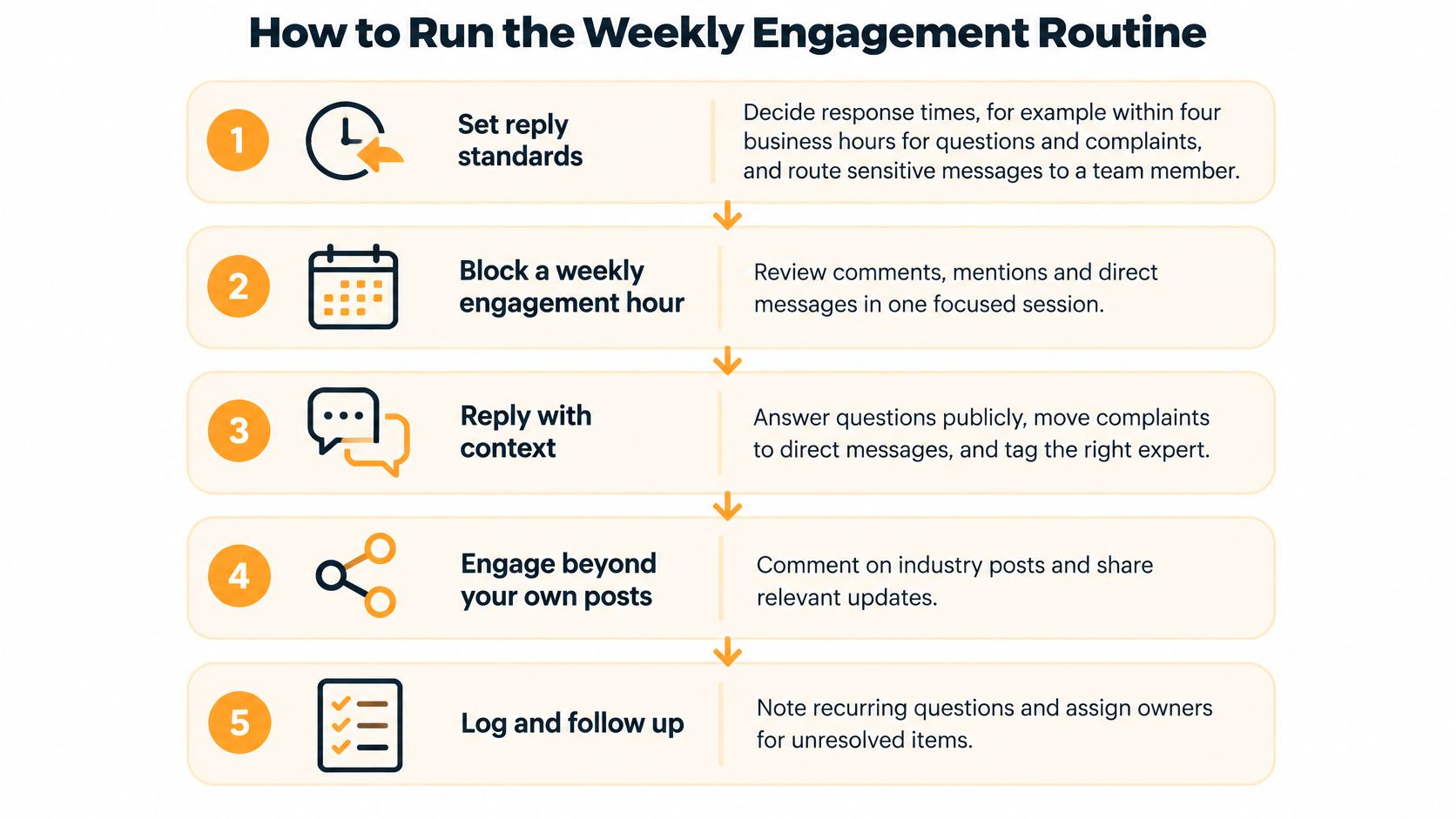
Posting is the easy half. The half that shapes how people feel about the company happens in the comments, and it collapses the moment it depends on someone remembering to check. The leader's job is to design the routine once, write down the standards, then let the team run it.
The full version takes about twenty minutes a day at a small company. The compressed version looks like this.
- Set reply standards. Decide response times, for example within four business hours for questions and complaints, then assign who handles each message type. Without a standard, the friendly messages get answered and the difficult ones age in the inbox.
- Sort the inbox every morning. Questions, praise, complaints, spam, in that order of clearing. The common slip is filing a complaint as spam because it is uncomfortable.
- Answer questions with specifics. A concrete answer plus a link where it helps. "Thanks for reaching out" teaches people to stop asking.
- Handle complaints in public, then move them. One reply that acknowledges the issue and names the next step, then the detail goes to a private channel. Deleting or arguing escalates a small problem into a screenshot.
- Reply to the first ten comments on your own posts within the hour. Early replies tend to help a post get seen, and they set the tone for everyone who arrives after.
- Log every recurring question. Three people asking the same thing in one week is a content brief for next month, not a coincidence.
- Review on Friday. Which conversations turned into a sales call, a recruiting message or a partnership intro? That outcome list is the number worth reporting, and it is what justifies the routine's existence when someone asks why the team spends an hour a day in the comments.
Engagement beats visibility on its own. A 2016 U.S. survey of social-media users who followed corporate CEOs found that interaction between CEOs and the public increased perceptions of authenticity and approachability, and those perceptions then improved trust and satisfaction. If interactive behaviour is what moves trust, a quiet post with a live reply thread outperforms a loud post with none.
If your team needs a deeper playbook for the conversations that happen off your own posts, these community engagement tactics cover the commenting and sharing side. A healthy week looks boring from the outside: no unanswered question older than one business day and a real reply thread on every post you published.
Approvals, Crisis Calls and Brand Risk
The instinct when a brand gets burned is to add an approver. That's usually the wrong fix. Apply one sign-off standard to every post and you get three-day turnarounds on holiday greetings while the risky statement still slips through, because nobody knows which tier it belonged to.
Sign-off should scale with risk. Post length tells you nothing about downside. A short tip can go out the same day. A statement on pricing, policy or a legal matter needs legal and the comms head, because the downside there is a correction, a lawyer's letter or a customer contract, and days rather than hours is the right speed for that.
Approval tiers by post type
| Post type | Who signs off | Target turnaround |
|---|---|---|
| Routine tip or industry comment | Social lead only | Same day |
| Customer or product story | Social lead and product owner | 1-2 business days |
| Statement on pricing, policy or legal matters | Legal, comms head and social lead | 2-3 business days |
| Public reply to a complaint | Social lead with support lead | Within 4 business hours |
| Crisis holding statement | Pre-approved crisis team | Within 60 minutes |
Design the tiers before you need them. A good approval system is judged by what doesn't happen: no correction issued, no tier negotiated twice, no post stuck in a thread while its moment passes.
The bar is also higher for a leader's personal account than for the brand account. Audiences hold a named executive to a higher standard of accuracy, and a claim that turns out to be wrong carries a face and a job title with it. When the CEO posts something that "feels right" and isn't, the correction lands on a person, and personal credibility is harder to repair than a logo's.
The crisis habit that buys you an hour
Keep pre-approved holding statements for the incidents you can predict: a service outage, a data issue, a complaint gathering momentum. Name one decision-maker so the room doesn't wait for consensus, and agree in advance that the leader can post a short acknowledgement within the hour while facts are still being confirmed. An acknowledgement isn't a verdict. "We're looking into this and will update by 4pm" buys the time a denial would burn.
The mistake to avoid is a policy statement going out before legal has seen it. One shared document naming an owner for each tier and the turnaround they've agreed to fixes most of that. Teams that run content approval workflows properly tend to find the same thing: documenting the tiers removes most of the arguments, because people stop negotiating each post from scratch.
The quick judgement call: if a post names a person, a price, a legal matter or a customer's problem, it gets a second approver. No exceptions for "it's just a comment".
Measuring Whether the Role Is Working
Vanity numbers are easy to report and hard to defend. Likes, follower counts and impressions all move for reasons unrelated to the person running the account, and a giveaway can add thousands of people who will never buy anything. Judge the role on four measures instead.
- Engagement quality. Replies, saves and shares that show someone read the post, not a like from a colleague.
- Reach inside the target audience. Whether the people you named as your audience saw it, rather than whether total followers grew.
- Conversations that reached another team. The count of threads that turned into a sales call, a candidate, a partnership intro or a support ticket.
- Comment sentiment. What people say when they aren't being polite, read across a month rather than a single thread.
Sentiment deserves the attention because the audience's trust is doing real work. Pew Research Center's Spring 2026 Global Attitudes Survey of 45,658 people across 37 countries found a median of 77% said these technologies had made people more informed about current events, while 79% said social media made people easier to manipulate with false information and rumors (Pew Research Center). Reach without credibility is a number that flatters you and protects nobody.
A monthly review takes under an hour: pick three goal-linked measures, compare them with last month and with the goal, then note what changed in the content. Say a leader tracked saves and inbound messages for 30 days and found that a product post drew fewer likes than the usual motivational post but produced three sales calls. The next month's mix shifted toward product detail. Write "the post coincided with" unless you can trace the link, because analytics rarely prove a sequence.
Sit with two checks platform metrics can't see. First, ask whether buyers, recruits and AI-generated summaries describe the company accurately, since those summaries increasingly shape the first impression. Second, track whether thought leadership reaches decision-makers. A 2026 B2B thought-leadership study surveyed 1,135 executives across seven countries, and 59% of final decision-makers said poor or absent thought leadership contributed to removing a vendor from consideration, as reported by PPC Land's coverage of the Edelman findings. Treat that as correlation until you can trace it.
For a deeper set of measures, these ways of measuring social media ROI go past the platform dashboards. End every review with one question: what would we do differently next month?
Your Next Step to Set Up the Role This Quarter
Five moves, and none of them need a budget line. Do these in order and the role stops being a permanent emergency.
- Write the one-page brief. Goal, channels, pillars, cadence, owner, review date. If it doesn't fit on a page, it's not a brief, it's a wish list.
- Assign an approval owner for each tier and confirm the turnaround times with them in writing. A table nobody has agreed to is a suggestion.
- Name one engagement owner and one backup. Holidays and travel are exactly when replies stall and complaints sit for four days.
- Audit the last 30 posts against your three goals. Note which ones earned their place and keep that pattern. Most audits find a quarter of the calendar existed because it was in last quarter's calendar.
- Put a 30-day review on the calendar and bring the measures from this guide to it, not screenshots of your best post.
If drafting is the bottleneck, a tool such as RedactAI can turn a few keywords into complete LinkedIn drafts using your profile and posting history, which shortens the blank-page stage without taking the decision away from you. The leader still judges and approves every post, and no tool can guarantee a post will perform.
Now the actual decision. Assign a dedicated owner this quarter, or keep the role part-time with a clear brief and a fixed review date. A part-time owner with a one-page brief and a 30-day review is a legitimate choice for a ten-person company. It stops being legitimate when it's just what happened because nobody decided otherwise.
RedactAI writes complete LinkedIn posts from a few keywords, using your own profile, posting history and tone, so the person holding the approvals isn't also staring at a blank page at 6pm. Its free tools include an AI LinkedIn Profile Review, a LinkedIn Post Formater and a LinkedIn Summary Generator with AI. Bring your brief and your pillars, and see how much faster the drafting stage gets at RedactAI.