Someone sends you a link at 9pm: a 40-second clip of a kitchen with good light, and a caption promising to explain what nobody tells you about that street. You've never met the person holding the phone. You're not even sure they're an agent. But you watch to the end, and now you know their name.
That's how first contact usually happens now. Not a sign rider, not a mailer. A face, a street you recognize, and an answer to a question you were already asking.
A real estate influencer is the person on the other side of that screen, and the job is less about reach than many assume. It works as a trust funnel: familiarity first, then a question, then a conversation, then a deal that either happens or doesn't. The creators who last measure what they do and disclose how they earn. The ones who burn out chase views and skip both.
What a Real Estate Influencer Actually Does
A real estate influencer builds a following around buying, selling, renting, or investing in property, and uses that audience to earn trust before a deal starts. Think of the coffee shop owner every neighbor knows. When somebody needs a broker, that name surfaces first because it's already familiar, not because it was advertised loudest.
The audience sizes up fast, and the four common creator types carry different risks.
| Creator type | Typical content | Main audience | Biggest risk |
|---|---|---|---|
| Agent | Listing tours, neighborhood tips, client stories | Buyers and sellers in one city | Talking up listings without disclosing the commission |
| Broker or team lead | Market updates, hiring posts, closing stats | Agents and local sellers | Presenting one good quarter as a long-term trend |
| Investor | Deal breakdowns, rental math, renovation logs | Aspiring investors | Showing best-case returns as if they were typical |
| Property educator | Financing explainers, inspection checklists, first-time buyer guides | First-time buyers | Hidden promotion inside neutral-sounding advice |
The followers don't care which of the four you are. They care whether your content answers a question they already had before they found you.
Agents film listing tours, neighborhood tips, and client stories. The ones who hold attention show the walk from the front door to the bus stop, not just the renovated kitchen, because that's the detail a buyer can't get from listing photos. If you're rebuilding that personal brand on video, Pinnacle Property Media's agent branding guide walks through the format choices that make an agent recognizable rather than interchangeable.
Brokers and team leads post market updates, hiring news, and closing numbers to an audience of agents and local sellers. Investors break down deal math, rent-to-price ratios, and renovation budgets, and their viewers are usually people considering their first rental.
Property educators explain financing, inspections, and first-time buyer steps to an audience that is often months away from acting, which makes patience part of the format.
Follower count alone doesn't make somebody an influencer here. In 2024, 48% of Canadian consumers aged 18 to 29 followed more than 20 influencers, according to an IZEA report cited by the Canadian Real Estate Association, so attention is split twenty ways before you post anything. Credibility comes from whether the audience acts: calls, books a viewing, or asks a specific question about a specific street.
How Credibility Gets Built One Post at a Time
Trust doesn't arrive with a viral tour. It builds from repeated, visible behavior, the kind a follower can predict after watching you for six weeks.
The four habits that compound
- Consistency you can see. Pick a rhythm you can hold in a busy month, even if that's twice a week. The goal is for your name to be familiar before anyone needs help, because nobody hires the agent they discovered yesterday.
- Local detail instead of adjectives. Name the street, the school zone, the last sale price, the actual days on market. A listing described as a strong investment tells a buyer nothing they can verify.
- Fast replies. People judge whether you're listening by how quickly the answer arrives. A useful reply the same afternoon beats a perfect one next week, and response speed is one of the few advantages a solo agent has over a big team.
- Honest limits. Say when a market is cooling, when a deal fell apart, and when a house suits only a handful of buyers. Conceding the downside is the fastest way to make your upside believable.
The role matters because the audience is already there. A 2025 report cited by The Seattle Times found that 41% of surveyed Gen Z and millennial buyers and sellers used social media to learn about real estate, while nine in ten millennials still used a real-estate agent, and one in five respondents had used AI chatbots for real-estate advice.
Influence opens the conversation. The agent relationship closes it. Neither one replaces the other, and creators who pretend otherwise lose deals they never see.
That pairing is the whole argument for pairing reach with accuracy. Platforms start the journey; a professional who can answer the follow-up question finishes it.
Before publishing anything, write a one-line promise: who you help, in which area, with what. Read every draft against that line. If a post doesn't serve it, it belongs in a different week. And check that your own profile makes the same promise, because a free LinkedIn profile review takes minutes and shows where a stranger would get lost.
Video Formats That Earn Attention and Trust
Consumers in the United States spent an average of 1 hour and 23 minutes a day on social media in 2024, up from 1 hour and 11 minutes in 2020, and daily video time climbed from 28 minutes to 49 minutes, according to the National Association of Realtors, which also found that 44% of consumers prefer longer videos once they're sufficiently interested in a topic.
Short for discovery, long for trust
Those two numbers describe a two-level job. Short video gets you found by someone scrolling with no intent. Long video earns the trust of someone who already stopped and wants the full explanation. Skipping the second level leaves you with an audience that knows your face and nothing about how you think.
| Format | Job | Typical length | Example post |
|---|---|---|---|
| Short property tour | Discovery and reach | 15 to 60 seconds | Walk through a listing's kitchen in one minute |
| Market explainer | Early trust | 1-3 minutes | What rising rates did to buyer offers this season |
| Neighborhood guide | Local authority | 5-10 minutes | Commute, schools and parking on one street |
| Buyer Q&A video | Education and conversion | 2-4 minutes (recommended) | Why pre-approval comes before a viewing |
| Client story | Social proof | 2-4 minutes | A first-time buyer's offer timeline, shared with consent |
A short tour lives or dies in the first three seconds, so open on the best room rather than the front door. Market explainers work when they answer a question buyers are already asking, which is usually about how rate changes affect what they can offer, not about national averages.
Neighborhood guides are where local authority gets proven: commute times at 8am, where guests park, which corner gets the street noise. Buyer Q&A carries conversion because it addresses the thing viewers are nervous about, and nervousness is what stalls bookings.
Client stories give social proof, with two conditions. Get written consent, and show the full timeline, including the offers that lost, because a smooth story reads as an ad.
Practical rule: shoot once, publish three times. The nine minutes of raw footage from one walkthrough becomes a 30-second hook, a two-minute explainer, and a longer guide you can keep sending people for a year.
Using LinkedIn to Grow a Real Estate Audience
LinkedIn rewards posts that sound like a person describing their work. Brochure copy dies there. The audience skews professional, so a market update or a financing explainer can travel further than it would on a photo app when it's written by someone who clearly does the job.
Here's the routine that holds up over a month.
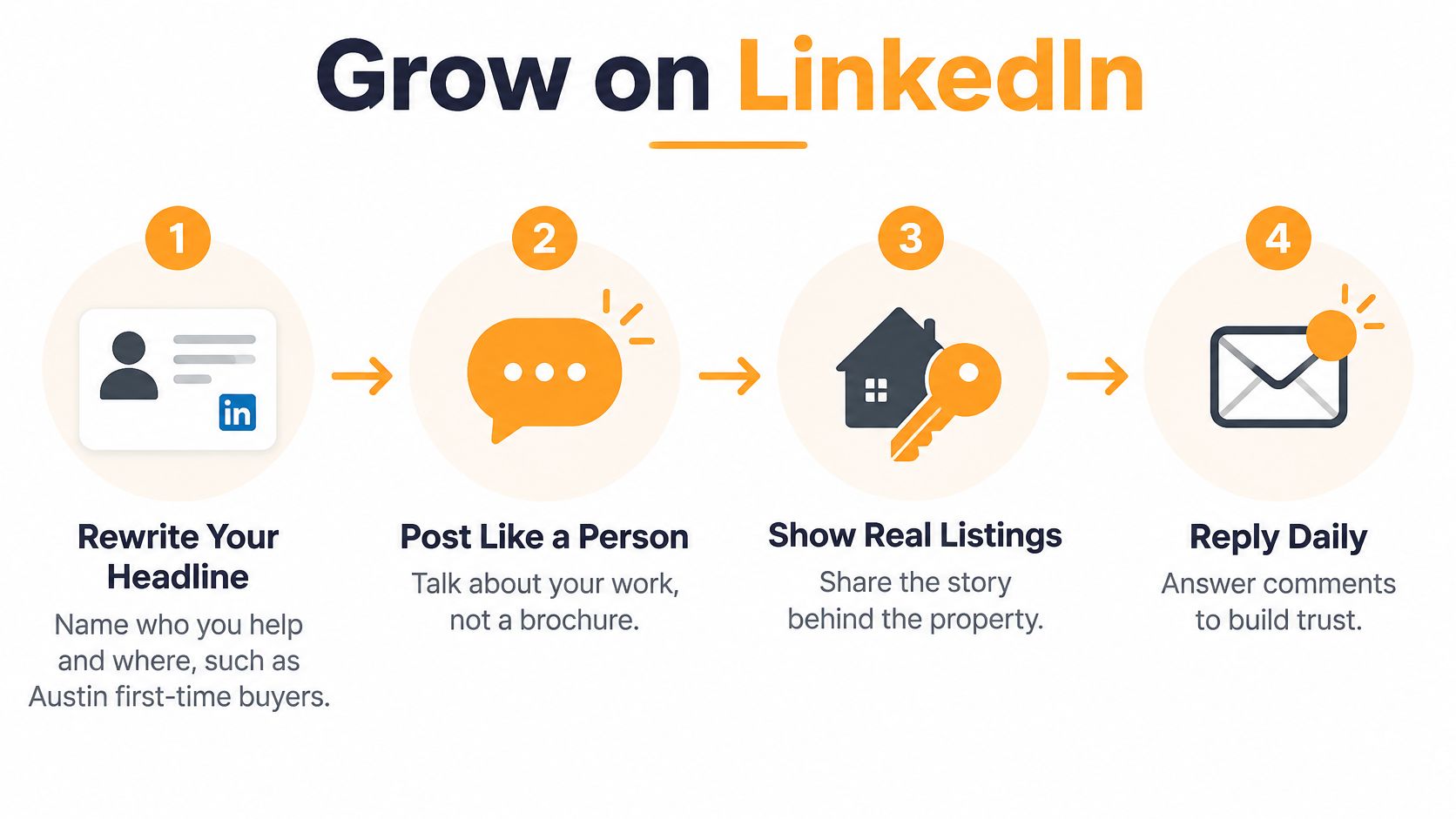
- Rewrite the headline to name who you help and where. First-time buyers in one city tells a stranger whether to keep reading. A job title alone doesn't, and it's the first line most visitors see.
- Pick three content pillars and stay inside them. Local market data, buyer education, and life in the neighborhood is a workable set. Three is enough variety for a month and few enough to keep your account recognizable.
- Post three times a week at the same times. Consistency trains the algorithm and your audience at once. Keep a backlog of drafts so a chaotic week doesn't break a streak you'll have to rebuild.
- Turn every video, blog post, or listing tour into a text post with one takeaway and a question at the end. Most of your followers will read rather than watch, and the question gives them a low-effort way to reply.
- Reply to every comment in the first hour. Early replies signal an active conversation, which helps the post reach more people, and they show the next visitor that a human is present.
- Review the questions you received once a month. Those questions are next month's topics, already validated. Read the phrasing carefully, because the exact words people use make better headlines than your summary of them.
When the writing itself is the bottleneck, LinkedIn consulting or a structured review of your last twenty posts will show you which pillar carries the account and which one is dead weight. Judge it on questions and profile visits, not likes.
Measuring Whether Followers Become Clients
Social media works better as a lead channel than as a billboard, and the benchmark supports treating it that way. The 2025 National Association of Realtors Technology Survey reports that 39% of respondents identified social media as the technology producing the highest number of quality leads, ahead of CRM systems at 23% and local MLS platforms at 17% (NAR technology survey).
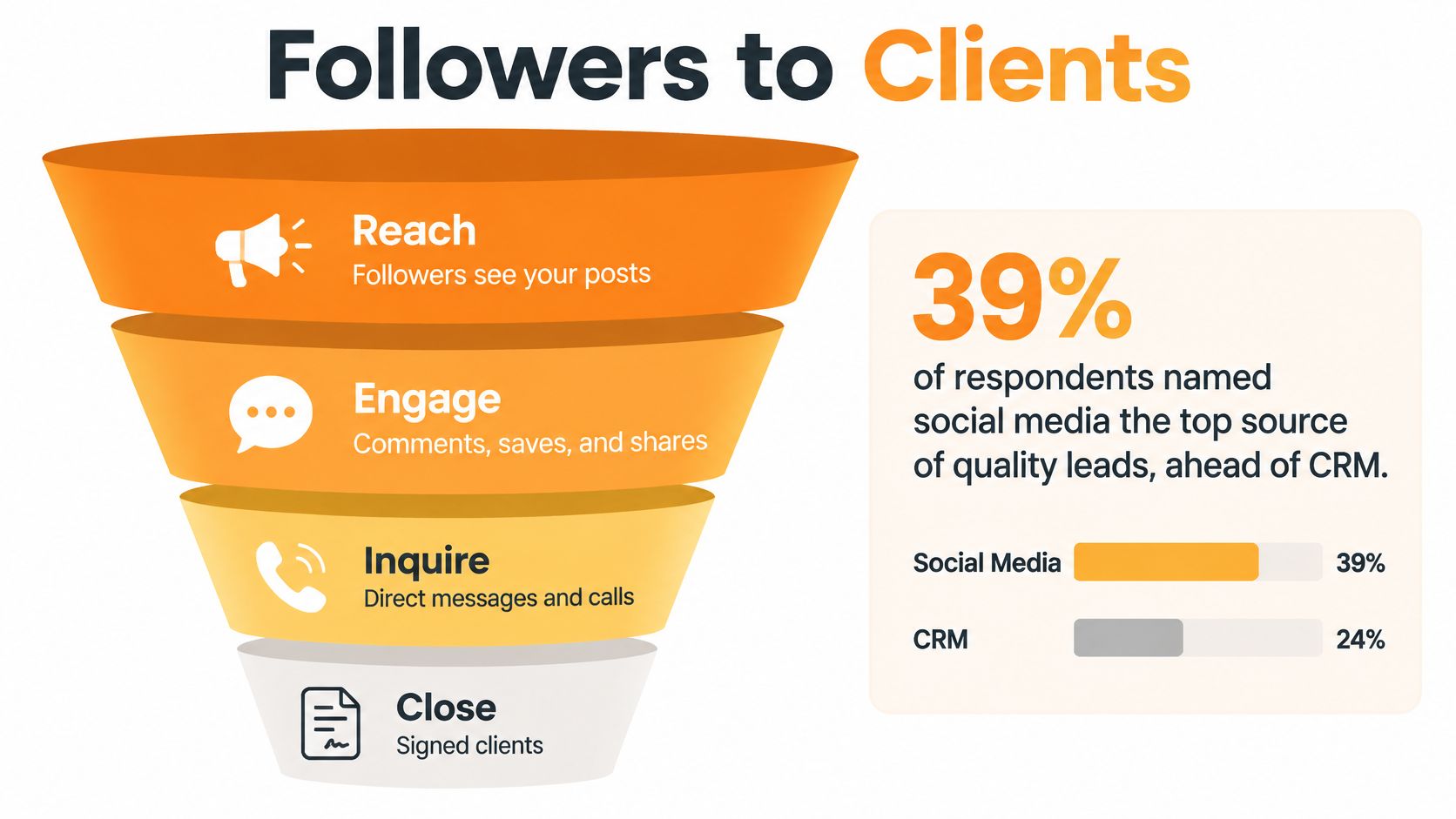
That doesn't mean every platform or post format performs equally. A 2025 survey of future homebuyers found that 55% said social media influenced their purchase decision, mostly by showing available homes and design inspiration, while separate buyer research found only 3% first contacted an agent through social media against 43% through referrals, as summarized in IPX1031's home buyer report breakdown. The influence is real. It just arrives sideways, through branded search and remembered names, not through a click.
Set up tracking before you post
Give each campaign a unique landing page or tracking link, a platform-specific phone number where you can manage one, and a source field in the CRM that an actual person fills in. Without those three, every later conversation starts with a guess.
| Metric | What it tells you | Where to find it | Check how often |
|---|---|---|---|
| Profile visits | Whether posts send people to your profile | LinkedIn analytics | Weekly |
| Inquiries | Whether profile visitors ask to talk | Inbox and contact form | Weekly |
| Consultations | Whether inquiries become real conversations | CRM source field | Monthly |
| Signed clients | Whether conversations become agreements | CRM pipeline | Monthly |
| Closed transactions | Whether influence reaches revenue | Closing records by source | Quarterly |
Calculate conversion rates between the stages, not just totals. Weak inquiries usually mean the call-to-action is vague. Weak consultations usually mean follow-up is slow or the first reply was generic.
Segment by topic, platform, and market afterward, since a financing explainer that produces consultations in one suburb may produce nothing in another. Keep the wording honest too: a lead linked to a post is a lead linked to a post, and claiming the post caused it will cost you the ability to learn from the next one.
Disclosure and Trust Rules to Follow
Disclosure is a trust problem before it's a legal one. The Federal Trade Commission states that a material connection such as payment, employment, a family or personal relationship, or receiving something of value must be disclosed clearly and conspicuously when it could affect how an audience reads an endorsement, and that the disclosure has to travel with the endorsement rather than sit on a profile page (FTC disclosures 101).
Run this before you hit publish.

A checklist to run before you publish
- Name the connection. Payment, a free service, a referral fee, an employer, a relative. If any of them apply, say so where viewers see it without expanding the post.
- Classify the post. Independent commentary, agent-owned listing, paid endorsement, gifted experience, or affiliate promotion. Each one gets a different label, and mixing two in one post confuses the reader.
- Use plain words. Paid partnership, sponsored, or a short note that you may receive compensation. Clever phrasing reads as concealment.
- Substantiate the claim. No guaranteed appreciation, no effortless returns, no superior financing, and no personal experience you did not have.
- Show the assumptions behind the math. Interest rate, down payment, taxes, insurance, and the month the numbers were pulled. Label forecasts as your view, not as fact.
- Store the evidence. Screenshot the rate sheet, the comps, the lender quote. When someone asks in eight months, the file answers for you.
Keep the education and sales lines apart. A financing explainer stays credible when it doesn't push a product in the same frame, and a sponsored post is labeled every single time, including the third repost.
The stakes rise with younger buyers. In the 2025 NextGen Homebuyer Report, 40% of Gen Z respondents said they turn to social media for financial education, while trust in loan officers sat at 19.5%, as reported by Real Estate News. Influence built on confident predictions is fragile. Influence built on visible uncertainty and named incentives lasts longer.
If you lend or refer to lenders, the advertising side has its own requirements beyond the FTC label, and the LendingXpress compliance guide covers the regulatory ground. Recheck recycled content on a fixed schedule, because an old post carrying last year's rate or a missing disclosure misleads people months later.
Start Your First Real Estate Influencer Plan
Turn all of it into one month of work.
- Pick one niche and one city. Narrow enough that a stranger can repeat it back to you.
- Write a headline that names both. Update your profile the same day, since a great post sends people to a profile that has to hold up.
- Choose one primary format and post it three times a week. Neighborhood guides if you want authority, buyer Q&A if you want consultations.
- Set up one tracking link and one CRM source field. Two fields beat a dashboard you never open.
- Review the metrics at the end of week four. Compare profile visits and inquiries against your week-one baseline, then keep the topic that moved them.
Tools help with the drafting, not the credibility. RedactAI builds a personalized model from your LinkedIn profile link, using your name, experience, headline, description, and your last 100 posts, and its free AI LinkedIn Profile Review is a sensible first stop if you want to see how your current profile reads before you commit to a routine (content creation tools). It handles drafts and scheduling, and its terms are honest that it doesn't guarantee a post will go viral, so measure it on profile visits and inquiries rather than applause.
Influence in this business is earned slowly, with consistent and honest content, by someone who answers the message. The agent or lender a viewer finally calls is the one who makes the deal.
RedactAI writes LinkedIn posts in your own voice, learned from your previous posts, and can turn a single listing tour or market explainer into a week of drafts you can schedule. For a real estate influencer building a measured trust funnel, that removes the blank page without removing the judgment. Visit RedactAI to run a free profile review and start your first month of posts.