Most advice about LinkedIn for entrepreneurs starts with the wrong question: “How do I get more reach?” Reach is useful only when it puts you in front of people who can buy, refer, hire, fund, or strengthen the business. A large audience of irrelevant viewers can make a dashboard look healthy while leaving your pipeline untouched.
Treat LinkedIn as three things instead. It's a database of professional trust signals, a weak-tie network that bridges different business communities, and an attention system that values reading time more than shallow reactions. Your profile, posts, comments, and conversations work together to answer one commercial question: why should the right person trust you enough to continue the relationship?
That shift changes your operating metrics. You stop chasing connection volume and start tracking stakeholder diversity, qualified profile visits, meaningful replies, referrals, and conversations that move forward. You also stop asking AI to sound like a founder and start using it to help the founder publish more of what only they know.
The Real Reason LinkedIn Matters for Entrepreneurs in 2026
“Post more and grow faster” is incomplete advice. Posting frequently can amplify a vague position, an unconvincing profile, or a network full of people who will never become customers. Entrepreneurs need relevant visibility, not exposure as an abstract goal.
LinkedIn began as a professional network and has expanded into a global business environment. The platform launched on May 5, 2003, reached 1 million members in August 2004, passed 10 million members by April 2007, exceeded 100 million members by 2011, and LinkedIn's current corporate description reports more than 1 billion members across more than 200 countries and territories (LinkedIn history and scale). That scale matters because a founder's public expertise can reach beyond a local network, existing referrals, or a familiar industry cluster.
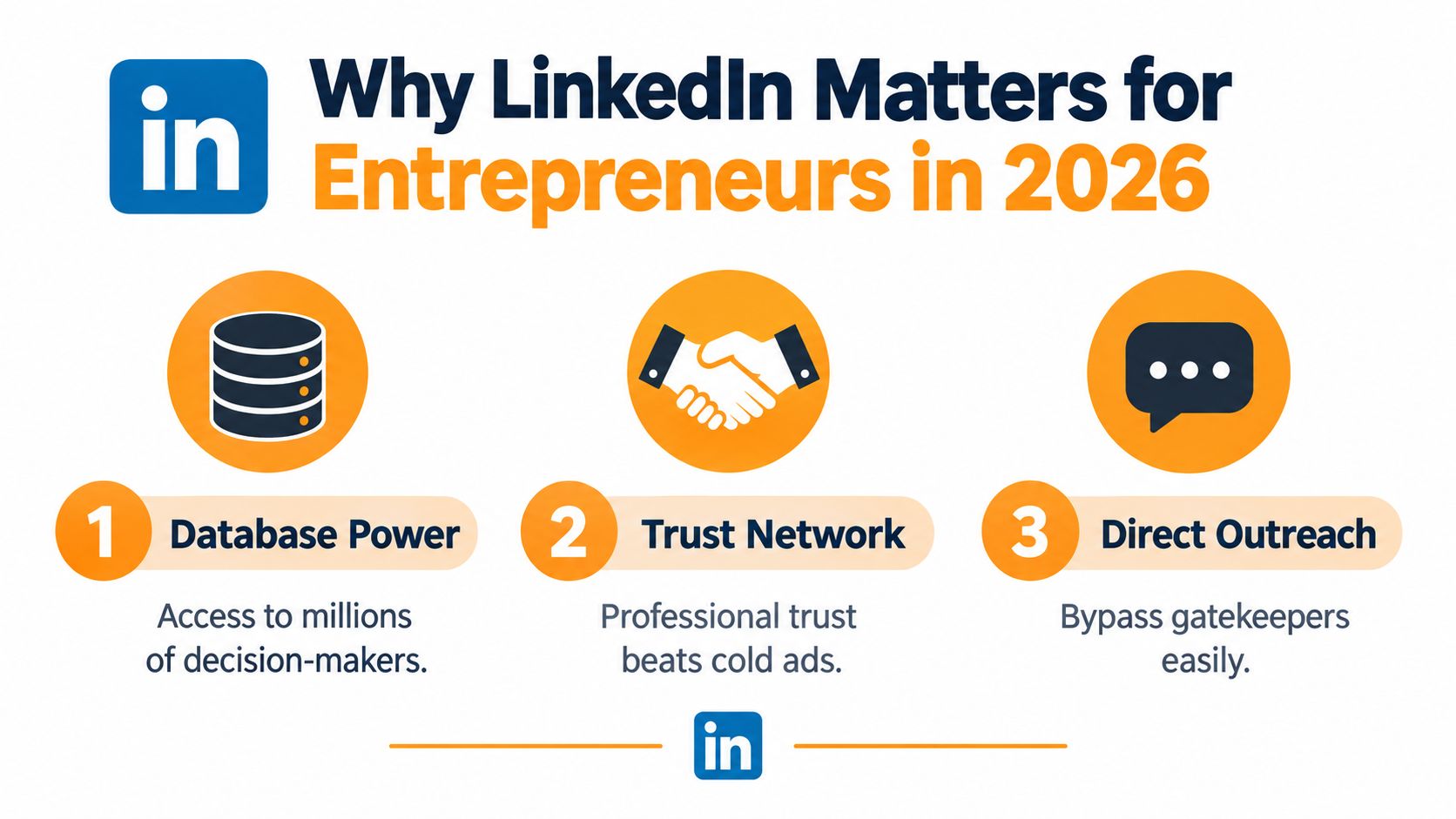
Three beliefs that should guide your strategy
First, your profile is a persistent database of professional trust signals. It records experience, affiliations, expertise, recommendations, public thinking, and the context around your work. A prospect often checks that evidence before replying to an outbound message.
Second, LinkedIn is a bridging network. Weak ties can connect you to communities you don't already occupy, including potential customers, operators, investors, researchers, partners, and candidates. The value isn't the number of names in your network. It's the variety of useful relationships and the quality of follow-up.
Third, the feed rewards attention quality. LinkedIn's engineering team describes on-feed dwell time, when at least half of an update is visible during scrolling, and after-click dwell time, when someone views content after opening it, as ranking signals (LinkedIn's explanation of feed dwell time). Clear writing, short paragraphs, and a strong opening therefore matter more than stuffing every post with engagement bait.
Strategic rule: Optimize for the right-person density of your audience, not the largest possible audience.
Choose the business job first. If you need customers, publish useful category education and proof. If you need talent, show how the company operates. If you need investors, demonstrate judgment and market understanding. If you need partners, make your capabilities and working principles visible. LinkedIn matters when your content and profile make the next relationship easier to start.
Building a Founder Profile That Converts Visitors
Your profile has one job before it has many: make a relevant stranger understand who you help, what you know, and why your experience deserves attention. Don't begin with a clever headline or a polished banner. Begin with the audience you want to attract.
Position the profile around a commercial problem
A role-only headline such as “Founder at Acme” wastes valuable context. A specialist headline can create sharper recognition, but it may narrow future opportunities. A flexible headline preserves optionality, but it often becomes generic. Choose based on your current priority.
Use this sequence:
- Name the audience. State whether you work with SaaS teams, agencies, enterprise buyers, recruiters, or another clear group.
- Name the problem. Explain the costly or recurring issue you help solve.
- Name the mechanism. Mention the distinctive approach, category, or expertise behind your work.
- Add proof carefully. Use verifiable experience, customers, publications, or outcomes you can defend.
Your About section should read like a direct answer to a buyer's first conversation. Start with the problem you understand, explain what you've learned from working on it, describe who benefits from your approach, and end with a low-friction next step. A story-led opening can humanize you, but don't let personal history bury the reason someone should contact you.
Turn experience into evidence
Rewrite each experience entry around decisions and responsibilities, not job descriptions. Explain what you built, who it served, what constraints shaped the work, and what kind of conversation you're open to now. Avoid unsupported superlatives. Specific reasoning creates more credibility than inflated claims.
Use the Featured section as a proof shelf. Put a strong post, a useful resource, an interview, a product explanation, or a clear example of your thinking there. Feature proof that supports your current positioning, not whatever received the most reactions.
Before publishing, use this checklist:
- Headline: A relevant person can identify your audience and problem immediately.
- About: The first lines establish a point of view, not a biography.
- Experience: Each role shows judgment, scope, and evidence.
- Featured: The selected items support your current business objective.
- Contact path: A visitor knows whether to comment, message, book, or refer.
If outbound supports your content program, study hireSDR.com outreach templates for message structure, then adapt the language to the relationship and context. Generic scripts create distance. A thoughtful profile can't rescue an outreach message that sounds copied.
For a deeper profile-by-profile checklist, use this guide to optimize your LinkedIn profile. Your profile is the conversion layer. Content only performs commercially when the visitor finds a credible reason to stay.
The Post Formats That Actually Compound
A founder shouldn't publish a random mix of opinions and hope the algorithm discovers a strategy. Each format should perform a business job. Lessons build authority, contrarian analysis creates category tension, founder stories make judgment visible, proof reduces perceived risk, and recruiting stories help the right people understand the company.
Dwell time changes how you write all five. Put the core insight near the top, use short paragraphs, and create a clear path from problem to mechanism to takeaway. LinkedIn's feed research supports treating qualified reading time as an attention-quality proxy, while also warning that dwell time isn't commercial intent on its own (LinkedIn feed dwell time research).
| Post format | Primary job | Format hint |
|---|---|---|
| Lessons learned | Build authority | Start with a decision that changed your approach |
| Contrarian take | Shape category thinking | Name the popular advice you reject and explain why |
| Founder story | Build trust | Show the constraint, choice, and consequence |
| Proof post | Reduce buying risk | Share verifiable evidence and the lesson behind it |
| Recruiting story | Attract aligned talent | Explain how the team works, not just what the role requires |
Start with lessons and decisions
Lessons learned are the best starting point for many founders because they turn lived experience into useful guidance. Don't write “we learned the importance of focus.” Write about a specific trade-off, what you initially believed, what changed, and what you'd do differently.
Contrarian posts work when the argument has a mechanism. “Personal branding is overrated” is a slogan. “Founder content fails when it targets everyone, because nobody recognizes their own problem in it” gives the reader something to evaluate.
Founder stories need restraint. The story isn't valuable because you had a difficult week. It's valuable because your decision reveals how you think, what you prioritize, or how you handle uncertainty.
Use proof and recruiting posts selectively
Proof posts should connect evidence to a buyer's concern. A product screenshot without context rarely helps. Explain what the evidence demonstrates and what it doesn't demonstrate. That discipline protects trust.
Recruiting stories should show the operating environment. Explain how decisions get made, how feedback works, or what kind of person succeeds on the team. Avoid turning every post into a vacancy announcement.
For additional format ideas, use this guide to types of LinkedIn content. Then label every draft by its intended audience and business job. If you can't name both, the post probably isn't ready.
A reliable structure is simple:
- Hook: State the tension, surprising observation, or costly mistake.
- Mechanism: Explain what caused the outcome and what others can learn.
- Takeaway: Give the reader a decision, principle, or action.
Don't force the structure into identical wording. Readers can recognize a template when every post sounds mechanically assembled.
A Weekly Cadence and AI Workflow That Fits a Founder
A founder's content system should survive product launches, sales calls, hiring, and bad weeks. Build the smallest rhythm you can maintain, then improve the quality of the inputs rather than adding more publishing obligations.

Use the week as a production loop
Monday is for observation. Capture customer objections, sales-call language, product decisions, team debates, and questions people keep asking. Raw notes are more valuable than generic prompts because they contain your actual point of view.
Tuesday is for selection. Choose one observation for authority, one for trust, and one for demand or recruiting. If an idea doesn't connect to a stakeholder category, keep it in the backlog.
Wednesday is for drafting. Write the first version yourself or record a voice note. An AI tool can expand the idea, suggest openings, cut repetition, create variations, or adapt a strong post for another format. It shouldn't invent customer evidence or manufacture certainty.
Thursday is for editing. Remove generic claims, add the specific trade-off, verify every factual statement, and make sure the post sounds like something you'd defend in a live conversation.
Friday is for review. Record who engaged, which stakeholder categories appeared, what conversations began, and whether any post influenced a useful relationship. Don't judge the week by reactions alone.
AI handles formatting, repurposing, idea expansion, and pattern interruption well. Keep judgment, first-person evidence, trade-off calls, customer observations, and defensible opinions human. LinkedIn's 2025 research found that 65% of people worry about whom they can trust online as new technology increases deceptive content (LinkedIn authenticity research coverage). That makes authorship signals part of the strategy, not a cosmetic detail.
Human-signal test: If you removed your name, could a customer still recognize the experience and judgment behind the post?
Use a creator workflow resource such as workflow tools for creators to organize capture, drafting, review, and scheduling. RedactAI is one option for turning profile context, past posts, and personal experiences into LinkedIn drafts, while also supporting content ideas, scheduling, recycling, and analytics. Whatever tool you use, keep a final human review before publication.
The practical boundary is clear. Automate the repetitive work around publishing, but never automate the reputation you're asking the market to trust.
Turning Connections Into Qualified Conversations
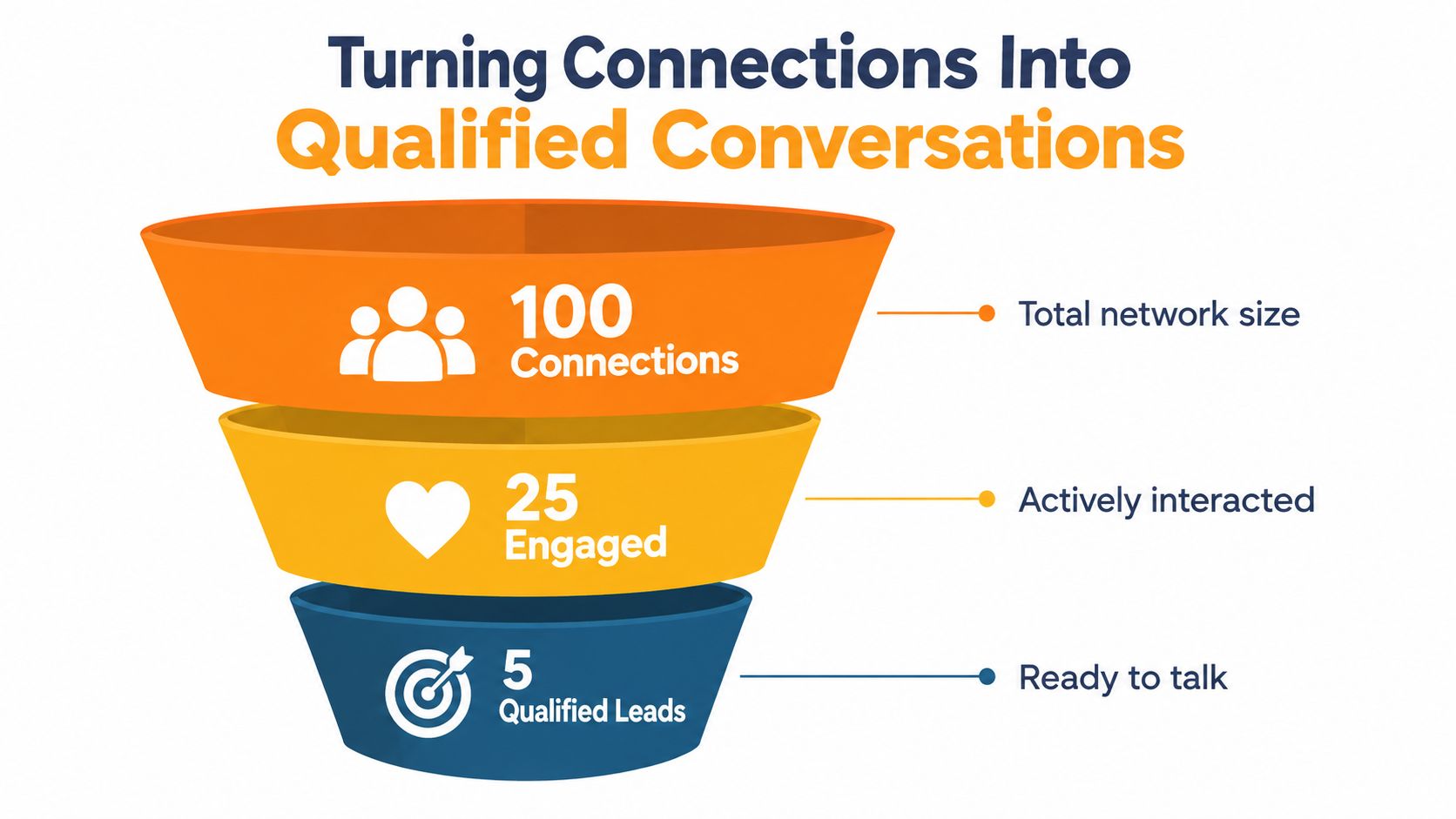
A large connection count can hide a weak network. A founder who connects only with peers in the same niche may gain familiarity without gaining new information, introductions, or commercial access.
Research using public profiles of 15,000 startup entrepreneurs across twelve major German universities found no positive effect of virtual network size or embeddedness on future entrepreneurial success, while finding small positive effects associated with network location and diversity (research on virtual networks and entrepreneurial success). The practical lesson is blunt: build a network with useful gaps in it.
Map the people you actually need
Use four stakeholder categories as a starting map:
- Customers: People who experience the problem, own the budget, influence the decision, or can introduce you to those people.
- Operators: Founders and functional leaders who can share hard-earned knowledge, context, and referrals.
- Investors: People who understand your market, stage, business model, or geographic focus.
- Partners: Agencies, platforms, researchers, suppliers, and complementary providers who expand your reach or capability.
Don't treat these categories as a prospecting list. Treat them as communities you should understand. Follow their work, leave useful comments, ask informed questions, and notice where your knowledge helps.
Convert weak ties through relevance
A weak tie becomes commercially useful through repeated, relevant exchanges. Start with a specific reason for connecting. Reference a real idea, shared market problem, event, customer segment, or mutual relationship. After the connection, don't immediately force a pitch.
Use a simple progression:
- Recognize context. Respond to something they published or a problem they publicly discussed.
- Add value. Share a useful observation, resource, introduction, or concise answer.
- Create continuity. Return later with a relevant update or thoughtful question.
- Invite a conversation. Make the reason clear and keep the ask proportionate to the relationship.
Track distinct stakeholder categories reached, qualified conversations initiated, referrals generated, and collaborations progressing. Connection count belongs in the background. It isn't the outcome.
The best network isn't the biggest one. It's the one that gives you access to perspectives and relationships your current circle can't provide.
Metrics That Connect Posts to Pipeline
Impressions tell you how often content appeared. They don't tell you whether the right person cared. Likes and comments add context, but they still don't prove that a buyer, partner, investor, or candidate moved closer.
Start by assigning every post two labels: intended audience and intended outcome. A category-education post may target prospective customers and create demand. A founder lesson may target customers, partners, or recruits and build trust. A proof post may support conversion. A recruiting story may support talent attraction.
LinkedIn's 2025 global research found that 77% of B2B marketing leaders say buyers rely on professional networks to vet brands, while 81% say authentic voices are more important than ever (B2B buyer and authenticity research coverage). Your dashboard should therefore show whether relevant people are using your profile and content to evaluate the business.
Build a small weekly dashboard
Track these fields in a spreadsheet:
- Distribution: Impressions and audience characteristics.
- Attention: Expansion clicks, comments, saves, and meaningful reading signals where available.
- Relevance: Target-account engagement and qualified profile visits.
- Relationship movement: Replies, referrals, introductions, and conversations started.
- Commercial progress: Meetings booked, opportunities influenced, and assisted conversions.
Don't force perfect attribution. Buyers may see several posts, visit your profile privately, engage later, and convert after a separate conversation. Record the content themes that appeared before the relationship advanced, then look for patterns over time.
A post with fewer impressions can outperform a broad post if it brings the right decision-maker into a useful conversation. That's why right-person density is more actionable than reach alone.
For a more detailed measurement framework, use this guide to LinkedIn analytics. If conversations begin to exceed the founder's capacity, compare the Best place to hire SDRs based on your market, budget, and management needs. The hire should support a clear process, not compensate for unclear positioning.
Review the dashboard weekly. Keep posts that attract the right people, revise posts that earn attention without relevance, and stop formats that generate activity but never produce relationship movement.
Putting Your LinkedIn Operating System Together
Good LinkedIn work is not a collection of hacks. It's a compact operating system with four connected parts: a profile that explains your value, content that demonstrates judgment, networking that broadens access, and measurement that protects the business from vanity metrics.
Use a 30, 60, and 90 day rollout
During the first 30 days, fix the foundation. Rewrite the headline and About section around one priority audience. Replace vague experience descriptions with evidence and decisions. Select Featured items that reinforce the position. Create a stakeholder map and begin capturing observations from customer and team conversations.
By day 60, establish the publishing loop. Test lessons, contrarian analysis, founder stories, proof, and recruiting content against different stakeholder jobs. Use the hook, mechanism, takeaway structure without making every post sound identical. Spend time in other people's conversations, especially outside your immediate professional cluster.
By day 90, make decisions from relationship data. Identify which themes attract qualified profile visits, which stakeholder categories engage, which conversations progress, and which posts merely produce surface activity. Keep the formats that support business priorities. Retire the ones that only make the dashboard look busy.
Pin this operating checklist above your desk
- Position: One clear audience, problem, and point of view.
- Proof: Experience and examples you can defend.
- Publish: Content assigned to a specific business job.
- Participate: Useful interaction with diverse stakeholder groups.
- Convert: Follow-up that turns relevant weak ties into conversations.
- Measure: Qualified attention and relationship progress.
- Protect trust: Human evidence and judgment remain visible in AI-assisted work.
Good performance looks different for every founder. A consultant may need a small number of serious buyer conversations. A startup CEO may prioritize investor access, hiring, or category education. An agency leader may care about target-account engagement and partner referrals. Define success by the relationship your company needs next, then build the profile, content, and outreach around that outcome.
The warning signs are easy to spot: you celebrate impressions without checking audience quality, accept generic AI copy because it publishes quickly, collect connections without following up, and publish topics disconnected from current business priorities. Correct those problems before adding more volume.
RedactAI helps entrepreneurs turn profile context, past posts, and personal experiences into LinkedIn drafts made to fit them, while supporting ideas, scheduling, recycling, and performance tracking. Visit RedactAI to build a faster publishing workflow that keeps your real judgment and voice at the center.