Most advice about an ai content calendar generator is backwards. It starts with prompts, templates, and posting frequency. That's why so many LinkedIn calendars end up sounding polished, busy, and forgettable.
The issue isn't that AI can't write. It's that content is often generated without defining what it needs to do, who it needs to reach, and how it should sound. AI can build a 30-day plan in seconds and cut manual planning time by up to 70%, but the useful part is the alignment with brand goals and audience insights, not the speed alone.
If your LinkedIn content still reads like recycled “5 tips” posts, the fix usually isn't a better prompt. It's a better system. The system that works has two parts most generic tools miss: personal tone fidelity and dynamic cadence optimization. One makes the posts sound like you. The other stops your calendar from turning into a rigid publishing spreadsheet that ignores live performance.
Beyond Generic Ideas: Setting Your Strategic Foundation
A lot of people say AI can't sound human. That's not quite right. AI usually sounds generic when the operator gives it generic instructions.
An ai content calendar generator works best when it has boundaries. The useful inputs are not “write LinkedIn posts for me.” The useful inputs are your goals, your audience, your core themes, and the tension you want your content to create. Without that, the tool fills empty slots with safe ideas and bland phrasing.

Start with outcomes, not output
Teams often chase consistency before relevance. That's how they end up posting every weekday and wondering why nothing compounds.
The better move is to define the job of your LinkedIn content. For one person, that job is driving inbound leads. For another, it's becoming known for a category. For a recruiter, it might be attracting candidates. For a founder, it may be credibility with buyers, investors, and future hires.
A practical strategic brief for LinkedIn should answer these:
- Primary objective: What business result should your content support most directly?
- Audience pressure points: What problem is your reader dealing with at work right now?
- Desired perception: After reading three posts, what should people believe about your expertise?
- Conversion action: What should a strong post make a reader do next? Follow, comment, visit your profile, reply, or book a call?
Practical rule: If your objective could apply to any business on LinkedIn, it's still too vague for AI to help well.
Build three to five real content pillars
Content pillars are where most calendars either become strategic or collapse into filler. You don't need ten categories. You need a small set that you can defend with actual experience.
For a consultant, a strong mix might look like this:
- Operating lessons: What changed results in your client work or internal systems.
- Contrarian takes: What common industry advice you disagree with, and why.
- Personal narratives: Moments that shaped your point of view.
- Breakdowns: Sharp analysis of campaigns, posts, trends, or positioning choices.
- Proof of work: Screenshots, workflows, before-and-after thinking, or lessons from execution.
That structure gives an ai content calendar generator something to organize around. It also makes your month feel coherent instead of random.
The fastest way to sanity-check your system is to compare it against a stronger editorial model. If you want a practical reference point, this guide to a LinkedIn editorial calendar shows the kind of planning discipline most creators skip.
Give the AI context that matters
The useful context isn't your company bio pasted into a prompt. It's the material that reveals judgment.
Feed the system things like:
- Past posts that felt most like you
- Comments you've written that sparked good conversations
- Sales call notes or audience objections
- Topics you're tired of seeing framed badly
- Stories you can only tell because you lived them
If you're comparing tools, it helps to explore AI calendar options with one question in mind: can the tool organize strategy, or is it only spitting out topic lists? There's a difference.
Crafting Prompts That Generate Your Authentic Voice
The “robotic AI content” problem doesn't come from AI alone. It comes from shallow prompting. Users often prompt for topic, not voice. That guarantees average output.
That gap matters on LinkedIn. 78% of executives report that AI-generated content often feels “robotic” or “inauthentic” because it fails to replicate an individual's unique voice and expertise. LinkedIn data also shows posts with personal storytelling elements outperform generic educational posts by 2.3x, which is exactly why voice fidelity matters more than volume.
Build a personal tone profile
Before you generate a month of posts, create a one-page tone profile. This becomes the reference layer you reuse in every prompt.
Include details like:
- Default tone: direct, warm, skeptical, witty, analytical, blunt, generous
- Sentence style: short and punchy, medium-length and structured, story-led
- Words you use often: phrases that genuinely sound like you
- Words you avoid: corporate filler, hype language, clichés
- Point of view: what you consistently believe that shapes your advice
- Story assets: career moments, mistakes, lessons, client patterns, turning points
- Audience relationship: peer, operator, mentor, founder, specialist
A lot of professionals struggle to define this in the abstract. Studying examples and patterns helps. This article on finding your writing voice is useful because it turns “voice” into something observable instead of mystical.
AI usually fails at authenticity when you ask it to imitate a vibe. It performs much better when you give it evidence.
Prompt for perspective, not just format
Bad prompt:
“Write a LinkedIn post about content strategy.”
Better prompt:
“Write a LinkedIn post for B2B founders about why most content calendars fail after a few weeks. Use a direct, skeptical tone. Avoid buzzwords and motivational phrasing. Make the post feel like it came from someone who has managed content systems and is frustrated by generic advice. Include one short personal-style observation about seeing teams confuse consistency with strategy. End with a question that invites operators to respond.”
The second prompt works because it includes:
- Audience
- Specific angle
- Tone constraints
- Point of view
- Experience cues
- Structural guidance
Prompt templates for authentic LinkedIn content
| Content Type | Prompt Template Example |
|---|---|
| Personal story post | “Write a LinkedIn post based on this work experience: [insert event]. The lesson is [insert lesson]. Use a reflective but unsentimental tone. Keep the story concrete. Avoid inspirational clichés. Tie the lesson to [audience problem].” |
| Contrarian opinion post | “Draft a LinkedIn post arguing against this common advice: [insert advice]. My position is [insert position]. Write in a calm, authoritative voice. Include one practical example and one line that acknowledges nuance.” |
| Educational breakdown | “Turn this framework into a LinkedIn post for [target audience]. Explain it like an operator, not a guru. Use plain language, short paragraphs, and one sharp takeaway people can apply today.” |
| Experience-led advice | “Write a post that begins with a mistake I've seen repeatedly in [industry or function]. Then explain what works better. Make it sound experienced, not preachy. Include a specific scenario and an actionable closing.” |
| Comment-to-post expansion | “Take this comment I wrote and expand it into a full LinkedIn post: [insert comment]. Keep the same tone and phrasing style. Add one example from practical work and a stronger hook.” |
Add constraints that protect your voice
The strongest prompts usually include a short “do not” list. That's where a lot of voice control happens.
Use constraints such as:
- Don't use marketing clichés
- Don't sound motivational
- Don't over-explain the obvious
- Don't use list-heavy formatting unless the idea needs it
- Don't make claims I can't support from experience
- Don't end with a forced engagement bait question
Then add positive guidance:
- Sound like a practitioner
- Prefer specific observations over broad claims
- Use tension and contrast
- Leave some edges in the writing
- Make the reader feel spoken to, not marketed at
Feed the model raw material from your real work
The easiest way to improve tone fidelity is to stop treating prompts as one-off requests. Build a swipe file of your own language.
Useful source material includes:
- published posts that got strong discussion
- comments that led to profile views or direct messages
- voice notes transcribed after meetings
- client objections
- workshop notes
- lessons from deals won and lost
That's how an ai content calendar generator starts sounding less like an assistant guessing your tone and more like a system trained on your actual judgment.
Batching a Month of LinkedIn Content in One Afternoon
The best batching sessions don't feel creative. They feel operational.
That's a good sign. The point isn't to spend all afternoon “making content.” The point is to make a month of decisions while your context is fresh, then let the tools handle the repetitive parts. Done well, AI-driven content calendar generators can cut monthly planning time by 78%, turning a 12 to 16 hour process into 3 to 4 hours, according to Digital Applied's workflow breakdown.
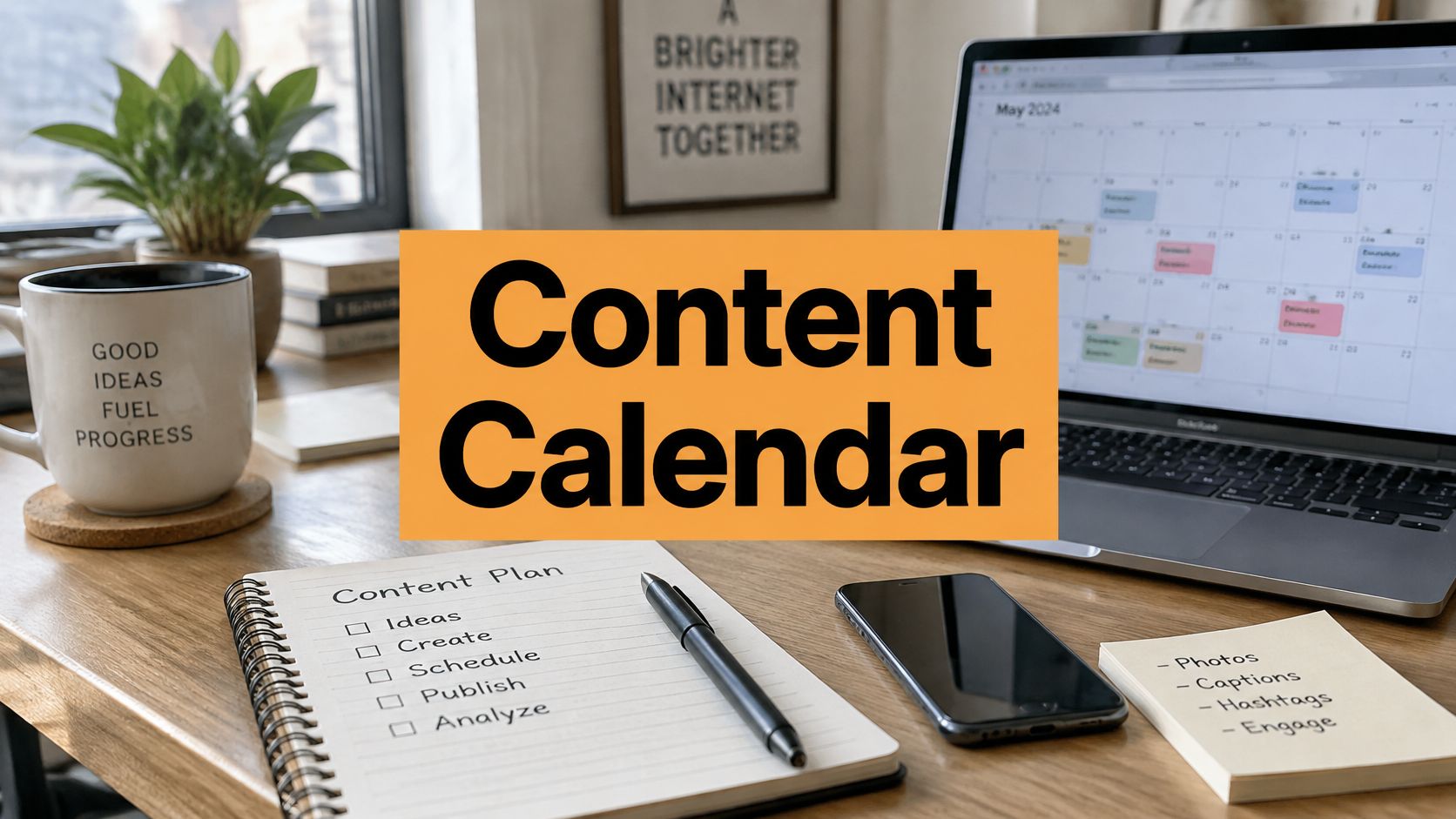
A clean visual workflow helps keep the session tight:

What the afternoon actually looks like
A practical batching session usually starts with strategy, not generation. Spend the opening block locking the month's themes, key stories, and campaign priorities.
After that, move through the month in weekly clusters instead of isolated posts. Themed weeks make generation easier because the AI can stay inside one context longer. One week might focus on authority-building takes. Another might lean on personal lessons. A third might support a campaign or launch.
Here's a realistic flow:
- Lock the month's pillars and themes
- Load your voice profile and prompt templates
- Generate several posts per theme
- Keep only the drafts with a real angle
- Rewrite hooks and endings by hand
- Place each post into a simple calendar
- Queue visuals or supporting assets if needed
For example, if week one is “buyer mistakes,” generate several angles at once: one personal story, one contrarian opinion, one educational breakdown. That's much faster than opening your tool every day and asking it to surprise you.
If you want help moving from rough idea to post draft faster, a dedicated LinkedIn post generator can be useful as a drafting layer inside that batching workflow.
Where most batching sessions go wrong
People waste time polishing weak drafts. That's the trap.
The first pass should be ruthless. If a draft feels generic, delete it. If the hook sounds like everyone else on LinkedIn, regenerate it. If the post makes a fair point but doesn't contain your perspective, it doesn't belong in the calendar yet.
A quick review video can also help you visualize what a high-efficiency process should feel like:
Operator mindset: Batch for momentum first. Polish for credibility second.
That's the difference between a content session that produces thirty drafts and one that produces a usable month of LinkedIn posts.
Automating Your Cadence with Smart Scheduling and Repurposing
A static calendar looks organized. It doesn't always perform.
Most creators still use scheduling like a filing cabinet. They pick dates, assign posts, and assume consistency alone will carry the strategy. LinkedIn doesn't reward that kind of rigidity. Audiences change, conversations move, and some topics earn more engagement in one week than they would in another.

Stop treating scheduling as admin work
Scheduling should be a performance decision, not just a publishing step. Marketers using AI content automation save 10 to 15 hours per week, and tasks like caption writing and scheduling can be compressed into 30 minutes, according to MindStudio's overview of content calendar automation.
That time only matters if you use the gain well. On LinkedIn, that means watching for patterns in audience response and making timing adjustments instead of blindly honoring the original plan.
A smarter cadence includes:
- Holding flexible slots: Keep room in the week for reactive posts when a live topic matters.
- Adjusting based on response: If your audience consistently engages more on certain days or times, shift the queue.
- Matching format to idea: Some ideas need a text post. Others deserve a document post, carousel, or short opinion thread.
- Spacing similar themes: Don't stack three educational posts back-to-back just because the calendar had empty cells.
Repurposing is not laziness
A lot of professionals still think recycling content is a shortcut that weakens originality. In practice, it's one of the highest-impact things you can do.
Your strongest ideas usually deserve more than one pass. A post that performed well as a personal story can become a sharper contrarian take later. A framework post can be rewritten as a “mistake I keep seeing” post. A comment thread can become a standalone post with better structure.
If you want examples of how to amplify content's reach, repurposing frameworks like these are useful because they focus on angle changes instead of simple copy-paste reuse.
Try these repurposing moves:
- Turn insight into story: Start with the same lesson, but anchor it in a real moment.
- Turn story into framework: Extract the process behind the experience.
- Turn high-comment post into sequel: Answer the strongest objection from the comments.
- Turn a broad take into niche advice: Rewrite it for a tighter audience segment.
Don't ask whether a post has already been published. Ask whether the idea has been fully exploited.
That mindset makes your ai content calendar generator more adaptive and a lot less wasteful.
Closing the Loop: Using Analytics to Train Your AI
The first month of AI-assisted content gives you material. The second month should give you a better system.
Users often look at analytics after posting and stop at surface-level reactions. They notice likes, maybe comments, then move on. That wastes the most valuable part of the process. Analytics aren't just proof of performance. They're training data for your next content cycle.

Read patterns, not vanity metrics
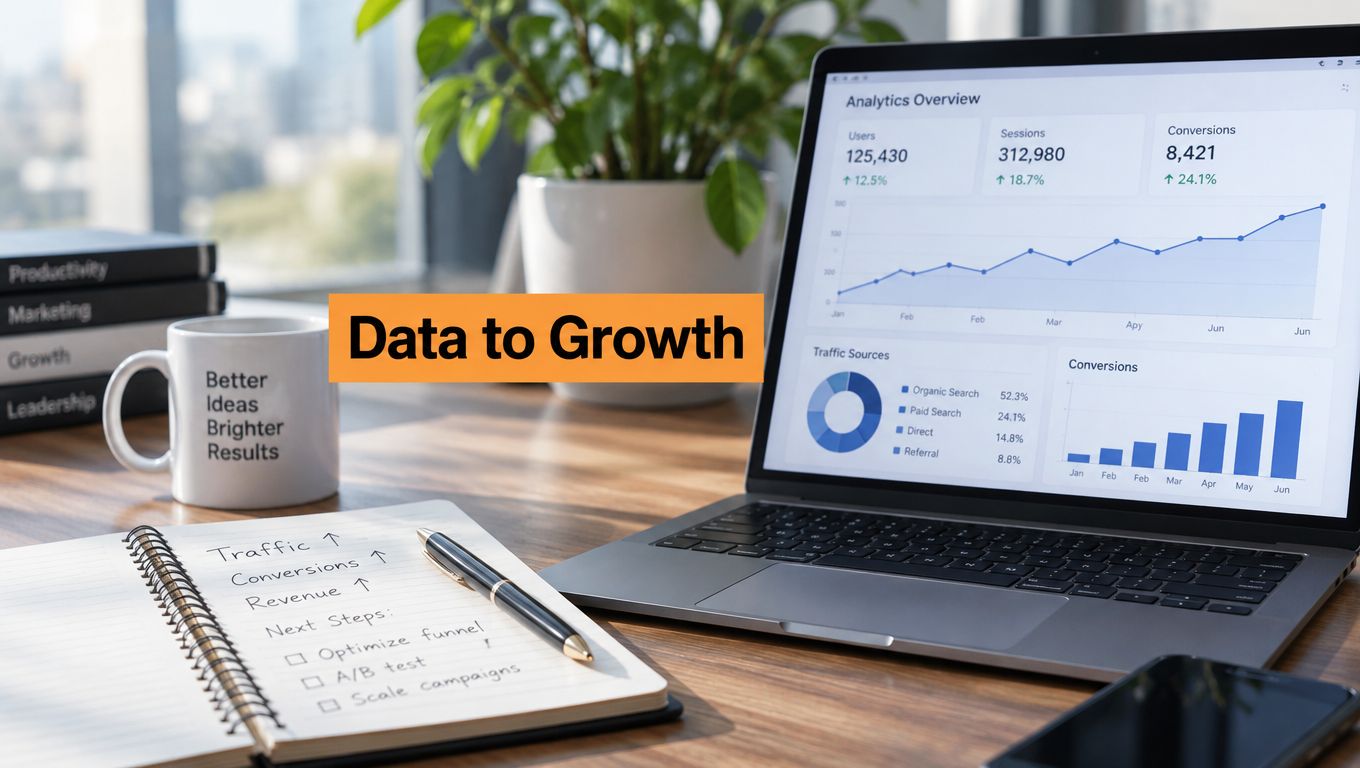
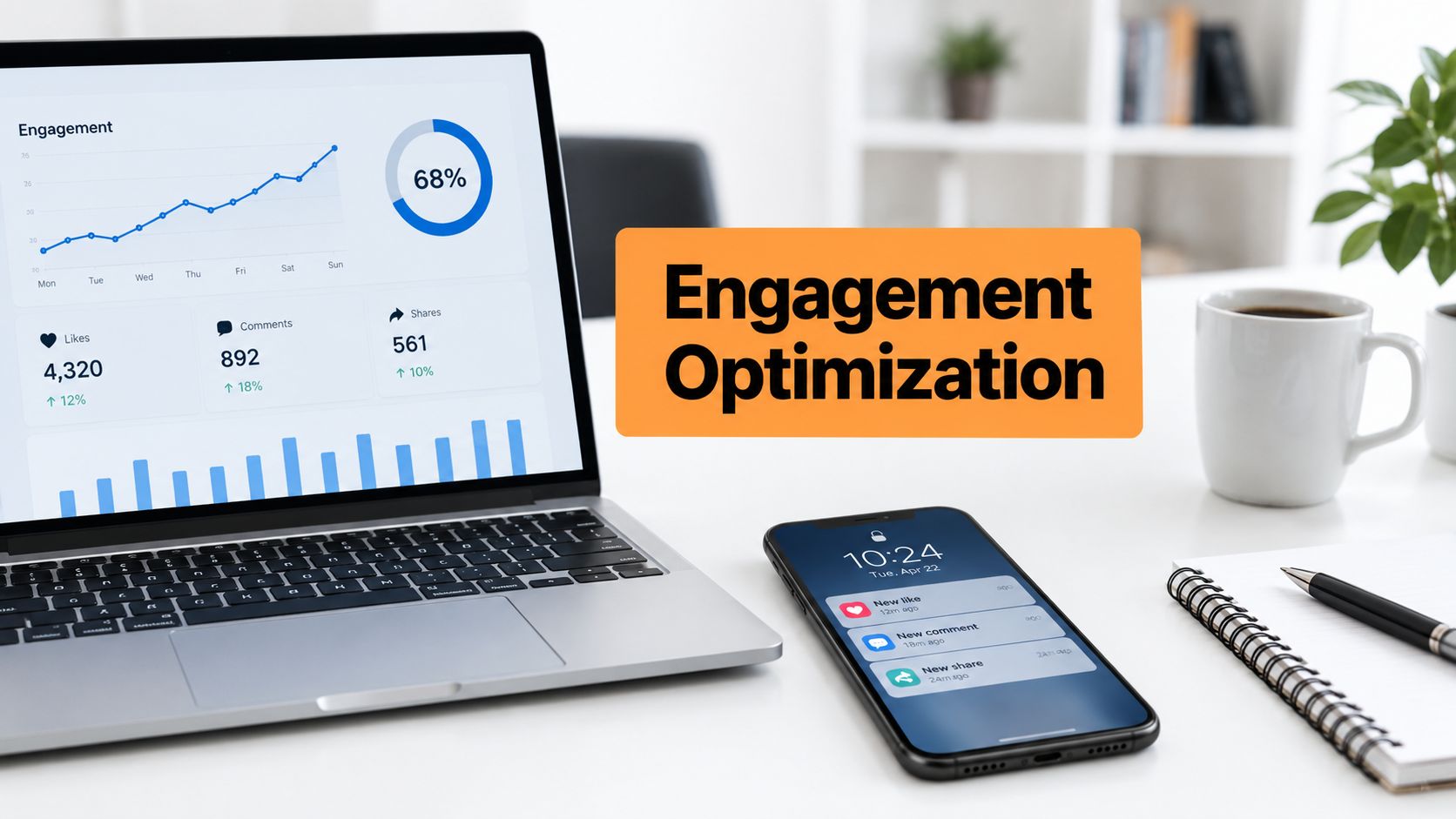
Dynamic scheduling matters because behavior changes. Creators using dynamic, analytics-driven scheduling see a 45% increase in follower growth compared to those using static, pre-set calendars. The reason is simple: most generators still don't use integrated analytics to fine-tune timing or recycle top-performing content in real time.
That doesn't mean you need a giant dashboard. It means you need to study response quality.
Look at things like:
- Comment quality: Are people adding their own experiences, disagreeing thoughtfully, or tagging peers?
- Profile curiosity: Which posts make people want to learn more about you?
- Share behavior: What gets passed along because it reflects well on the reader?
- Connection signals: Which themes lead to relevant inbound conversations?
A post with moderate reach and strong business relevance often teaches you more than a post with broad vanity engagement.
Translate performance into better prompts
Once you see patterns, feed them back into your system. Doing so sharpens the AI.
If personal stories attract stronger comments, ask for more experience-led posts. If contrarian opinions earn attention but weak conversions, keep the edge but tighten the audience relevance. If educational posts get saves but little discussion, test stronger hooks and more specific examples.
A simple monthly review can use this framework:
| Signal | What it likely means | Prompt adjustment |
|---|---|---|
| Strong comments on personal posts | Your audience responds to lived experience | Ask for more first-person examples and real work scenes |
| Good reach, weak response | Topic was broad but not specific enough | Narrow the audience and sharpen the problem |
| High saves on frameworks | People value utility | Generate more structured breakdowns with immediate application |
| Strong response at certain times | Timing fits audience behavior better | Shift scheduling windows and reserve similar posts for those slots |
Build a real feedback loop
A high-performing ai content calendar generator isn't static. It's iterative.
Use a review rhythm like this:
- Collect results from the month
- Tag each post by pillar, format, tone, and outcome
- Spot what repeated across winners and losers
- Update your tone profile, prompt rules, and cadence plan
The calendar should learn from the audience. If it doesn't, you're just automating repetition.
That loop is what closes the gap between generic AI planning and a system that becomes more accurate over time.
The Future Is Human-Directed AI
The strongest AI content systems don't replace judgment. They multiply it.
A good ai content calendar generator handles the repetitive work that drains good strategists. It helps organize themes, draft variants, queue posts, and keep momentum. But it still needs a human to supply the sharp opinion, the genuine story, the lived nuance, and the decision about what deserves attention.
That matters most on LinkedIn, where trust usually comes from specificity. People follow operators who sound like they've done the work. They ignore polished sameness.
The future isn't AI writing your presence for you. It's AI helping you publish with more consistency, more relevance, and less friction, while your expertise stays at the center. That's the system that lasts.
If you want that kind of system without the usual generic output, RedactAI is built for LinkedIn professionals who care about sounding like themselves. It learns from your profile, posting history, and personal context so your drafts feel closer to your real voice, then helps you schedule, repurpose, and improve your content based on performance.