You're probably doing one of two things right now. Either you're posting on LinkedIn and hearing crickets, or you've stopped posting because the last few attempts felt pointless.
That usually isn't a content talent problem. It's a visibility problem.
LinkedIn is often treated like a place to tidy up a profile, drop the occasional post, and hope the right people stumble across it. That's not how getting noticed works anymore. If you want recruiters, buyers, collaborators, or peers to find you, you need three pieces working together at the same time: a searchable profile, content that matches how LinkedIn distributes attention, and engagement that leaves a visible trail of expertise.
If you want the short version of how to get noticed on linkedin, it's this: make your profile easy to find, make your posts easy to engage with, and make your activity easy to trust.
Your Foundation for LinkedIn Visibility
If your posts get low reach, don't start by blaming the post. Start with the profile behind it.
A strong profile matters because recruiters and decision-makers find people through multiple surfaces on LinkedIn, and the exact terms in your headline, About section, and job titles influence discovery. LinkedIn also has over 1 billion members, and discovery depends more and more on how algorithmic systems connect skills, titles, and content engagement to search behavior, as noted in this LinkedIn visibility discussion.

Fix the headline first
Your headline is not a status update. It's a search field.
“Marketing Leader seeking new opportunities” is weak because it tells people very little and gives search systems almost nothing specific to latch onto. A better headline includes the role you want, the expertise you want associated with your name, and the context you work in.
A simple structure:
- Target role
- Core specialty
- Business context or audience
- Optional credibility signal
For example, instead of “Consultant,” write something closer to: consultant for B2B SaaS positioning, messaging, and go-to-market strategy. No fluff. Just searchable relevance.
Build the About section for discovery, not autobiography
Most About sections fail because they read like compressed resumes. They list everything, position nothing, and bury the important terms halfway down.
Use this order instead:
- First line: Say what you do using the terms people search
- Second block: Clarify who you help or what problems you solve
- Third block: Reinforce your strongest tools, specialties, industries, or functions
- Final lines: State what kind of conversations or opportunities are relevant
Your first sentence does more work than the rest of the section combined. Don't waste it on a vague personal statement.
If you're targeting recruiter attention, define your job titles first. Then map 8 to 15 core keywords and place the most important ones in your headline and first About sentence, while naturally repeating them in experience bullets and skills. That recruiter-focused workflow is outlined in Lindsey Pollak's advice on LinkedIn strategies that impress recruiters.
Use skills and experience like proof, not decoration
The skills section is not the place to collect random buzzwords. Pick skills that align with the searches you want to appear in. Then make sure those same terms also show up in your experience section.
A practical profile tune-up looks like this:
- Headline: Put the highest-intent terms here
- About: Repeat the most important terms naturally near the top
- Experience: Use role-specific language in your bullet points
- Skills: Add the exact skills someone would filter for
If you need a deeper walkthrough, this guide on how to optimize your LinkedIn profile is a useful companion.
What actually works
I've seen the biggest gains come from specificity. Specific title. Specific niche. Specific tools. Specific industry.
What doesn't work is trying to sound impressive to everyone. That usually makes you invisible to the people who matter.
Crafting a High-Impact Content Strategy
Posting more isn't the strategy. Posting in the formats LinkedIn already rewards is the strategy.
Buffer's 2026 report says LinkedIn's average engagement rate reached 6.50% in its 2025 data, and that thought leadership posts get 6x more engagement than job content, while carousels earn 278% more engagement than video and 596% more than text-only posts according to Buffer's LinkedIn statistics.
That tells you something important. The platform favors content that teaches, frames expertise, and gives people a reason to stop scrolling.
Early in your process, it helps to think visually about your mix.

Pick content pillars that support your actual goal
A lot of professionals post whatever happened that week. That creates randomness, not momentum.
Your content pillars should tie directly to the reason you want to be noticed. If you want recruiter attention, post around your function, your thinking, and the kind of problems you solve. If you want inbound leads, focus on buyer pain points, decisions, and lessons from real work.
A simple setup:
- Authority pillar: Teach your craft
- Perspective pillar: Share your take on industry shifts
- Proof pillar: Show how you think through real problems
- Personal context pillar: Add selective stories that support credibility
Match the message to the format
Here's the mistake I see constantly: strong idea, wrong packaging.
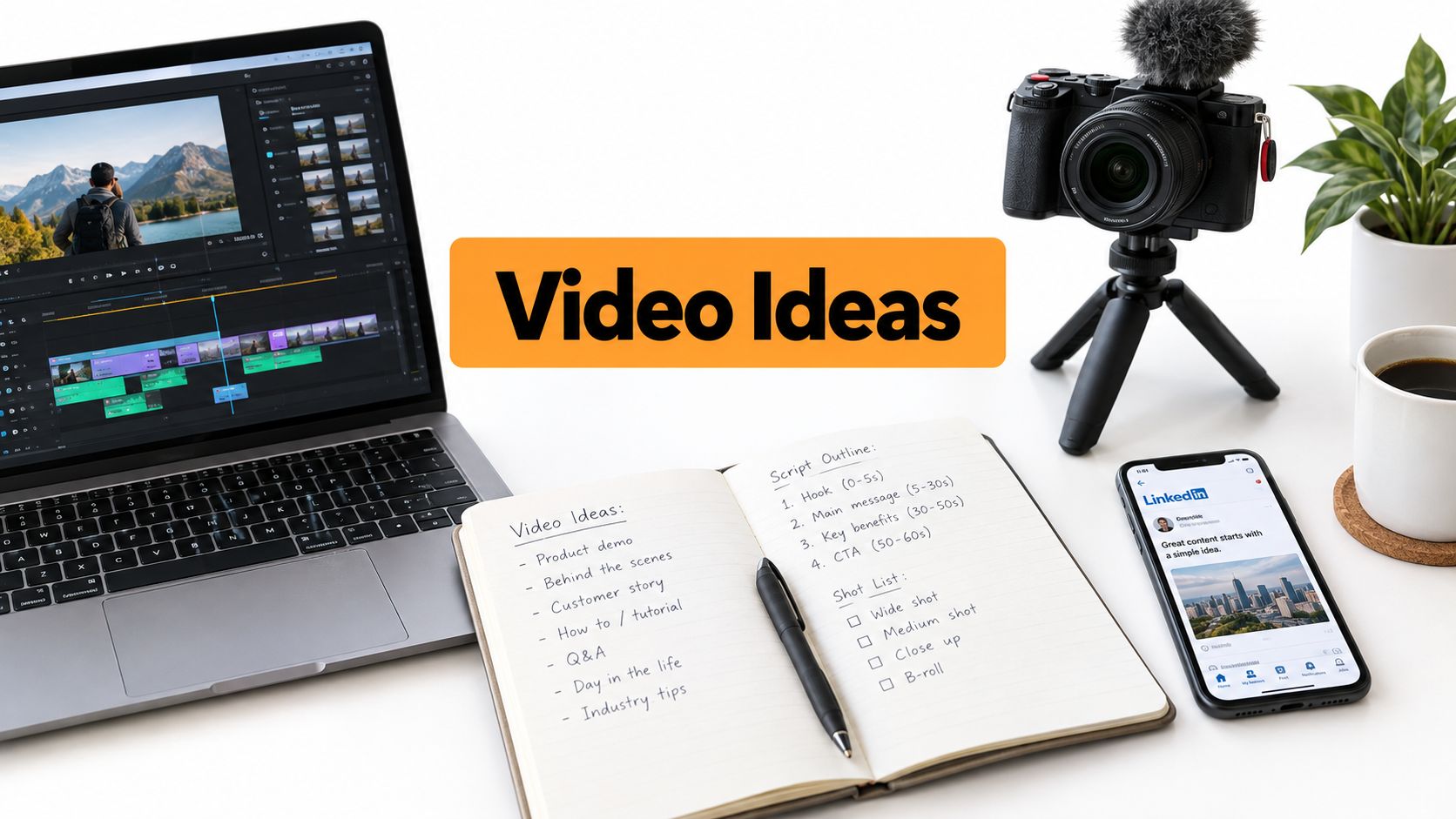
If you've got a framework, process, teardown, or lesson with steps, turn it into a carousel. If you've got a sharp opinion or quick insight, video can work well. If you've got a career update, make it useful by attaching a lesson, pattern, or takeaway instead of just announcing the news.
One more useful clue comes from Wavecnct's summary of Search Wilderness analysis. It notes that longer posts around 1,900 to 2,000 characters can achieve strong reach, short posts do best around 150 to 300 characters, educational videos get 3x more engagement than promotional videos, and videos under 30 seconds are more likely to be watched to completion, according to Wavecnct's LinkedIn statistics roundup.
That's why polished promotion often falls flat. Educational content gives people a reason to engage.
Here's a simple idea matrix you can use.
| Goal | Content Type | Example Post Hook |
|---|---|---|
| Build authority | Carousel | “5 mistakes I keep seeing in enterprise sales messaging” |
| Generate leads | Short educational video | “If your landing page sounds smart but doesn't convert, start here” |
| Attract recruiters | Thought leadership post | “What hiring managers usually miss when they evaluate operations talent” |
| Grow peer recognition | Industry perspective post | “The advice everyone repeats about brand strategy is incomplete” |
| Start conversations | Story plus lesson | “A client question changed how I explain positioning” |
Later, when you share links from your content elsewhere, it's worth understanding how previews work. This own.page guide to social media metadata is useful if you care about how your posts and linked pages appear once they're shared across platforms.
This walkthrough is worth watching if you want more ideas on what strong LinkedIn posts look like in practice.
Keep the production system light
Most busy professionals don't need a giant content machine. They need a repeatable one.
Practical rule: Build one strong idea into multiple formats instead of inventing from scratch every time.
If you want help turning rough ideas into posts, a planning resource like this LinkedIn content strategy guide can help you structure themes, hooks, and formats without defaulting to random posting.
The Art of Strategic Engagement
LinkedIn doesn't just reward publishing. It rewards visible participation.
That matters because people rarely make decisions based on one post alone. They click through, scan your profile, look at your recent activity, and decide whether you seem active, credible, and relevant. Merit America's recruiter-approved advice emphasizes regular posting and a visible activity trail, and notes that recruiters pay the most attention to candidates who are active and apply within the first 72 hours of a job posting in this guide to LinkedIn profile tips recruiters approve.

Stop leaving lazy comments
“Great post.”
“Thanks for sharing.”
“Couldn't agree more.”
Those comments are functionally invisible. They don't add insight, they don't signal expertise, and they don't make anyone curious enough to click your profile.
A strong LinkedIn comment usually does one of three things:
- Adds nuance: “This is true for startups, but in larger orgs the handoff problem changes the equation.”
- Adds example: “I saw this firsthand during a rebrand where the issue wasn't messaging, it was internal alignment.”
- Adds a question: “Do you think this still applies when the buyer isn't the user?”
Use a daily engagement rule
You don't need to live on LinkedIn. You need to be deliberate.
I like a simple rhythm: engage with your feed broadly, leave a handful of thoughtful comments on relevant accounts, and publish when you have something worth saying. If you're job searching or trying to raise your professional visibility, also follow target companies and engage with posts in the orbit you want to be part of.
A useful routine:
- Scan your feed for relevance, not entertainment
- Comment where your expertise adds context
- Reply to comments on your own posts fast
- Visit target companies and key voices regularly
- Apply quickly when a role fits
The most useful engagement leaves evidence of how you think, not just proof that you were online.
What works better than volume
A lot of people waste time commenting everywhere. That creates noise, not positioning.
A better trade-off is fewer comments with more substance. If the right people keep seeing your name attached to practical, credible takes, your profile starts doing more work without you posting nonstop.
What doesn't work is treating engagement like networking theater. People can smell fake enthusiasm and drive-by self-promotion immediately.
Measuring What Matters for Growth
If you're serious about how to get noticed on linkedin, you need to read your signals correctly.
Likes are often the first thing noticed because they're visible. Likes can be useful, but they're not the clearest sign of progress. What matters more is whether the right people are finding you, clicking through, and engaging with the themes you want to be known for.
Recent LinkedIn advice suggests that even 2 to 3 thoughtful posts per week can keep you on recruiters' radar, which pushes back on the idea that daily posting is necessary, as discussed in this LinkedIn visibility video. That means your measurement framework should focus on consistency and relevance, not sheer output.
Read the signals in context
Here's the simplest way to interpret the main indicators inside LinkedIn:
| Metric | What it usually means | What to do next |
|---|---|---|
| Search appearances | Your keywords are working well enough to surface you | Improve the headline and About section if clicks stay low |
| Profile views | Your activity is generating curiosity | Make sure your profile converts that interest into credibility |
| Post comments | Your topic is creating conversation | Double down on that angle or format |
| Low engagement across several posts | The message, format, or hook isn't landing | Change the packaging before changing your whole niche |
Diagnose the bottleneck
If search appearances are decent but profile views feel weak, your headline is probably too generic.
If profile views rise after comments and posts, but messages don't follow, your profile may be attracting the wrong audience or failing to show clear relevance.
If one post gets discussion and the next four don't, don't panic and reinvent everything. Look for pattern mismatch. Maybe the strong post taught something concrete and the weak ones were just updates.
Use a lighter review cycle
You don't need to obsess over every post. Review trends weekly or every couple of weeks.
Look for repeat signals:
- Which topics start real conversations
- Which post formats get saves, comments, or profile clicks
- Which activities lead to relevant profile visits
- Whether your cadence is sustainable
The right system is the one you can keep running without burning out.
Common Mistakes That Keep You Invisible
Most LinkedIn problems aren't caused by a lack of effort. They're caused by effort spent in the wrong places.
I can usually tell within a minute why someone isn't getting noticed. The profile is vague, the posts are self-focused, the activity is inconsistent, or the whole account feels like it belongs on another platform.

Visibility blockers to remove fast
Generic headline
“Open to work,” “seeking opportunities,” and broad labels like “consultant” don't give LinkedIn or humans enough context. Use exact role, specialty, and market language instead.About section as a bio dump
If your summary reads like a chronological life story, it's working against you. Lead with what you do, who you help, and what you're known for.Only promotional content
Constantly pitching your service, company, or offer makes people tune out. Teach first. Explain your thinking. Give useful perspective.Posting with no consistency
Vanishing for weeks and then posting five times in two days creates a weak signal. A smaller, steadier rhythm is more believable and easier to sustain.Using LinkedIn like Facebook
Recruiters explicitly warn against “Facebook-izing” your profile. Personal content isn't the issue by itself. Irrelevant, low-signal posting is the issue.
The trade-offs people ignore
A polished profile with no recent activity looks dormant.
A high-activity account with a messy profile leaks attention.
A steady stream of inspirational fluff may get surface reactions, but it won't build clear professional positioning. And motivational one-liners rarely create the kind of profile visits you actually want.
If someone visits your profile after seeing your post or comment, they should instantly understand what you do and why you're relevant.
What to do instead
Try this quick audit:
| Mistake | Better move |
|---|---|
| Vague headline | Add exact title, expertise, and niche |
| Resume-style About section | Turn it into a positioning statement |
| Random posting | Build around a few repeat themes |
| Generic comments | Add examples, context, or a smart question |
| Overly personal feed | Keep the content tied to professional relevance |
The fastest route to visibility is often subtraction. Remove the habits that dilute your signal, and the good work you're already doing becomes easier to notice.
Your LinkedIn Acceleration Kit (Templates and Tools)
You don't need another lecture. You need a set of assets you can use this week.
Here are a few practical templates that work because they sound normal, they respect the platform, and they make it easy for people to respond.
Connection request template
Use this when you have a reason to connect.
Hi [Name], I've been following your posts on [topic] and liked your perspective on [specific point]. I work in [your area], and I'd love to connect.
Short beats clever. Specific beats flattering.
Recommendation request template
This works better than “can you write me a recommendation?”
Hi [Name], I'm refreshing my LinkedIn profile and thought of the work we did together on [project or context]. If you'd be open to it, I'd really appreciate a short recommendation focused on [strength, project, or outcome]. Happy to return the favor.
Fill-in-the-blank post structure
Use this when you know the lesson but don't know how to frame it.
Hook
One belief, mistake, observation, or tension
Example: “Most LinkedIn posts fail before anyone reads the second line.”Context
Briefly explain where the insight came fromMain lesson
Give the practical takeaway in plain EnglishProof or example
Show how that idea plays out in real workClose
End with a question or a concise takeaway
Weekly cadence that busy people can maintain
You don't need daily publishing. You need a rhythm you can keep.
- Monday: Comment on relevant industry posts
- Tuesday: Publish one educational post
- Wednesday: Reply to comments and connect with new relevant people
- Thursday: Publish one perspective post or short story with a lesson
- Friday: Review profile views, search appearances, and post responses
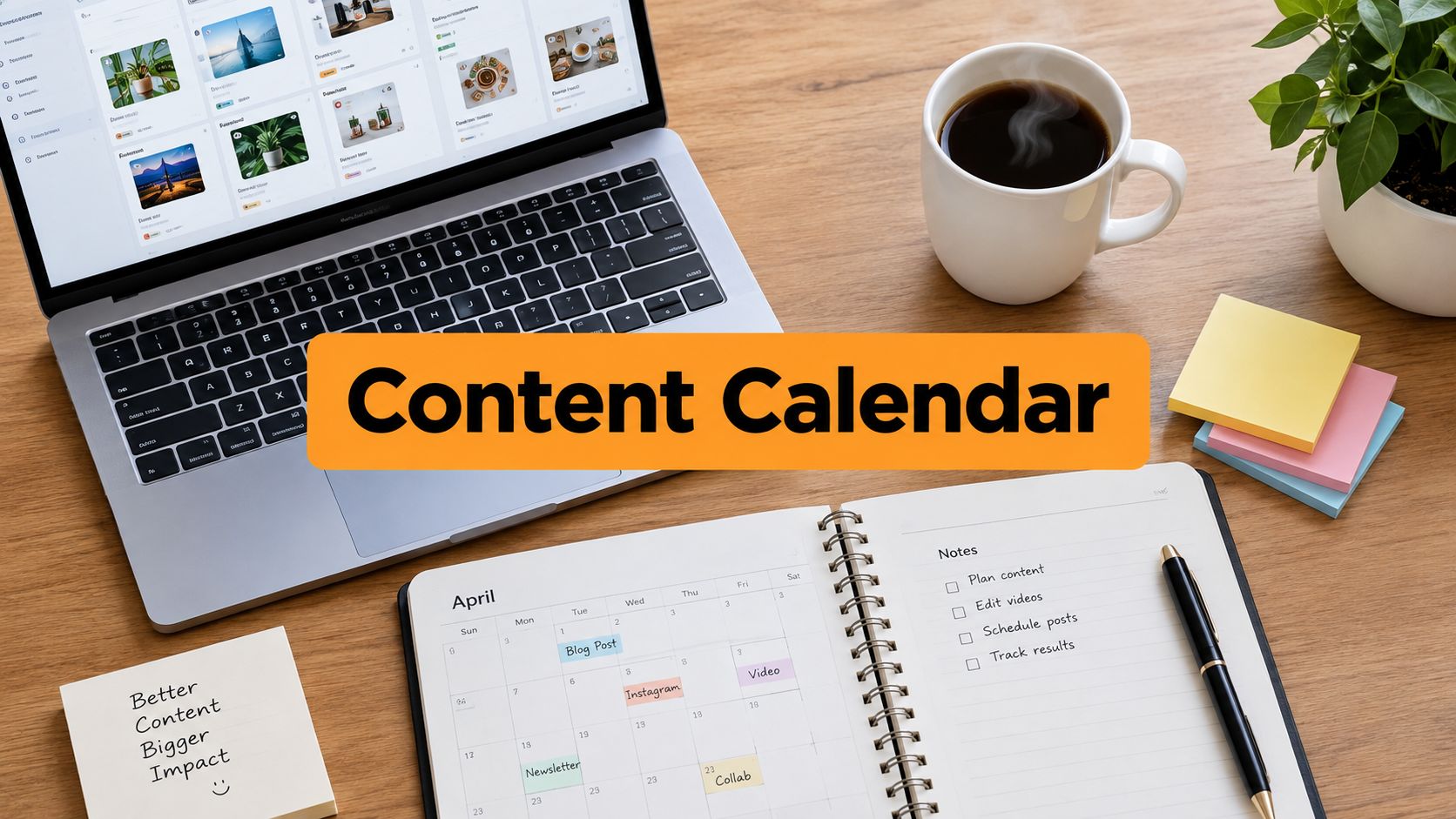
If you want help systematizing that workflow, this LinkedIn content calendar template gives you a cleaner structure for planning without overcomplicating it.
One tool that can speed up the process
If you're busy and need help turning ideas into usable LinkedIn drafts, RedactAI can support the workflow by analyzing your profile and posting history, generating post ideas, drafting content in your tone, and helping maintain a consistent publishing schedule. Used well, that kind of tool is most useful for speeding up execution, not replacing judgment.
That distinction matters. Tools can help you move faster. They can't decide what you should be known for.
If you want a faster way to turn this playbook into consistent execution, take a look at RedactAI. It helps professionals create LinkedIn posts in their own voice, organize ideas, and keep a reliable publishing rhythm without turning LinkedIn into a full-time job.