From Badge to Buzz: Turn Conference Highlights into Likes. You just got back from a major industry conference. Your notes app is a mess, your camera roll is full of stage photos, and your LinkedIn draft box is empty. That's a familiar spot. A lot of smart people attend great events, then wait too long to share anything useful, and the window closes.
The fix isn't “post more.” It's knowing which conference highlights make good LinkedIn content, and how to shape each one into a post people want to read. A keynote needs a different angle than a workshop. A product demo needs more judgment than a networking recap. If you treat every highlight the same, your posts start sounding like recycled event coverage.
That's also why conference highlights aren't just about documenting what happened. They're closer to content packaging. If you've ever thought about how platforms save and organize story moments, the same logic applies here. The definitions of Instagram Highlights are a useful parallel. Pick the moments worth preserving, frame them clearly, and make them easy for other people to revisit.
Below are 8 conference experiences you probably already had this week, plus the LinkedIn post structure, hook, CTA, and repurposing angle for each one.
1. Keynote Speeches and Thought Leadership Presentations
Keynotes are usually the easiest conference highlights to post about, and also the easiest to ruin.
What works is extracting one sharp idea and adding your take. What doesn't work is posting a blurry stage photo with “So many amazing insights today.” Nobody learns anything from that. If the speaker shared a framework, a tension, or a contrarian point, that's your content.

Post structure that usually lands
Use a simple flow:
- Hook with the claim: “The most useful idea I heard at today's keynote wasn't about growth. It was about focus.”
- Name the insight: Share the one point that stuck.
- Add your interpretation: Explain why it matters in your day-to-day work.
- Close with a practical question: Invite your audience into the topic.
A strong keynote post reads less like event coverage and more like filtered thinking. That's the difference between “I attended” and “I understood.”
Practical rule: Don't summarize the whole keynote. Pick the one idea you'd still remember next month.
If you want to keep building on keynote ideas after the event, study a few thought leadership content examples. You'll notice the best posts don't just report what a speaker said. They connect that idea to a real business decision, a trend, or a friction point practitioners already feel.
A template you can steal
Try this:
“Just heard a keynote on [topic].
The biggest takeaway for me:
[one concrete insight]
Why it matters:
[how this changes your work, team, clients, or market view]
What many will do:
[common weak reaction]
What I think they should do instead:
[your practical recommendation]
Curious how others are handling this:
[question]”
Best CTA: ask for agreement or pushback, not applause.
Repurposing idea: turn the keynote takeaway into a carousel with three slides. Slide one is the claim. Slide two is what the speaker argued. Slide three is your version of how to apply it.
2. Networking and Relationship Building Sessions
Networking content gets weird fast when it turns into name-dropping.
The strongest posts from mixers, roundtables, and hallway conversations focus on the substance of the interaction. Not “great meeting brilliant people,” but “three founders kept raising the same operational problem.” That shift makes the post useful even to people who weren't in the room.
What to post instead of a people collage
A practical networking post usually starts with a pattern. Maybe several recruiters mentioned the same hiring bottleneck. Maybe agency owners kept talking about client education. Maybe sales leaders disagreed on follow-up timing but agreed on qualification.
That gives you a real post angle. It shows you're not collecting business cards. You're listening.
If you want better prompts for this kind of content, relationship-building skills is a useful place to sharpen the thinking behind the post, especially if you want your networking recap to sound human instead of transactional.
A clean format for relationship posts
Try one of these:
- The pattern post: “After six conversations today, one issue kept coming up…”
- The perspective shift post: “A conversation over coffee changed how I think about…”
- The community post: “The best part of this event wasn't a session. It was hearing how peers are solving…”
Keep the names private unless you have permission. Mention roles or industries instead. That protects the relationship and keeps the focus on the lesson.
Some of the best conference highlights happen off-stage. They just need better framing to become content.
Best CTA: ask your audience if they're seeing the same issue in their market.
Repurposing idea: take one networking conversation and turn it into a short LinkedIn poll, then follow up the next day with your take on the responses. That sequence often works better than a single recap post because it extends the conversation beyond the event itself.
3. Product Launches and Technology Demonstrations
Product launch posts flop when they read like unpaid press releases.
A launch or demo becomes good LinkedIn content when you answer one question clearly: who should care, and why? That means less “exciting innovation” language and more practical interpretation. What changed? What problem does it solve? What trade-off comes with it? Where might adoption stall?
The angle that gets attention
The best launch post is rarely “Here's what was announced.” It's closer to “Here's what this changes for teams like mine.”
If you watched an AI tool launch at a marketing conference, don't recap every feature. Pick the feature that will change workflow, content quality, review cycles, or reporting. If you saw a new CRM integration at an event like Dreamforce or INBOUND, comment on implementation friction, not branding language.
A useful hook sounds like this:
- “This launch matters if you own the handoff between marketing and sales.”
- “The demo was impressive, but the real question is adoption.”
- “Most coverage will focus on the feature. I'm more interested in the workflow change.”
A post template for launch commentary
Use this structure:
- Hook: one sentence on the significance
- What launched: brief and plain-English
- Why it matters: who benefits first
- What could go wrong: training, cost, complexity, data quality, change management
- CTA: ask how peers would evaluate it
Trade-offs are important. Smart readers trust posts that include friction. If you say every demo was brilliant, you sound like conference staff.
Good repurposing move: split your post into a mini-series. Post one covers the announcement. Post two covers your likely use case. Post three compares the launch to the existing way teams solve that same problem.
4. Case Studies and Success Story Presentations
Case study sessions are gold for LinkedIn because they're already built around narrative. Problem, approach, result, lesson. You don't need to invent the structure. You just need to translate it for your audience.
In healthcare settings, case study presentations work best when they combine quantitative and qualitative evidence and follow a clear sequence of Introduction, Problem Statement, Methodology, Results, and Discussion, according to guidance on successful healthcare conference case studies. That same logic carries over to LinkedIn. Clear story beats make the takeaway easier to trust and easier to remember.
What people usually miss
Restating the visible lesson is common. The stronger move is to find the hidden one.
If a speaker shares a success story about a content overhaul, the obvious lesson might be “better messaging helped.” The hidden lesson could be that the team simplified internal approvals, defined ownership earlier, or stopped trying to please every stakeholder. Those are the insights practitioners save.
When you write your post, avoid pretending you have access to every internal detail. Stay honest. Pull out the method, not private metrics you didn't get.
If you create this kind of content often, how to write case studies for business is worth bookmarking because it helps turn a conference takeaway into something structured enough to publish without sounding stiff.
A post format that feels smart, not recycled
Try this:
“Best case study takeaway from today's event:
The headline lesson looked like [obvious point].
The true lesson was [deeper operational insight].
Why that matters:
[application to your field]
I'd borrow this part:
[specific method]
I'd be cautious about this part:
[context or limitation]
Would this work in your environment?”
Best CTA: ask whether the same method would hold up in another industry, team size, or market.
Repurposing idea: use the case study as the basis for a short newsletter section or a voice-note style LinkedIn video where you explain the “hidden lesson” in under a minute.
5. Panel Discussions and Expert Roundtables
Panels give you something keynotes usually don't. Tension.
That's why they make strong LinkedIn content. When several operators, executives, or specialists answer the same question differently, you get contrast. Contrast drives comments because readers can place themselves on one side of the issue.

Post the disagreement, not the agenda
A weak panel recap lists topics covered. A strong one isolates the moment panelists diverged.
Maybe one CEO argued for hiring specialists early while another pushed generalists. Maybe one marketer favored long-form authority building while another prioritized distribution. That disagreement is the post.
You don't need to quote people unless you captured their words accurately. Paraphrase the viewpoints clearly and responsibly.
When experts disagree in public, your job isn't to flatten the difference. Your job is to explain why the difference matters.
A useful panel post formula
Here's a simple structure:
- Hook: “The most interesting moment in today's panel was where the speakers disagreed.”
- Viewpoint one: summarize in one or two lines
- Viewpoint two: summarize in one or two lines
- Your take: where each view fits
- CTA: ask readers which approach matches their reality
This format works especially well for leadership panels, GTM roundtables, and hiring discussions because those topics rarely have one right answer.
There's another practical angle here. Coverage often skips the “what now?” piece, especially for underserved groups. One source notes that 65% of attendees feel confused about turning conference insights into inclusive interventions for underserved communities, while only 9% of highlight articles feature panel or roundtable models that bridge knowledge to action with specific data on reaching those populations, according to this discussion of underserved-community conference coverage. So if your panel touched cost, access, language, transportation, or insurance barriers, that's worth turning into a LinkedIn post with a real action angle.
Repurposing idea: turn one panel disagreement into a “two things can be true” post. Those often perform well because they lower the pressure to pick a simplistic winner.
6. Industry Trend Reports and Market Research Findings
Trend-report sessions can make your content look credible fast, but only if you handle them carefully.
The trap is dumping stats without context. The better move is to use one data point to support a practical observation. Then explain what a team should do with it. Data is the entry point, not the whole post.
Use one number, then do the interpretation
A useful example comes from event planning itself. In 2026, 50% of professional meeting planners are using AI to help plan and execute events, according to Cvent's event statistics roundup. That matters because conference highlights are no longer just recorded moments. Organizers are increasingly using event tech and real-time attendee signals to identify which sessions, speakers, and topics deserve more visibility after the event.
That shift gives you a sharper LinkedIn angle. Instead of posting “Here were my favorite moments,” you can post “Here's what the event seemed to reward with the most attention, and why I think that matters for the industry.”
A strong data-driven post format
Try this sequence:
- Lead with the data point
- Translate it into plain English
- Explain the business implication
- Add your own observation from the event
- Ask readers if they're seeing the same shift
For example, if a conference report points toward a market move in AI, learning, compliance, hiring, or buyer behavior, don't stop at “interesting stat.” Say what it changes for practitioners. Budgeting? Team structure? Content priorities? Vendor evaluation?
One caution: don't pile on numbers for the sake of sounding serious. Readers remember interpretation better than data dumps.
Repurposing idea: use the same trend-report insight in three formats. A text post for your immediate take, a carousel for the broader implications, and a comment on someone else's conference recap that adds your perspective without repeating your full post.
7. Hands-On Workshops and Skill Development Sessions
Workshop content works because it's naturally concrete. You learned something, tried something, and can usually apply something.
That said, workshop posts often turn into vague enthusiasm. “Great session on personal branding” doesn't do much. “I changed the first line of my LinkedIn headline because of one workshop exercise” is better. Specificity wins.
Here's the image that fits this kind of practical, in-the-room learning:

The best workshop post starts with action
Post what you changed, tested, or plan to implement within the next week.
That's stronger than posting notes. It signals that the session affected your behavior, not just your attention span. In conference measurement, post-event feedback often looks at session quality, speaker effectiveness, content relevance, and knowledge gained, and organizers also compare registration with actual attendance while tracking networking value and broader coverage, as described in this overview of how conferences are evaluated. The practical lesson for LinkedIn is simple. The workshop post that performs best usually shows applied knowledge, not passive attendance.
A good hook might be:
- “I used one workshop exercise today and immediately saw a flaw in my process.”
- “The most useful session I attended wasn't a keynote. It was a hands-on workshop that forced me to rewrite…”
- “One small change from today's workshop is going straight into my workflow.”
A template for workshop-based posts
Use this:
- What I learned
- What I changed
- What I'm watching
- What I'd tell someone else to try
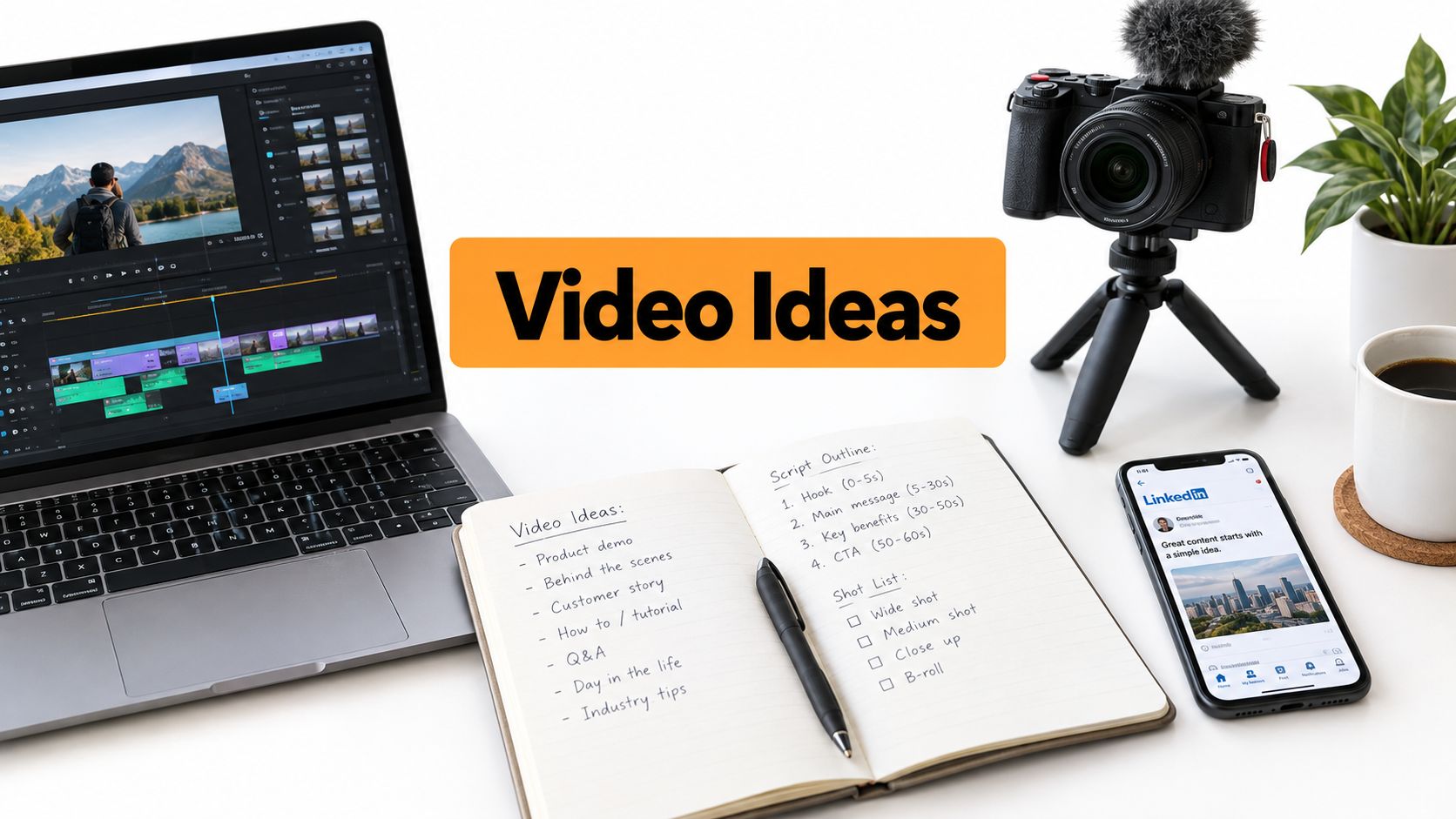
And if you want to turn workshop content into richer media, a short video works well as a follow-up:
Keep it simple. One takeaway, one application, one invitation for others to compare notes.
A workshop post should answer one question clearly: what are you doing differently now?
Repurposing idea: create a “testing this for 7 days” series. Day one is the lesson. Later posts share what held up, what broke, and what needed adaptation.
8. Networking Announcements and Partnership Reveals
Partnership news can be some of the best conference highlights for LinkedIn, especially if your audience cares about ecosystem shifts, integrations, channel strategy, or competitive positioning.
But don't just repeat the announcement. Your value is in the analysis. What does the partnership enable? Who gains a strategic advantage? Which customers benefit first? Where could the partnership be more complicated than the press release suggests?
Read the strategy behind the reveal
A conference partnership announcement usually signals more than cooperation. It can signal distribution strategy, category pressure, technical dependency, market expansion, or a defensive move against a rival.
That's the lens to use in your post. If two platforms announce an integration, ask whether it reduces switching costs, improves reporting continuity, or tightens platform lock-in. If two agencies announce a collaboration, ask whether the combined offer solves a client handoff problem that used to create friction.
A simple post structure for partnership commentary
This one works well:
- Hook: “This partnership matters for one reason…”
- What was announced: plain-English summary
- Who it affects: customers, partners, practitioners, or competitors
- What it signals: strategic interpretation
- CTA: ask what readers think happens next
There's also a content gap here worth exploiting. One source notes that 78% of professionals are looking for compelling talk angles that showcase unique expertise, while only 12% of highlight summaries include actionable frameworks for identifying underserved market gaps, according to this page on finding speaking angles. A smart partnership post can fill that gap if you use the announcement to surface a neglected problem or a market segment most event recaps ignore.
Repurposing idea: turn your post into a “what this means for…” series. One version for practitioners. One for buyers. One for leaders thinking about market positioning.
8-Point Conference Highlights Comparison
| Session Type | 🔄 Implementation Complexity | ⚡ Resource Requirements | 📊 Expected Outcomes | 💡 Ideal Use Cases | ⭐ Key Advantages |
|---|---|---|---|---|---|
| Keynote Speeches and Thought Leadership Presentations | High, extensive prep, rehearsals | High, speaker time, AV, production | Broad reach and social buzz; strong brand credibility | Major conferences; trend-setting announcements | ⭐ Massive visibility and authority |
| Networking and Relationship Building Sessions | Medium, event curation and facilitation | Moderate, venue/time, curated guest lists | New connections; potential partnerships (long-term ROI) | Business development, recruiting, collaborations | ⭐ Authentic relationship-building |
| Product Launches and Technology Demonstrations | High, tight coordination and speed | High, demos, technical experts, press access | Newsworthy engagement; rapid attention spike | New product announcements, early adopter positioning | ⭐ High shareability and topical relevance |
| Case Studies and Success Story Presentations | Medium, data gathering and narrative crafting | Moderate, access to metrics, participant consent | Credible proof points and actionable frameworks | Demonstrating ROI, sales/marketing evidence | ⭐ Strong credibility and practical takeaways |
| Panel Discussions and Expert Roundtables | Medium, moderator prep and panel coordination | Moderate, multiple expert bookings, moderation | Diverse viewpoints; debate-driven engagement | Exploring trade-offs, opinion-based content | ⭐ Rich perspectives that spark discussion |
| Industry Trend Reports and Market Research Findings | Medium, data interpretation and synthesis | Moderate–High, research access, analysis tools | Authoritative, data-backed narratives and forecasts | Thought leadership, forecasting, benchmarking | ⭐ Evidence-based credibility and future signals |
| Hands-On Workshops and Skill Development Sessions | Medium, interactive design and facilitation | Moderate, facilitators, materials, small groups | Practical skills with immediate application | Training, tool adoption, capability building | ⭐ Actionable learnings and demonstrable progress |
| Networking Announcements and Partnership Reveals | Low–Medium, PR coordination and timing | Low–Moderate, press releases, analysis | Short-term news attention; strategic signaling | Partnership reveals, integrations, market moves | ⭐ Timely strategic relevance and conversation starters |
Your Conference Content, Amplified
Most people don't need more conference content ideas. They need a faster way to turn raw moments into finished posts before those moments go stale.
That's the essential work after an event. Not to document everything, but to select the conference highlights that can carry a useful point, shape them for LinkedIn, and publish while the conversation is still alive. A keynote becomes a perspective post. A workshop becomes an implementation post. A panel becomes a debate post. A partnership announcement becomes an analysis post. Same event. Very different outcomes.
The good news is you probably already have more content than you think. Your notes app, session photos, voice memos, saved brochures, and follow-up conversations are all raw material. The mistake is waiting until you have time to write the “perfect” recap. That usually turns into silence.
A better system is to package each highlight according to its natural format. If it's a speech, extract one argument. If it's a networking moment, pull out the pattern. If it's a product demo, focus on the workflow impact. If it's research, interpret the implication. That's how conference highlights stop being memories and start becoming authority-building content.
There's also a practical reason to be selective. Generic event recaps blur together. Focused posts travel further because they give readers a reason to respond. People comment when they see a tension, a usable framework, a smart disagreement, or a lesson they can apply on Monday morning.
This matters even more if you attend hybrid or large-format events where the in-room and online experiences create different takeaways. Teams planning coverage for those environments can learn a lot from London hybrid conference solutions because the production setup often influences which moments are easiest to capture, clip, and repurpose later.
If you want your post-conference content to work, keep these standards in mind:
- Be specific: One insight beats ten vague takeaways.
- Add interpretation: Don't just repeat what happened.
- Show trade-offs: Credibility comes from nuance.
- Post quickly: Fresh beats polished if the insight is clear.
- Build a series: One conference can fuel weeks of content.
That's the playbook. You don't need to be the loudest person from the event. You need to be the clearest thinker in the feed after it ends.
RedactAI helps you turn messy conference notes into polished LinkedIn posts fast. Drop in a takeaway, a speaker theme, a networking insight, or a product announcement, and RedactAI can generate post drafts, adapt them to your voice, and help you keep the momentum going after the event instead of losing it.