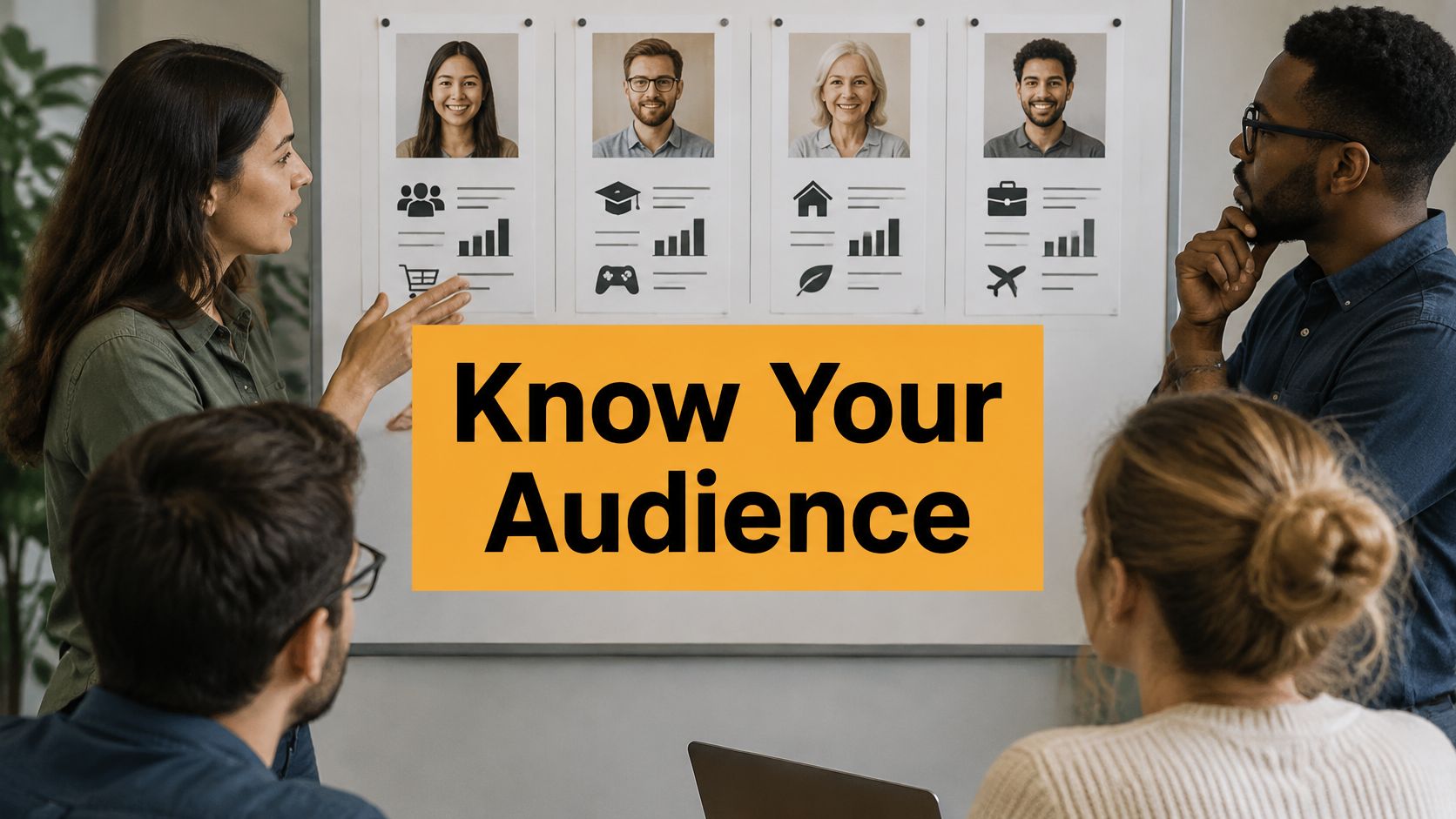
Audiences don't ignore your content because it's bad. They ignore it because it wasn't built for them. McKinsey found that 71% of consumers expect personalized interactions and 76% get frustrated when they don't happen, according to McKinsey research on the value of personalization. That's the surprising part. Personalization isn't a bonus anymore, it's the baseline people judge you against.
Stop marketing to everyone. The best audience segmentation strategies don't just split a list into smaller lists. They tell you which message, channel, and offer deserves attention right now. Start with the outcome you need to improve, whether that's engagement, lead quality, conversion, retention, or expansion, then pick the signal closest to that behavior.
The strongest setups usually pair something stable, like role or company size, with something dynamic, like intent or lifecycle stage. Demographic context tells you who someone is. Behavioral and intent signals tell you what they're likely to do next. Account signals tell you whether there's a real company behind the click.
How to Use This List
Each strategy below follows the same four-part playbook. Define the segment, collect the right data, activate it on LinkedIn or in broader campaigns, and measure it with specific KPIs. You'll also see channel specific thinking, similar to segmentation strategies for TV ads, because a segment that can't change an action isn't a strategy. It's just a label.
1. Demographic Segmentation
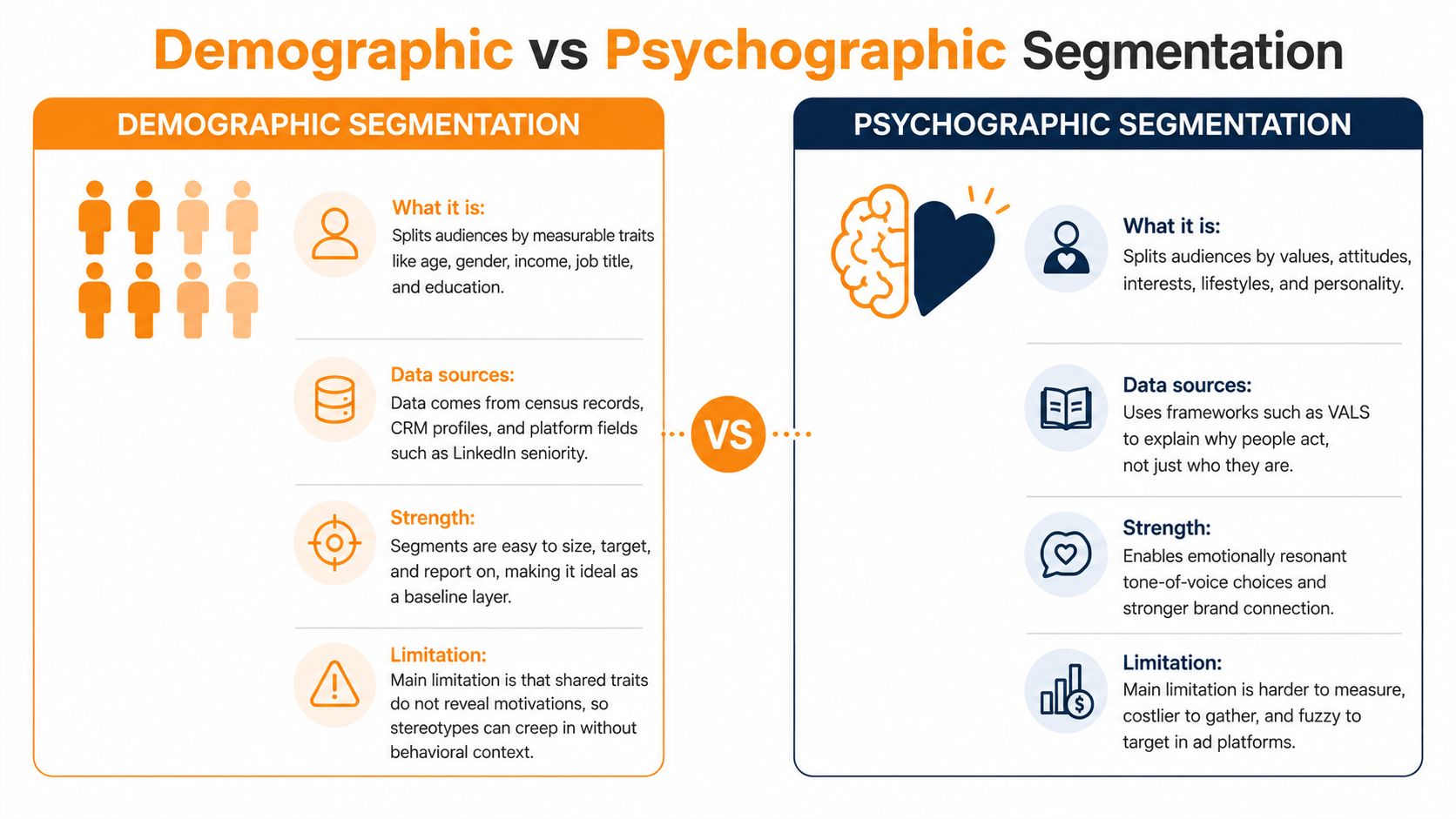
Demographic segmentation is the oldest trick in the book for a reason. It became a formal strategy in 1956, when Wendell R. Smith argued for treating a mass market as smaller homogeneous groups, a shift traced in Harvard Business School research on segmentation history. You're grouping by age, income, education, occupation, seniority, and years of experience. It's easy to collect and easy to explain to stakeholders. It's also easy to lean on too hard.
Define and collect. On LinkedIn, start with seniority and job function, since those shape the language people trust. An executive scans for risk and outcomes. An early career job seeker scans for practical steps and proof they can do the work. Pull this from LinkedIn Campaign Manager, CRM fields, and profile data. Systems like Experian Mosaic and Nielsen Claritas PRIZM do the same job for households at larger scale.
Activate and measure. Write one version for executives, another for mid-career specialists, and don't pretend the same hook works for both. Then layer behavioral data on top instead of stopping at the job title. If you're building your foundation, this guide to what audience segmentation is lays out the basics clearly.
- KPI to watch: Engagement rate and profile views by seniority tier
- Refresh rule: Rebuild profile based segments regularly, because roles change often
- Trade-off: Cheap and stable, but weak at predicting timing or intent
2. Geographic Segmentation
Geography shapes more than where someone lives. It shapes posting time, language, regulation, cultural norms, and which industry stories feel relevant. McDonald's India removing beef and pork from its menu is the classic example. The product changed because the local context demanded it, not because a global brand guideline said so.
Playbook for Location Based Targeting
Define segments by country, region, city, or time zone. Collect location from LinkedIn profiles, Campaign Manager location targeting, and website analytics. Don't collect precise location if a region is enough to make the decision. You rarely need more granularity than the campaign can use.
Activate by scheduling posts for your audience's business hours, not yours. Reference local hiring rules, funding news, or events when you're writing for a regional segment. A recruiter in London and a recruiter in Austin may share a job title, but they don't share the same labor market this week.
Measure reach and comment rate by region and by posting hour. For B2B thought leadership, geography works best as a secondary filter on top of role or intent. Used alone, it tells you where to send a message, not whether anyone wants it.
3. Psychographic Segmentation
Two founders can have identical demographics and completely different reactions to your post. One values disruption and speed. The other values proof and process. Psychographic segmentation groups people by values, attitudes, interests, and motivations, which explains why they act, not just what they clicked.
SRI International's VALS framework has segmented U.S. consumers by psychological motivations since the late 1970s. Patagonia does a simpler version of the same thing. It builds its audience around shared environmental values, attracting buyers who prioritize sustainability over price or trend.
Playbook for Values and Voice
Define segments around professional philosophies, such as growth, security, creativity, or efficiency. Collect signals from open ended survey questions, comment language, saved posts, and which tone earns replies. Ask followers what challenge they are trying to solve, and listen to the words they use.
Activate by matching tone to values. Send data driven breakdowns to the efficiency crowd, contrarian takes to the disruptors, and personal stories to people who save narrative posts. Measure saves, comment quality, and follower growth per tone. Voice matching pays off most here, especially for RedactAI users who need posts to sound like a person, not a template.

4. Behavioral Segmentation
What people do beats what they say in a survey. That's why behavioral segmentation is now the operational default. Nearly 90% of marketers base personalization on audience segments and 63% create segments from user behavior, according to DESelect research on AI and personalization in marketing. Netflix taste clusters and Starbucks Rewards offers both run on this logic. Observed action predicts the next action.
Define cohorts like consistent thought leaders, infrequent experts, sales led publishers, and career brand builders. Collect a simple feature set: days since last post, posts per month, average engagement rate, topic mix, and format preference. If you want the mechanics behind this, read up on how behavioral targeting works before you build.
Activation and Measurement
Activate differently for likers, commenters, sharers, and profile visitors. Commenters get a reply and a follow up question. Profile visitors get a relevant DM or a proof based post. Measure against a generic baseline using holdouts: engagement rate, profile views, follower growth, and post completion.
Practical rule: If a behavioral segment doesn't change your next prompt, cadence, or call to action, merge it with the segment next to it.

5. Firmographic (B2B Account) Segmentation
In B2B, the person clicks but the company pays. Firmographic segmentation groups accounts by industry, company size, revenue, location, growth stage, and technology stack. It's the backbone of account based marketing. Terminus and Demandbase built platforms around firmographic filters for named accounts, and Salesforce tailors sales plays by company size and industry for the same reason.
Playbook for Account Level Targeting
Define your ideal customer profile with industry, size, and stage before you write anything. A ten person agency and an enterprise procurement team don't need the same post, offer, or proof point. Collect data from your CRM, company page followers, enrichment tools, and LinkedIn Campaign Manager account targeting.
Activate by writing posts that name the pain points of that specific profile. Tag every post by target industry so you can see which sectors respond. Agencies using RedactAI can build separate content paths for startup clients versus enterprise clients instead of recycling one generic authority post.
Measure account level outcomes, not just likes. Track engaged accounts, qualified meetings per segment, and pipeline created. The trade-off is clear. Firmographics are great for prioritization and budget focus, but they tell you nothing about whether a specific person inside that account cares right now. Pair them with intent or engagement.
6. Role-Based (Buyer Persona) Segmentation
A CEO, a marketing manager, and a recruiter can work at the same company and need three different messages. Role based segmentation turns abstract data into concrete personas with goals, challenges, and decision habits. HubSpot publishes separate personas for marketers, sales professionals, and service leaders. Gong builds distinct content for revenue leaders, managers, and reps. Neither team writes for a generic B2B reader.
Define three to five personas only. For RedactAI's audience, that might be Startup CEO, Agency Owner, and Freelance Ghostwriter. More than five and your content calendar becomes unmanageable. Collect evidence from sales calls, comments, DMs, and support tickets. If you're starting from scratch, this walkthrough on creating buyer personas gives you a workable template.
- For each persona: List three recurring pain points in their own words
- For each pain point: Map one post format and one proof asset
- Validation step: Check comments from real people in that role monthly
Activate by rotating persona specific posts through the week. Measure comment rate and DM quality per persona, not total reach. Personas go stale fast, so treat them as hypotheses you keep testing.
7. Needs-Based (Jobs-to-Be-Done) Segmentation
People don't follow you for content. They follow you to make progress. Jobs to Be Done, popularized by Clayton Christensen and extended by Bob Moesta and Tony Ulwick, groups audiences by the job they're hiring a product or post to do. Christensen's milkshake example showed morning buyers hiring the shake for a long commute, which changed how the product should be designed and sold.
A freelance ghostwriter hires RedactAI to produce client drafts quickly. A startup CEO hires it to build visibility with investors. Same tool, different job, different message. Intercom used Moesta style switch interviews to find the moments that pushed customers to change tools, and you can use the same format with followers.
Playbook for Job Based Content
Define jobs like win clients, attract hires, or build credibility. Collect answers by asking what prompted someone to start posting, switch tools, or reach out. Activate by grouping your calendar by job instead of topic, which is where content personalization based on real needs starts to matter. Measure job specific outcomes: inquiries, applications, or investor meetings, plus saves as an early signal.

8. Engagement and Lifecycle Stage Segmentation
A stranger, a regular commenter, and a paying client shouldn't get the same message. Lifecycle segmentation groups people by relationship stage, from awareness through consideration, conversion, loyalty, and advocacy. HubSpot's model moves contacts from subscriber to lead to customer to evangelist. LinkedIn creators can run a simpler version with the same logic.
Define three stages to start. Follower means awareness. Commenter or DM contact means active engagement. Prospect or client means conversion or revenue. That's enough structure to change your messaging without building a complex nurture system you'll abandon in a month.
Playbook for Stage Based Messaging
Collect stage signals from post engagement, profile visits, Lead Gen Form completions, and website retargeting lists. A spreadsheet or simple CRM tag works fine at creator scale. Activate by alternating educational posts for followers with proof based posts for people closer to buying, such as client results, process breakdowns, or specific outcomes.
Sending bottom funnel proof to cold followers usually doesn't speed them up. It just teaches them to tune you out earlier.
Measure stage movement, not just stage size. Track how many followers become commenters, how many commenters start conversations, and conversion rate per stage. If a stage never moves, your content for that stage is the problem.
9. Value-Based Segmentation (RFM Analysis)
Not every follower deserves the same hour of your week. Value based segmentation ranks people by Recency, Frequency, and Monetary value, known as RFM. Direct marketers and retailers use it to find champions for VIP programs. Starbucks uses recency and frequency to send reactivation offers to lapsed customers instead of discounting for people who would buy anyway.
Adapt it for LinkedIn. Score recency by the last meaningful comment or message. Score frequency by repeat engagement over time. Score monetary by business value, such as project inquiries, referrals, or actual revenue. A quiet prospect who referred two clients outranks a daily liker who will never buy.
Playbook for Prioritizing Relationships
Define tiers like champions, active supporters, and at risk contacts. Collect scores from your CRM, post analytics, and a simple manual review of inquiries. Activate by inviting champions to early access, a private newsletter, or a preview of new work. For at risk contacts, send one personal, relevant resource. Don't blast them.
Measure revenue and referrals per tier, reactivation rate, and retention. The risk is obvious if you're not careful. RFM can make you transactional with people who noticed you early. Use it to prioritize attention, not to ignore everyone with a low score.
10. AI and Predictive Clustering Segmentation
Manual segments miss patterns hiding in combinations. AI clustering, propensity modeling, and lookalike modeling find groups based on topic, timing, tone, and engagement together. Yet adoption is still limited. Forrester data for 2024 showed 21% of B2B teams used AI or ML for segmentation, reported in Marketing Interactive coverage of B2B AI adoption. That's an opening if you do it transparently.
Google Analytics 4 predictive audiences flag users likely to purchase or churn. Salesforce Einstein scores leads by likelihood to convert. For LinkedIn content, start smaller. Cluster on a few variables first, then check whether the groups make practical sense to a human.
Playbook for Predictive Segments
Define multi dimensional segments across role, objective, expertise, voice, and publishing maturity. Don't force a founder who also recruits into one box. Collect only user authorized profile and activity data, and let people correct inferred labels. Activate with different prompts, examples, and cadence per predicted objective, such as authority building or hiring. Measure with holdout uplift tests on engagement and conversion, plus precision and recall for objective classification.
10 Audience Segmentation Strategies Compared
| Segmentation Type | Basis | 🔄 Complexity & Resources | 📊 Expected Outcome | 💡 Ideal Use Case | ⭐ Key Advantage |
|---|---|---|---|---|---|
| Demographic | Measurable individual traits, such as job title, seniority, age, or education | Low; widely available profile, CRM, or census data | Clear, measurable audience groups | Establishing a baseline for targeting and reporting | Simple to implement and inexpensive |
| Geographic | Location, language, time zone, or regional context | Low; profile or platform location data | More locally relevant messaging and scheduling | Local campaigns, regional content, and time-zone planning | Easy to apply across most platforms |
| Psychographic | Values, attitudes, interests, and lifestyle | High; often requires surveys or interviews | More resonant messaging and tone | Tailoring thought leadership to audience motivations | Explains why audiences respond |
| Behavioral | Observed actions, such as clicks, comments, purchases, or content views | Medium to high; requires tracking, analytics, and data governance | Action-oriented targeting and personalization | Engagement-based nurturing and recommendations | ⭐ Reflects measurable behavior and intent |
| Firmographic (B2B Account) | Company attributes, such as industry, size, revenue, or growth stage | Medium; requires accurate company and account data | Focused targeting of high-fit organizations | Account-based marketing and ideal customer profile targeting | Aligns marketing and sales around target accounts |
| Role-Based (Buyer Persona) | Job responsibilities, goals, challenges, and objections | Medium; typically uses interviews, sales data, and analytics | More role-relevant content and messaging | Creating content for distinct B2B decision-makers | Makes audience needs actionable for teams |
| Needs-Based (Jobs-to-Be-Done) | The progress or outcome an audience seeks | High; requires qualitative research and interviews | Clearer positioning around desired outcomes | Product messaging and content planning by audience goal | Reveals the reasons behind solution choice |
| Engagement and Lifecycle Stage | Relationship stage, from awareness to advocacy | Medium; needs consistent CRM and engagement tracking | Better-matched messages across the conversion journey | Nurture programs and funnel content | Clarifies next steps and conversion gaps |
| Value-Based (RFM Analysis) | Recency, frequency, and monetary or relationship value | Low to medium; needs clean transaction or engagement history | Prioritized retention and re-engagement | Identifying loyal, high-value, or at-risk contacts | Helps focus limited time and budget |
| AI and Predictive Clustering | Patterns across multiple data points and predicted actions | High; requires quality data, technical expertise, and privacy controls | Scalable predictions and micro-segments | Large datasets and ongoing personalization | Finds patterns that manual rules may miss |
Build Segments That Earn Attention
Pick one decision your segmentation has to improve. Not five. One. Maybe you need better lead quality from LinkedIn, or you need existing clients to stay longer, or you need agency prospects to reply at a higher rate. Define a segment specific enough that you'd recognize its members in your comments, then test it against a broad control group. If the segmented version doesn't beat the generic version, you don't have a segment. You have a theory.
Track one outcome KPI and one diagnostic KPI together. Outcome KPIs include qualified lead rate, conversion rate, retention, and account pipeline. Diagnostics include reach, click through rate, saves, and time spent. The diagnostic tells you where the funnel broke. The outcome tells you whether anyone should care. Teams that only track reach end up optimizing for attention from people who will never buy, hire, or refer.
Review monthly. Merge segments that behave the same way, because maintaining separate content paths for identical behavior wastes your calendar. Retire weak assumptions quickly, especially personas built from internal opinions instead of comments, calls, and purchase behavior. People change roles, goals, and posting habits. Your segments should change with them, which is why a quarterly rebuild beats an annual persona workshop that produces a PDF nobody opens.
The Part Most Guides Skip
Privacy and trust aren't compliance footnotes. They change whether personalization works at all. Research found 53% of consumers are extremely or very concerned about privacy while only 33% trust companies to use personal information responsibly, detailed in Forrester's 2025 U.S. consumer privacy segmentation report. That same work notes trust raises willingness to accept personalization. So segment by consent posture too. Some professionals are fine with profile based personalization. Others want explicit controls or minimal inference. Give each group a clear value exchange and a do not infer rule.
AI skepticism deserves the same honesty. A 2026 systematic review of 41 studies found privacy, perceived control, and transparency mattered for trust, while fairness and manipulation were examined only sporadically, summarized in Forrester research on understanding customers to build trust. Executives may want efficiency but reject posts that sound manufactured. Recruiters and sales teams can over target based on sensitive proxies without meaning to. Test every AI segment for incremental impact, perceived authenticity, and disparate impact across groups. Compare it against a simple human defined cohort. If the complex model barely wins, keep the simple one.
A useful test: Would this segment still feel fair and recognizable if the person in it saw your definition written down?
When you're ready to find your target market segments, start narrow and prove value before you scale. One well defined audience, one changed message, one measured outcome. Then expand to the next group. The best audience segmentation strategies aren't the most granular ones. They're the ones that produce durable response without eroding authenticity, autonomy, or trust. Preserve the human context that numbers can't capture. A comment that says this helped me close a client is worth more than a dashboard full of anonymous impressions, and it usually tells you exactly which segment to serve next.
Stop writing one generic post for every follower and start building content paths for the CEOs, recruiters, consultants, and creators you want to reach. RedactAI analyzes your LinkedIn profile, posting history, and voice to generate personalized post drafts, ideas, and scheduling recommendations in minutes, so each segment gets relevant content without extra hours of writing. Try it free today and turn your segmentation plan into consistent, high impact LinkedIn posts your audience recognizes as yours.