You've posted for six months. You've shown up, shared lessons, added a hook, maybe even tried a carousel. You get polite likes from the same twelve people, and still no recruiter messages, client inquiries, or real conversations. It's frustrating because the effort is there.
Usually, the problem isn't effort. It's a missing anchor. Readers can't tell what you're known for, who you're writing for, or why your take sounds different from everyone else's. Your posts are fine in isolation, but they don't stack up into a clear reputation.
That idea isn't new. Personal branding became a formal business concept in 1997, when Tom Peters popularized it in Fast Company and reframed professionals as people who could deliberately manage a distinctive reputation, according to research on the history of self-branding. Digital platforms later made those reputations searchable and shareable far beyond local networks.
Today the stakes feel personal. In 2025, 50% of U.S. professionals said a strong personal brand mattered more than a strong resume, according to a questionnaire of 1,000 professionals conducted on behalf of Aurora University. The eight personal branding examples below show which anchors stick. Don't copy their fame. Copy the mechanism underneath it, and skip the parts that won't work at your scale.
1. Simon Sinek Builds a Personal Brand Around One Memorable Idea
A manager preparing a team meeting can use the Golden Circle to ask three questions: Why does the work matter? How will the team do it? What needs to happen next? Simon Sinek built his public identity around this framework, which arranges Why, How, and What in a memorable sequence.
That sequence connects his work across formats. His TED talk, How Great Leaders Inspire Action, introduces the Golden Circle; Start With Why develops the same idea in book form; and Leaders Eat Last applies his purpose-led perspective to trust and safety. The recurring framework makes the connection between the talk and books clear, even as each work explores a different angle.
A focused idea can also make thought leadership relevant to business decisions. The Edelman-LinkedIn B2B Thought Leadership Impact Report based on 3,484 global business leaders reports that thought leadership can prompt executives to reconsider supplier relationships. That supports a broader point: useful ideas can shape how buyers assess their options. It does not show that a single framework alone drives that response.
What to Copy and What to Skip
Choose one professional problem you want people to associate with your name, such as reducing onboarding drop-off or pricing freelance projects with more confidence. Build a simple framework from work you have done yourself. A label cannot substitute for a useful method.
Try three LinkedIn posts this week: explain your framework, apply it to a real situation, then show where it has limits. That last post earns trust. A broad claim may attract attention, but a narrow, defensible idea is easier to apply and repeat.
- Copy the association: Keep returning to the same core idea across examples and formats.
- Skip the grand claims: State who the framework helps and where it falls short.
Practical rule: If a reader can't repeat your main idea after two posts, you're varying the topic too much and repeating the principle too little.
A framework becomes easier to discuss when people can see it take shape. A workshop whiteboard makes the thinking visible to the whole group.

2. Brené Brown Combines Research Authority With Human Storytelling
Plenty of people post about vulnerability now. Very few can pair a personal story with genuine subject depth the way Brené Brown does. Her brand isn't just emotional openness. It's research on vulnerability, courage, shame, and empathy translated into language managers recognize from their own meetings.
Her TED talk, The Power of Vulnerability, carried those themes to a broad audience. Daring Greatly explored vulnerability and courage, while Dare to Lead applied the work to leadership behavior. The story gets you in. The research foundation keeps her from sounding like a motivational quote account.
That balance is useful if you're in HR, coaching, consulting, or leadership. You need warmth, but you also need decision makers to trust your judgment. Brown shows that a specific, slightly uncomfortable moment can open a post, as long as the payoff is a professional insight readers can use.
A LinkedIn Version You Can Use
Structure one post like this. Start with a concrete scene, name what it revealed, then give one action. A manager might describe freezing during a layoff conversation, explain what preparation was missing, and share the checklist used next time.
- Copy the separation: Label what's your observation and what's supported by research, and cite evidence when you make research based claims.
- Skip oversharing: Don't publish identifiable employee, client, or candidate stories without permission, even if the lesson feels valuable.
- Set boundaries first: Decide which topics are off limits before vulnerability becomes part of your strategy.
The interaction below captures the point. Trust grows in conversation, not from performing openness for reach.

3. Gary Vaynerchuk Makes a Distinctive Voice Recognizable at Scale
A short clip can sound unmistakably like Gary Vaynerchuk before you know the topic. His fast pacing, direct address, and entrepreneurial urgency give his videos a consistent voice. The useful lesson is consistency, not sheer volume: people recognize a point of view when it carries across subjects and formats.
Wine Library TV introduced that voice through online wine videos, before short-form video became standard practice. The GaryVee Audio Experience brought it to audio, while Crush It! and Crushing It! connected his name with digital entrepreneurship and personal branding. Each format reaches people differently, but the core perspective stays recognizable.
Visible leadership can also make a company feel more personal. Gary Vaynerchuk's public presence shows how a leader can make a brand's voice easier to identify. The trade-off is that visibility takes time, and a style built around one personality can be difficult for a team to reproduce. Choose a cadence and tone you can maintain, rather than copying his intensity.
What to Copy Without Burning Out
Copy the repurposing discipline, not the performance. After a webinar, podcast conversation, or customer interview, pull out three distinct lessons. For LinkedIn, give each one a fresh opening and enough context to stand alone. Reposting the same clip everywhere saves time, but it can feel detached from what each audience needs.
A simple workflow helps keep the output manageable. Practical methods for scaling content creation can help you organize the process. Use tools to draft variations, then edit out wording you would not use in a real conversation. This week, turn one conversation into a LinkedIn post with one clear takeaway. Aim for a pace you can sustain, such as twice a week, rather than trying to match a large team's output. A borrowed persona may attract attention briefly, but a voice you can keep using builds recognition over time.
4. Ann Handley Turns a Recognizable Writing Style Into Professional Authority
Ann Handley sells writing expertise by demonstrating it in public. That sounds obvious, but many consultants claim communication skill in posts that read like everyone else's. Her warmth, humor, and plainspoken advice make the work itself the proof.
Everybody Writes gives practical guidance on business writing and content creation. Her newsletter, Total Annarchy, mixes storytelling with writing and marketing lessons. Her role as Chief Content Officer at MarketingProfs reinforces the link between her personal expertise and a professional education brand.
This is one of the most transferable personal branding examples for LinkedIn because you don't need a stage or a video team. You need sentences people can recognize and advice they can apply before lunch. A recruiter, marketer, or founder who writes clearly about a specific reader's problem already looks more credible.
Her model also leaves room for personality without forcing confession. A small aside, a well chosen example, or a funny but precise phrase can distinguish you while keeping the focus on the reader's job.
Build Your Own Voice Guide
- Collect your best lines: Save five paragraphs you've written that sound most like you, and note the rhythm, vocabulary, and sentence length.
- Name phrases to avoid: List corporate filler you'd never use with a client, then cut it from drafts.
- Write to one reader: Picture a specific hiring manager or founder and solve one recognizable problem.
If you're still defining that sound, exercises for finding your writing voice give you a starting point. Replace one generic tip this week with a before and after edit. Show the weak sentence, revise it, and explain the change. Readers remember demonstrated skill more than claims about skill.
5. Justin Welsh Owns a Specific Audience and Connects Content to Products
Justin Welsh speaks to a defined reader: people building one person businesses. That focus shapes his topics, voice, and offers. A reader can quickly tell whether his advice fits their work.
His newsletter, The Saturday Solopreneur, extends that focus. Products such as LinkedIn OS and Content OS give readers systems related to the ideas he shares publicly. His model connects each step: content introduces his approach, the newsletter keeps readers learning, and the products help them put the systems into practice. The trade-off is a narrower audience, but a clearer path from attention to an offer.
Copy the Alignment and Skip the Follower Chase
Start with a one sentence positioning statement: name whom you help, the problem you solve, and the experience behind your advice. Then choose three content pillars that connect naturally to your service or product.
Try a weekly mix of a tutorial, a story drawn from your experience, and an informed opinion. Track qualified conversations, newsletter sign ups, and inquiries alongside impressions. Broad business inspiration may earn attention, but it can bring readers who have no reason to buy from you. Choose topics for fit, not reach alone.
The chart compares audience growth with building a connected business. Use it to check whether your content attracts the people your offer is designed to help.
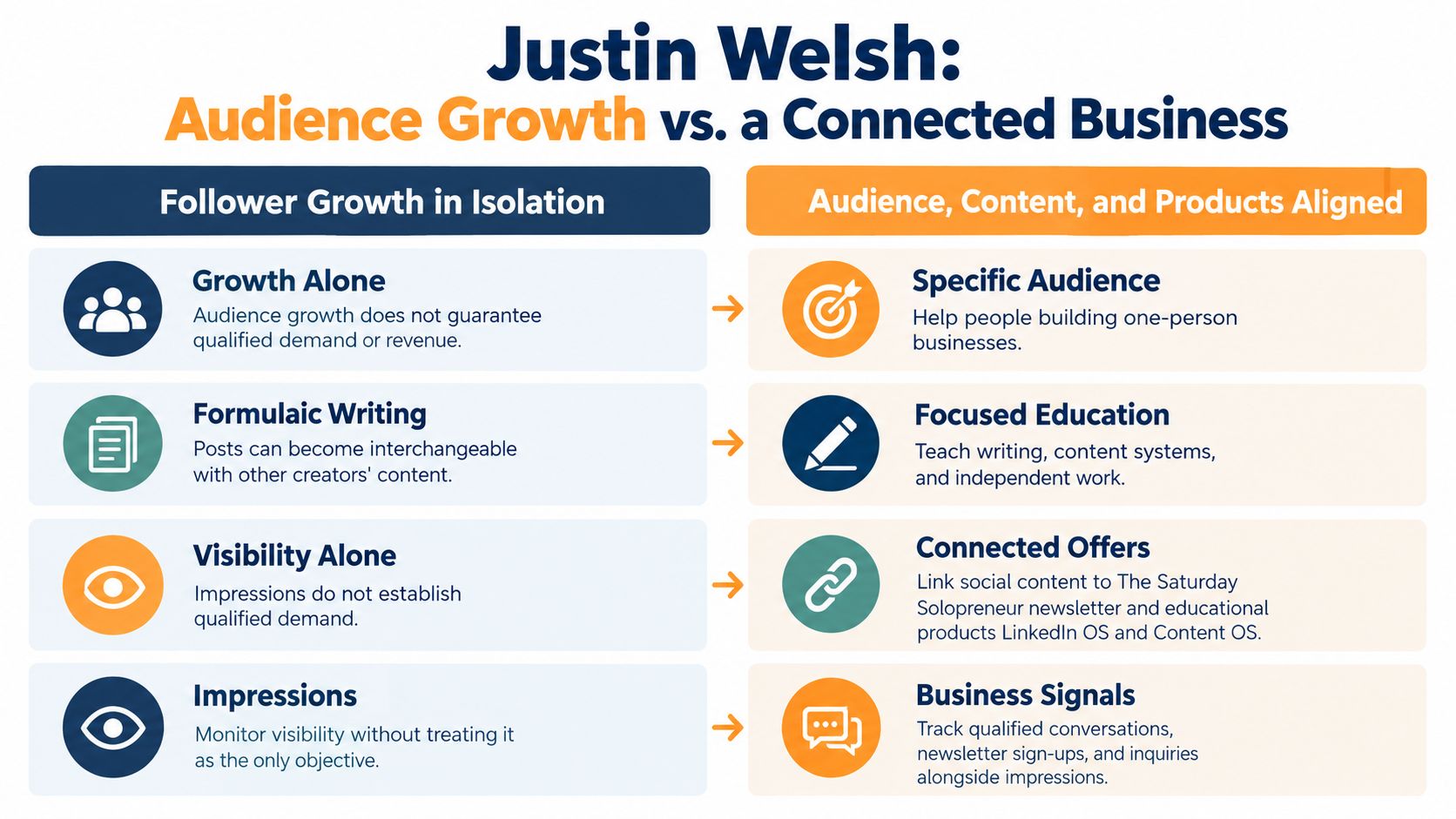
This week, review your last few posts. For each one, ask whether it serves your intended audience and points toward a useful next step. Keep what does both, and revise what attracts attention without supporting your offer.
6. Chris Do Demonstrates Expertise by Teaching the Work Behind the Outcome
A polished portfolio tells prospects you finished something. Chris Do goes further and shows how he thinks while the work is messy. Through The Futur, he teaches design alongside pricing, positioning, sales, and client conversation skills, which makes his expertise easier to judge.
His association with the design studio Blind gives professional context to the teaching. Recorded coaching and role-play discussions let viewers hear how he'd handle objections, scope changes, and awkward money talks. That visibility is powerful for consultants and freelancers because buyers rarely struggle to find options. They struggle to tell who's good.
The video below is a useful format to study because the teaching happens through live reasoning, not a slide full of conclusions.
Try this on LinkedIn. Pick a recent decision and break down the constraint, the alternatives you rejected, and the trade off you accepted. A web designer might explain why a simpler homepage beat a more expressive layout for a technical buyer. A sales consultant could unpack why a discovery question changed the deal.
For structure, approaches to educational content creation can help you turn expertise into teachable posts. Copy the transparency about reasoning. Skip exposing confidential details. Anonymize client questions, remove identifying numbers unless you have permission, and write some posts for buyers in business language. Your peers may praise craft details, but prospects pay for outcomes they understand.
7. Austin Kleon Builds Trust by Sharing Process and Influences
A reader can judge a creative practice more easily when the creator shows how the work develops. Austin Kleon builds his brand around that idea, combining writing, visual creativity, and practical advice on sustaining a creative practice. For early-career professionals, the useful lesson is to show how they think, not to claim expertise they have yet to earn.
In Show Your Work!, Kleon presents sharing the process as a way to help people discover creative work. Steal Like an Artist explores how influences shape an individual practice, while his newspaper blackout poetry gives his ideas a recognizable visual form. Together, they make small proof the brand's repeatable mechanism: publish useful work, show where ideas came from, and give credit.
A Weekly Process Post That Earns Trust
A process post builds trust when it gives readers evidence of how a decision was made. Kleon's approach turns experiments and influences into material others can learn from. Try it on LinkedIn this week:
- Document one problem: Describe what you tried, what changed, and what you would do differently. Keep the focus on a decision readers can apply.
- Credit influences: Name the book, colleague, or creator that shaped your thinking. Attribution helps readers trace an idea and see how you developed it.
- Protect other people's work: Ask permission before sharing client materials, internal screenshots, or collaborative drafts.
Share the lesson, not just the activity. A process post should leave readers with a decision they can borrow.
Copy Kleon's openness about experiments and influences. Skip turning LinkedIn into a diary. Sharing every task can blur your expertise; one clear example of a changed approach gives readers something useful to test. When a result is still developing, say so. Credibility comes from showing the work accurately, not presenting every experiment as a win.
8. Oprah Winfrey Builds a Values Led Brand Through Listening and Consistency
Oprah Winfrey's reach is not replicable. Her method offers a more practical lesson: build a public identity around values, then show those values consistently through the work. Empathy, personal growth, and human connection are evident in the way her interview format gives guests room to tell their own stories. Listening is not a slogan here. It shapes what the audience sees and hears.
The Oprah Winfrey Show made that approach central to her public identity. Oprah's Book Club extended it through thoughtful recommendations, while OWN, the Oprah Winfrey Network, brought the same identity into a media business. Each step connected to an existing audience expectation rather than introducing a new persona.
You can apply the same principle on LinkedIn without Oprah's platform. Interview a customer or colleague, ask questions that let them explain their experience in their own words, and share a specific lesson with their permission. The trade-off is time: careful listening takes longer than posting a quick opinion. It also gives you more useful material and helps keep your brand grounded in real people's concerns.
Use Values as Evidence and Not Decoration
Choose two or three professional values, then show them through decisions. If you value clarity, explain the criteria behind a tool recommendation. If you value mentorship, interview a colleague and share a practical insight with permission.
Copy the curiosity and consistency. Ask considered questions, represent people's answers accurately, and connect what you learn to a decision your readers face. Skip values posts built only around slogans. Pair each story with evidence of what you can do, so readers see both your principles and your capability. This week, publish one short interview or recommendation that demonstrates a value through a concrete choice.
How the eight personal brands differ in positioning, best-fit audience, and main risk
| Item | Core Positioning | Best For | Main Risk |
|---|---|---|---|
| Simon Sinek: Build a Personal Brand Around One Memorable Idea | Anchor a recognizable brand around a clear framework and central idea. | Professionals seeking consistent positioning for content, speaking, or consulting. | A memorable framework may oversimplify complex problems or become repetitive. |
| Brené Brown: Combine Research Authority with Human Storytelling | Pair research-based expertise with relatable personal storytelling. | Executives, HR specialists, and consultants who want to appear credible and approachable. | Personal disclosure can create privacy risks or feel performative without relevant expertise. |
| Gary Vaynerchuk: Make a Distinctive Voice Recognizable at Scale | Use a recognizable voice and adapt content across platforms. | Creators and founders repurposing substantial content for different audiences. | A polarizing style or high publishing volume can undermine fit or quality. |
| Ann Handley: Turn a Recognizable Writing Style into Professional Authority | Demonstrate writing expertise through useful, warm, and distinctive communication. | LinkedIn writers, marketers, and consultants whose writing showcases their skills. | A polished voice cannot compensate for weak ideas or inaccurate advice. |
| Justin Welsh: Own a Specific Audience and Connect Content to Products | Align a clearly defined audience, recurring content, and related offers. | Solo operators building a connected content and product business. | Formulaic content may blend in, and audience growth may not produce qualified demand. |
| Chris Do: Demonstrate Expertise by Teaching the Work Behind the Outcome | Make professional reasoning visible through teaching, critiques, and examples. | Consultants, agencies, and freelancers whose expertise is hard to evaluate from deliverables alone. | Advice may lack market context, and detailed tutorials may attract peers instead of buyers. |
| Austin Kleon: Build Trust by Sharing Your Process and Influences | Build credibility by sharing work in progress, influences, and creative methods. | Professionals who want to make their thinking and working process visible. | Sharing can become self-focused or expose confidential information and intellectual property. |
| Oprah Winfrey: Build a Values-Led Brand Through Listening and Consistency | Connect communication, recommendations, and ventures through consistent values. | Executives and creators aiming to build trust through empathy and consistency. | Recommendations carry reputational risk, while broad inspiration may not demonstrate specific expertise. |
Turn These Examples Into Your Own Playbook
A strong personal brand is easier to recognize when its ideas stay connected. Choose one anchor for the next 30 days, rather than switching between a framework, a personal story, and a product pitch that do not sound like the same person. Repetition helps readers understand what you do and who you help.
Pick the anchor that addresses your current gap. If readers enjoy your posts but cannot describe your expertise, borrow Sinek's single-idea approach. If your work is strong but hard to evaluate, show the reasoning behind it, as Chris Do does, or share a regular look at your process, as Kleon does. If your content attracts the wrong audience, use Welsh's example: sharpen your positioning until the right reader recognizes themselves. The trade-off is focus. A clear anchor may leave some topics out, but scattered messaging makes your expertise harder to remember.
Credibility matters more than polish. Research connects perceived personal brand credibility with hiring judgments, as discussed in the Journal of Brand Management study on personal brand equity. Treat your content as evidence of how you think and work, not as decoration. This week, take one claim you make about your expertise and pair it with a concrete example of a decision, result, or limitation.
Your profile photo also shapes how recruiters judge credibility, according to research on LinkedIn profile photographs and recruiter credibility judgments. Choose a clear image with a natural expression and direct camera orientation. Then keep your headline and About section consistent while you assess profile visits and relevant conversations. A photo can support a credible impression, but it cannot replace proof of your work.
Turn the anchor into three LinkedIn posts this week, each aimed at the same reader and problem. Use one to explain an idea, one to show how you make a decision, and one to name a limitation. Coaches refining their positioning can build your brand as a coach while keeping the emphasis on proof. Tools like RedactAI can generate variations in your tone, but edit the drafts to preserve your examples, judgment, and phrasing.
After 30 days, review the response. Impressions show reach; replies from target readers, profile visits that lead to calls, and qualified inbound messages offer more useful signs of credibility. Keep formats that start real conversations. Revise the anchor if they do not. Repeat the idea in fresh, useful ways so people have a chance to remember it.
Ready to turn a personal branding example into a LinkedIn routine that still sounds like you? RedactAI helps draft posts from your experience and writing style, generate variations, and maintain a publishing cadence. Bring your chosen anchor and three rough ideas, then edit the drafts before publishing.