You finish a good client meeting, send a connection request, and open your own LinkedIn profile. The headline still describes your previous role. Your About section reads like a job description, and your latest post doesn't resemble the thoughtful advice you just gave across the table. You know what you bring to the work. Would someone who hasn't met you know it too?
Why Your LinkedIn Presence Already Speaks for You
Consider a senior consultant who explains complicated decisions clearly, earns repeat business, and gets warm referrals. This is a hypothetical example, but the mismatch is familiar: in person, the consultant offers useful judgment; online, visitors find a job title, a list of responsibilities, and little evidence of how that person thinks.
That profile doesn't prove the consultant lacks expertise. It gives a new visitor very little to work with. Someone considering an introduction has to fill the gaps themselves or ask the person who recommended the consultant.
Personal branding is the deliberate work of making your professional value understandable. Your personal brand is the impression people form from what they can observe, including your work, language, public interactions, and digital presence. A polished banner can support that impression, but it can't substitute for substance.
Think of trust as a system
A useful way to understand the key elements of personal branding is through interacting layers:
- Authenticity means your public identity matches your experience, values, and behavior.
- Competence means people can see the expertise behind your claims.
- Communicative consistency means your messages point toward a recognizable professional identity.
These layers need each other. Authenticity without visible competence leaves people unsure what to hire you for. Competence expressed through scattered messaging makes your specialty difficult to remember. Consistent messaging built on exaggerated claims creates a polished impression you can't defend.
A 2025 qualitative study of personal branding examined 15 professionals and identified authenticity, consistency, value creation, narrative framing, and social-capital development as recurring dimensions; it also cites a 2023 LinkedIn report in which 82% of hiring managers reportedly expressed greater trust in applicants with a clear, credible online presence. That's a finding about trust, not evidence that those managers all inspect profiles before meeting candidates.
Start with what a visitor can actually see
Open your profile as if a colleague has just recommended you. Read the headline, About section, Featured material, and recent activity without supplying the context you already know.
Write down what a visitor could reasonably infer about your audience, specialty, and working approach. Then compare that impression with the work you want to do next.
You don't need to become more impressive online. You need to make your real expertise easier to recognize.
This week's first action is an audit, not a publishing sprint. Identify the biggest gap between your actual contribution and your visible signals.
The Six Building Blocks of Every Strong Personal Brand
Treat your brand like a house you're planning to live in, not a display you're decorating for a weekend. Credibility is the foundation, your value proposition provides the framing, content fills the rooms, and consistency keeps the structure connected. Voice and visuals help visitors recognize whose house they've entered.
The analogy isn't a scientific model. It's a practical way to organize decisions that otherwise turn into disconnected tasks: rewrite a headline, choose a banner, publish something, then wonder whether any of it fits together.
The six elements at a glance
| Element | What it does | Where it shows up on LinkedIn | One-line audit question |
|---|---|---|---|
| Value proposition | Defines whom you help and the contribution you make | Headline, About section, service descriptions | Can the right reader recognize their problem? |
| Brand voice | Gives your ideas a characteristic way of sounding | Posts, comments, messages, profile text | Would I say this to a respected colleague? |
| Visual identity | Makes your presentation coherent and recognizable | Headshot, banner, documents, carousels | Do these choices fit my professional positioning? |
| Content strategy | Organizes what you teach and why it matters | Recurring topics, formats, Featured material | Does this help the audience I want to serve? |
| Consistency | Keeps your underlying promise stable | Topics, presentation, publishing habits, interactions | Do my visible signals point in the same direction? |
| Credibility | Gives people a basis for believing your claims | Examples, explanations, evidence, recommendations | What supports what I'm saying? |
These aren't separate projects with separate finish lines. A consultant who promises practical operational advice but publishes vague motivational posts has a content problem and a positioning problem. Someone who describes themselves as approachable but replies dismissively has a voice problem and an authenticity problem.
Put the decisions in a small brand specification
Create a brand specification in Google Docs, Notion, or your notes app. Record your target audience, expertise territories, tone vocabulary, visual choices, acceptable evidence types, and boundaries around what you won't claim or share.
Research on personal-brand image construction identifies authenticity, competence, and consistency as core elements and discusses how coherent cross-platform identities support recognition and engagement. The practical application is alignment, not identical wording everywhere: a profile summary and a comment can sound different while expressing the same professional standards.
Give each element a current-state note and a next action. For example, under credibility, you might write that your profile claims strategic expertise but contains no visible strategic analysis. The next action would be to feature an appropriate piece of work, not add another adjective.
Keep this document short enough to consult before publishing. It should help you decide what belongs, not become another branding exercise you never use.
Your Value Proposition and Brand Voice
A café promising quick, dependable coffee makes different choices from one offering a quiet morning ritual. Neither promise is better. Each tells the owner what experience to create and tells customers whether they're in the right place.
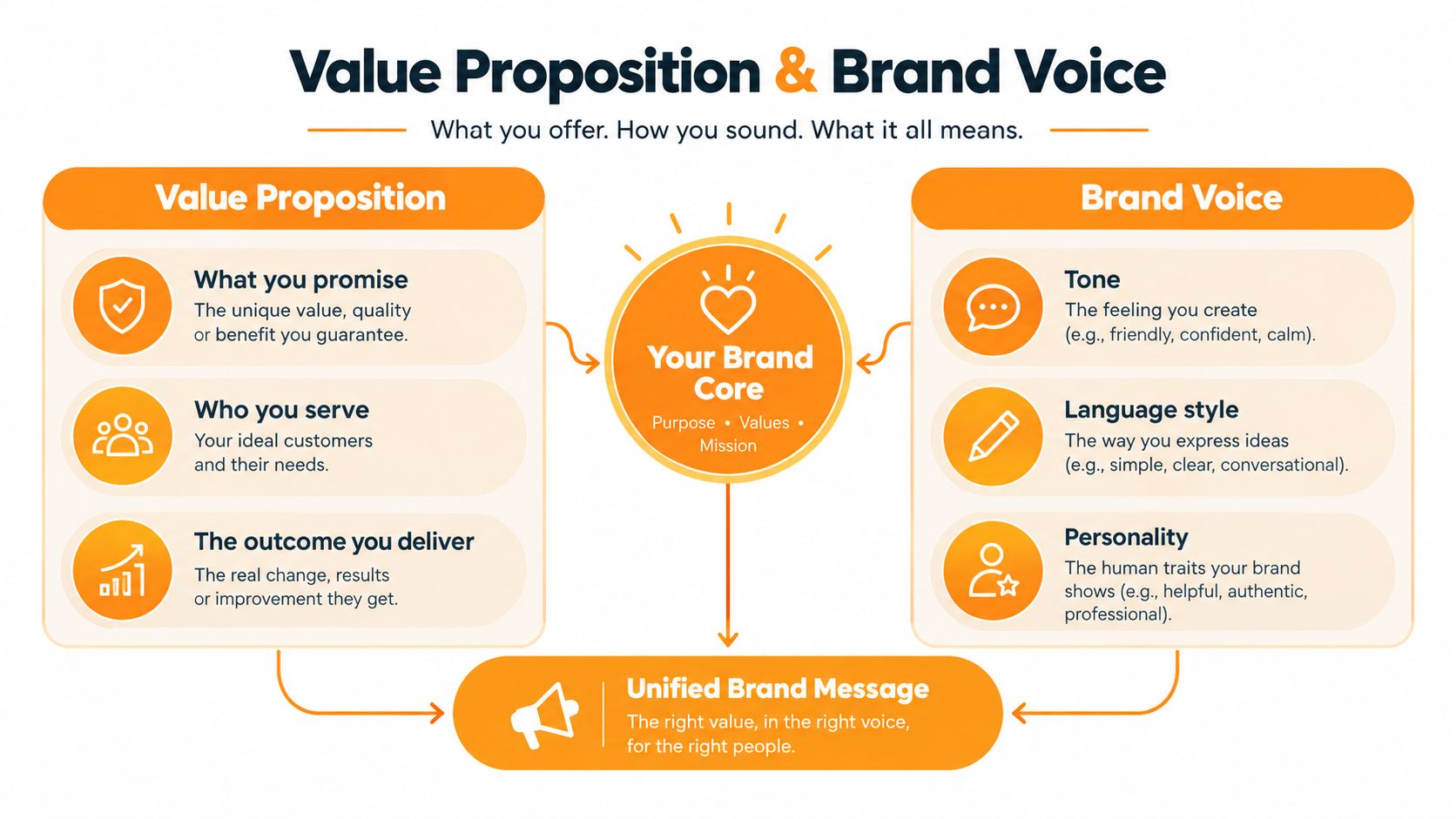
Your value proposition should do the same. It isn't a grand statement about changing an industry. It's a clear description of whom you help, which problem you address, and how your contribution differs from generic help.
For a hypothetical recruitment consultant, “I connect talent with opportunity” gives readers little to distinguish. “I help growing operations teams define senior roles before they start hiring” makes the audience and problem more concrete, provided that's work the consultant does.
Write a promise you can explain
Draft a short positioning statement that names your audience and problem, then explains your approach. For example:
Positioning test: Could a former client recognize your work in this statement without needing you to explain it?
A useful draft might describe helping technical founders make their expertise understandable to prospective customers, followed by an explanation of how you turn interviews and working examples into clear content. That's an illustrative statement, not a claim about a real consultant.
Use this guide to writing a personal brand statement to refine the wording. Then test the result in your LinkedIn headline and opening About paragraph, where readers shouldn't have to decode your role.
This diagram separates the promise from the way you express it.
Make your voice usable, not decorative
Choosing “professional” as your tone isn't enough. Describe observable writing choices:
- Direct means stating the main point before the background.
- Specific means naming the decision, constraint, or example.
- Generous means helping the reader apply an idea without talking down to them.
Also record words you avoid, your preferred sentence rhythm, and how you handle disagreement. You might favor plain verbs over promotional language and acknowledge exceptions rather than making universal claims.
Read your recent posts aloud. Mark phrases you'd never say in a working conversation and rewrite them. If you use an AI drafting assistant, provide this vocabulary alongside examples of your own writing, then check the output against your experience.
Voice is recognizable judgment expressed in language, not a collection of catchphrases. You can be serious in a technical explanation and warm in a reply without becoming a different person.
Visual Identity and Content Pillars on LinkedIn
Your LinkedIn profile is a little like a neighborhood storefront. The sign tells visitors what's inside, the window gives them a sample, and the presentation suggests what kind of experience to expect. Conflicting signals make visitors work harder to understand the offer.
Use photography as a deliberate presentation choice, not as evidence of expertise.

Audit the visible presentation
Start with the basics rather than commissioning a complete redesign:
- Headshot Check whether you're easy to recognize and whether the setting feels appropriate for your work.
- Banner Make the message legible and relevant to the contribution described in your headline.
- Document styling Use compatible colors and readable typography across recurring resources.
- Featured section Select work that helps a visitor understand your expertise, rather than displaying whatever you published most recently.
You don't need a suit to look credible. Choose clothing and surroundings that fit how you work with your audience. If you're considering professional photography, meet Liz the photographer from Liz by Design Photography as a starting point for reviewing a photographer's background before discussing your own brief.
Choose topics from work you can discuss
Content pillars are recurring expertise themes, not rigid containers for every thought. For a hypothetical sales leader, useful themes might include discovery conversations, deal qualification, and coaching account teams. The common thread is helping sales managers make better decisions.
Review your past posts, presentations, meeting notes, and questions colleagues ask you. Group the material by the problem it helps someone solve. Choose themes where you have both experience and something useful to explain, rather than subjects you hope will make you look impressive.
Use this LinkedIn content strategy guide for personal branding to organize those themes into a publishing approach. Record each theme's audience problem, available evidence, and suitable formats in your visual-and-topic specification.
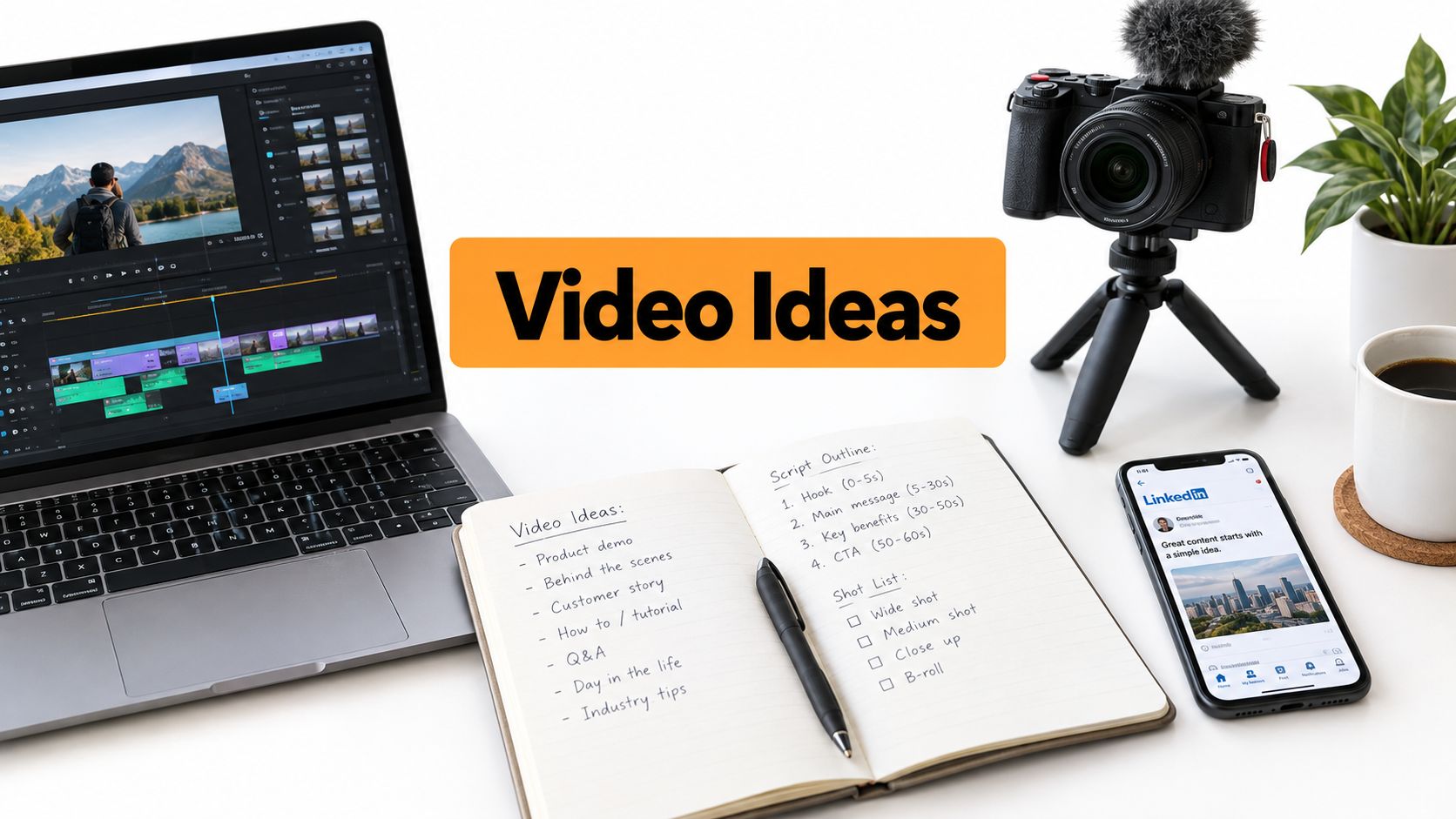
If you prefer a video resource alongside the written exercise, use this as an additional viewing option.
Your concrete action this week is to make the banner, Featured section, and planned topics agree. A visitor should find a relevant sample of the expertise your profile promises, not just coordinated colors.
Consistency and Credibility as Trust Accelerators
Publishing frequently and publishing credibly aren't the same task. A professional can maintain an active feed while giving readers little reason to trust their judgment. Frequency tells readers you're present; evidence helps them evaluate what you know.
In the 2025 Edelman-LinkedIn B2B Thought Leadership Impact Report, 64% of B2B audiences trusted thought leadership more than marketing materials and product sheets when assessing capabilities, while 79% of hidden buyers were more likely to advocate for a vendor during an RFP when it consistently published high-quality thought leadership. Those findings concern B2B providers, not a guaranteed outcome for individual LinkedIn accounts, but they offer a useful reason to prioritize substantive expert content.
Give every claim a visible basis
Use a claim, basis, implication structure when drafting. The claim states your point, the basis explains why you believe it, and the implication tells readers what they can do with it.
A hypothetical recruiter might argue that an unclear role brief can create confusion during interviews. To support that argument, they could describe an anonymized situation they observed, explain its limitations, and suggest clarifying decision authority before interviewing.
The example works only if the experience is real. Don't invent a client story to make an otherwise reasonable opinion seem more authoritative.
Research on credibility in personal branding connects demonstrated competence, distinctiveness, relevance, and consistency with stronger business communication. For your writing, separate firsthand evidence from interpretation and clearly labeled professional judgment.
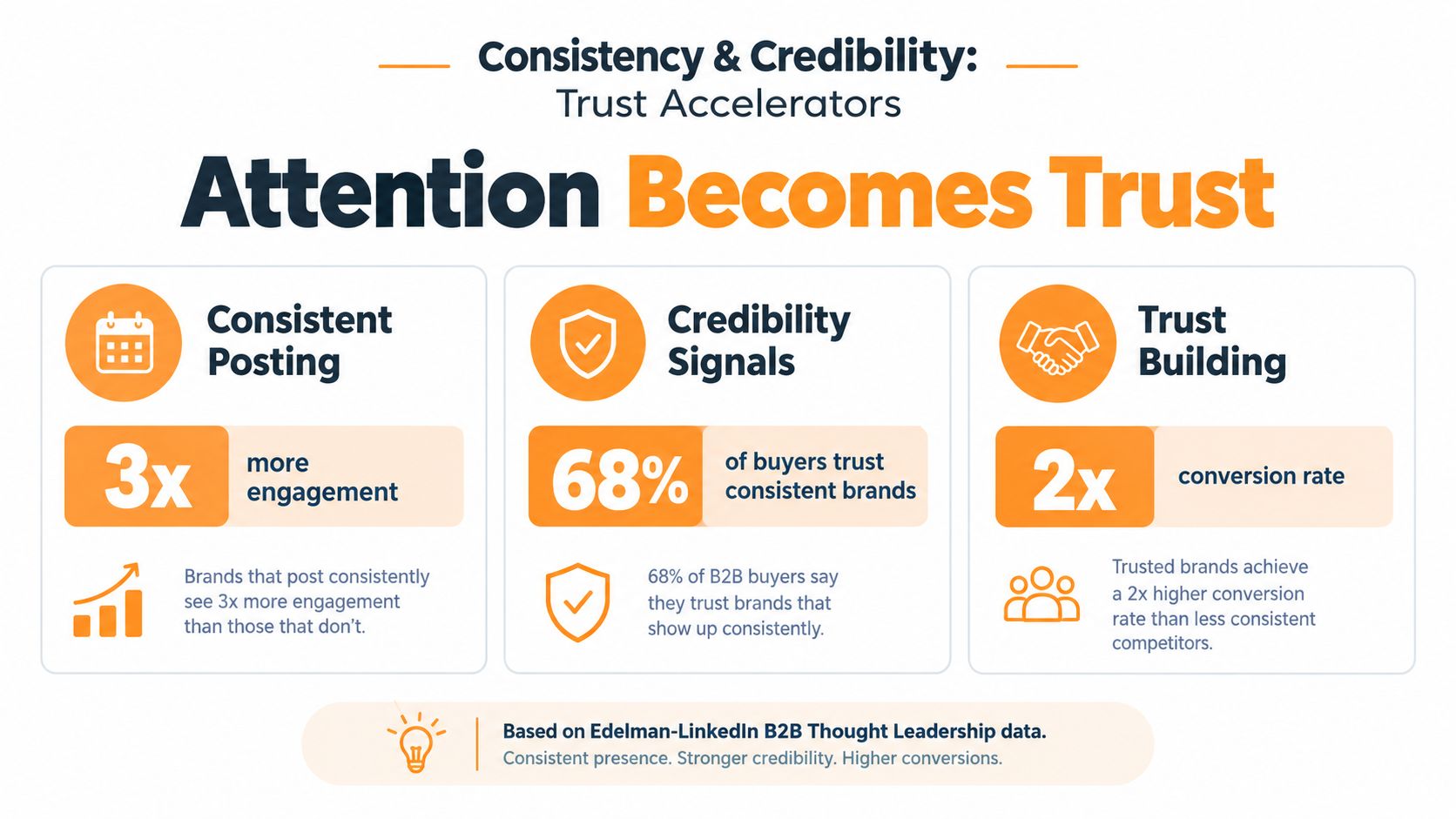
The visual below illustrates the intended connection between consistency, credibility, and trust. Its engagement and conversion multipliers aren't established by the cited findings and shouldn't be used as benchmarks.
Audit the body of work, not the biggest hit
Apply the thematic-concentration exercise from the earlier image-construction research: classify your last 30 posts by expertise territory and calculate how much of the sample belongs to your chosen themes. Use it as a diagnostic exercise, not a performance target.
Look for both drift and repetition. Unrelated popular posts may obscure your positioning, while repeatedly making the same point with different hooks gives readers little new information.
For a practical definition of what should remain stable, consult this explanation of brand consistency. Keep the expertise and standards steady while varying examples, questions, and formats.
Consistency means keeping a recognizable promise, not publishing the same lesson indefinitely.
This week, strengthen an existing draft with real support and inspect your recent body of work. Neither action requires posting more often.
A One-Week Plan to Apply the Elements on LinkedIn
Use a working week to produce a usable first version of your brand specification. You're not trying to finish your reputation by Friday. You're removing obvious mismatches and establishing a routine you can maintain alongside your actual job.
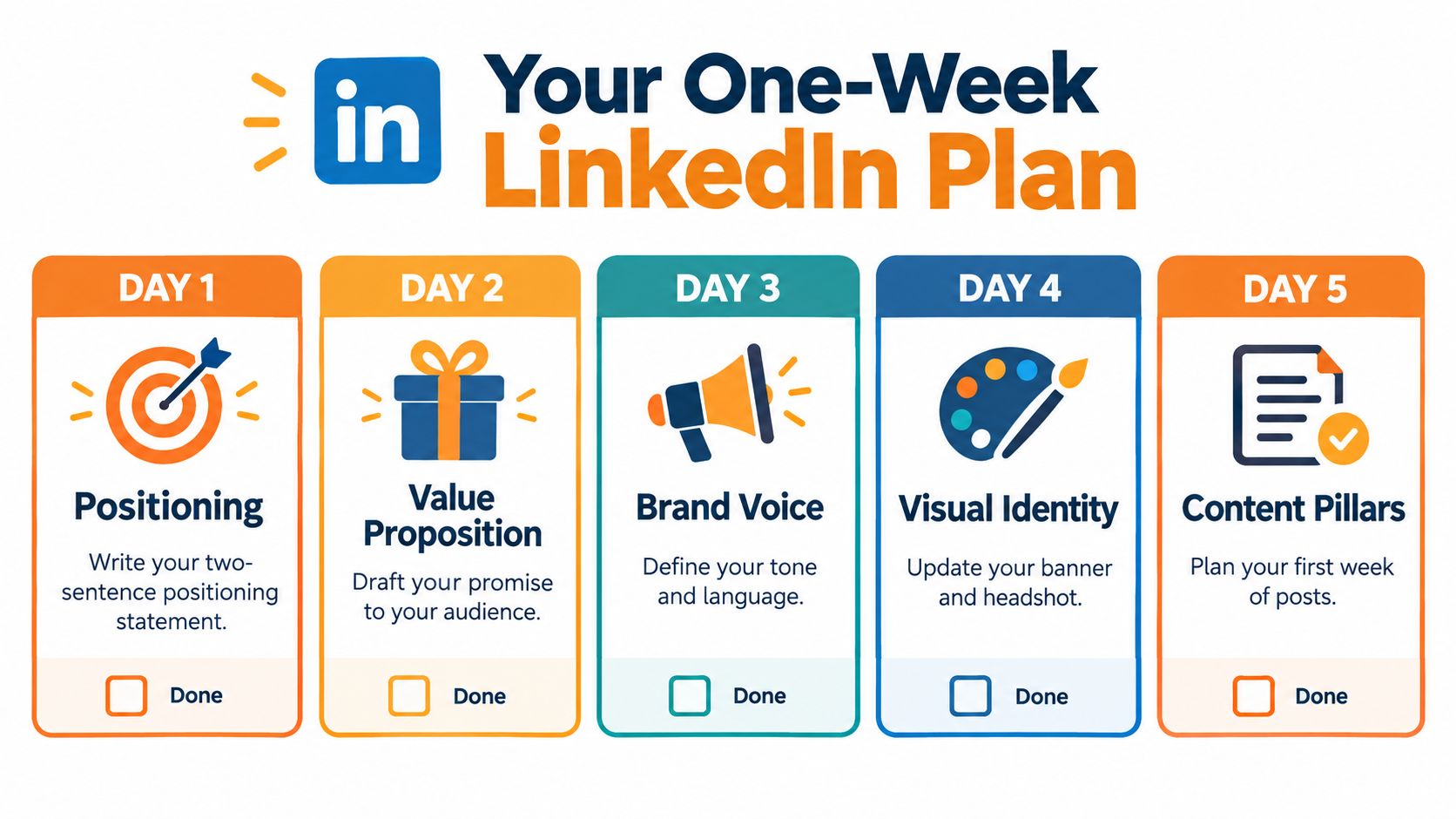
The visual offers a positioning-first checklist. The schedule below brings profile changes forward and adds evidence review and measurement.
Monday and Tuesday establish the profile
Monday is for positioning. Draft your audience promise, choose tone anchors, and check the wording against work you can substantiate. Ask a trusted colleague what they think you're describing; if their answer differs from your intention, revise before polishing.
Tuesday is for presentation. Review the headshot, align the banner with the promise, and select relevant Featured material. If an appropriate work sample isn't ready, record what you need to create rather than filling the space with something unrelated.
Save a copy of the original profile text. Keeping the earlier version makes it easier to compare your changes and avoid losing useful detail.
Wednesday through Friday make the system operational
| Day | Main focus | Concrete moves |
|---|---|---|
| Wednesday | Content pillars | Group existing material by audience problem, label recent posts, and choose themes you can support |
| Thursday | Credibility | Draft from genuine experience, identify the basis for the claim, and check confidentiality and limitations |
| Friday | Consistency | Choose a sustainable cadence, prepare the next publishing slots, and create a simple tracking sheet |
On Wednesday, include offline material in your review. A useful explanation from a client workshop may be a better starting point than the topics that happened to attract reactions in your feed.
On Thursday, run an evidence check before a style check. Remove unsupported outcomes, clarify which details are hypothetical, and ask whether the reader could mistake your interpretation for an established fact.
On Friday, make room for responding as well as publishing. Scheduling a post doesn't complete the relationship work, and a cadence that leaves no time for thoughtful replies may not suit your professional goals.
Use Google Sheets or Notion to record the post topic, intended audience, distribution, relevant responses, and any follow-up. Keep the tracking simple enough that you'll maintain it.
Finish with usable artifacts: updated profile text, a compact brand specification, an evidence-backed draft, and a realistic publishing routine. If something remains unfinished, assign a specific next action instead of treating the entire week as a failed launch.
Trust Beats Reach and What to Watch Next
A large audience can be useful, but it's not automatically the right audience. If your goal is consulting work, recruitment, partnerships, or sales conversations, you need people who understand your contribution and have a reason to rely on it.
LinkedIn's 2025 global survey of 19,268 professionals across 14 markets found that 43% turned to their professional network first for workplace advice, while 64% said colleagues helped them decide faster and with greater confidence. That supports a relationship-oriented approach, not the assumption that every follower has equal professional value.
Watch the quality of the response
Keep reach metrics separate from indicators that deserve closer investigation:
- Qualified conversations Notice whether relevant people ask about problems within your expertise.
- Referrals and recommendations Record when someone introduces you for the kind of work you want.
- Substantive responses Look for questions, applications, or informed disagreement rather than reactions alone.
- Relevant next steps Track whether attention leads to an appropriate meeting, collaboration, or request.
These are trust proxies, not direct measurements of someone's belief in you. A profile visit may mean curiosity; a thoughtful conversation gives you more context. Review the signals together rather than declaring success from an isolated spike.
Treat your brand as an ongoing feedback loop
The key elements of personal branding belong in a loop: define your contribution, make it visible, support it with useful work, listen to the response, and refine your choices. Adjust when your expertise or audience changes, not whenever an unrelated topic attracts attention.
For the rest of 2026 and beyond, keep a repeatable review habit rather than planning endless relaunches. Start by asking a trusted contact what they would recommend you for, then compare that answer with your LinkedIn presence. The next improvement should make that recommendation easier to understand and substantiate.
For drafting support alongside your brand specification, visit RedactAI, which helps professionals create personalized LinkedIn posts using their profile, posting history, and experiences. Bring your tone guidelines and a genuine working example, then review the draft for evidence and audience relevance before publishing.