A clever phrase won't make a weak LinkedIn profile persuasive. Your headline is a positioning decision. It should quickly clarify who you are, whom you help, and why a profile visit is worth someone's time.
That matters because LinkedIn is now a very crowded professional marketplace. The platform passed 1.3 billion registered members worldwide in January 2026, compared with roughly 1.2 billion in January 2025, while independent summaries estimate about 310 million monthly active users and 134 million daily active users (LinkedIn scale and audience data). LinkedIn also spans more than 200 countries, so a headline has to balance searchable role language with a clear niche and a human tone.
The best LinkedIn headline ideas aren't random templates. They match a specific audience, conversion goal, and professional identity. A job seeker needs a different emphasis from a consultant, founder, recruiter, or creator. You'll find ten practical formats below, followed by a simple way to customize each one and test meaningful variations. Tools such as RedactAI can help generate alternatives and compare engagement patterns, provided the final wording still sounds like you.
1. Role and Value Proposition Headline
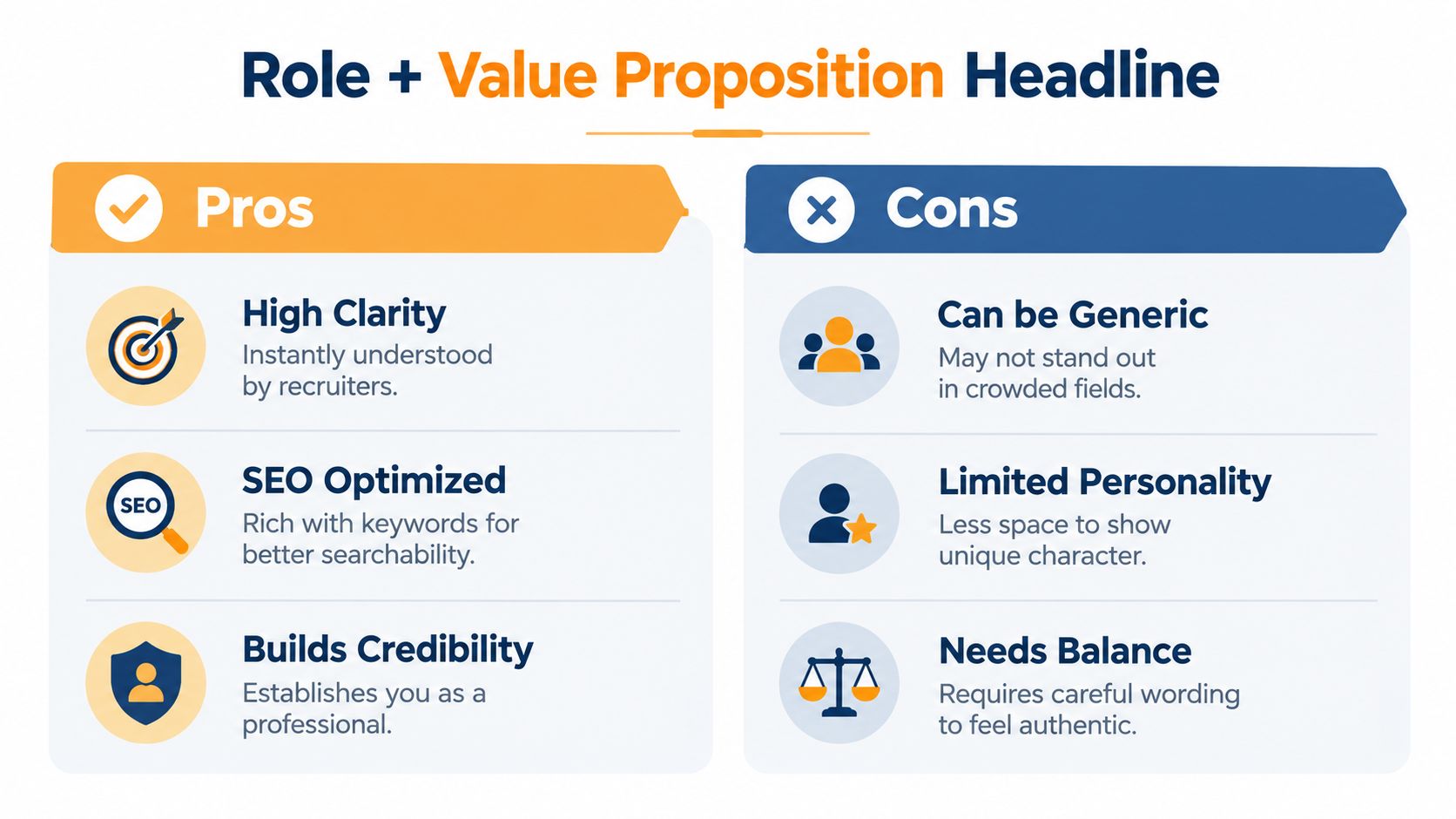
The role and value proposition format works because it answers two questions immediately: what do you do, and what benefit do you create? Start with the role people are likely to search for, then add the result or transformation you support.
Examples from this format include:
- Content Strategist | Helping B2B Companies Generate Qualified Leads
- Executive Coach | Helping Leaders Build High-Performance Teams
- Sales Director | Closing Enterprise Deals That Drive Revenue Growth
- HR Consultant | Transforming Company Culture and Employee Engagement
Leading with the role gives recruiters, prospects, and casual profile visitors an anchor. The value proposition then narrows the audience. “Marketing Consultant” is broad. “Marketing Consultant | Helping SaaS Teams Turn Product Education Into Pipeline” gives the right reader a reason to continue.
A quantified promise can add force, but only when you can support it elsewhere in your profile. Don't add an impressive-looking figure just because headline templates encourage numbers. Use a result from your own work, explain its context in the About or Experience section, and make sure the claim reflects your actual contribution.
Practical rule: Use the audience's language, not an internal job description.
Customize the format
Take your current title and run it through this exercise:
- Replace the role: What title would your target audience use when searching for someone like you?
- Name the audience: Which industry, company type, or professional group do you serve?
- Convert responsibility into value: What changes because you do the work well?
- Remove abstraction: Replace “support growth” with a concrete business or career outcome.
For example, “Content Manager | Responsible for editorial planning” can become “Content Strategist | Helping B2B Software Teams Explain Complex Products Clearly.” The second version is more searchable, more specific, and easier for a potential client to interpret. For further guidance on combining role, value, skills, and personality, see this LinkedIn headline guide from RedactAI.
2. Problem and Solution Headline
A problem and solution headline starts with the audience's frustration instead of your job title. That can feel more relevant to buyers because it mirrors the words they use when describing a challenge.
Consider these patterns:
- Struggling With LinkedIn Writer's Block? | I Help Creators Publish Consistently
- Tired of Losing Qualified Leads? | Sales Manager Building Better Follow-Up Systems
- High Turnover Holding Back Growth? | HR Strategist Building Cultures Where People Stay
- Not Getting Enough Qualified Leads? | Marketing Agency Owner Focused on Demand Generation
The trade-off is credibility. A sharp problem statement earns attention, but an exaggerated promise makes the profile sound like an advertisement. “Is your business failing?” creates unnecessary drama. “B2B founders struggling to explain complex products” identifies a real audience and a recognizable problem without claiming that every reader is in crisis.
This format works especially well for consultants, coaches, agency owners, and service providers. It can be less suitable for a candidate whose primary goal is to appear in searches for a conventional role. In that case, put the role first and use the problem as the second element.
Turn a vague description into a problem-led line
Start with a sentence such as “I provide content strategy for growing businesses.” Ask which people need that service most urgently and what situation causes them to seek help. You might arrive at “B2B Teams With Strong Products but Unclear Messaging | Content Strategist Making Complex Offers Easier to Buy.”
Check the promise before publishing it:
- Specificity: Can a reader recognize the problem quickly?
- Relevance: Does it describe the audience you want?
- Credibility: Does your profile show how you solve it?
- Follow-through: Do your About section and recent posts address the same issue?
Test different pain points one at a time. If you use RedactAI to generate variations, compare the quality of profile visits and messages, not just which wording attracts the most attention.

3. Authority and Credentials Headline
Credentials can shorten the trust-building process, particularly in fields where buyers, employers, or partners need evidence of formal training. A CPA, PMP, ICF credential, AWS certification, or recognized publication may tell the reader that you meet a professional standard.
Strong examples combine authority with a useful position:
- Certified Executive Coach (ICF) | Leadership Development for Senior Teams
- CPA | Tax Strategy Specialist | Helping Business Owners Plan With Confidence
- AWS Certified Solutions Architect | Cloud Infrastructure and Security
- SHRM-SCP | Talent Strategy and Recruiting Operations
The mistake is turning the headline into a résumé line. A long chain of certifications may demonstrate effort, but it doesn't explain why the credential matters to the reader. Prestige alone also has limited value when it isn't connected to the work you want next.
Choose credentials by relevance, not by how impressive they look in isolation. A credential should support the role, market, or problem named elsewhere in the headline. If you're targeting a regulated or technical field, formal qualifications may deserve priority. If you're a creator or generalist consultant, a reader-facing outcome may do more work than another acronym.
Use the one-proof-point rule
Build the headline with three decisions:
- One relevant credential: Select the qualification your audience recognizes and cares about.
- One proof point: Add a publication, leadership context, client type, or specific achievement you can substantiate.
- One positioning statement: Explain the work you do for a defined audience.
For example, “MBA | Strategy Consultant | Helping Family-Owned Businesses Improve Operational Clarity” is more useful than “MBA | Executive | Entrepreneur | Advisor | Speaker.” The first tells readers where the authority applies.
Keep the rest of your profile aligned. Your About section should explain the credential's relevance, while your Experience section should provide evidence of the work. RedactAI's authority-building guidance can help you explore versions that lead with credentials or outcomes, but don't let generated language replace accurate proof.
4. Curiosity Gap Headline
Curiosity can earn a profile click, but only when it creates a specific, answerable question. A headline such as “Most LinkedIn Headlines Are Doing This Wrong” invites interest, yet it doesn't tell the reader whether the subject is recruiting, sales, content, or executive branding.
Better versions establish the domain first:
- B2B Hiring Advisor | The Interview Question That Reveals Weak Processes
- LinkedIn Content Strategist | Why Helpful Posts Still Fail to Create Conversations
- Founder Coach | The Scaling Habit That Creates Operational Drag
- Workplace Culture Writer | The Leadership Assumption Teams Rarely Challenge
A curiosity gap works when the implied answer exists somewhere on your profile. Your About section, Featured content, or recent posts should resolve the question. Otherwise, the headline feels like clickbait rather than a promise of useful expertise.
Avoid unsupported numbers and dramatic claims. A statement like “I helped 50 CEOs avoid the number one hiring mistake” requires accurate, documented evidence. If you can't defend the claim in a conversation, don't put it in the headline.
Apply the clarity test
Read the line and ask:
- Does the reader know the professional domain?
- Can they identify the intended audience?
- Is the implied question narrow enough to answer?
- Does the profile contain that answer?
- Would the wording still make sense without a click?
A good curiosity headline creates a reason to explore. A bad one withholds basic information. “I See What Others Miss” may sound intriguing, but it doesn't identify your role, audience, or expertise. “Recruiter | Helping Technical Teams Spot Stronger Evidence in Interviews” preserves curiosity while giving the reader a useful label.
Treat this format as a tone choice, not a permanent identity. It suits thought leaders and active creators, but a direct role and niche headline may perform better when recruiting or selling depends on immediate clarity.
5. Achievement-Focused Headline
An achievement-focused headline makes your track record the central proof of capability. It suits experienced professionals, founders, sales leaders, recruiters, marketers, and operators whose results can be summarized accurately.
Examples include:
- Content Strategist | Built Editorial Systems for Complex B2B Products
- Startup Founder | Built and Sold a Technology Business | Now Advising Operators
- Recruiter | Placed Professionals Across Technical and Commercial Roles
- Marketing Leader | Led Growth From Early-Stage Demand to Scaled Pipeline
The strongest achievement is usually not the longest list. Readers need context to interpret a result. “Generated revenue” is incomplete without knowing whether you led strategy, managed a team, owned a channel, or contributed to a broader effort.
Use a metric only when it passes three checks:
- Accuracy: Is the number correct?
- Relevance: Does it matter to the audience you want to attract?
- Support: Can your Experience section or portfolio explain it?
A precise figure without context can create skepticism. A qualitative accomplishment with clear scope may be more persuasive than a number that sounds inflated.

Build an evidence hierarchy
Start with your role, then select the proof your audience values most:
- Business owners: Revenue, cost control, operational improvements, or customer retention.
- Recruiters: Scope, role relevance, team leadership, and outcomes tied to the target position.
- Peers: Recognized work, useful systems, publications, or meaningful contributions.
- Clients: A transformation they can understand and verify.
“Sales Director | Enterprise Account Growth | Built Repeatable Pipeline Operations” may be stronger than a crowded headline containing several disconnected accomplishments. You can place supporting achievements in the About and Featured sections.
Avoid copying metrics from example templates into your own headline. The structure is reusable, but the evidence must come from your work. If you want multiple versions, RedactAI can help test which combination of role, achievement, and audience language creates the most relevant engagement.
6. Niche Expertise Headline
A niche headline tells the right people, “This profile is built for your situation.” Instead of presenting a broad capability, it narrows by industry, audience, company stage, business model, or problem.
Compare these versions:
- Fractional CFO | Financial Strategy for SaaS Companies
- Executive Coach | Supporting Women Founders Through Sustainable Growth
- Real Estate Marketing Specialist | Luxury Property Storytelling
- LinkedIn Content Strategist | Helping Solo Consultants Publish With Clarity
Narrowing the headline changes the opportunities you attract. A general “Fractional CFO” line may invite a wide range of inquiries. Adding “SaaS Companies” filters for a more specific market and signals that you understand its language, operating model, and financial concerns.
The risk is over-narrowing. If your headline includes a tiny audience description that nobody searches for, adjacent opportunities may never understand your relevance. Keep a broad role keyword near the beginning, then add the niche as the differentiator.
Complete a niche worksheet
Write one answer for each prompt:
- Who: Who benefits most from your work?
- Where: Which industry or market do they operate in?
- At what stage: Are they early-stage, scaling, established, or navigating change?
- Which problem: What recurring issue brings them to you?
- What proof: What work demonstrates your understanding of that niche?
Then combine the broad role with the sharpest useful detail. “Recruiter | Technical Hiring for Growing Product Teams” is still searchable as a recruiter while giving a target audience a reason to respond.
Your content must support the niche. If the headline says you serve founders but your posts only discuss general career motivation, visitors may doubt the positioning. Specialization works best when the About section, Featured content, and recent posts reinforce the same market.
7. Personal Brand and Mission Headline
A mission-led headline helps people remember what you stand for. It's especially useful for creators, authors, founders, coaches, and thought leaders whose visibility depends on repeated association with a recognizable idea.
Possible formats include:
- Creator of The Growth Mindset Movement | Helping Professionals Think Differently
- Founder of RedactAI | Helping Creators Develop Consistent LinkedIn Content
- Author and Workplace Culture Writer | Making People Operations Easier to Understand
- The LinkedIn Guy | Teaching Professionals to Build Influence Without Hard Selling
The personal brand should supplement clarity, not replace it. “The Growth Architect” may be memorable, but it doesn't tell a recruiter or buyer what you do. Add a role, audience, or outcome so the mission has a practical anchor.
Use audience figures, community milestones, or impact claims only when they're established and supportable. A headline isn't the place to borrow credibility from a goal you haven't reached.
Pair identity with usefulness
A reliable structure is:
Recognizable identifier | Role or audience | Mission or practical benefit
For example, “The Clear Messaging Coach | Helping Technical Founders Explain Their Products” gives the reader a name-like concept, a service context, and a benefit. It also creates a clear content direction. Posts, videos, and Featured resources can all reinforce the same promise.
Consistency matters more than novelty. Use the same identifier in your banner, About section, posts, and website where appropriate. If your public identity changes every few weeks, readers may remember the phrase but not the expertise behind it.
If you're still building recognition, lead with the role and use the mission as a secondary element. Once people already associate you with a distinct body of work, the brand name can take more space. This approach can help you build your personal brand effectively without sacrificing professional clarity.
8. Format-Breaking Headline
A format-breaking headline uses visual signals such as an emoji, arrow, bullet, or unusual punctuation to create hierarchy. It can work well for creators, startup founders, designers, coaches, and other professionals whose audiences respond to personality.
Examples:
- 📱 LinkedIn Content Strategist | Helping Creators Publish With Personality
- Startup Advisor | Building Stronger Founder Operating Systems 🚀
- ✍️ Content Creator | AI-Assisted Ideas for Professional Writers
- Sales Leader | Turning Scripts Into Better Conversations 🎯
The visual element should guide the eye, not compete with the message. A symbol before the role can create a clear entry point. Several unrelated emojis, decorative separators, and excessive capitalization make the headline harder to scan and may undermine trust in conservative industries.
Use formatting to create hierarchy:
- First: Role or searchable specialty.
- Second: Audience or value proposition.
- Third: Personality, mission, or invitation.
A decorative headline may win attention, but a clear headline earns the right kind of attention.
Edit in two passes
Write the expressive version first. Then remove anything that doesn't clarify role, audience, outcome, or tone. “🚀 Growth Wizard | 💡 Marketing Ninja | 🔥 Helping Everyone Win” becomes “Growth Marketing Strategist | Helping B2B Teams Build Clearer Demand Systems.”
The second version may look less dramatic, but it communicates more. If personality matters to your brand, restore one relevant symbol after the core message works without it.
Review how the headline appears in comments, search results, and connection requests. Mobile truncation can hide the latter portion, so put the role and primary keyword early. Test a traditional version against the format-breaking version using the engagement information available through your publishing workflow.
A short visual prompt can also support your content planning. For example, RedactAI's embedded LinkedIn headline video illustrates how headline presentation can connect with broader profile and content strategy.

9. Experience and Unique Angle Headline
Your past experience becomes persuasive when it explains your current point of view. This format works for career changers, cross-functional operators, former executives, and specialists who now serve a different audience.
Examples include:
- Corporate Communications Leader | Now Helping Founders Explain Complex Ideas
- Engineer Turned People Leader | Bringing Data and Empathy to HR Strategy
- Former Agency Strategist | Teaching In-House Teams to Build Better Content Systems
- Investor and Operator | Helping Founders Avoid Common Scaling Mistakes
The transition word matters. “Former Engineer” alone describes history. “Engineer Turned People Leader” explains how that history shapes the way you work today.
Don't use background as decoration. A unique angle needs visible evidence in your posts, projects, recommendations, or About section. If you claim to combine data and empathy, show both in your public thinking. If you say you've worked across agencies and in-house teams, explain the practical insight that combination gives clients.
Make the past serve the present
Use this sequence:
- Name the credible foundation: Your previous role, discipline, or environment.
- Signal the shift: Use “now,” “currently,” or “turned” to make the change clear.
- State the current audience: Identify who you help today.
- Explain the angle: Name the perspective or method that differentiates you.
A career change headline shouldn't apologize for the transition. It should translate previous experience into relevant evidence. “Transitioning to Product Marketing | Former Product Manager | Customer Research and Positioning” is clearer than a headline that lists unrelated past and target roles without a connection.
Keep the claim modest and demonstrable. You don't need to announce yourself as a forward-thinking professional. A practical angle, supported by real work, usually sounds more credible than a grand promise.
10. Action-Oriented Call-to-Action Headline
A call-to-action headline tells visitors what to do next. It works best when there's a clear offer behind it, such as a consultation, audit, resource, conversation, or application process.
Examples:
- LinkedIn Content Strategist | DM Me Your Biggest Content Challenge
- Sales Coach | Schedule a Conversation About Your Sales Process
- HR Consultant | Hiring a Team? Let's Discuss Your People Strategy
- Content Coach | Stuck on Your Content? Apply for Personalized Support
The CTA is only one part of the conversion path. The reader needs to understand the benefit, the action needs to be easy, and you need to follow up promptly. “DM me” without a reason to respond creates work for the visitor. “DM me your content challenge for a focused first suggestion” gives the action a purpose, provided you can deliver that experience consistently.
Avoid aggressive urgency unless it reflects a real capacity limit. Pressure can make a professional profile feel transactional, especially when the audience hasn't built trust yet.
Build the promise behind the action
Before publishing, answer three questions:
- Who should act: Recruiter, founder, buyer, candidate, or peer?
- What will they receive: A resource, audit, conversation, or next step?
- What happens afterward: Who responds, how quickly, and with what level of commitment?
A consultant might use “Operations Advisor | Message Me Your Bottleneck for a Practical Starting Point.” A recruiter may prefer “Talent Partner | Connect If You're Building a Technical Team.” The first offers a defined exchange. The second keeps the invitation lower pressure.
Measure meaningful outcomes rather than raw clicks. A CTA that generates fewer but better-fit conversations can be more valuable than one that attracts broad curiosity. RedactAI's call-to-action examples can help you create variations, but your profile should make the promised next step real.
10 LinkedIn Headline Types Compared
| Headline Type | Implementation Complexity 🔄 | Resource Requirements ⚡ | Expected Outcomes 📊 | Ideal Use Cases 💡 | Key Advantages ⭐ |
|---|---|---|---|---|---|
| Role + Value Proposition Headline | Low 🔄, simple structure, keyword-focused | Low ⚡, minimal research/copy | Clear role visibility; improved searchability 📊 | Individual professionals, sales, consultants, founders | Instant clarity & credibility; SEO-friendly ⭐⭐⭐ |
| Problem-Solution Headline | Medium 🔄, needs audience insight & wording | Medium ⚡, testing and audience research | Strong relevance; higher engagement from target prospects 📊 | Consultants, coaches, agencies solving clear pains | Emotional resonance; attracts ideal clients ⭐⭐⭐ |
| Authority + Credentials Headline | Low–Medium 🔄, select/prioritize credentials | Low–Medium ⚡, existing creds; occasional upkeep | Increased trust; appeals in regulated/competitive fields 📊 | Legal, finance, healthcare, senior experts | Immediate trust signal; supports premium positioning ⭐⭐⭐ |
| Curiosity-Gap Headline | Medium 🔄, craft intrigue without misleading | Low–Medium ⚡, copy skill + supporting content | Higher profile clicks and engagement; traffic spike 📊 | Content creators, marketers, thought leaders | Stands out; drives curiosity and conversations ⭐⭐⭐ |
| Achievement-Focused Headline | Low–Medium 🔄, choose and contextualize metrics | Medium ⚡, requires verifiable results/data | Strong credibility; attracts results-oriented opportunities 📊 | Sales leaders, founders, consultants with track records | Concrete proof of impact; differentiates via metrics ⭐⭐⭐ |
| Niche Expertise Headline | Medium 🔄, define niche while retaining search terms | Medium ⚡, depth of expertise + targeted content | More relevant leads; higher conversion within niche 📊 | Specialized consultants, fractional providers, niche experts | Reduced competition; premium positioning ⭐⭐⭐ |
| Personal Brand + Mission Headline | High 🔄, requires consistent brand strategy | High ⚡, sustained content & audience building | Long-term recognition; community and partnership growth 📊 | Thought leaders, creators, entrepreneurs | Builds memorable identity and loyalty over time ⭐⭐⭐ |
| Format-Breaking Headline | Low–Medium 🔄, design hierarchy; avoid clutter | Low ⚡, creative formatting/testing | High noticeability; possible trade-off in clarity 📊 | Creative professionals, marketers, personal brands | Visual distinctiveness; conveys personality ⭐⭐ |
| Experience + Unique Angle Headline | Medium 🔄, translate background into a clear angle | Low–Medium ⚡, narrative + supporting evidence | Differentiation with credibility; attracts innovative roles 📊 | Career switchers, cross-functional experts, consultants | Combines proven experience with unique perspective ⭐⭐⭐ |
| Action-Oriented Call-to-Action Headline | Low 🔄, straightforward CTA inclusion | Medium ⚡, must deliver on promised action | Increased direct inquiries and conversions 📊 | Service providers, coaches, sales professionals | Clear conversion path; drives meetings and leads ⭐⭐⭐ |
Turn One Template Into a Better Test
The best headline isn't the most creative option. It's the one that helps the right person identify your relevance and take the right next step.
Start with the audience. Are you trying to reach recruiters, prospective clients, collaborators, investors, peers, or a broader professional network? A recruiter needs searchable role language. A consultant may need a problem and outcome. A founder may need authority and mission. A creator may have more room for personality, but clarity still comes first.
Choose the goal next. Your headline can support discovery, credibility, network growth, or conversion, but it can't give every goal equal space. If you're actively looking for a role, lead with the role and specialty. If you're selling a service, lead with the audience's problem or your strongest relevant result. If you're building a public voice, pair your recognizable identity with a clear description of the work.
Then select one structure from the list. Don't combine every format into one crowded line. Role, niche, credentials, achievements, and a CTA can all be useful, but the headline needs a hierarchy. Put the primary role or keyword early, especially because guidance on LinkedIn visibility emphasizes the importance of the first part of the headline, with different sources pointing to the first 45 to 60 characters as especially important (Forbes guidance on LinkedIn profile visibility).
Replace every placeholder with language your audience uses. “Growth expert” is weaker than “B2B Demand Generation Strategist.” “Helping businesses succeed” is weaker than “Helping independent consultants package complex services.” Use exact, supportable claims. If you include a metric, credential, client type, or milestone, make sure the rest of the profile can substantiate it.
Create two meaningful variants, not two cosmetic rewrites. Change the priority, not just a synonym. For example:
- Version A: B2B Content Strategist | Helping SaaS Teams Explain Complex Products
- Version B: Content Strategist for B2B SaaS | Turning Product Expertise Into Clearer Demand Content
One version leads with the role. The other leads with the niche. Compare which attracts more relevant profile views, search appearances, connection requests, and inbound conversations. Don't chase attention alone. A headline that produces broad engagement but attracts nobody who needs your expertise isn't doing its job.
Freshness also matters as an operating habit. One 2026 source recommends reviewing headline performance after a change and treating the headline as an ongoing search asset rather than a one-time branding statement (headline maintenance guidance). Change it when your target role, audience, offer, proof, or content focus changes. Don't rewrite it only because you're bored with the wording.
Use this final review:
- Role keywords: Would your intended audience search for these words?
- Audience: Can the right person recognize themselves?
- Outcome: Does the headline explain the value you create?
- Authenticity: Does it sound like a real professional, not a slogan generator?
- Readability: Can someone scan it quickly on a small screen?
- Proof: Are claims accurate and supportable elsewhere?
- Next action: Does the reader know what to do after understanding your position?
RedactAI is an optional way to generate personalized variations, preserve a consistent voice, and review engagement patterns alongside your LinkedIn content strategy. Use it as a drafting and testing aid, then make the final decision based on your expertise and the quality of responses.
Use RedactAI to turn your positioning into several LinkedIn headline variations that still reflect your own voice and experience. Visit RedactAI to create, refine, and compare headline and content ideas before you publish.