Most executives don't need another course on posting more. They need evidence that the hour they spend reading LinkedIn every week is shaping a purchase somewhere. Edelman and LinkedIn's B2B Thought Leadership Impact Report surveyed 3,484 global business executives and found they spent an average of at least one hour per week reading thought-leadership content, while earlier research in the same series found 30% of decision-makers rated what they encountered as mediocre, poor or very poor. That hour, and that quality gap, is the market a personal branding consultant works in.
The job is not decoration. It's the difference between a profile that lists jobs and a public record that shows how you think, what you'd do in a buyer's situation and why your judgment is worth paying for. The consultants who do this well are part strategist, part editor and part nagging calendar reminder.
The ones who do it badly sell mystique. They promise visibility, post motivational quotes in your name and vanish when you ask which conversation came from which post. You can tell the difference before you sign.
What a Personal Branding Consultant Actually Does
Start with the ownership gap. In 2024, approximately 40% of C-level executives were reported to possess a strong personal brand, compared with 70% of entrepreneurs and 60% of influencers, according to MentorEU data cited by Mandala System. The people with the most operational responsibility are the least likely to have built a public identity around their expertise. That's not a talent problem. It's a time and system problem.
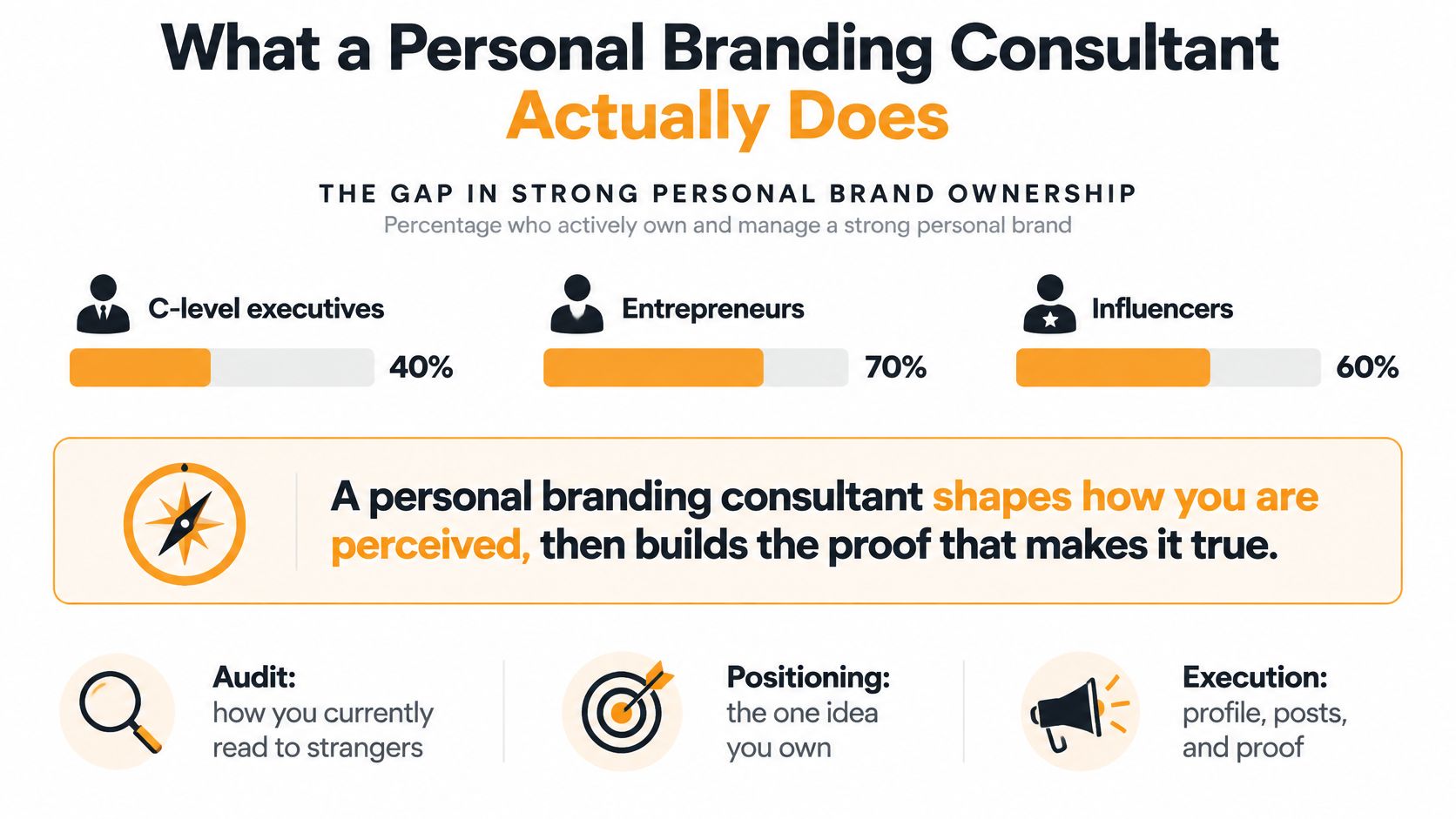
A personal branding consultant turns what you already know into a recognizable, repeatable public point of view, then builds the publishing habit that makes it true.
Think of the role as a personal trainer for reputation. The consultant designs the program, checks your form, spots the weakness in your argument and tells you when you're coasting. The consultant does not lift the weight for you. You still have to show up, supply the raw experience and answer the questions that make a post worth reading.
The neighbours are not the same job
A career coach fixes your job search: résumé, interviews, salary negotiation. A ghostwriter supplies words, usually without deciding what you should be known for. A PR agency chases media coverage and awards. A LinkedIn trainer teaches tactics: hooks, formatting, comment strategy. Each can be useful. None replaces the positioning decision.
A branding consultant answers the harder question first: what should a stranger remember about you six weeks after meeting you online? Then they build the published proof around that answer. The posting schedule is downstream of the positioning, not the other way round.
If you're preparing for that positioning conversation, an AI content brief generator can turn a messy page of notes into a structured brief you can test on three people before you pay anyone.
The quality gap is the actual market
The demand side is not short of content. It's short of judgment. Decision-makers spend real hours reading expert material, and a large share of what they find reads like a vendor brochure with a headshot attached. That gap creates room for a consultant who can help a client publish a defensible point of view instead of another list of five lessons.
The work also fits people whose credibility is their product: founders, fractional executives, recruiters, consultants, sales leaders and specialists moving into advisory roles. Their buyers don't need a louder profile. They need a reason to trust the person behind it.
So what do they sell, what does it cost, and how do you know it worked? Those three questions separate a useful engagement from an expensive content calendar.
The Service Menu Behind the Job Title
Eight services cover most of what a personal branding consultant sells, and most clients need two or three, not all eight. The menu is finite. Here's the map before anyone starts selling you a program.
| Service | What you actually get | Typical timeline | Who needs it |
|---|---|---|---|
| Brand audit and positioning | Teardown of profile, posts and search visibility, plus a one-sentence positioning statement | 1-2 weeks | Anyone starting from scratch or changing roles |
| Profile optimization | Rewritten headline, About section, featured items, banner and keyword targeting | 5-10 days | People whose profile undersells their seniority |
| Content strategy and pillars | 3-5 themes, a posting cadence and 20-30 approved ideas | 2-3 weeks | Professionals who freeze at the blank box |
| Ghostwriting and editorial support | Drafts in your voice, built from calls or voice notes | Ongoing, weekly | Executives with no writing time |
| Thought leadership program | Interview-based articles, points of view and data-led posts mapped to buyer stages | 3-6 months | Founders, consultants and sales leaders |
| Speaking and podcast prep | Pitch list, talking points, rehearsal and clip use | 2-4 weeks | People with visibility but weak delivery |
| Analytics and reporting | Monthly view of reach, qualified profile visits, inbound messages and pipeline influence | Monthly | Anyone paying a retainer |
| Reputation and crisis support | Alerts, response drafts and cleanup of old posts | As needed | Leaders facing public scrutiny |
The profession borrows from reputation management, career strategy, communications and organizational studies, not just advertising. That matters because a positioning problem, a recruiting problem and a sales problem can overlap, but they are not the same brief.
Table stakes
Brand audit and positioning is the first paid deliverable worth buying on its own. A good version ends with one sentence you can say out loud without cringing, plus the evidence from your last 50 to 100 posts that supports it. If the deliverable is a 30-slide deck and no sentence, you bought decoration.
Profile optimization is narrower. It rewrites the headline, About section, featured items, banner and keywords for the searches that matter. A stranger should be able to read the About section and summarize it back to you in one line. If they can't, the rewrite failed.
There is a practical version of this work inside tooling now. RedactAI offers a free AI LinkedIn Profile Review tool, along with a free LinkedIn Post Formater and a free LinkedIn Summary Generator with AI. Those tools help with structure and diagnosis, but they do not make the positioning decision for you. They are useful when the client has a clear point of view and needs a faster path from notes to a publishable profile or post.
Production
Content strategy and pillars gives you three to five themes and 20-30 approved ideas, not a generic content calendar. Each theme should have ten seed ideas behind it and a reason your audience would care. An idea you'd never say out loud on a sales call doesn't belong in the plan.
Ghostwriting and editorial support delivers drafts in your voice, built from calls or voice notes, plus scheduling. The test is simple: could you defend every sentence in a meeting without disowning it? If not, it's a ghostwriter's voice, not yours.
AI-assisted production changes the cost of the drafting layer. RedactAI creates a personalized AI from the customer's LinkedIn profile link, using their name, experience, headline, description and post history, including the last 100 posts. It generates complete LinkedIn posts from a few keywords, using profile information, posting history, real-time industry insights and relevant online data. It can also recycle content from YouTube videos or blog posts into LinkedIn posts in seconds. That is useful for volume. The trade-off is control, so the published material still needs a client-ready voice check.
Premium
A thought leadership program uses interview-based articles, real data and posts mapped to buyer stages: problem recognition, solution evaluation and vendor selection. This is the tier where the value gets easier to argue. 73% of B2B buyers consider thought leadership a more trustworthy basis for assessing a company's capabilities than traditional marketing materials, according to the 2024 Edelman and LinkedIn B2B Thought Leadership Impact Report. The premium tier earns its fee when your buyer is spending serious money on a complex decision.
For clients who want execution handled for them, RedactAI's Done For You service includes a dedicated LinkedIn expert, profile optimization, audience growth and networking, scheduling at peak engagement times, and a monthly performance report. A team of LinkedIn experts creates, publishes and optimizes the customer's content every week, with 3-4 posts per week in the customer's voice. A free audit can be requested for the Done For You service. That is a different purchase from strategy: you are buying operating capacity, not a few recommendations.
Speaking and podcast prep, ongoing analytics and reputation support sit in the premium tier too. They're valuable, but they're support services, not the foundation.
Photography, website redesign and paid ads are usually upsells. Buy them if you need them. Don't let them crowd out the audit, the positioning or the publishing habit.
Point at the two or three rows you need before you take a second meeting.
How an Engagement Runs From First Call to First Post
A good engagement feels boring by week three. You're publishing on schedule, arguing about one sentence and checking who replied. The exciting part, the positioning decision, happens early and then gets tested in public.
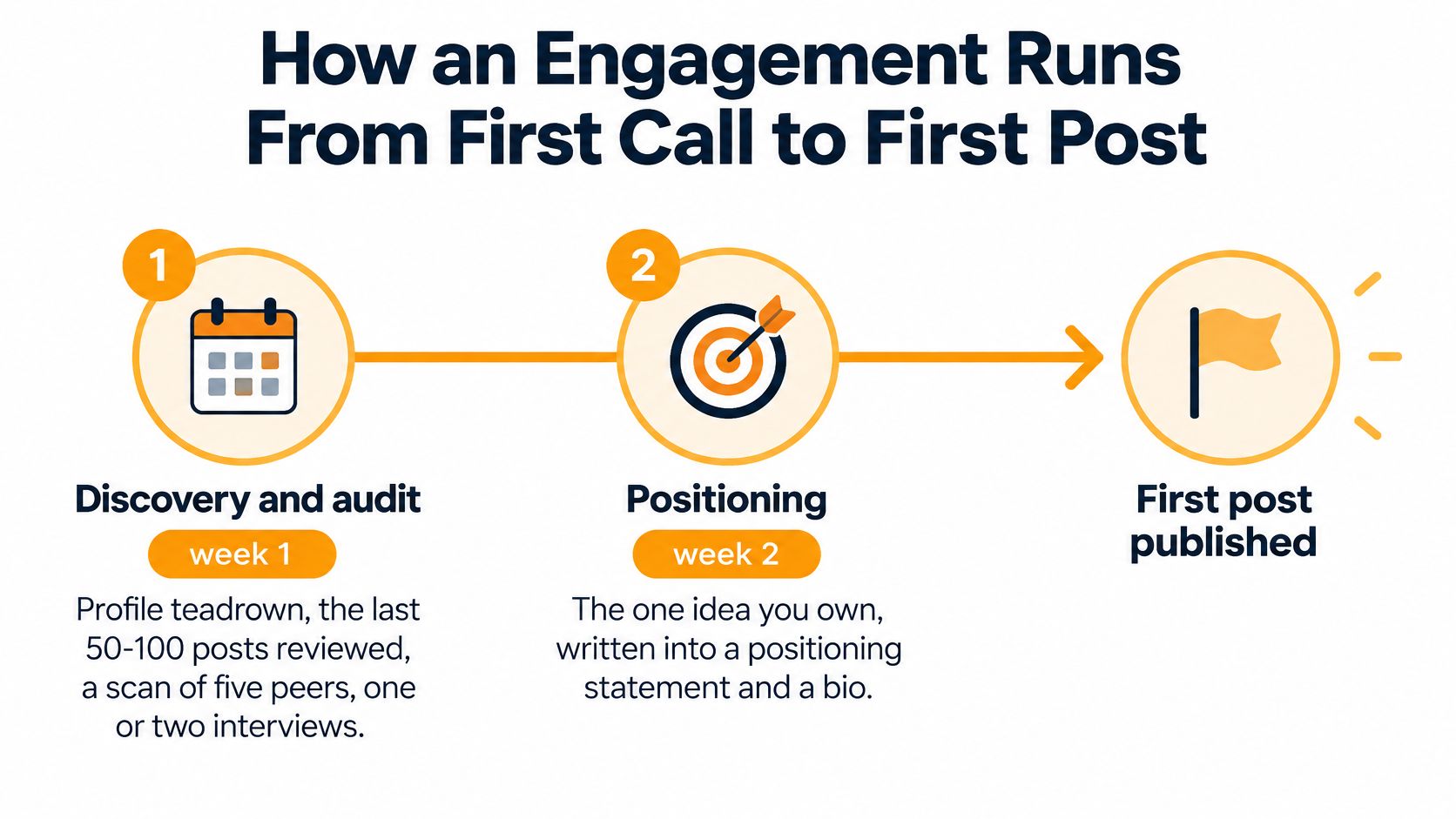
- Discovery and audit, week 1. The consultant tears down your profile, reviews your last 50 to 100 posts, scans five peers and runs one or two interviews. You should leave with a written diagnosis, not a compliment.
- Positioning, week 2. The output is a single sentence in the shape of "I help X do Y by Z." Then it gets stress-tested on three people who know the work. If they can't repeat it back, it's still a draft.
- Profile rebuild, weeks 2-3. Headline, About section, featured items, banner and keyword targeting for the searches that matter. This is mechanical work with a strategic brief behind it.
- Content pillars, week 3. Three to five themes, each with ten seed ideas and a split across expertise, story and opinion. I'd use a rough 60/30/10 split: mostly expertise, some story, a little opinion. The exact ratio matters less than having a rule you can follow when you're tired.
- Publishing cadence, week 4 onward. Two or three posts a week for twelve weeks, scheduled at peak times, plus comment time on other people's posts. Comments are not a side activity. They're how a new account gets seen without posting more.
- Monthly review, ongoing. What got saved, shared, quoted and who sent a message. The review should change the next month's plan, not just report last month's numbers.
What the client has to supply
The consultant can't invent your experience. You need to give 60 to 90 minutes a week, voice notes when an idea strikes, real objections from sales calls and a little patience. The sales objections are gold. They show what buyers worry about, and they give a consultant the problem framing that makes a post useful.
Honest timeline: Profile changes show up in weeks. Positioning shows up in months. Anyone promising a transformed reputation in ten days is selling activity, not authority.
The video walkthrough below covers the same rhythm if you want to see how the stages connect before you commission them.
The process red flags are easy to spot once you know them. A proposal with no audit behind it is a template with your logo on it. A content plan that ignores your niche is a repackaged calendar. And an engagement with no plan for handing the habit back to you is designed to keep you dependent. You should be able to run the system yourself after six months, even if you choose not to.
What the Work Costs and How It Gets Priced
Prices in this market are not published on a rate card. The same brief can come back at five times the price depending on who you ask and how much production is bundled. Treat any figure you're quoted as a planning band rather than a fixed price, and check it against the scope you need.
| Engagement | What is usually included | Commitment |
|---|---|---|
| Hourly advice | Audit call, profile feedback, Q&A | None |
| One-off profile and positioning package | Audit, positioning statement, profile rewrite, 30-day plan | 2-4 weeks |
| Monthly strategy retainer | Strategy, feedback on your drafts, monthly review | 3-6 months |
| Ghostwriting retainer | Drafts in your voice from calls or voice notes | 3 months |
| Executive thought leadership program | Interviews, research-led posts, media and speaking support | 3-6 months |
| Multi-executive agency program | Several executives, production, consolidated reporting | 6-12 months |
| Group cohort or course | Templates, live sessions, peer feedback | 4-8 weeks |
Why does one quote come back at a fraction of another for what sounds like the same job? Seniority is part of it. A consultant who has worked inside your industry charges for pattern recognition. Production is the bigger variable. If writing, design, scheduling and reporting are bundled, the number rises. If you're buying strategy only, the number falls.
Contract length changes the monthly rate. A six-month commitment usually gets a lower month than a one-off sprint. Local market matters less than it used to, because most of this work happens remotely, but it still shows up in the quote.
Then there are the extras that appear after you sign. An onboarding or audit fee may be separate. Content beyond the agreed count gets billed per post. Photography, paid scheduling tools, analytics subscriptions and travel for in-person workshops often sit outside the retainer. Rushed turnaround is almost always a surcharge.
The cheap test is to buy the audit as a standalone paid piece before you commit to anything longer. You'll learn how the consultant thinks, whether they listen and whether the diagnosis is specific to you. If the audit is generic, the retainer will be too.
Do the arithmetic out loud. A six-month retainer at $3,000 a month is $18,000. Something has to come back for that to make sense: inbound conversations, qualified profile visits, a speaking invitation, a board introduction or traceable pipeline. If nobody can name what should come back and how you'll see it, the engagement is a cost, not an investment.
Ask every provider one question before you sign: "What happens in month four if the numbers don't move?" A good answer includes a diagnosis, a change of approach and a conversation about whether the fit is wrong. A bad answer is a new package.
If you're weighing a profile rewrite against a broader engagement, this breakdown of LinkedIn profile writer cost is a useful sanity check on scope before you compare quotes.
Where AI Fits Without Losing Your Voice
The glossy consultant pages skip the uncomfortable part. Buyers and hiring managers are already suspicious of AI-assisted writing, and that suspicion lands on the person whose name is on the post. A 2025 USC global survey found 42% of respondents were strongly concerned and another 27% moderately concerned about being unable to distinguish human-written from AI-generated content, while a separate 2025 survey found 77% wanted to know whether content was created by AI, fully or partly, according to USC's research on AI. More polish can be a downgrade if it removes the signals that make you recognizable.
Three modes, three risk levels
AI as editor. Grammar, tightening, restructuring, catching repetition. Low risk. The thinking and the evidence are still yours.
AI as thinking partner. Outlines, counterarguments, research prompts, idea generation. Medium risk. It needs your judgment at the end, or the post turns into a generic essay with your name attached.
AI as ghostwriter. Whole drafts from a keyword. Highest risk to perceived integrity, competence and care. It can work for a brand built on curation or news roundups. It rarely works for an executive whose value is judgment.
Rule of thumb: if you wouldn't defend the sentence in a meeting without checking the draft, don't publish it under your name.
The rules that keep a brand intact are not complicated. Include one detail per post that only you could tell. Preserve your own vocabulary, including the phrases a grammar checker wants to smooth away. Make at least one defensible claim and explain its business consequence. Disclose when a draft is generated, especially if the topic touches your professional judgment.
The authenticity audit
Over a month of posts, I'd flag four things: generic claims, unsupported certainty, excessive polish and missing lived experience. Generic claims sound like every other consultant. Unsupported certainty says "always" and "never" without evidence. Excessive polish removes the specifics that make a story credible. Missing lived experience is the big one: the post could have been written by anyone with a search engine.
An authenticity audit doesn't rewrite your voice into a brand voice. It protects the voice you already have while catching the sentences that would embarrass you in a client call.
If you're setting up an editor workflow, this walkthrough of an AI drafting and editing workflow shows where to keep the human pass. The same discipline applies to using AI to write LinkedIn posts without sanding off the parts that make you sound like a person.
This matters most for executives, recruiters and consultants whose value is trust rather than reach. A recruiter who publishes polished, generic AI posts is telling candidates something about how they'll be treated. An executive who does it is telling the board something about how they make decisions.
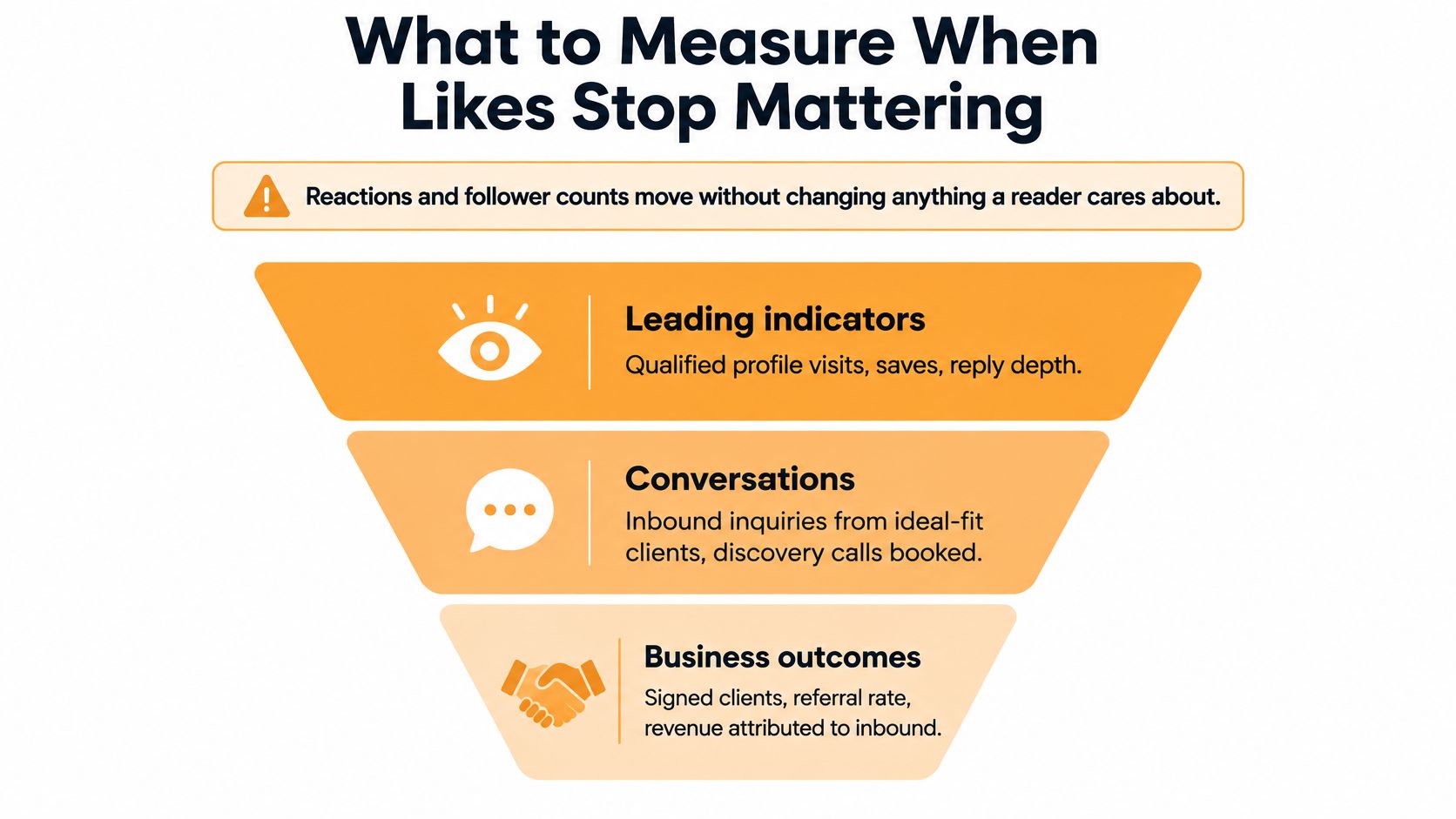
What to Measure When Likes Stop Mattering
Reactions and follower counts move without changing anything a reader cares about. A post can get 400 likes and produce zero conversations with the people who control a budget. That's not a branding failure in the abstract. It's a measurement failure.
Richardson Search's guidance on executive personal branding points to more meaningful indicators: strategic partnerships, investor relationships, board invitations, media opportunities, employee engagement and retention. Those are the outcomes senior people want. The hard part is establishing a baseline and assigning credit when the sales cycle runs for nine months.
The three layers that matter
- Leading indicators: qualified profile visits, engagement from target accounts and relevant inbound messages. A visit from a CFO at a company on your target list is worth more than a thousand impressions from strangers.
- Relationship indicators: introductions, meetings, referrals and recruiting conversations. These are the middle of the funnel, where a post turns into a human exchange.
- Outcome indicators: pipeline influence, hiring success, partnership revenue, speaking invitations and board opportunities. Here, you find out whether the brand earned something more than attention.
The three examples below are illustrative composites, not reported results. A fractional CFO tracked CFO-level profile visits and turned two of them into board conversations in a quarter. A recruiter stopped posting generic hiring tips and started posting about the specific roles that were hard to fill, which produced candidate replies instead of likes. A freelance designer got one referral from a post about a messy redesign, and that referral became a $12,000 project. The pattern is the same in each case: the post produced a conversation with a person who could act.
Set up attribution before month one
You need baseline numbers before you publish anything: current profile views, search appearances and inbound messages per month. Then tagged links, a CRM field for "how did you hear about me" and a 15-minute monthly qualitative check. The check is where you ask three people who replied what they read and what they thought you did.
The scoring loop is how you decide what to publish next. Edelman and LinkedIn's one-page summary of effective B2B thought leadership names three attributes: strong research and data, improved understanding of business challenges and concrete guidance. Turn that into a simple rubric. Rate every draft on evidence density, problem specificity, actionability and author distinctiveness. Then compare those scores against engagement quality, not total reach.
The 60-day test: if you stopped posting for 60 days, would any real conversation disappear? If the answer is no, you've been buying attention, not building a brand.
For a deeper attribution model, see this guide to measuring social media ROI.
How to Pick the Right Consultant for Your Situation
The first call should feel like a diagnostic, not a pitch. If the consultant spends most of it describing their process and none of it asking what you sell, who buys it and what happens after a deal closes, you're being sold a package.
Five questions to ask on the first call
- Do they audit before prescribing? A consultant who skips the audit is guessing. The audit should include your posts, your profile and the searches you show up for.
- Can they name a client whose audience overlaps yours? Not a famous logo. An actual buyer similar to the one you need to reach.
- Do they write, or only strategize? If writing is part of the scope, ask for two sample posts they wrote themselves. If they can't show you, they're subcontracting the most important part.
- Who owns the content, the relationships and the login credentials? You should own your account, your drafts and the relationships that come from them. Anything else creates control you don't want them to have.
- Can you run the system yourself after six months? A good engagement leaves you with a positioning statement, a content engine and a measurement habit. Not dependence.
Red flags are just as specific. Guaranteed follower or engagement counts are a fantasy. One template for every client shows up in the posts before the proposal. No measurement plan means you'll never know what worked. No sample posts they wrote themselves means the writing is outsourced to someone you'll never meet.
| Option | Best for | What you still do yourself | Time to first output |
|---|---|---|---|
| Solo consultant | Mid-career and senior professionals who need judgement, not volume | Show up, supply raw material, edit drafts | 2-4 weeks |
| Boutique agency | Executives who need production plus media and speaking support | Approve angles and appear on calls | 2-3 weeks |
| DIY with templates | Tight budgets and people who like writing | Everything: research, drafting, scheduling, measuring | 1-2 weeks |
| AI-assisted workflow | Anyone who wants consistent volume without losing their voice | Choosing angles and adding lived experience | 1-3 days |
| Internal comms team | Executives inside large companies | Approvals, interviews and calendar time | 4-8 weeks |
If you're comparing production partners more broadly, this comparison of SaaS demand generation firms compared is a useful sanity check on scope and reporting.
Before you hire anyone, run the free test. Write down the five themes you want to own, rewrite your headline in one sentence and ask two people who don't work with you what they think you do. If you can't answer that, you need judgment more than production. If you can, you need volume and consistency. RedactAI offers a free AI LinkedIn Profile Review and Summary Generator, plus a free audit for anyone who would rather hand over the work through its Done For You service. Both are optional. The self-test works without either.
RedactAI can take the parts you already know and turn them into a publishing system that still sounds like you. Start with its free AI LinkedIn Profile Review and Summary Generator to see what a stranger sees, then request a free audit for the Done For You service, where a team of LinkedIn experts creates, publishes and optimizes your content every week. Visit RedactAI when you're ready to test the system on your own profile.